Mugging for Coffee

Life is better with an insulated coffee mug.

In exciting Swiss news, a Canadian almost paid the equivalent of $35 Cdn for an insulated coffee mug yesterday. That Canadian was me.

I desperately miss my travel coffee mugs. Yes, desperately – coffee-drinkers will understand the all-encompassing importance of the coffee experience, including the vessel in which the coffee is cradled. That desperation drove me to spend yesterday afternoon searching for a suitable mug that would not call our financial future into question.

Such a mug was not found, driving me to our town’s new Starbuck’s coffee shop. Do I need to explain that Starbucks is a coffee shop? There I found a darling mug, but for the aforementioned $35. For a few moments, it looked like I would become the kind of person who pays that much for a cup.

Happily, my DNA kicked in and would not allow me to go through with it. Today, I went back onto the streets and shops, suddenly struck with a brilliant idea to look for coffee mugs in book stores and paper/art sections of the local department stores.

This makes no sense, of course, but that is the world of product-placement and to prove that i was not out of my mind, I found an insulated travel mug complete with twist top and handle for about $10.

It was next to some stuffed animals. I cannot explain this, but wait until I finish my first cup of coffee. Then maybe it will make sense.

Christmas Market in Our Little Town


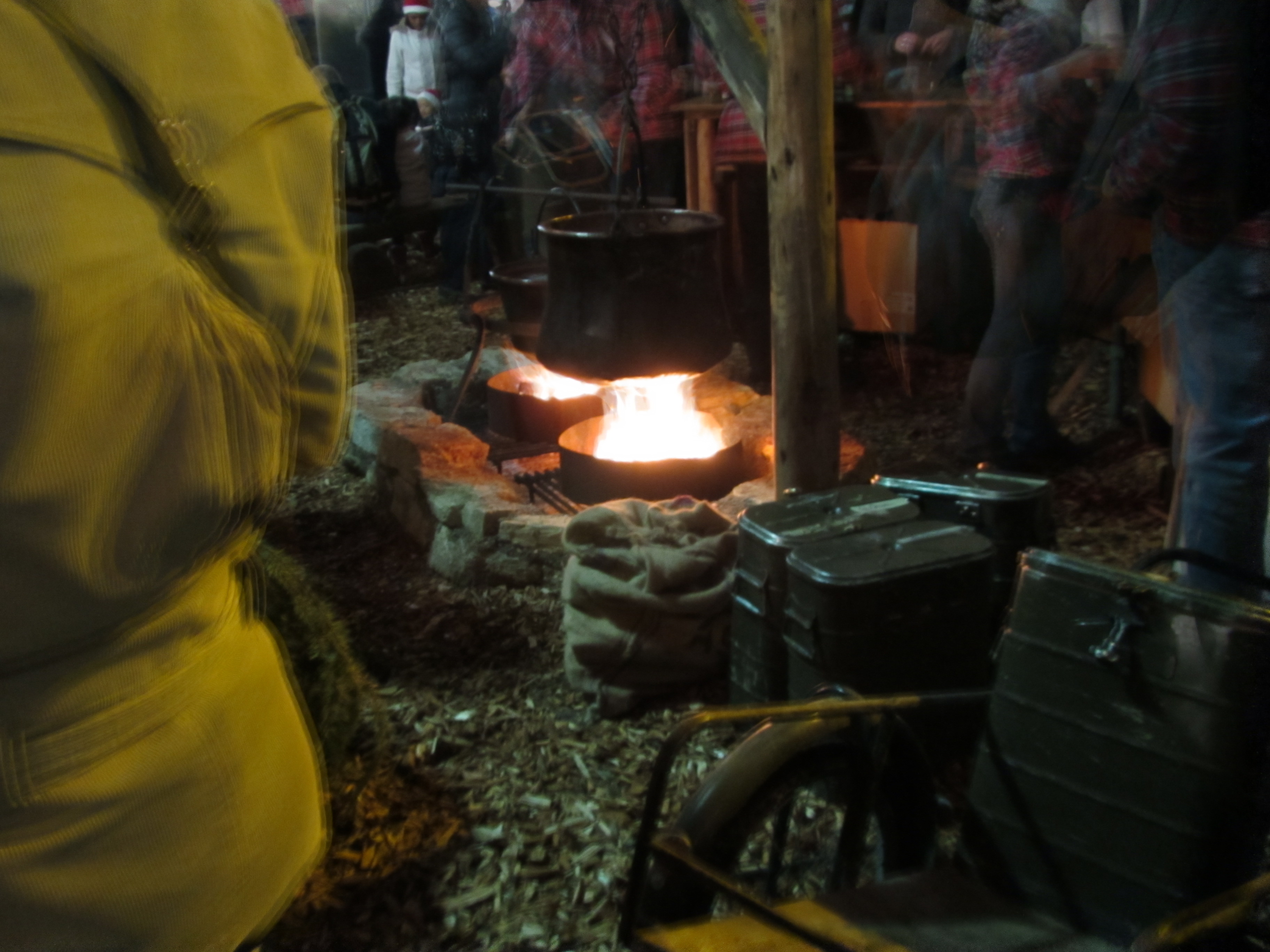
This is a cauldron of gluhwein (mulled wine) over an open fire, sitting in a bed of wood chips and evergreen boughs, surrounded by around 200 people drinking the gluhwein, under large canopies. What could possibly go wrong?

A few blogs back, I suggested that small-town Christmas markets tend to have better offerings than big-city markets. I still stand by that – for Canada. Not so much for Switzerland, at least not so far.

Our little town’s Christmas Market booths are very much like those in Zürich. The downside of both is that aside from gluhwein, the emphasis was light on local handmade goods. On the up-side: Zürich had lively street performances going on, so the Big City wins this time around.

That is, unless one of the features of our town’s street market goes awry. A pedestrian corridor has been layered in wood chips, adorned with logs and evergreen boughs, in the midst of which the Swiss keep two hot fires burning beneath two large cauldrons of steaming wine. This is surrounded by about 200 people drinking the mulled wine, with most of the space protected under large canopies.

This is the kind of thing that would make Vancouver Island fire chiefs sit up, take notice, then pass out from horror.

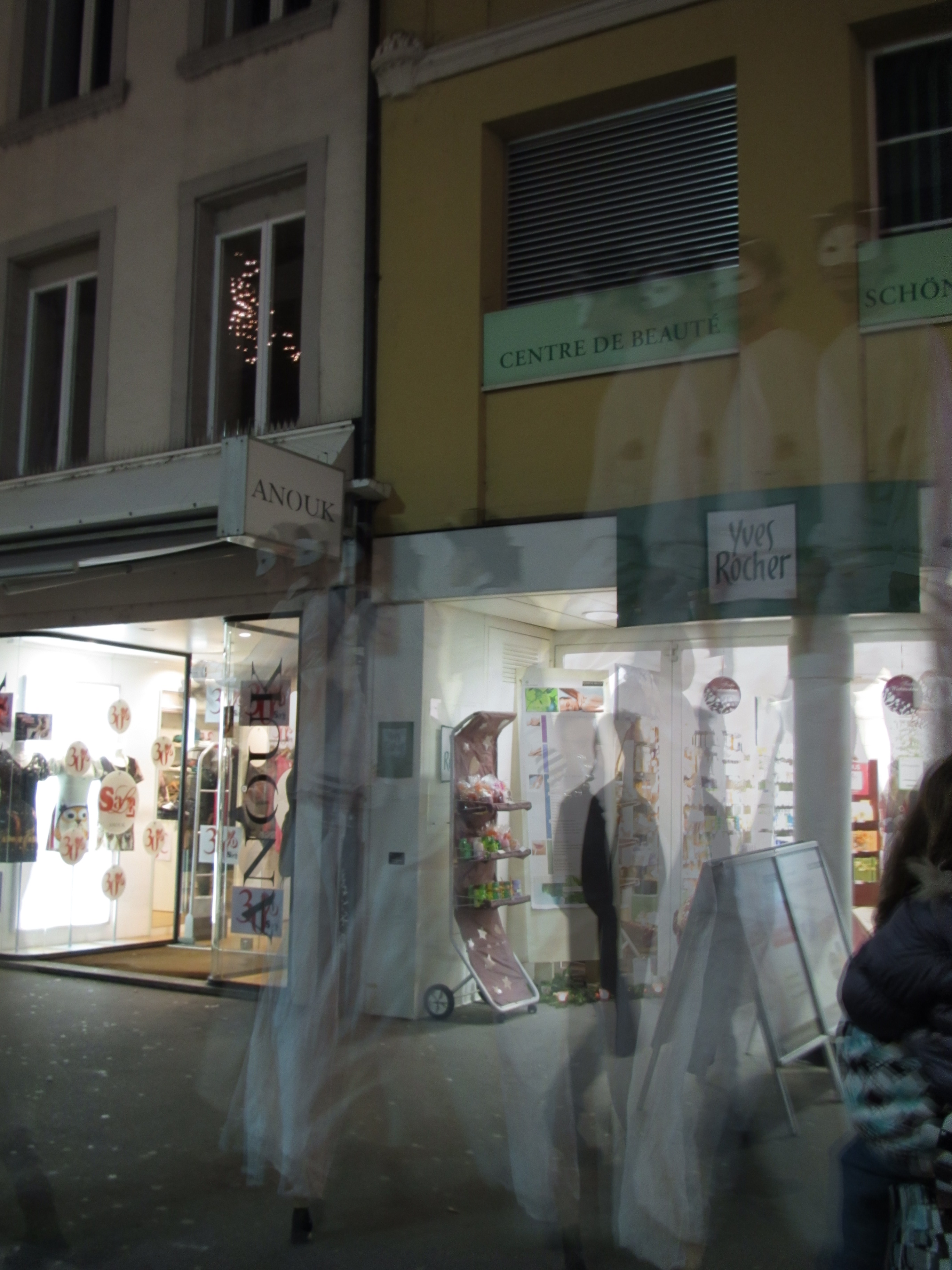
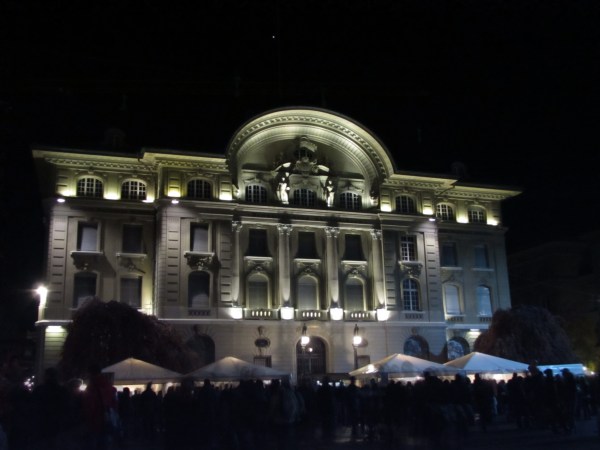
Some day, this photo will appear on some "ghost" website, alleging ghosts walk the streets of Biel/Bienne. Note: Not ghosts. Just a slow shutter on moving targets on a dark street. Still, pretty cool photo.


Not ghosts, not at all.


Stand-off in Zurich Street: How the Swiss Argue – Quietly, with Dignity and Patience

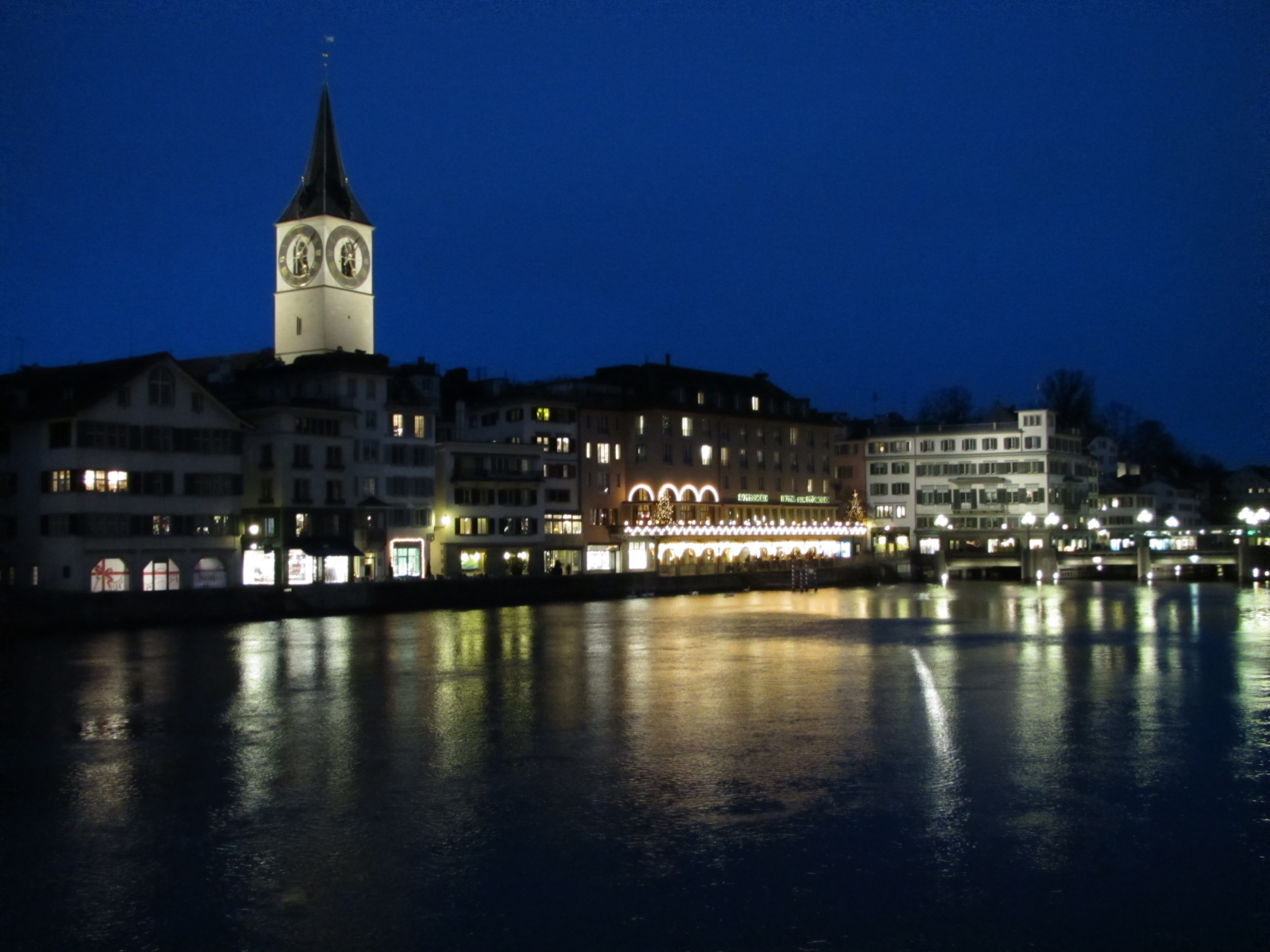
Zürich is a lovely city in the day time, and it’s just as pretty at night. Here are a few shots from our visit there last weekend, plus a little parking drama.

Drama on Zürich streets: Two drivers squabble over a parking space. The man standing outside the car has left his SUV in the middle of the road to confront the driver in the car who darted in front of him to "steal" the spot. They both appeared willing to wait it out indefinitely, but then a spot opened up nearby and the man standing took it. Just to be clear, the driver seated in the car in this photo is the jerk. Moral justice: When he got his car into his spot, he and his wife were unable to get out because the spot was too tight for their vehicle. We didn't stick around to see what he did next because I took photos throughout the exchange and did not want to get punched out by the driver when and if he did ever get out of this car.

A view across the Limmat River, looking on St. Peter Church clock tower, built in 1534 that at 8.7 metres across is said to be the largest church clock tower.


Looking across the bridge (in shadow) toward Grosse Munster in Zurich.

Naughty or Nice on Zurich’s Streets

Watch out, little girl, you might get a SMACK!

It’s not everyday that an old guy spanks me with a broom and walks away without a bruised solar plexus.

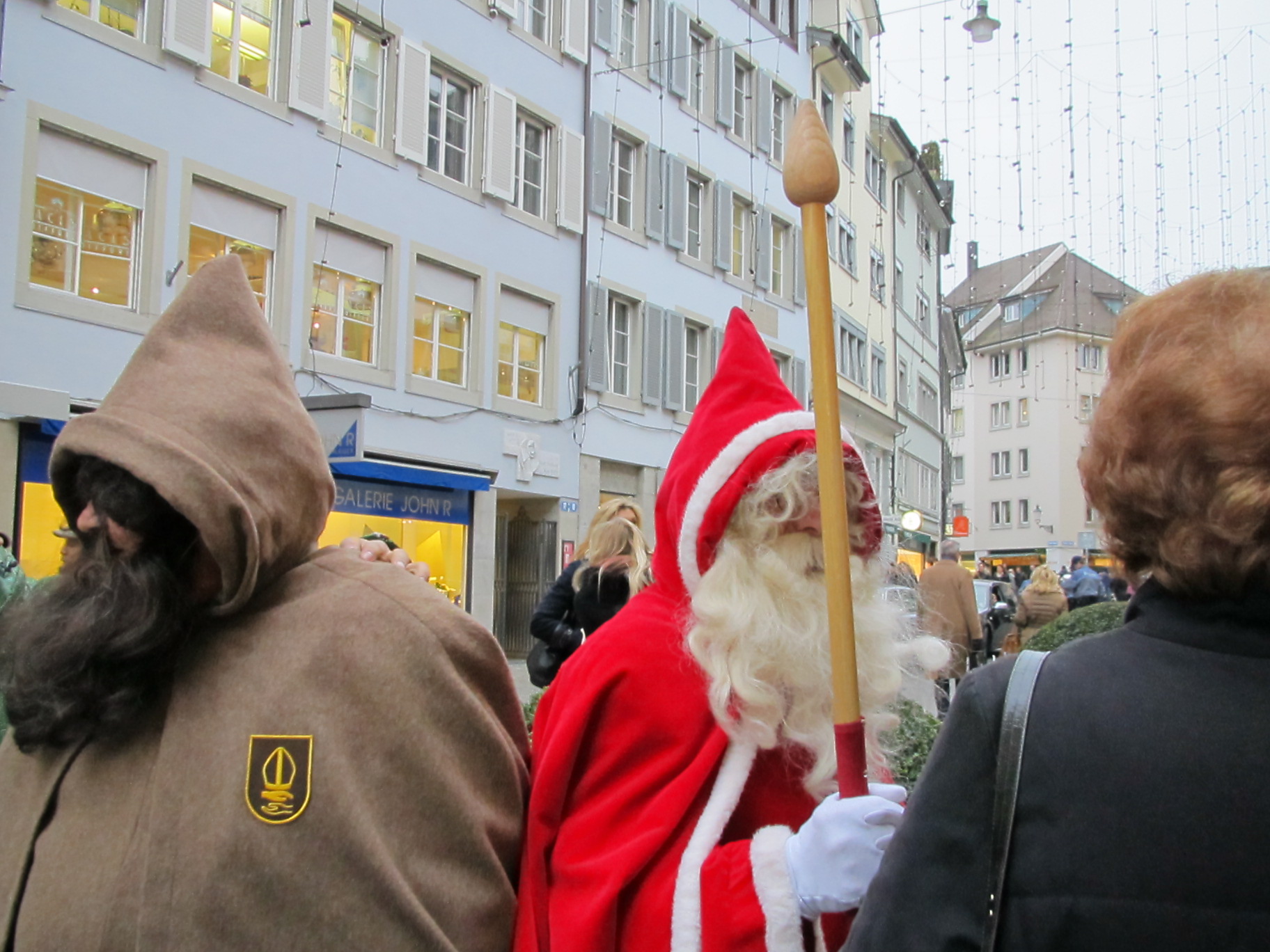
But we’re in Switzerland, and when in Switzerland, do as the Swiss do, which is to tolerate stranger-on-stranger slaps. The stranger in question was Schmutzli, a dark-natured counterpart to a Santa Claus-like figure whom the Swiss assure me is not at all a Santa Claus, but a Swiss Father Christmas. Santa Claus, it is said, is a North American creation. I’m sure someone will argue with that, but that is how the Swiss see this.

Wherever Father Christmas strolls the streets in his characteristic red costume, Schmutzli is not far away in a hooded brown monkish robe, brandishing a twig whisk with which he punishes bad children, or if there are no children around, a middle-aged woman who mistakenly comes within reach.

The Swiss are a fun, friendly people, even when they roam the streets beating people with sticks.

Schmutzli later informed me that he was paid by the municipality to play his role, and that Zürich has plenty of Father Christmas and Schmutzli pairs roaming the streets. Nice work, if you can get it.

Smacking strangers in a tourist-district, however, calls for a certain amount of diplomacy. First, Schmutzli is in costume, which makes him appear less threatening. Second, as he delivers the spank, he smiles benignly and applies only a light, judicious touch, cause who knows, maybe someone has grabbed him by the neck and pushed him into the ground before, such as a woman fresh off the plane from New York or perhaps he has met my Aunty Rosie.

And finally, Schmutzli carries a large sack full of goodies, which he offers after the ceremonial “beating” of the bad child.

Santa has an evil twin!

While our own brush with Schmutzli and his twig-broom was uneventful, the tradition does have its nasty side. It is reported that a boy in Lucerne was chased and beaten by a band of teenage self-appointed Schmutzli. Yikes.

In some traditions, Schmutzli abducts children, which explains why this tradition fails to gain traction in North America. The season would be thick with lawsuits. That would certainly make a Merry Christmas for lawyers.

You can learn more about Schmutzli by clicking here. 

Tidbit: I once interviewed a priest named Father Christmas. I got his name through the New York Dioceses who assured me there were several real Father Christmases in Canada and the U.S. He was very jolly. 

Big city lights

Light's appear to float above a Zürich old-town lane. The lights are hung pendant-style on lines that dangle from cables strung between buildings on either side of the street. They look like giant fireflies when they move in the breeze.

Unbeknownst to the rest of the world, Zürich’s Christmas lights have been clutched in controversy. It began when the Swiss, forward-thinking people that they are, decided their light display gobbled down too many watts, and so they put themselves on an electric diet, replacing the incandescent light bulbs with LED.

That led to a dismal showing the following year when the Christmas lights did not so much shine as that they glowed like dying embers. The city was cast into shame. This year, the city promised a return to glory with even better LED lights.

Depending on who you believe, LED lights consume about 1/10th the energy of their incandescent cousins, but only if you only use 1/10th the lights. I don’t know the math on the number of LEDs now strung along Zürich’s beautiful streets, but my guess is that the numbers and therefore, the power consumption has gone up. I can’t wait for the day that Zürich puts up ten times the LEDs it did in its inaugural LED year, thus nullifying their ‘progress.’

For reasons not known by me, LED lights also do not photograph well.

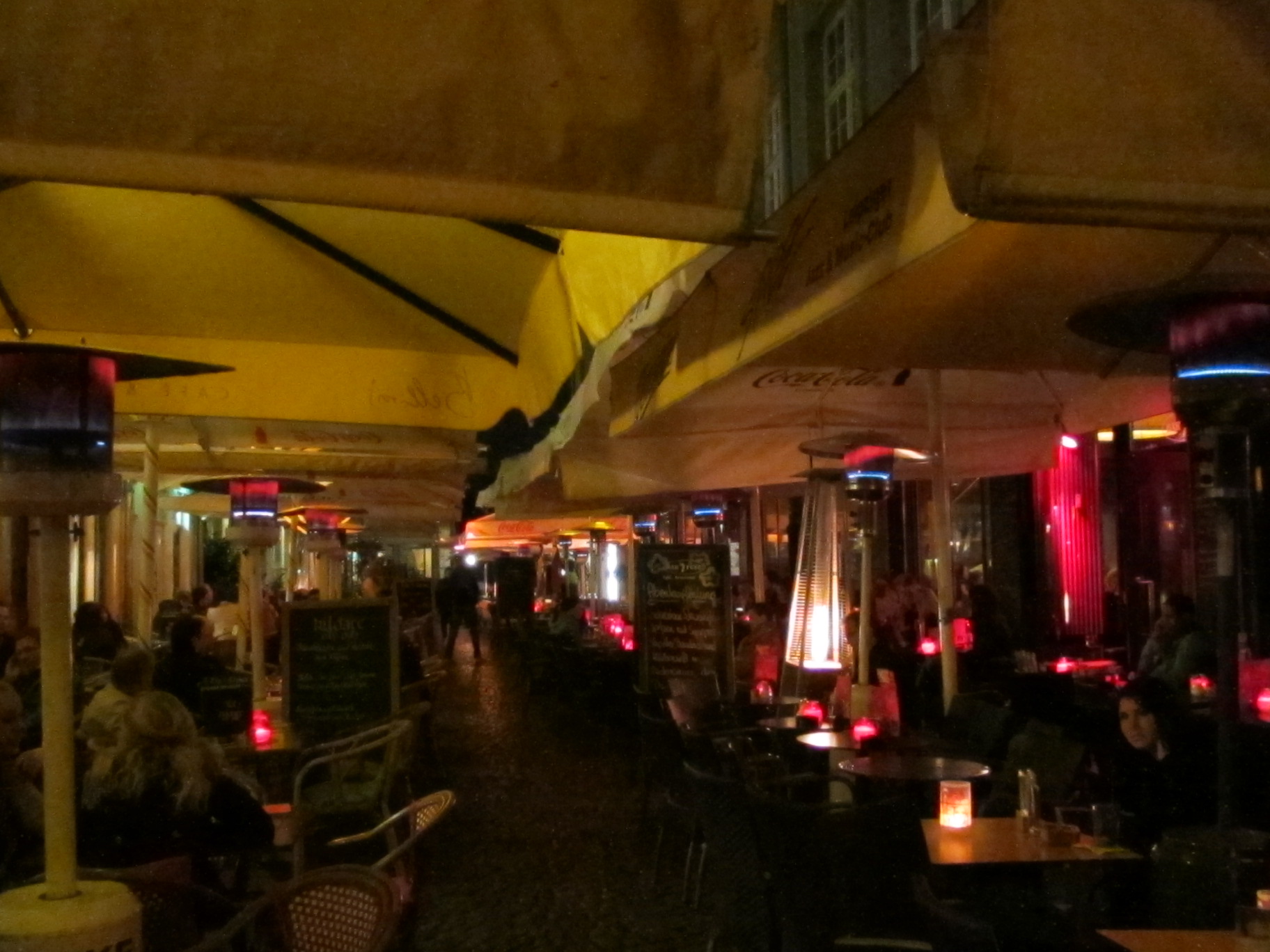
A posh outdoor cafe in Zurich.

There is some discussion among film professionals about images photographed in LED light as being flat and lacking texture. I don’t know about that, but a glance at my photos from our tour of Zürich suggest this is true.

At home, I am an LED nut, using these lights to add a lovely glow to my Christmas lighting decor, but the truth is, there are a lot more light strings running through my yard than there used to be, making me wonder if LED is the aspartame of the electric world. It’s meant to help us reduce kilowatts/calories, but in the end, we just consume more, but without the guilty conscience.

LED aficionados also praise LED lights for their longevity, claiming they last eight to 10 times longer than incandescents. I’m sorry to report that this has not been my experience. I have already had to replace LED light strings that were only five years old. This does not beat out my old incandescent twinkle-lights’ lifespan.

Nevertheless, Zürich’s display did look lovely, although a little dim. It will appear dimmer still in these photos, and that’s too bad.

Reporter’s Secret About Christmas Markets: Get Out of Town

We trolled through Zürich’s Christmas Market last weekend, taking in the heady aromas of gluhwein (mulled wine) and rotting cheese.

The Swiss don’t consider it rotting cheese, but whatever they call this bacterial mould thing, it reeks so badly that I have not been able to get near enough to learn its name.

Despite my aversion for puke-stinking cheese, this concoction must have something going for it, because people line up in large numbers wherever it is served. Dave has tried to convince me to take a bite, but the tidal gag reflex kicks in and I can not.

Christmas decorations at the Zürich market.

In my former life as a staff reporter, I was called upon to cover festivals, community art shows, markets and the like. This does not make me an expert on their qualities, but it does put me into “observer” status, and so here’s the scoop on street markets. You don’t have to go to the big city to get the best stuff.

It is true.

On British Columbia’s Vancouver Island, Victoria has a grand Christmas market, that I will not name here, that is posh, well-promoted and high-profile. On the other hand, the country-cousin markets in Metchosin, Sooke and Sydney are cobbled together in an earthy fashion with goods laid plainly out on tables, their actual makers (or a stand-in relative) posted behind the wares. The decor amps up a little sometimes, but mostly that is what it is.

They may not have as elaborate a set-up, but the goods have a genuine homegrown quality.

Life-size Christmas models top a children's carousel at Zürich's Christmas Market.

Take for example Sooke’s leading jam and preserve artist, Mary Holland*. Her goods are made from her own garden produce, and she comes up with flavor combinations that are so delicious, even I, the fussiest eater in the world, cannot resist them, slathering them not only on fresh bread, but on hamburgers, chicken, hotdogs, everything. Yum.

Nothing at the glorious urban market comes even close to Mary’s preserves. Just so everyone knows, I don’t use the term “jam and preserve” with the word “artist” all that often. My vernacular is not constructed to adopt passing fancies of language. A jam-maker is a jam-maker in my dialect, however, Mary has elevated the practice into artistry. There, I said it.

What does this have to do with the Zürich Christmas Market? Maybe nothing, but at this moment our town’s downtown streets are crammed with little sheds being decorated for its market. It will not have a glamorous Swarovski-crystal bejewelled Christmas tree towering over it, as does Zürich’s market, but maybe it will have homegrown goods that match the scale of Sooke’s, and possibly exceed that of Zürich’s market.

I don’t know yet whether it will, but I know from experience that it is possible.

And there’s nothing wrong with Zürich’s market. Just saying.

*She and her husband Steve run Little Farm – Mary’s Medleys in Sooke.

Fruity fruit

In the fascinating world of international travel, I bring you the story of fruit.

Foreign food is different, not just because each culture and country has its own way of seasoning, cooking and serving food, but because the food itself will be different. It is the same principle as in wine, which is said to absorb its  unique flavours from the region in which the grapes grow.

And so, B.C. blueberries differ from Ontario’s (Ontario wild blueberries are better, sorry B.C.), Manitoba eggs taste nothing like those in Madrid, and so on.

Flavour matters to me. I love food. Who would have known it? But, I’m also very particular and so feel some trauma at leaving behind Canada with its fabulous wild blueberries, incredible sweet Silver Rill corn, unbeatable Alberta beef tenderloin and affordable salmon.

Here, everything tastes different. It’s not all bad. Despite my love for the flavours I grew up with in Canada, I have to admit that Switzerland’s store-bought strawberries leave North American franchise grocery offerings in the dust.

When it comes to Canada’s Bartlett pears, I am in heaven, but guess what. There are no Barletts in Switzerland, which has set me on a path of discovery.

I’ll just cut to the chase. Bartlett-lovers should head for Harrow Birnen Sweet, which comes from the same family as Bartlett and has almost exactly the same sugary texture and flavour. Buy it. You will be happy. Happier still, it is a late-season pear, so it was available in our stores until last week. Today, I ate the last one. Sadness descends.

In searching for a replacement, I also tested Italy’s one-pound “Abate” pear and Portugal’s 6 oz. “Rocha” pear. The Rocha is an acceptable Harrow/Bartlett replacement, but it is only 1/7th the pear in flavour, so adjust your standards accordingly. Italy, who has romanced the world with its fabulous eats, falls down on its face with Abate. It is literally a pound in weight, as my new digital scale confirms, and tastes something like an apple, but without the flavour. It costs about $2 a pear, hardly worth it.

How do I know? Despite the $2 investment, I chucked it in the garbage. I am really cheap. Chucking fruit after a single bite is the ultimate insult. Pear-growers in Italy probably felt a disturbance in the force.

Christmas markets here and there

Zürich Christmas Market - like any other market, but with boughs and lights.

Do one million Swiss Francs of crystals a Christmas tree make?

That is the question posed by the Swarovski tree, a crystal-encrusted tree in Zürich (with similar trees posted across the world).*

It stands in Zürich’s train station, towering over rows of huddled tiny evergreen-topped sheds that altogether make up Zürich’s famed Christmas Market.

Swarovski-jewelled Christmas tree. Who is the star in this display?

At 95 buckeroos per ornament, that is some tree. Bloggers and Youtube-posters report the twinkle costs one million Swiss Francs (the amount cannot be found on the Swarovski website).

It begs the questions about whether this is Christmas. My knee-jerk reaction is that it is not.

It is far removed from the first Christmas when a teenage gal inhaled the aroma of manure as she gave birth to her illegitimate son, after suffering the sting of rejection from the town’s innkeepers (who probably would have found a room for her had she been a centurion’s wife). If you’ve ever been turfed out of an emergency room while in massive pain, you might have an idea of how rough a night it was for Mary and Joseph.

But that illegitimate baby’s message, as anyone who has read the Gospels will know, is that neither poverty, stink, politics, or oppression matter so much. While his followers hoped for an overthrow of Roman rule, Jesus discarded the topic, pointing out that his kingdom was not mired in such earthly trivialities.

His point, if I read it right, is that these outward things need not affect one’s inner life or value. It is the heart that matters, not the hearth. As far we know, he never waged a petition campaign to force innkeepers to take in labouring mothers, although through the centuries that came after, his followers built hospitals in the spirit of his message. Doubt me? From where do you think the word “Saint” in front of so many hospitals came from?

But this is not to diss Swarovski who to their credit subscribe to a historically correct moniker for their display. They call the tree what it is: A Christmas tree. Not a holiday homage, festive festooning or anything silly like that.

As a writer steeped in the conviction that everything means something, I could say the shine of the crystals points to heaven, a place not yet found on any map, but which another writer called “the enduring myth.” How can you explain it when so many people sense its presence?

The crystals are one thing, but it is the tree that catches my eye, a creation harvested not from a factory, but a forest. It points to another creator, who is the subject of great debate, especially at this time of year. From whatever side you argue this, the tree is brilliant workmanship.

So here’s to Swarovski for the shiny bits, and here’s to God for the tree, Christmas and all that it means.

*Click on this link to see tree locations across the globe.

Swiss parliament legalizes illegal downloading

Crazy Stupid Love from the Hollywood Reporter

At this moment, I am downloading the movie Crazy, Stupid Love via my iTunes account,  in defiance of the Swiss parliament that recently refused to outlaw illegal downloading.

Yes, you read that right. Illegally downloading music, games, movies or otherwise is, well, legal in Switzerland.

The decision was made this week after the parliament determined that those who download illegally are the same people who purchase downloads, that is, they are customers. Switzerland reckons this means the creative owners of the goods suffer no financial harm from electronic piracy.

I am very excited about this. Not because I engage in this practice myself (I prefer to pay for the stuff – call me old-fashioned), but because I am a big-time IKEA shopper and if this legalizing-theft trend continues, pretty soon I will be able to walk out of any IKEA store with unpaid goods.

I’ve been eying the IKEA free-standing kitchen units for some time. I’m going to save thousands of dollars this way.

But first, I’ll wait for the Swiss parliament to catch up to my plan and legalize in-store retail theft.

*I don’t own the copyright to the above photo of Steve Carell. It came from the Hollywood Reporter website. I doubt they own it either. It is a promo-photo, so we have to expect the producers want it to be reproduced to spread “buzz” on their product. If, however, their lawyers send me a note with grim warnings, I shall remove it, even though I am in Switzerland.

Adele, a fabulous singer.

Post-script: In all fairness to the complexity of this issue, I have no real opinion on whether Switzerland is being smart or stupid. For example, I watched a lot of Adele videos on YouTube before buying a pile of her music through iTunes. The YouTube broadcast is legal, but what if it wasn’t? Didn’t checking out her vocal qualities turn me into a bona-fide customer?

Post-script 2: For those who want to know more about Switzerland’s downloading decision, here’s a link to an article that discusses this topic at length.

It’s Saturday, Saturday …

Rain fell overnight, much to the delight of the Swiss who are enduring a drought that has not only parched its creeks and waterways but also left its famous skiing regions bereft of snow.

Meanwhile, in our little town the streets are filling up with wooden cabins of varying styles, going from slapped-together plywood shacks to fanciful cottages of beadboard walls and gingerbread trim, and then to the grand stuff: A heavily-timbered log cabin. Yes, a real log cabin. All this is in preparation for Biel/Bienne’s Christmas Market, which promises to be a fabulous one, but it does not open until next weekend and so later today we’ll head to Zürich where there are not one but two Christmas Markets, plus what has been promised to be a fabulous light display. I’ll post those pictures later.

In the meantime, here are some photos of last weekend’s wanderings:

This was our second time strolling through the village of Murren. It was almost December and we expected snow, but saw none but that which topped the mountains. The ski hills are reported to be dry, choking the Swiss economy which is already battling the woes of having a strong currency in a weak market.

You can access Murren on either side by gondola and a cute little train ride, but you can also walk between either access points. This is the trail between Murren and the Lauterbrunnen gondola station. It is an easy walk with only mild grades and goes through some forest that looks a lot like Vancouver Island's Galloping Goose. A motorized wheelchair could make this trip with just a little help over some rough patches.

The mountain-clinging village of Murren is full of sturdy-timbered chalets that look exactly as you would expect them to, but this one. This one is a little sloppy compared to the rest.


Murren: We think this is a charming way to decorate a ski cabin.


Here is a Swiss mountain. As Bernese Mountain Dogs are my witness, I do not know its name.


We are like the Bushes, but not

The Bush family might be Canadians - they are cottage-crazy like so many Canucks.

Former U.S. presidential couple George and Barbara Bush famously lived in a Texas hotel after leaving office. We, also, live in a hotel after leaving our “offices,” that is places of work*. I wonder if our experiences in hotel-living had any similarities.

If I recall President Bush 41’s televised interview on the topic of hotel-living, he liked it very much.

As an aside: He is called 41 by his family to distinguish him from his son, the 43rd U.S. President – a detail garnered from a friend who was invited to Walker’s Point – the Walker-Bush Kennebunkport** ancestral home, making this one fact I knew long before some of the news staff at NBC. I could not divulge it – I was sworn to secrecy about the visit, a promise I would never break because the owner of the secret is a neighbour who has a clear view of my favorite swimming route, and I don’t want to give him any reason to ignore me should I run into trouble on one of my swims. Also, his mother makes great cookies and my children would stop talking to me if I did anything to staunch that supply. It does not matter that my kids are adults. They still covet and fight over those cookies.

But I drift from my topic…

Aside from the fact that our hotel “suite” is 400-square feet and only one room, while the Bush suite was probably more spacious, we also enjoy some of the fun of hotel living.

One highlight of a protracted hotel stay is that the hotel staff discard some of their professional reserve, which adds a certain hilarity to the day. For example, not long ago the staff sweated out endless bugs and dead-ends during a computer “migration” to an ‘improved’ system. The transition was scheduled for what has historically been the hotel’s slowest season, but disaster-devils are always sniffing out opportunity and so the hotel was flooded with unexpected guests on the day of the system transfer.

When I strolled past the front desk and asked the staff how the transition was going, a hotel manager delivered a lively German-English outburst of exasperation that I regret not having video-taped, because it certainly would have made for highly entertaining reality television.

“Every room was filled,” said the manager.

I cannot provide a longer quote, because the rest of it was in German swear-words. At least they sounded like swear-words. It is hard to tell with German.

I wonder if George and Barb ever enjoyed such behind-the-scenes drama as they strolled past the front desk at their hotel. Maybe not. Maybe the Secret Service shielded them from the hotel staff. It would have been too bad for them.

* The Bush family are also crazed cottagers, like us and so many other Canadians, although their cottage is fancier. The drawback is that it has Secret Service staff around, and to a cottager, a Secret Service agent is just a guest who won’t leave. Poor Bushes. 

**Kennebunkport is not as easy to spell as it looks. Here are some other ways I spelled it before checking:

  • Kennethbunkport
  • Kennetbunkport
  • Kenebunnkport
  • Kenbunkport
  • Kenbunksport
You would think the Bushes would have done something about this while they were in office.

Import joys

O beloved affordable shoes, where art thou?

Shopping in Switzerland is not as much fun as one might think. For one thing, my favorite shoe brands here cost two to three times as much as they do in North America. A pair of Clarks loafers runs over $180, my treasured Merrell hikers are in the same range and higher.

No problem, I thought.  I’ll just order on-line.

This has not worked out as happily as I had hoped. While I scored the lovely North American prices, shipping costs tipped near the $40 mark, plus a few extra dollars for the import fees. Ouch. But it was still cheaper than buying locally.

That was until Switzerland’s diligent import bureaucracy caught up with me and plastered another import fee in the neighbourhood of 32 to 45 Swiss Francs on to my cute little purchases.

I am not going to reveal how expensive this has become, because just saying it produces a scorching sensation in my skull. This has not actually helped the Swiss import bureacracy as much as they would like, because I will just stop buying shoes until I find a more fiscal-friendly store, and very likely that will only occur when I’m back in Canada.

Nevertheless, I still love Switzerland. It has so many chocolateries, how could I not?

In other retail news: Here’s a photo of a typical “sale” price sticker in Swiss stores that reads “top price.” I’m sure they mean “best price,” but the first thing our North American brains read is that the store is charging the top/ highest price anywhere. Maybe that is what they mean. After all, this is Switzerland.

The Third Space

We call "dibs" on this tree in our town square. It's our biggest yet!

We don’t have a Christmas tree this year, unless we count the 50-foot one in our third space.

Never heard of a third space? It is a jargon-piece belonging to architects and city planners. The first two spaces are the private and public rooms inside the home.

The third space is the exterior public space, such as restaurants, town squares, parks, bus stops. Okay, I added bus stops on my own, but they seem like third-spaces to me.*

"Our" Christmas decorations this year are bigger than basketballs!

Here’s why. The third space is a sort of living room for the population. Anybody can be there. Third-spaces are everywhere in Europe, especially in densely populated areas where private living spaces are too small to adequately serve the social and emotional needs of their occupants. And so, the occupants head out elsewhere, as a preventive measure against roommate or family homicide. In North America, Starbucks fills this role nicely.  Playgrounds are another example of third-spaces. But I ramble …

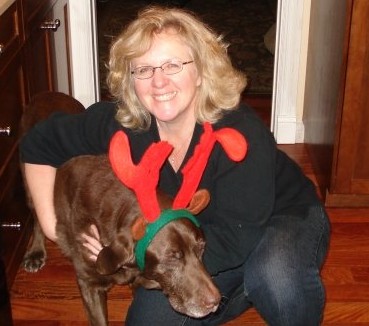
Stand still for longer than two seconds and you run the risk of being grabbed and festooned. This is actually a mild form of dog-decorating. We used to outfit our yellow lab in a complete harness of bells, antlers, etc.

With this in mind, I’ve decided to look upon the magnificent Christmas tree in our town square as my own. It’s the only tree I will have this year, which is going to be something of an experience.

Even our neighbour's dogs are not safe from my decorating mania. Deck the dogs in wraps of woolens, fa la la la la, la la la la.

Why? Because, I am a Christmas-decorating nut. Every year, my house turns into a red, tinsel and bauble warehouse with trees of all sizes appearing in every corner and on every countertop.  It is out-of-control. It takes weeks to pull together and weeks to take apart.

I don’t see anything wrong with this.

This year, however, I am restricted to two little white-poinsettia plants on our dining room table on the strength of the reasoning that there is no point in buying decorations I cannot bring home.

How sad, but not too sad because the time I used to devote to decking the halls is now spent in endless browsing through Christmas decorations in local stores, a pastime that is feeding my imagination for when I decorate next year (my husband will not be happy to read this).

For those wondering: The current craze in Swiss Christmas decorations leans towards a style that would fit in nicely with Canadian cottages. They are very earthy, roughshod and fuzzily charming.

Lights of Life Christmas display at Marietta, Georgia, Chiropractic College

In the meantime, there’s all these third-space decorations to enjoy.

*As explained to me by a Montreal architect whose name I forget, calling into question whether I remember his “third-space” monologue well enough. Would it not be interesting if I was fascinated enough in my topic to actually fact-check it?

Timid traveller at the halfway point, sort of

Steve: We're on a mountainside. What could go wrong?

Oh not much, except maybe falling off a cliff.

____________________________________________________________________

We are reaching the halfway point of our stay here in Switzerland. I started this blog to give some insight on the realities of overseas life, which from the outside has a glam shine to it, but on the inside, is more like listening the grinding sound of our lives coming to a halt. It is akin to being stuck in traffic, except the scenery is always changing.

I admit the scenery is pretty spectacular.

Being away means that we lose pockets of widely known information, such as who was premier in British Columbia. I was totally unaware of David Miller’s term in that office, owing to a protracted stay in Spain during his short tenure. At this moment, I cannot name most of Canada’s provincial premiers, even those that I have lived in.

On a more personal level, we lose touch with the dramas and comedies running in the lives of our friends and families, although this is not as parched an informational season as it was on past work terms, thanks to Facebook, email and Skype.

The truth is that living overseas is not the same as touring overseas. It is laced with unsympathetic administrators, and the occasional xenophobe who holds a grudge against all foreign workers and their families.

More mountains. Ugh.

The bureaucratic presence, however, has subsided for the time-being, and despite Switzerland having recently voted in what is regarded as its most insular xenophobic party, the number of actual xenophobes on the street are few. And so without an undercurrent of worry about being kicked out of the country, this blog has turned into something of a travel-blog, replacing the old travelogues – remember those? If you’re do, you are very old.

The problem is that travel blogs are supposed to include adventure and, of course, lots of travel. I am afraid of travel, so any element of adventure in these notes is totally unanticipated by me.

When I worked at a city paper, the editors realized my cowardice and my sheltered risk-adverse lifestyle, and so took it upon themselves to send me wherever the opportunity for crushing injury was most likely to occur. They knew it would generate a lively article typed out by my terrified fingertips, should I still have them on my return to the office.

This week, we did have the potential for a small brush with adventure (aside from the blast and smoke at the train station) with the arrival of Steve, one of our son’s old friends who is working in Switzerland over the winter. Steve is famous for having adventures of all sorts. He’s the type that attracts them, so if ever we were going to plunge off a cliff edge, this would be the day.

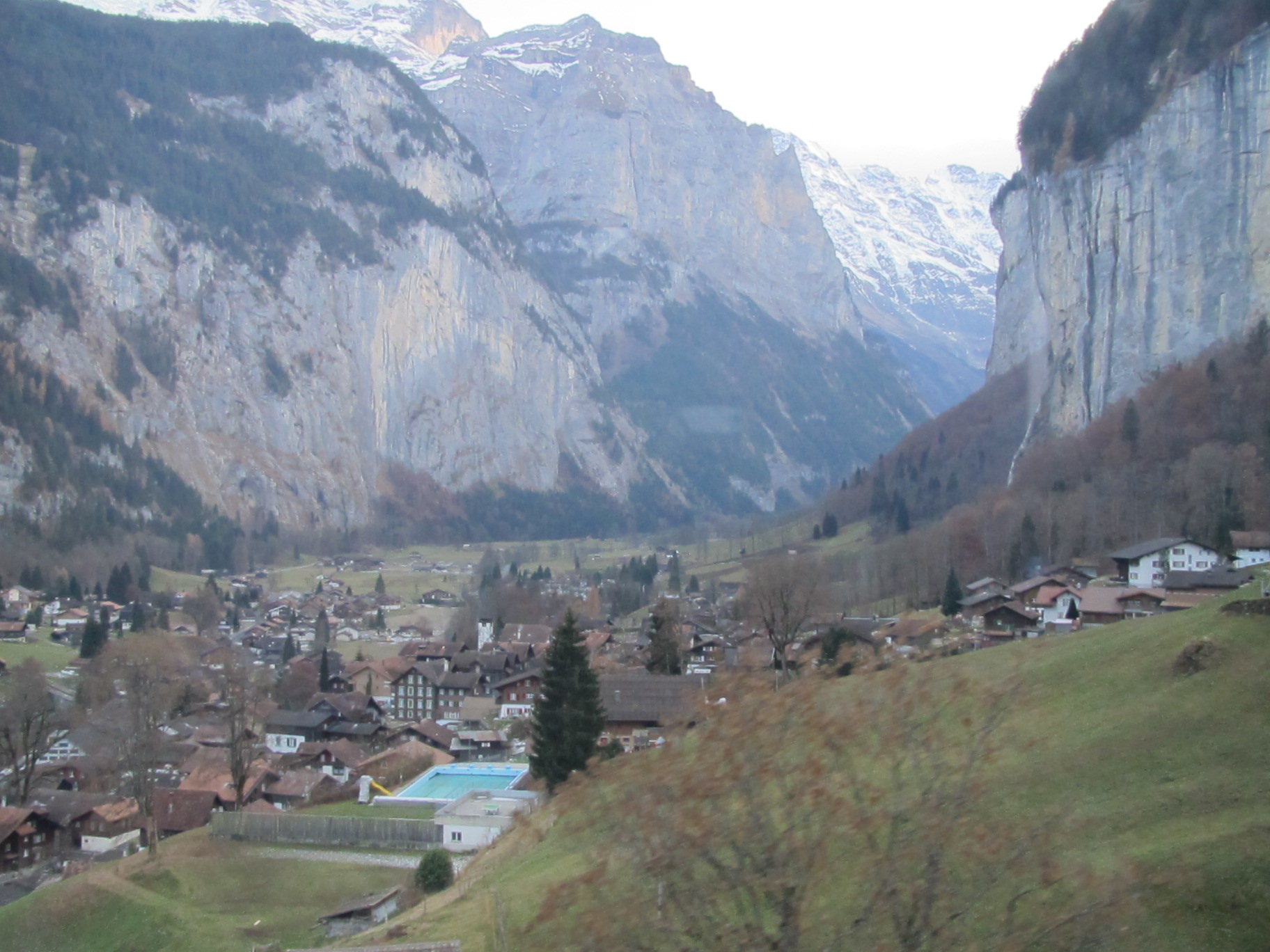
The steep cliffs in Lauterbrunnen.

Note of personal interest: Steve actually almost led to our son plunging off a cliff edge on Vancouver Island, when he convinced our boy the climb was not really a pure vertical. Also, Dave will not go golfing with Steve ever again, although Steve says, “You have to get over that.” I will describe what “that” is another time, but it happened almost a decade ago.

As we exited the train at Lauterbrunnen, I commented on how everything was going so well, despite Steve’s presence. He said, “Who would think that in ten minutes, we’ll be clinging to a cliff edge.”

He was wrong about that, but it was not entirely outside of the realm of possibility.

Later that day, when we heard that bang in the Bern train station and saw a column of black smoke rising up to the roof, I was not really surprised. I always expect the worst, so it made sense that we would arrive at the precise moment some terrorist organization should decide to detonate a crowded rail station.

Imagine my surprise that it turned out to be nothing, which leads us to the upside of being a pessimist: Happiness and wonder. Joy is what comes of expecting everything to go wrong, and finding that not everything does.

Optimists miss out on so much.

In the meantime, we have seven or eight more months here. Let’s see if we can get into any trouble in that time. And for those looking for more adrenalin in their lives, check out Jeb Corliss sailing off a Swiss cliff by clicking here. 

Bern is not all about bombs

The Swiss parliament building in Bern, just before the laser light show begins.

Emerging with renewed energy from the blast at Bern’s train station, we hit Bern’s streets heading past the parliament buildings where we heard loud noises and saw a huge crowd gathering.

At this point, we had no clue that the blast at the train station was merely a harmless mechanical/electrical malfunction, so the gathering masses were of some interest to us. The last time we had stepped onto the cobblestone square in front of the parliament building, it was surrounded by police and full of Tamils lobbying against any deportation of their numbers back to Sri Lanka where they might have an unpleasant experience, such as facing execution.  I have no comment on their political situation, but along with the requisite smouldering angry young men, the crowd was full of children and elderly people, so that seemed safe enough to me and I dove in see what was the matter.

My sons later observed that this was unwise.

“When you see police surrounding black people, do not go in there. It never ends well,” said one. That is true in some instances, but in this one there was no violence, and because the Tamils have jobs and families to attend to, they did not camp out in the square, as has now become the fashion with protest movements.

But that was then.

We joined the crowd and were treated to a delightful laser light show that played over the parliament building. It was awesome. Click here to see a short version of the show (click to the one-minute mark for the coolest part), and here for a longer 15-minute version. 

How you view terrorist activity is sometimes a matter of proximity

Bahnhof Bern: Services in the neighbourhood of 150,000 passengers a day, centered in a national capital. Yup, this could be a terrorist target.

BERN, SWITZERLAND It sounded like a gun blast at first or a tire-burst. A big one. Then a column of black-grey smoke rose above the passenger train at the Bern train station. The crowd on the platform started and lurched instinctively away from the blast, but no one ran.

The explosion appeared to come from the train the second-track over from the train we had just exited and as is always the case with deciding what to do in an environment where we don’t speak the local language, we watched the crowd to see their reaction.

BBC image of 2004 bombing at Madrid's Atocha train station.

The escalator to an overhead walkway was jammed with people, who all turned to survey the explosion site. On the walkway, people stood and pointed, but no one appeared to panic.

Hmmm, column of black smoke, loud bang – probably nothing wrong. That’s what the crowd reaction told us. We waited for a second explosion, the big one, but it did not come. Thank God.

Bern is Switzerland’s capital city and the train station is massive and densely populated. That makes it a target similar in scale to a London or Japanese subway or Madrid’s Atocha train station. This is what goes through one’s mind when gauging how to react to a loud bang, that and whether searchers will find enough body parts to identify us by DNA and so inform our families of our scattered whereabouts.

Nothing happened afterward, and there was no news of it in the local media, so we can only assume it was some kind of mechanical or electrical gaff, although we didn’t see any mechanics or train staff running toward the site of the blast. The Swiss, they are a calm bunch.

It brought to mind Noam Chomsky and his famous comment in the wake of 9/11 about how Americans should not be so fussed about terrorist attacks, and that the U.S. is big enough to take a hit. It seemed he was unaware the U.S. had already taken a hit with a kill-rate of over 3,000, more lives lost in a few hours than the Irish Republican Army had achieved in over three decades. I would have mailed him a copy of the New York Times dated Sept. 12, 2001 if I had his address.

I also wanted to call Mr. Chomsky and suggest he provide the addresses of his parents or children to the terrorists as an acceptable target, to see if he would then think a “hit” not such a big deal.

When living in an American/British/Canadian enclave in Madrid, we were occasionally treated to warnings that Spain’s Basque terrorists (ETA) were going to target the local malls during the Christmas season to send a message to the Americans. Our U.S. friends were somewhat taken aback, having never heard of the Basque or even been aware that their government had anything to do with the Basque complaints. It did not, but that was not of interest to the terrorists. All they were looking for was a victim that would attract big headlines and American victims fit the bill.

That’s the thing with terrorists – they don’t have to worry about re-election and so they can pick their victims at random without having to defend their decisions at the next polling of the electorate. And while the Spanish turned tail and voted to

run for cover when they did suffer their most significant terrorist attack at the Atocha station in 2004, which occurred just before a national election where they turfed the party that supported sending troops to Afghanistan (however token in number), they were not always so accommodating to bullies.

Interestingly, Spain is the one country that had earlier seen a reduction in terrorist activity when the Spaniards wearied of the ETA blasting children and civilians, and the population took to the streets in a protest not against their government for ‘not controlling the terrorist situation,’ but against the terrorists themselves. It was a refreshingly intellectual move on the part of the Spaniards and one we wish more protesters would emulate.

The ETA took note and announced a ceasefire that turned out to be its longest one (which sadly ended when we were there in 1999/2000).

But that drifts from my point that how one views terrorist activity can be governed by proximity. Living in zones that are potential or declared targets imbues the threat with vigour. Living safely in the confines of wherever Chomsky dwells or others who like to blame the victim or the government of the day for threats authored by madmen is another thing.

It is something to think about while gauging whether to run, drop to the ground or just wait for that final fatal bomb to go off while going about what is an otherwise ordinary day.

After-note: We described the Bern train station sound and smoke to our hotel staff friends and they said it was likely a problem in the electrical system. See, nothing wrong. 

Shameless puppy posting!

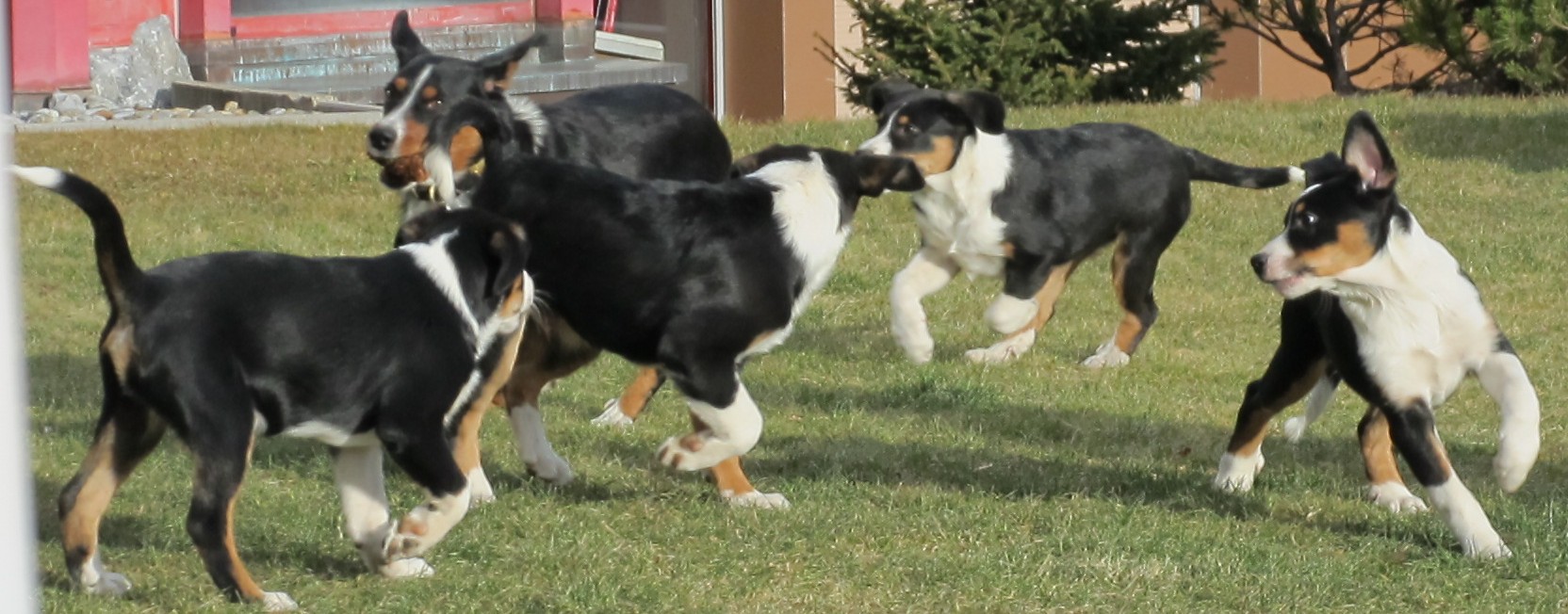
Puppies frolic at Murren Cafe Bistro.

We didn’t take one home, but we wanted to. We watched this litter of pups and their mom frolic at the lawns, under the tables and inside the restaurant of the Cafe Bistro at Murren high in the Swiss Alps.

Tapping out a novel in under a month and the joys of rewriting

Books, books, books, books.

FRIDAY, PART ONE – WRITE A NOVEL IN A MONTH? SURE, WHY NOT? I spent half of my day in restaurants yesterday, three hours of which was at our town’s new Starbucks for a writers meeting. The stated goal was to get as much writing done as possible while quaffing towering latte’s and downing cheesecake and other baked yummies, but I wrote exactly one word and spent the rest of the time chatting over one of the other writer’s novels.

The gal is a genius and doesn’t even know it. She has crafted a mystery thriller that was good enough to hold my attention for 40 minutes, which, because she doesn’t know me well, she does not realize she has achieved something in the order of a miracle.

I have a very short attention span. The point of this is to say that she was a little downcast at the prospect of rewriting. She has laid down the story in the sweep of Nanomo, a one-month challenge to write a 50,000-word novel in November.

At other writer meetings, I’ve heard a Manitoba gal read off a stream of her novel’s narrative that came across in a rapid-fire distinctive voice. Here is more talent that may not be aware of her own merits.

I lived in the world of hyperactive-rewrites for almost 10 years as a journalist and hope both these gals do not shelve their roughshod drafts, and keep rewriting, even if it takes a year or two, and in the meantime to look for an agent or publisher. As they say in writing classes, we’re not writers, we’re re-writers. Everything needs polishing and re-polishing. Too many writers wait for some magical moment to start looking for a publisher, missing what could be amazing formative years in a writing career.

Hold on to that day-job while doing all this rewriting, though. The publishing world is a cruel and competitive one.

I reached my 50,000-word count early on (see hyperactive-writing-comment above) and finished my novel at 72,000 words, which I will now spend at least six months editing and then we shall see where that goes.

Friday’s dining, part two.

Toni's Ristorante in Biel/Bienne - a winner!

THREE HOURS IN ONE RESTAURANT WAS NOT ENOUGH – FRIDAY IN BIEL/BIENNE CONTINUED …..But back to the restaurant stuff. Three hours inside a restaurant was not enough for one Friday so at about 7 p.m., Dave and I walked two blocks to Toni’s Restaurant, which sits in a white-washed ancient building on the border of Biel/Bienne’s cobblestone-laid medieval town.  We have not always had the best luck with restaurants lately, so my expectations were set to “gag.”

When we entered, we found a cocktail party on the main floor in full bore. The staff had to search for someone with some English who explained that yes, the restaurant was open (the wine-tasting event downstairs made us suspect it was booked up for a party). They led us upstairs to an empty, but utterly charming restaurant made up of a warren of small rooms (although there was one large room that could accommodate a party of 20 or more).

Empty dining rooms make us nervous that the locals know something we do not, but we pressed on. The waitress showed us into a room where she indicated we take the table of our choice, which, by the way, is what we saw her do later when other patrons arrived. Is this a Swiss custom? I do not know, but it is a nice one. We took the table overlooking the empty outdoor cafe (it was cold outside) and some nasty new construction that is sure to ruin the ambience of the old town’s borders.

But never mind about that. The menu only comes in Italian, German and French, and with the waitress’ limited command of English and our even more paltry assortment of French words, we managed to steer Dave away from ordering horse steak for dinner. When he exclaimed no to the horse, the waitress said, “It’s okay, we have bunnies to eat, too.”

I have no objection to others eating horse or bunnies (ugh), but as a childhood vegetarian, it took me something to just come around to eating beef (pork and chicken came later, fish even later in my 30s after moving to Canada’s west coast, the Mecca of seafood).

We safely ordered beef tenderloin at 43 Swiss Francs a plate. That’s about 50 bucks Canadian. Ouch. The meal came with a savoury carrot soup delivered in a tiny demi-tasse bowl and sumptuous olive bread. When the steak arrived, we were surprised to see it sitting solo on a large plate, surrounded by sautéed arugula and topped with paper-slices of parmesan, but we dug in and  my-o-my, it was the best beef we’ve had here yet.

It was a little odd that it came without the usual potato or vegetable accoutrements, however, it was a generous portion and in fact, it felt good to just enjoy the beef. It is pan-fried, not grilled or broiled, and the seasoning was subtle.

We later enjoyed a 12.75 Franc dessert of mango sorbet and hot chocolate cake with chocolate-cream filling. Words cannot do justice to the mango sorbet. It was richly laced with what must have been fresh mango, because the weight of the fruit chunks gave no indication they had ever seen the inside of a freezer. The chocolate cake was delicious, too.

We ordered just the one dessert for the two of us to share, but it turns out we could have ordered two. The portion was small, but just right for topping off a substantial steak. The restaurant gets a five-star rating in my books. Fabulous food, wonderful wait-staff, top-notch relaxed atmosphere, great layout for quiet dining, and yes, by the time we left the restaurant, it was packed. It seems the Swiss dine at a later hour that we North Americans.

If you want to read more about this restaurant, or find its locale so you can test my appraisal of its merits, click here. 

Things you learn on the street

Thursday night, as we strolled Nidaugasse, our town’s pedestrian thoroughfare through its retail district, a young balloon-festooned gal approached us, speaking in French. We weren’t afraid. We’re from Canada. We’ve seen people dressed weirder.

We happily explained that we do not speak French, did not understand a word she said, so we could not give money to her cause/protest/campaign or accept any pamphlets which would be indecipherable to we unilingual clodheads.

It turned we were wrong on all counts. She is getting married today, and so her girlfriends, dressed in little black bunny ears, were taking her out on the streets where she sold little waxen candies in honour of her impending marriage. I’m not sure what this is really about in terms of whether it is a tradition or just something goofy her buddies thought up, but her happiness was infectious. She offered us a candy for any amount of money and we regrettably had to inform her we carried as much money as the Queen of England, which is to say not a penny.  I had not even brought my wallet.

She gave us a candy anyway, and we wished her a beautiful wedding day and happiness in her marriage.

On the same street earlier in the day, one of our town drunks wandered bellowing belligerently such that he actually cleared an entire block of pedestrians. I did not have my camera to show this, but it was fascinating to the see the one guy in the street, while the blocks on either side of him were filled with shoppers. A picture like that would terrify Victoria’s Ken Kelly, an affable chap who runs the Downtown Victoria Business Association in British Columbia, Canada. They are a group of retailers who can be found hand wringing over the commercial degradation of Victoria’s downtown due to its sad street population.

And speaking of town drunks, our leading town drunk was seen up in our neighbourhood this week, walking straight and tall, dressed jauntily like an old sea-captain and looking incredibly sober. We’ve seen him thus several times, and doubt this is a twin, because he has a distinctive mashed up nose that can only be the result of some serious injury or accident, not something likely to be repeated by nature.

And that’s the news from our town’s streets. A happy bride and a screeching alcoholic, each affecting the street atmosphere in their own way.

Sledding in Switzerland

Swiss sleds

I offer this photo of toboggans as further proof that the Swiss national character is imbued with risk-taking in the extreme.

Old-fashioned wood sleds* complete with slope-slickening metal runners to make what could be a tooth-smashing venture into a skull-crushing one are filling the stores. Ah, the Swiss. They know how to make an insurance agent take to the drink.

I have not lately spent a lot of time in North American store’s children’s departments, so it is possible that the sale of wooden sleds in Canada has escaped my notice, but I believe these are no longer available there.

Note the extra height of the sled, raising the centre of gravity so as to create added lift when this thing goes airborne and flips.

It is said that you learn about your own culture when you are removed from it and this is true. For example, it was during our tenure in Spain that we realized Canadians and Americans are a smiley bunch. We smile at anything, anyone, anywhere at any time. To the Spanish, this made us look suspect, as though we were about to go through their pockets or perhaps ask them for directions back to the insane asylum.

In Switzerland, we have learned that Canadians are crazy about safety. We block off roads when heavy-duty construction is underway. Here in our Swiss village, I’ve been able to walk a narrow path down an alley while cranes swung large department store windows a few stories above my head and backhoes dug around who knows what kinds of pipes in the ground below, only a spit away from my feet. Close a road? The Swiss wouldn’t hear of it.

A Biel/Bienne bike.

A block away, they have erected a heavy timbered frame over a major pedestrian thoroughfare. The frame is held in place by wedges lodged between the large posts and the concrete block’s hole.

No guy wires or supportive beams are holding this thing up, and from where I stand, a stiff wind could turn this into something resembling a set on a horror movie. But there it is, unsupported, still standing and waiting for some kind of Christmas decorations to be added to it. Either that or this monstrosity is in the first construction stages of what will be a public gallows. I will keep you informed as work progresses.

In the meantime, I am trying to figure out how a local apparition of a bike (see above) actually works. The handlebars are extremely high up and the only visible support for the seat is that it’s tethered between the post and fore-frame by a woven strap. That can’t be safe.

*The price tags on the wooden sleds run up into the hundreds of dollars. Possibly, this prevents the very young or foolhardy from purchasing them, although I doubt it. There are a disproportionate number of people walking our streets with leg casts, crutches and the like.

3: Parting is Such Sweet Sorrow or Tschues

Happy to be headed home, but a little sad to leave the land of castle ramparts and lovely, friendly people.

We are going through our social ‘exit process,’ which is much more pleasant than the bureaucratic one.

We said good-bye to our beloved Starbucks buddies who presented us with a Starbucks Switzerland mug.

Tomorrow we’ll say good-bye to the Lollipop girl who runs our favorite candy shop and who recently exposed her midriff to us to show a sweeping tattoo marking some Swiss legend that we could not understand. We also could not understand why a gal with such fabulous abs would want to colour over them, but that is the youth of today. Now if someone like me opted for a tattoo to visually sculpt my midriff into looking more concave and much less convex, that would make perfect sense. Calm down, Mom. I’m not going to do it.

Switzerland the lovable.

I said farewell to the most embittered glaring grocery store cashier who admitted I really wasn’t that much of a problem. I said so long over coffee and Swiss pastries to a Swiss/Afghani/Indian/American friend with communist sympathies and an adorable calico kitten, as well as her hockey-playing Swiss husband who mistakenly thinks the best team in the NHL is the Detroit Red Wings.

Venner Well: A Swiss warrior statue in Biel’s old town that embarrassed its makers by breaking off at both legs when being set up and then suffering follow-up breakages during stormy weather. The well dates back to the 1400s; the stone statue may date back to the mid-1500s, but the translated records were not clear on that point. It could be older.

Our hotel staff have been saying good-bye to us for weeks, but the intensity is now ratcheting up. They are threatening to lock the doors in a bid to thwart our ‘escape.’ They regularly offer a detailed comparative analysis on the merits of living in Switzerland versus Canada, always arriving at the same conclusion, which is that we will be back by autumn. We’ve been actively campaigning for the ones more familiar to us to come visit in Canada, with the caveat that room service at our house will not measure up to the hotel’s standards. *

Tomorrow we will meet with a young Indian couple and their two daughters who have become like our “Swiss grandchildren.” I preferred to think of them along the lines of nieces, but the parents keep referring to us in grandparent terms, forcing us to accept the fact that we are definitely well into our 50s. Yuk on that. We’re going to miss them, but again we hope they will stop in for a visit some time, although that is less likely as they appear Singapore-bound after their term here.

I have not said farewell to my Winnipeg friend and dame of roller derby fame named Jam Buster, because if our paths can cross at a random writers meeting at an all-by-chance Starbucks 7,000 km away from home, you gotta know no planning is required for us to run into each other again.

*There is no room service in our house. Never has been. Ask our kids. They may still be bitter about this. 

Second stops in the small spots of Switzerland.

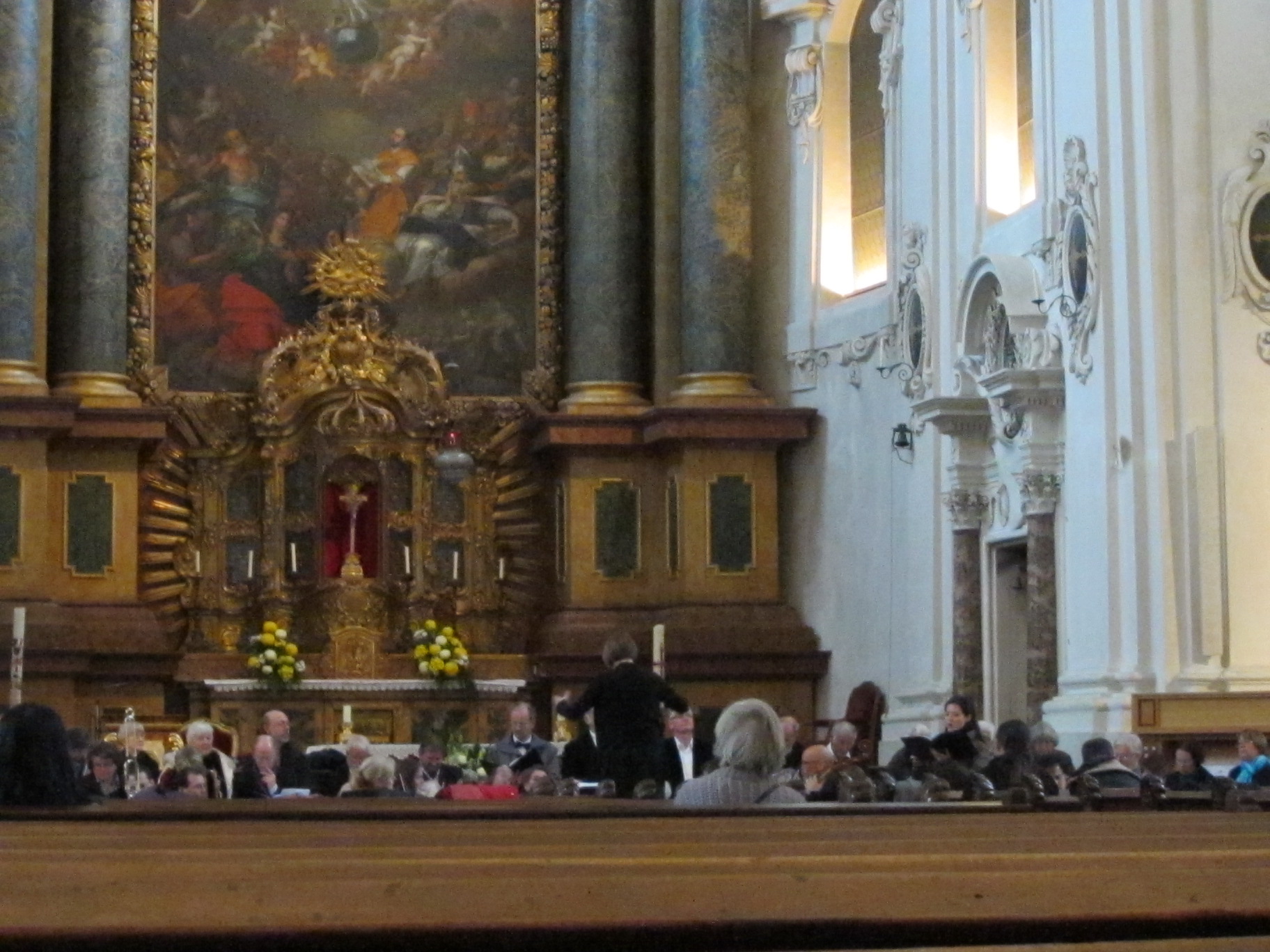
Just another quiet church music rehearsal.

Switzerland has any number of sites worth seeing a second time, and one of those is Solothurn, where for the second time we stumbled into the Jesuit Church (Jesuitkirche) on the main drag and for the second time, happened into a music rehearsal. Do I detect an echo? (click here to hear what we heard and to see the camera pan over the ceiling frescoes)

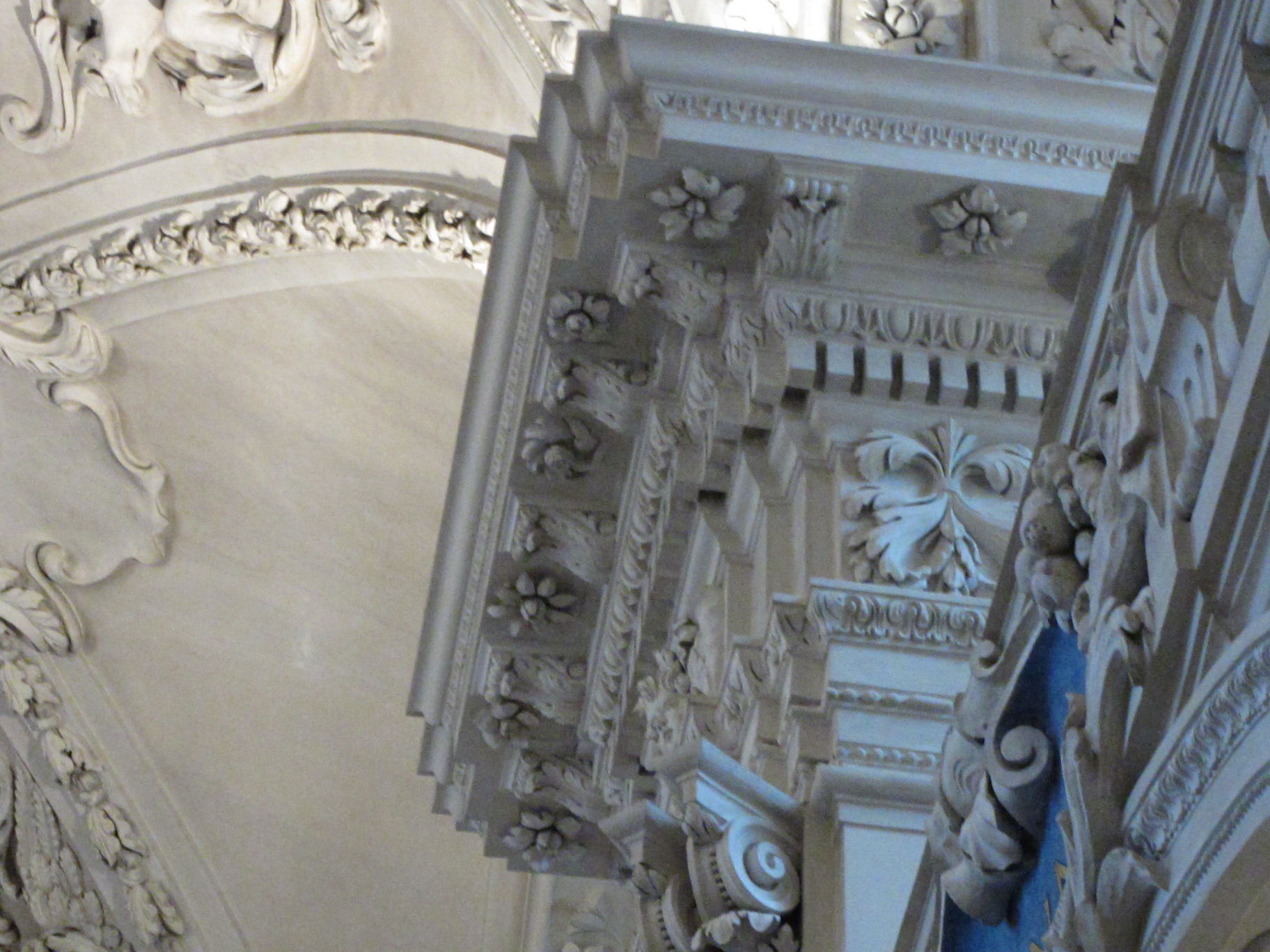
Architectural detail in frescoe-jewelled High Baroque architecture found in Solothurn's Jesuitkirch, built in the late 1600s. We had showed up in the Spring and walked in on a colourful folk-gospel rehearsal featuring a female soloist whose voice matched the High Baroque building’s rising arches and columns. This time, we got a “horse of a different colour” with a choral and classical music performance, just for us and a few others drafted in off the street to enjoy the moment. It’s times like these that we have to suspect God loves to show off the good stuff.

Switzerland has a little of everything, including Christian martyrs that the Romans beheaded in the 3rd century, and who are remembered in statuary at St. Ursen Kathdrale. As is usually the case, the Romans did not mind the Christians worshipping God, they were just peeved the Christians refused to acknowledge Rome's deities, demonstrating that what ticked off people then, ticks them off still.

I grew up in a university district with some fairly interesting friends who came from families of broad talents and skills, among them, a few professional symphony musicians.  Maybe my music tastes were crafted during those impromptu violin and piano concertinas that served as intermissions from discussions on international politics, biochemistry and the mental dysfunctions of our track coach. Ever since, my ear has preferred the roughshod uncut take on a musical piece, something like Susan Boyle’s first run at “I dreamed a dream” on Britain’s Got Talent in 2009. The heart and giftedness in her uncoached version of that song tops any of her later polished productions.

Which is to say, if you go to Solothurn, or any Swiss town for that matter, be sure to step into the churches and see what’s going on there. Odds are, there will be nothing but grand architecture and maybe the sale of souvenirs, but it seems that in Solothurn, the odds might be excellent that you will see something that you will never forget. Church music, living room jam sessions, rehearsals in unexpected places, these are the things that make memories that will go with us for years to come.

Oh yes, and chocolate. Chocolate makes memories, too. Speaking of which, Solothurn is home to a number of chocolateries, where visitors can idle the afternoon away comparing, cooing and slipping into chocolate comas. Not a bad way to pass the hours.

Other things to see:

    • St. Ur or St. Urses or St. Ursen Kathdrale on a sunnier day

      Kunstmuseum – A small art gallery with big art history, including work by Picasso, Cezanne and other masters. This vibrant museum also hosts modern art exhibits that are as good as anything to be seen in major cities.

    • St. Ursen Kathdrale – This church has been closed to the public, we believe due to renovations (remember our language limitations), but you can still enjoy its exterior, as well as a 250-stair climb up its bell tower for fabulous views. Note: Do not attempt this if you have a family history of heart disease. Click here for a description of the vertical march and to see our sunny-day visit to Solothurn in the Spring.
    • Altes Zeughaus – Weapons museum that we are sure is lovely, but we were too cheap to pay admission, so we offer no appraisal on its merits.
    • Rathaus – An appropriately named office building for the municipal government. In keeping with the foot-dragging policies of municipal governments everywhere, this building was constructed over a period of 235 years. Think of that next time you go to your town hall asking for street lights on your block.
    • Fortified walls, towers and gates – Stroll through the old-town to see remnants of these structures left over from the 1600s.

Rappelling Swiss Canals

BIEL/BIENNE, SWITZERLAND You see more of the world when you get out of your car and walk around. You may not go as many miles, but you cover much more ground, so to speak.

Swiss workers know how to have fun on the job. This man is one of a team of city workers who rappelled down a canal wall when there was a perfectly good staircase nearby. The bike was retrieved from the canal, a favorite chucking-out point for bike thieves (or maybe the bike owners themselves discard their rides in this way, perhaps fed up with the European cycling stereotype).

Today provides a good example. A deep stone-walled canal runs through our town. In the late afternoon, two city workers in a low-bed truck pulled up in the walkway by the canal (there is a roadway on one side and a walkway on the other).  Dressed in reflective orange coveralls,they unrolled a line over the canal’s 3.5-foot wrought-iron fencing, which, by the way, prevents no one over the age of three from climbing over and plunging down to an uncomfortable landing. The canal is roughly 15 to 20 feet deep at this point, so unless you took a header, you would probably survive the fall, although with some nasty deforming injuries.

They had tethered the rope to something, so that while one managed the rope, the other swung over the railing and rappelled down the canal. At least I hoped they fastened the rope to something, but in fact, it looked as if they had just looped it around the railing and the topside worker was hanging on to it while his buddy made his descent. I cannot be completely sure about this.

It should be noted that less than 30 feet away was a gate opening to a narrow set of concrete steps that the workers could have easily used. Let’s face it, rappelling is more fun than stairclimbing.

The worker reached the bottom whereupon he started plucking debris from the canal floor and chucking it in the general direction of his crew partner. The first few tosses were random and so boots, empty cans and unidentifiable flying objects landed among the strollers, which happened to include an elderly lady in a long grey coat who nearly got beaned with a shoe.

Such egregious disregard for work and public safety would get somebody in Canada fired, but this is Switzerland where if you can not dodge a few shoes now and then, you are not long for this world anyway.

I’m adding this to my list of proofs that the Swiss are a daring no-nonsense bunch whose primary goal is to get the job done on time, even if this means not getting the job done safely. Yesterday, bucket trucks and ladders lined Nidau Street (Nidaugasse) where workers strung framed Christmas lights overhead, all without benefit of redirecting the pedestrian traffic below. One slip and it would have been Christmas bulbs imbedded in skulls. That did not happen, however, and last night the streets were aglow with Christmas lights.

I would not have noticed any of this had I been speeding by in a car, but then, I also would not have been within range of flying boots and plummeting Christmas lights.

Heartbreaking timepieces

We are surrounded by watches, this being Switzerland, and this being the Canton of Bern, it is also the home of many recognizable Swiss watch brands, including Swatch, Rolex, Longines and so forth.

Not much of this means anything to me. I have a utilitarian attitude toward watches. They need to be on time, they need to be waterproof and they need to be cheap enough that when I lose or break one, it will not rend my soul into pieces.

Watches watches everywhere and not a digital face to buy.


I used to have an expensive Seiko watch, a brand that in Switzerland is despised as a basement-bargain inferior product. I lost that watch back in the 1980s and I look for it still. It was perfect in design and went with any outfit. When I realized it had gone AWOL, I searched every pocket, every closet, every drawer, every nook, every proverbial cranny and it all came to nothing. Even years later, every time we moved, I kept an eye open for that watch to float to the top of the boxes, but no. Nothing.

The habit birthed out of this was to only buy watches that I would not miss, and that watch brand happens to be Timex. If Seiko is despised in Switzerland, Timex is non-existent.

I know this, because my trusty waterproof, $45 Timex sports watch has lost a piece of its strap. There are no replacement straps to be found here in the heart-and-soul of watch-land. There are no Timex watches or even anything that looks like them. More than that, there does not appear to be any digital watches and worse even, every watch I have eyed comes with a heart-stopping price tag. That is to say, heart-stopping for me. I am incredibly cheap.

I have searched our downtown core and have come upon banks and banks of old-fashioned hour, minute and second-handed watches. It is as though 1970 did not exist (the year when Wikipedia says the first digital watches came into being, although I doubt Wikipedia. Nevertheless, I am too lazy to look further than that, so please do not quote me as a reliable source on this point).

And so I walk around with my not-so-secure strap, fearful of losing of my lovely Timex watch that has been with me through so many wonderful lake swims, so many jogs and walks, a stain-proof, reliable device that has a timer, stopwatch, alarm, pulse-taker, a watch I bought only because I knew it would mean nothing to me if I lost it.

It turns out I was wrong about that.

Of course, I bought it before I moved here where it is the rarest of timepieces. If it drops off my wrist, I am going to be looking for it everywhere, just like that blasted Seiko.


My beloved niece and random travels

Now this is a proper Swiss "river," running straight and orderly as all Swiss waterways should. Note: An untamed creek/river ran alongside it. The Swiss are not to be outdone, they will have every kind of waterway.

TAUBENLOCH, BIEL/BIENNE, SWITZERLAND  I received a note from one of my darling nieces this week (I have 11, no wait, that’s 12 nieces, plus one genius-Goddaughter), asking for my advice on where to travel as she’s planning to trot across Europe next spring.

The thing is, there are so many places to go that she could play pin-the-tail on the European map and land just about anywhere interesting, except for Olten, which we have already established is not worth visiting.

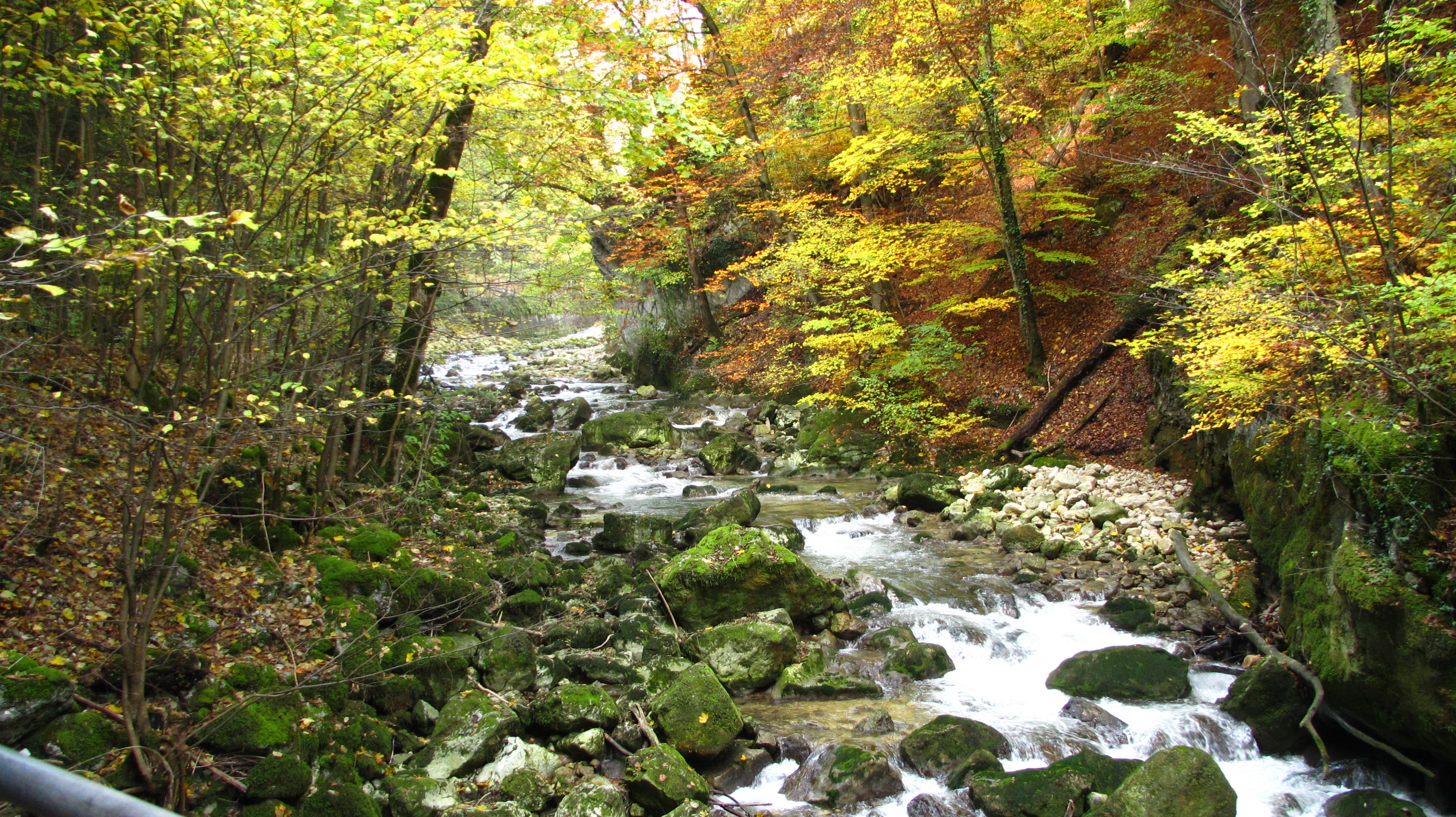
The Taubenloch gorge trail criss-crosses the Suze River as it falls from the Jura Mountains down into Lac Biel/Bienne.

But, Olten aside, we have done some random drop-in touring and been pleasantly surprised, as we saw on our trip to Thun, the not-so-well-known Swiss settlement north of the Bernese Mountains. Although it receives as little attention as Olten when it comes to tour guides and online searches, it turned out to be a fabulous place. Click here and here to see past posts and pics on Thun.

Europe is full of such lovely finds and not just in medieval villages, cathedrals, castles and pastries. We discovered a treasure in a canyon trail just north of our town of Biel/Bienne.

It swoops down into a steep limestone carved gorge that bellies out in a fast-moving river, or maybe creek. It’s not clear to me what qualifies as a river, as I’ve seen “rivers” in Spain that had all the panache of the ditch that ran in front of our small-town-BC home back in the 1990s. Yet the Spaniards called this worm of a waterway a “river.” Fascinating people, the Spanish.

You can understand that when someone describes something as “fantastic” to me, I reserve judgment until laying my own eyes on the thing. This is what happens to people who have lived in Spain. They are forever sceptical about everything.

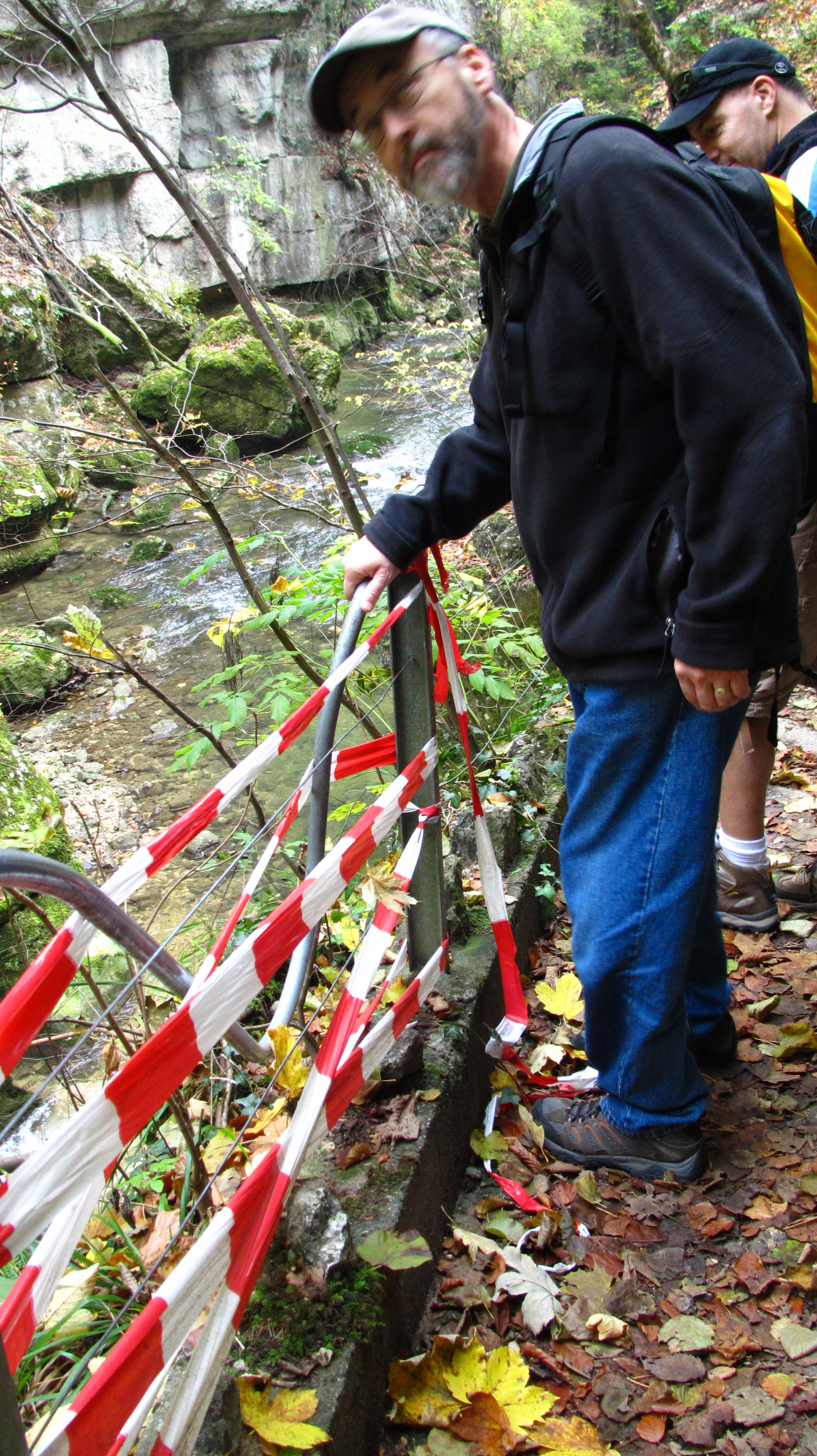
Check out the metal railing, bowed by falling rock. The Swiss know how to add excitement to a cliff-side trail.

But the Taubenloch trail is nothing to be sceptical about – it turns out that it is a charming, although sometimes alarming stroll. The alarming part is the ample evidence of landslides as can be seen by security tape and warning signs around badly deformed metal railings where the falling boulders have messed with the trail. As late as 2009, the trail was cut off due to a number of landslides. This makes walking it a very exciting venture, indeed.

A southerly portion of the trail scoops out of the limestone walls of the gorge, such that walkers are directly underneath massive overhangs of rock, overhangs that have visible stress fractures in them. It quickens the pulse as well as the pace.

There are gorges and waterfalls more grand to be found south of us in the Swiss Alps, but I am a scaredy-cat, so this was just the right start for me. I’ll try the big stuff later.

To get to the Taubenloch trail,take the train to Frinvillier (less than 10 minutes from Biel/Bienne or 30-40 minutes from Bern, or with train switches, about 90 minutes from Zürich). When you get off the train turn right, heading down to the underpass where you will make another right, going under the underpass that now is an overpass to you, until you come to directional signs in a small Swiss village. Take the sign pointing left (downhill) called Gorges du Taubenloch. It will look like you’re heading off to nowhere, but eventually the road leads to a skinny trail alongside a raised walled canal. This is the northern end. The trail meanders at a

The prospect of this stone ceiling caving in on us did not bother Dave's coworker, Mike.

gentle downhill in a southerly direction, crossing the Suze River several times via walking bridges. At a slow pace, you can cover the trail in 45 to 60 minutes. It is reported to be only two-kilometres long, although with all the winding and such, my pedometer showed it to be much longer.

Cost: We didn’t pay a cent, although as we exited the trail on its south end, we went through a gate, along with some signs in German or French, so it is possible there’s a donation box. The trail is said to be maintained by a non-profit society.

Taubenloch is full of tunnels and caves, some natural, some carved. Locals tell us caves were/are used as potential sniping points in case of invasion, and are also used to stockpile weapons all over Switzerland, which does not have an army per se as the entire male population is required to take military training and serve 3 weeks a year until age 34, although some are required to go til 50 - I would imagine they are 'special-ops.'

One other thing: The southern end of the trail comes out right into a Biel/Bienne suburb, and you can walk all the way back to the train station or look for a bus. I can’t give any advice on the bus, because we walked back home, which took less than an hour, although we did have a leisurely browse through an outlet store along the way. No nature hike is complete without at least one stop in a shop.

Xenophobe’s note: I mock the Spanish for their idea of what constitutes a river, but in all fairness, the Swiss would probably mock me or my fellow Canucks for finding Taubenloch to be awe-inspiring. This is because the Swiss own Switzerland, a pretty fabulous place in every way. 

Autumn is a lovely time to walk Taubenloch.

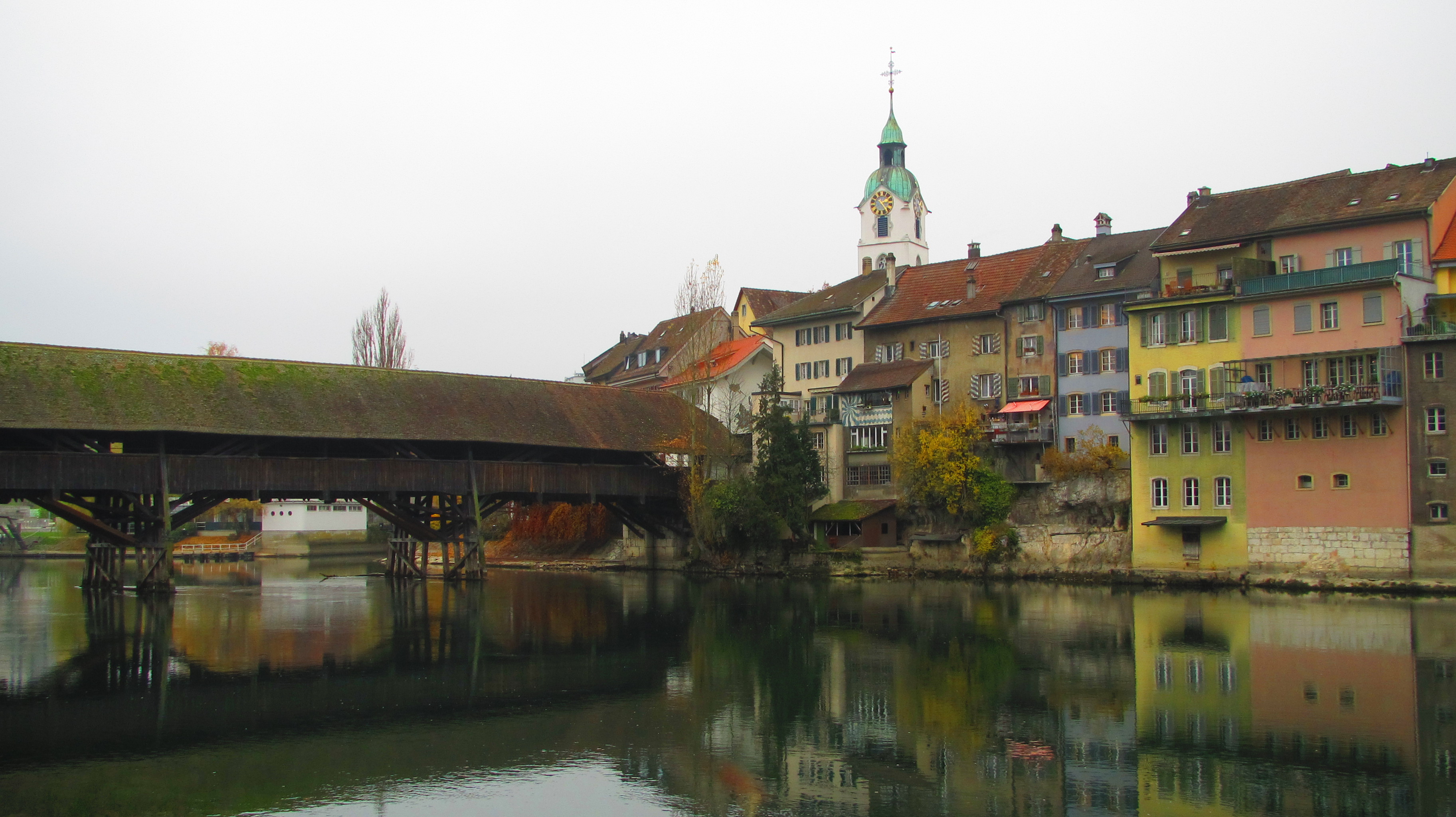
Olten

Olten painted house - when graffiti could legitimately be called art.

OLTEN About half the hits on hobonotes.com come from our friends and the other half from random Google searches, Facebook links, and other weird Internet searches.

For the half that are personally acquainted with us, this blog is a way of saying: Look! We are still alive! For the other half, it offers a peek into the pluses and sometimes-minuses of European travel, as well as a rigorous ongoing quality check on European chocolates and cheeses.

This blog-reader split is what crossed my mind as we strolled through Olten, a little Swiss town of about 17,000 where for every 100 Swiss babies born, there are about 80 births of non-Swiss babies. I mention the birthrate only because it is such an outstanding demographic figure and because it is Olten’s most interesting fact. This is true, as far as I can tell.

When a town's public art is mostly flat concrete-cast figures, it is time to start again.Ugh.

Olten does not figure large in travel guide books and two hours there told us why. Its old-town has the requisite narrow cobblestone avenues flanked with three-to-five-story apartment buildings complete with the usual colourful shutters and attic garrets, but lacks the “punch” that other Swiss villages deliver with their castles, ramparts and medieval churches. It is not a bad place to go, but it’s questionable whether it is worth the stop.

Olten is not without its charms.

This is what made me think about how to write about it for the website. If you are a personal acquaintance asking whether to make a tourist stop in Olten, I would say do not bother.

If you are a casual Google-search-initiated reader, I might be tempted to be more diplomatic and politely steer you toward other locales, but I’ve already outed Olten as a non-destination. Poor Olten.

I could be wrong about this. If any Olten-adoring reader cares to challenge me, I am willing to go back for a second look.

Sick Saturday

A cold bug has struck our little household, but we have to flee our premises anyway because it is the day the hotel housecleaning staff scour out our flat, so we’re off to Solothurn to hack, wheeze and spread some germs around. Photos to come, sometime, who knows when.

Breaking news: Dave says we’re also visiting Olten. Maybe we’re not that sick.

Want more stuff? Scroll down. 

A few more photos from Thun, Switzerland’s overlooked city & a note on crime

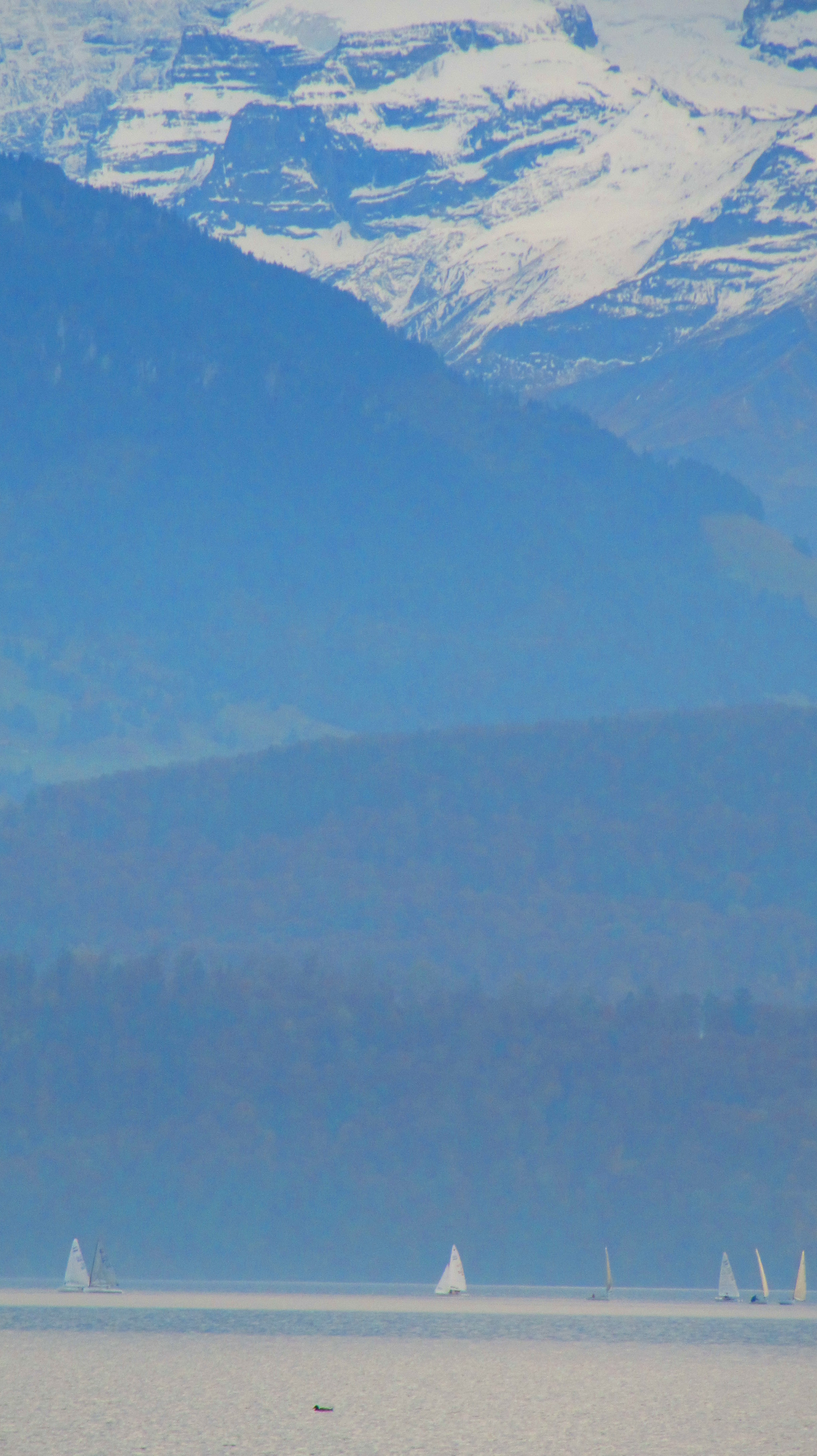
Sailing at Lac Thun on a beautiful November day.

Thun was so pretty that it is worth one more look. Here are some photos from that charming place.

A note on crime: We strolled the old-city without any sense that pickpockets were nearby, and even Thun’s train station lacked the menace that other European train stations have with their notoriety for thieves (see Paris blog about the Gare d’Lyon in that fair city by clicking here).

Many Swiss cities have urban injection sites for drug addicts, which reportedly are having some success in helping people out of that lifestyle, but their presence also leads to a whole lot of unpleasantness around many train stations (for some reason the sites are situated near the train stations, probably because the stations are in the city’s core, naturally).

Our little town of Biel/Bienne has an injection site near the train station, making it the most unsavory part of town. It’s too bad because it’s also the first place tourists see when visiting here. Thun didn’t seem to have that drug/drinking population, although we were there on a Saturday. Maybe they took the day off. We have seen our town’s preeminent drunk on the train – perhaps he was on holiday, or merely scouting for new franchise locations.

Covered walkway over a river dam at Thun, at the River Aar.

The Swiss even make car parks look pretty. They are a wonderful people.

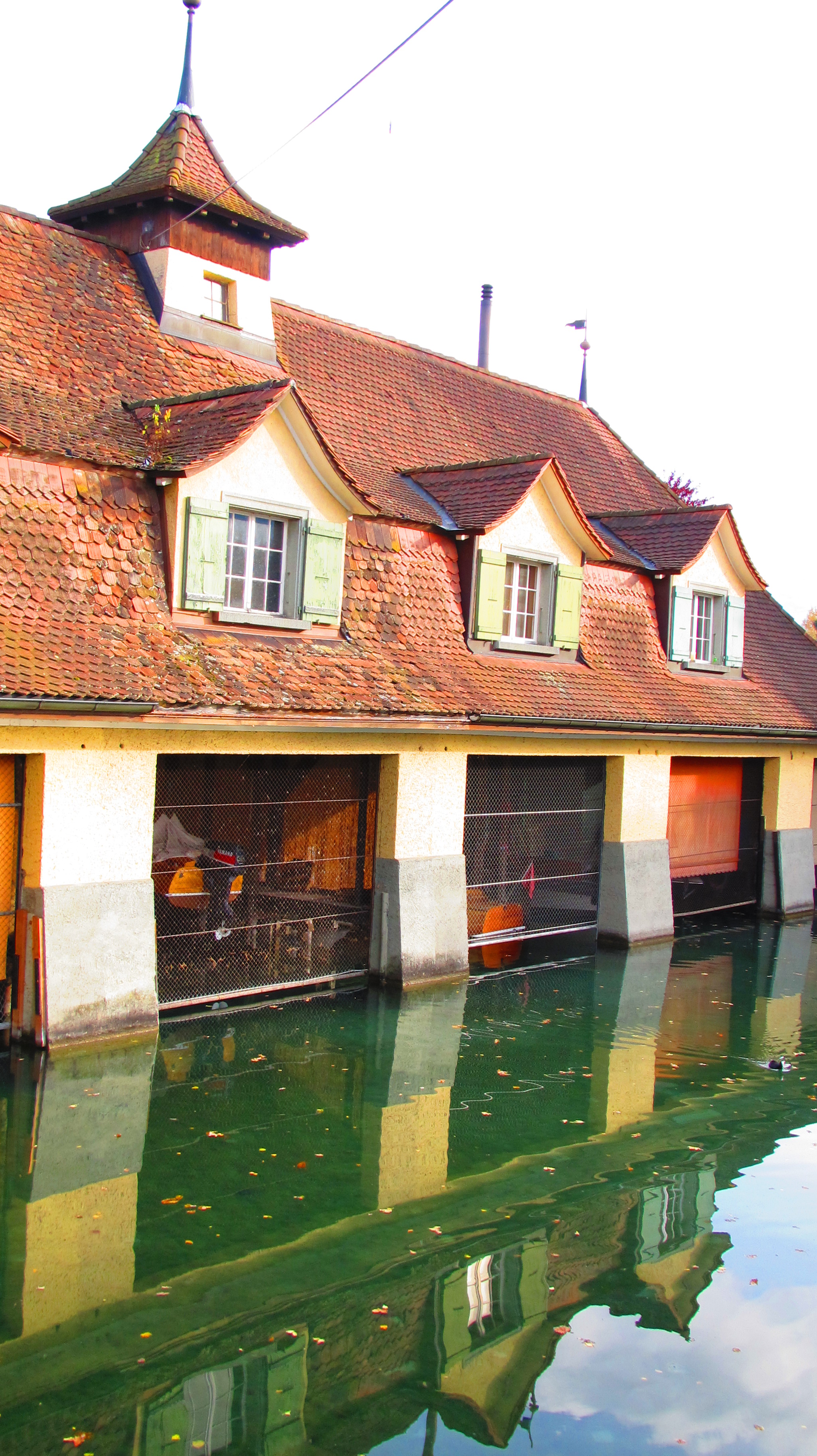
The Swiss idea for a garage along a river. This was off a little creek just a few metres from the River Aar - it was full of wood boats. Lovely.

Switzerland is like Victoria, B.C., Canada for its large trees. Holy dynamite, Batman! That's a big one.

Thun, beautiful but often ignored

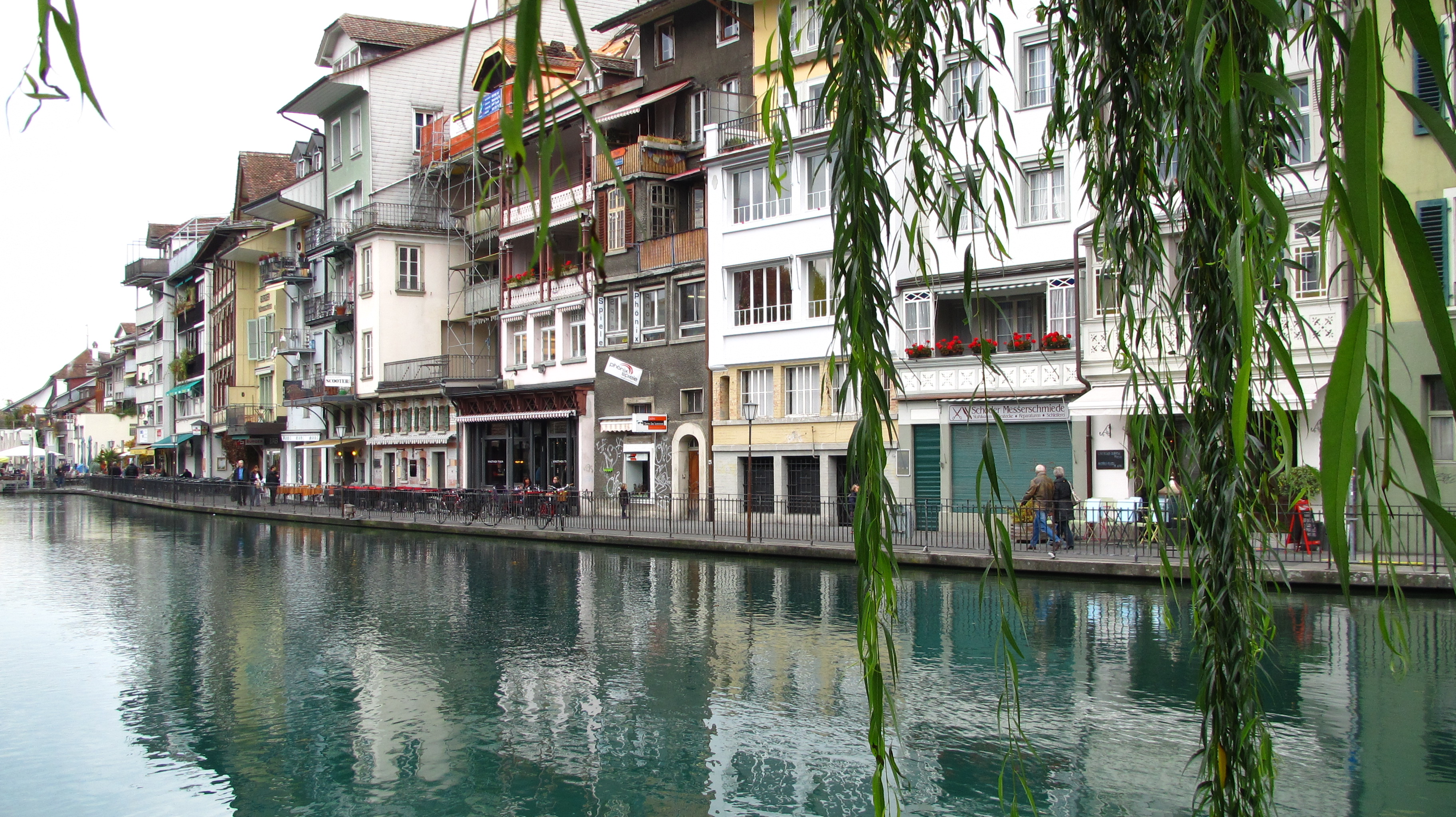
If this were Winnipeg, the residents would be sandbagging like mad. But it's not. It's Europe and so having water right up to the building's foundations is just fine.

Thun sits within sight of Switzerland’s spectacular Bernese Alps, which means that it is much-ignored as people speed on past to get to the mountains. It’s name is no help: Pronounced ‘toon,’ it struggles to be taken seriously, and fails to inspire curiosity the way that a name like Zermatt, Zürich or Neuchatel might. Poor Thunites.

But their town is lovely, with the River Aar running through it, the classical cobblestone streets, covered bridges, a castle, and scores of outdoor riverside cafes.

Once you make it up the steep stairs leading to the castle, you're rewarded with a maze of these lovely cozy walled cobblestone lanes.

Our first clue the town is somewhat overlooked came when we stopped in at the visitor information centre. These are often found in train stations and usually attract a lot of traffic as tourists flood up from the station platforms, but when we arrived we increased the office’s tourist population by 100%. The agent was so happy to see us that she came around from the booth to greet us, bidding us welcome in such a way that it was clear our presence was her only hope for job security.

The truth is, Thun would not rank high on any tourist guide’s “must-see” list, but that is because it has such fierce competition. As Dave has noted, while B.C. has one Victoria, Switzerland has about 500, or one every 10 minutes. How can a place stand out with competition like that?

Thun. Ugh. What a horrible place.

If you go, make sure to take the walk up to the castle. The stair-climbing will just about kill anyone – and as proof, not long after we arrived at the top gasping and clutching our chests, a woman not 30-years-old came up behind us, panting and red-faced. So it wasn’t just us. You will be rewarded with a stroll down some stone-walled, cobblestoned lanes that afford a lovely rooftop view over Thun and onto the Bernese Mountains, which everyone else has rushed off to see, leaving you with Thun all to yourself.

Thun has spectacular views of the Bernese mountains, including Jungfrau.

Music that needs to be explained along with the wreckless abandon of the Swiss

What is this swan thinking? Swans usually paddle languidly through calm waters, but this one must have been a teenager thrilling to the dangers of Thun's fast-moving waters.

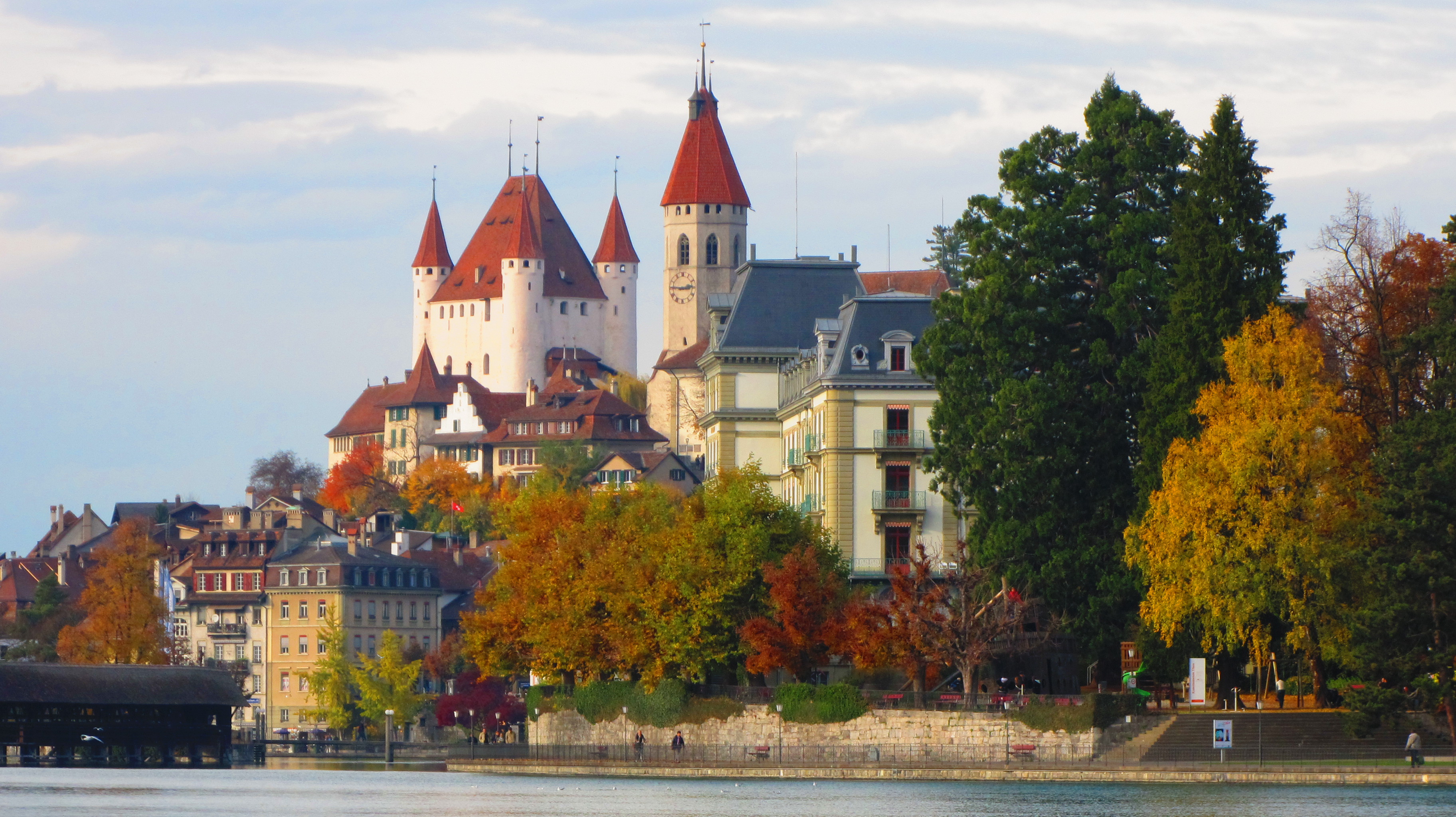
The castle in Thun against a lovely blue sky.

Thun may not be the name that comes to mind when one thinks of wandering Swiss towns, but if you have the time, it is a lovely place with covered wooden bridges, and a sparkling clear river – the River Aar in fact, which runs through so many villages that we are suspicious that instead of one river, it is actually about 10 with the same name. It is possible the Swiss were tired of naming things. They have a lot of mountains to name, so why not just paste the same moniker on a bunch of waterways? Am I joking? See below. ***

The town has at least two dams on it, and we watched swans bobble through in the churning waters of one, not really sure they would make it. The current is seriously scary and so, of course, it attracts the human young as seen in this video clip (click here). As is customary with the Swiss, the surfers seen in this clip have no protective gear – no helmets, no life jackets.

This is the oddity with the Swiss – although they apparently strap on endless harnesses when scaling cliffs, they are otherwise unconcerned with drowning, head injuries, plummeting tremendous distances down mountainsides, ramming their bicycles into cars, and so forth.

They are a wonderful people, but I’m sure their mothers are all exceedingly nervous.

This explains the Red Cross, the Swiss organization that provides emergency response across the globe. They have developed a heightened emergency-response infrastructure, methinks, because they are a little weak on disaster-avoidance while also being  strong on adventure-seeking. No wonder they’re good at bandaging wounds.

In the meantime, I made a promise to post a video clip of Swiss street musicians that may be good, or not. I am at a loss to explain it. We came upon these men in yeti-costumes on the streets of Thun, singing in pained voices and playing wind instruments that made my ears hurt. If any Swiss person can tell us what this is (click here for a short video clip), please do

*** I make joke about many rivers being named Aar or Aare. It is actually one heck of a long river that begins and ends in Switzerland, running about 295 km (183 miles), and is the funnel through which all the water of Central Switzerland drains (17,779 square kilometres or 6,865 square miles).

Tomorrow: More Thun along with more photos

More street talent

Rob van Wely and his travelling audience.

Biel is a small place in the grand scheme of all things Swiss. It’s not Lausanne, Bern, Zürich, Lucerne, Geneva – all of which have the air of international cities.

It certainly lacks the grandeur of Zermatt or the Alps, which are further south, but it is charming nonetheless, and has so many festivals that any North American city of a similar size appears comatose.

It also attracts a fair number of street performers. It is hard to qualify the value of these musicians. We’ve seen some in Victoria that were raspish to the point where listening to fingernails screeching along a chalkboard seem like a pleasant alternative.  In Switzerland, thus far, the street music has been very good. Maybe the old stone buildings add a particular acoustic value, but every weekend we are amazed at the performances so much that we-the-cheap regularly drop money in their upturned caps.

Here in Biel, we ran into a James-Taylor-ish street performer, Rob van Wely, a modern-day troubadour with a silky voice. In his limited English he told us he’s from Holland, and didn’t seem believe his voice was so nice. Decide for yourself. Check out his performance in Biel by clicking here.

“I whistle better,” he said. He was told 25 years ago that his voice is bad, and he admitted that to be heard over a crowd, he tended to yell. It stole away the gentle nuances of his voice meandering up and down the scale, and so he worked on his guitar-playing and whistling, but then discovered the magic of amplification and brought his vocals back to his performance.

Tomorrow, I’ll post another video of a street performer in Thun that could change my mind about the quality of street music. I just haven’t decided yet.

New links:

  1. Look here at AngloINFO, a Geneva-based website with some handy data for foreigners living in Switzerland.
  2. Look to your right to see a new weather box on HoboNotes. It’s a graphic that depicts the local weather reports (as they come from Bern, we’re too small here in Biel for our own weather reports). It is very cool, thank you to my friend C.A. for pointing it out to me. 
  3. For those who prefer the real thing, go to the Blogroll box to the right and click on “See it now” to go to a webcam showing you a view over Lake Biel, updated every 15 minutes. 

Sinking to new lows in the kitchen

We are sliding down the chute into culinary mediocrity, one forkful at a time.

The after-school cookie-muffin-and-scone-baking mom, that was me. No trans- fatty acids or cyclamates in my kids home-made snacks, just good old-fashioned butter and sugar.

How things have changed. Cooking in Switzerland has been challenging, mostly because six months in and I still haven’t figured out how to work our newfangled state-of-the-art oven. That and the combined horrors of shopping for food without taking out a mortgage has had an effect on our dining.

It began over the summer when I was in Canada and Dave took it upon himself to try out some prepared packaged meals from the grocery story. To his surprise, and later mine, it turned out they weren’t so bad, and with pricing between 5 and 7 Swiss Francs each, these meals have become staples in our weekly diet.

That is pretty low in my books, but today we sunk lower. I purchased pre-seasoned chicken breasts, reasoning that with pre-packaged food on the table four days out of seven, we were probably headed for heck anyway. How lame does a cook have to be to buy meat seasoned by a store? As lame as I am, as it turns out. A little pan-frying in butter and the pre-seasoned chicken turned out to be pretty good.

The price of vegetables makes me flinch (6 Francs a kilo for broccoli), but we have discovered packaged produce, such as bananas is much cheaper than the loose stuff in the bins. We had avoided the packaged produce precisely because it smacked of shoddy goods  – why package something if it wasn’t to conceal over-ripeness or bruising? It turns out that’s not the case in Switzerland, so we now buy our banans at 1.80 Francs for a big plastic bag instead of 3 Francs for a kilo.

We’ve also started shopping for cheeses, milk and other goods, mostly non-perishable, at a local convenience store called “Denners.” We earlier bought ground beef there and were suitably punished for that crime at dinner time. It tasted of something not quite beef. I don’t want to think about it. So, steering clear of beef, we have found other items there to be “okay” and weirdly cheaper than in the regular grocery store. This is the opposite of convenience stores in Canada where food is always priced way higher than in supermarkets.

I don’t know how much I’ve pared off our monthly 2,000 Francs grocery budget, but if we settle into this new “method,” I’ll try another week of collecting receipts and report back.

Still trying to figure out this country, the sweet and the sour


It’s funny what thoughts the town drunk will inspire.

For a teensy weensy little nation, Switzerland occasionally shows up in the top 10 richest countries in the world, which is something when you consider that it is competing against Qatar and the U.S.  In fact, according to Business Insider, it even topped the U.S., coming in at #6 over the U.S. at #7, based on GDP per capita.

Of course, where a country ranks depends on how the ranking is measured. For example, if a country’s riches were determined by the quantity of chocolates it produces, you would think Switzerland is #1, but guess what, it is not.

The top chocolate confectionary producer title goes to a U.S. company, Kraft Foods Inc. As a top consumer of chocolate products, I am stunned by this revelation from the International Cocoa Organization, a very real entity that I would love to work for.
Biel the beautiful.

Switzerland is the third-largest chocolate producer with the Swiss Nestle’ corporation placing it there, just behind “Mars,” a U.S. company. The U.S. is home to three of the world’s top-ten chocolate-makers.That is pretty impressive, but consider that Switzerland has two companies in the top ten, then compare the two  nations’ population and geography (the U.S. is gumpteenzillion times bigger, for one), and Switzerland is all the more outstanding. You have to think that if the U.S. applied the same degree of diligence that the Swiss do, we would be swimming in chocolate. This would be okay with me.

When the GDP alone is tabulated, Switzerland sadly gets bumped off the Top Ten list (the U.S. wins that one, even beating the legendary industry of the Japanese and the population-giant China who come in second and third respectively (according to 2008 GDP figures).

Switzerland still makes #21 on GDP alone, a real feat for a country that is one-tenth the size of Montana.

Thoughts of Switzerland’s relative wealth came to mind as I walked past Biel’s preeminent town drunk, a roguish, handsome white-haired man with an unfortunately crushed nose.

He is the fellow of whom I wrote early into our stay here, the same man who urinates openly in the square in front of the train station. He usually keeps to himself, and everyone gives him a wide berth, what with the urination thing, but lately he’s started lurching at passersby. It unnerves everyone, but he remains a fixture at the train station. He is the same fellow, by the way, who made loud freaky sounds as he walked behind me on one of the canal walkways.

Back in Canada, I’ve interviewed lots of homeless people, drunks, mentally ill, and so forth. People always talk about how harmless they are, but that is the same kind of wisdom that says bears are more afraid of us than we are of them, in other words, it’s bunk.

I’ve never felt completely safe in the presence of those who hand over their sensibilities to a bottle of booze or the drug-confection-of-the-day. These are ridiculously unpredictable people. As a reporter, where my job was to face up to them and engage in conversation, I found them somewhat fascinating, mostly because they weave such great fictions.

I know it’s politically incorrect to say so, but the volume of lies told to me by street people is amazing in its pure bulk, and mostly I discovered those lies by standing around long enough for the drug addict/drunk/street person to forget their original story and start into a second one.

On one occasion, I interviewed a man who alleged he had been roughed up by the police. I asked for his name. He gave it. Then he waved some kind of summons or ticket in my face to prove he had interacted with Victoria’s finest. I asked to see it and saw the name on the summons differed from that which he gave me. When I asked about this, he grabbed the summons and quickly fled on his bike. At least it may have been his bike. Give the high rate of bike theft in Victoria, I would guess he had “borrowed” it. This was not an unusual exchange.

Where this all goes is this: Switzerland is rich, and with a lauded social safety net, and yet we still have citizens veering on the streets with open beer cans in hand.

Yesterday, outside of a grocery store, I watched a few of the town drunk regulars (who have not risen to preeminent status) heckle a white-haired woman, her back a badly disfigured mountain range curved over so that she was a virtual comma when in her best upright position. She pulled her grocery cart past them, stumping along with her cane and unable to effect any getaway should one be needed. She kept her gaze fixed resolutely ahead while they shouted at her. I am not much in the way of personal protection, but I rushed up to walk just slightly behind and alongside her, signalling to the vagrants that perhaps she was my aged relative and my glare silenced the drunks who turned their attention in the opposite direction, as though perhaps they had been yelling at the crows.

Smarter people than me have puzzled over the problems of deviant behavior, drug addiction and such, but it seems that a crippled senior should be able to fetch some milk and eggs without having to run a gauntlet of yahoos.

We haven’t fixed this social ill  in Canada, but we shouldn’t feel too bad about this. If the Swiss with their smarts, industry and attention to detail haven’t figured it out yet, how could we?

Leaving Leipzig

Leipzig Nikolaikirche, the birthplace of the teardown of the Berlin Wall.

Some bad things have happened to my family in Germany, like European airlines extorting money from us in $500 chunks to let our dog or a bike pass through Frankfurt airport, and then my Dad was arrested there for refusing to be an informer for the Soviets. Tough luck, that.

The Berlin "Wall" as it appeared around the time my father tried to cross into West Berlin.

But none of those things occurred on this trip to Leipzig, so hopefully our bad run with Germany is over, which is a good thing because, gosh, their food is much better than expected, and certainly better than what they fed my Dad in that jail.

Leipzig has some sadly decomposed old grand buildings, such as the Astoria, which are almost as interesting to look at as the medieval quarter of town. The city’s northern outskirts are somewhat depressing, stretching out in decayed old industrial zones perhaps still lagging behind due to Communist rule even 30 years after the Germans gave the Soviets the boot. Nevertheless, the city centre outside of the historic quarter is lined with beautiful old architecture.

Leipzig's Astoria hotel, a grand old dam now in serious disrepair.

Less well-known to North Americans (but very well-known to Germans, I imagine) is that Leipzig was a beachhead of sorts during the Second World War. The Brits and Americans were busying themselves with bombing Berlin, when one night the Germans launched a significant concentrated counterattack, punching a big hole in the Allied Forces air fleet. The next night, the Nazis readied their forces for a repeat performance only to have the Allied fighter planes skirt around Berlin and hit Leipzig hard. It was a shock to the Germans, as the Allied Forces had never gone that far into Germany, and in fact, it was thought at the time that such a distance was out-of-range and safe from airstrikes.

Leipzig also housed a concentration camp. As the Allied Forces moved in, 12 Nazi guards torched a bunker with 500 prisoners in it, many of them Russians and Czechs. As some prisoners escaped the flames, they were gunned down by the 12, and those that escaped the bullets died in the electric fencing. Very few lived to relate the story. It’s the sad and shocking history of Germany, and another testament to the fact that there is no army so savage as a defeated one.

Hard to believe the culture that nurtured those 12 guards is the same one that was home to Bach, Mendelssohn, Goethe, as well as being the birthplace for Schuman. Leipzig still has a vibrant arts community, a university and parks, although I only walked into one park and immediately turned around as it seemed to have a derelict population. Probably nothing wrong, but why take a chance?
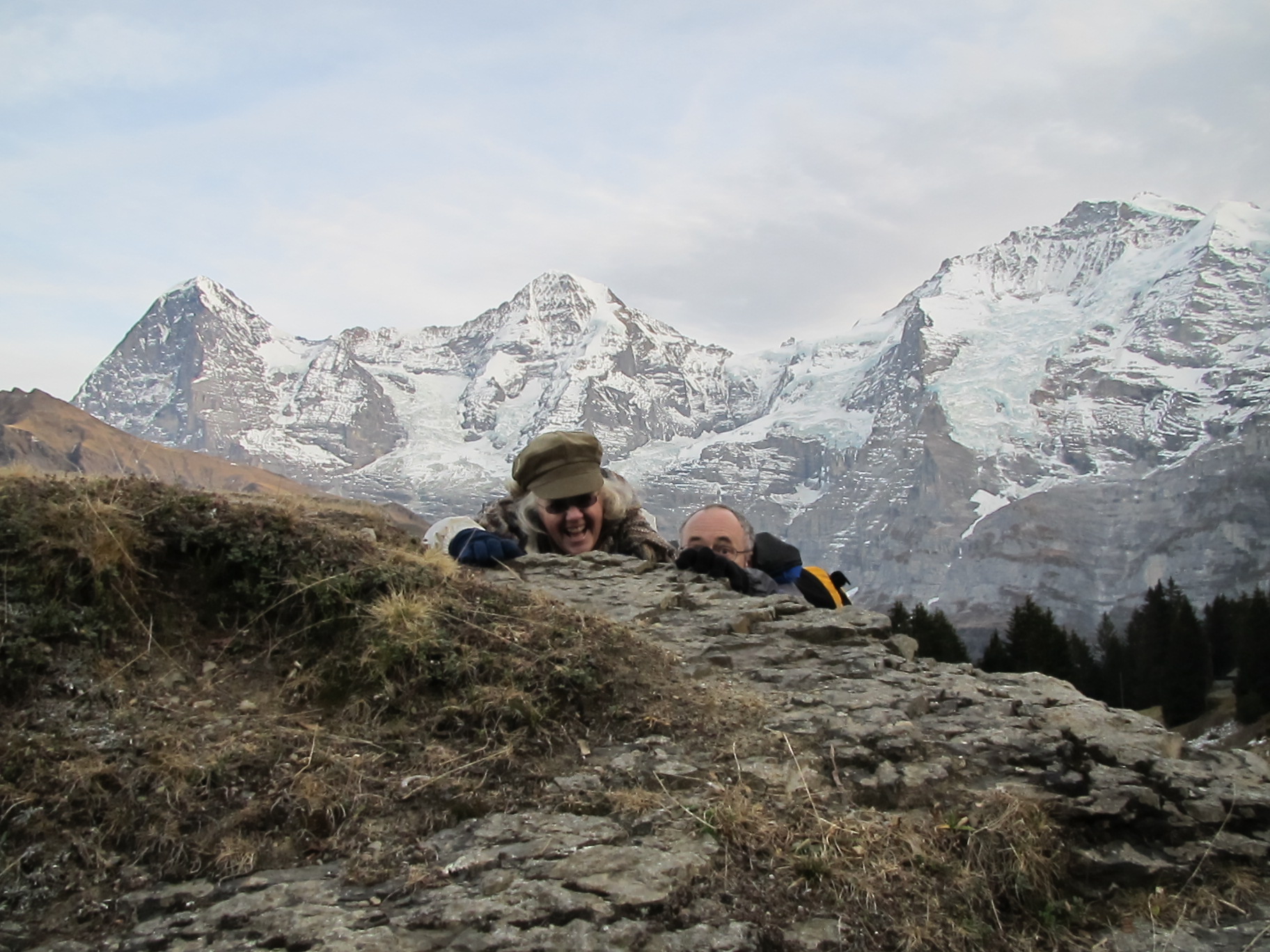
Bach statue outside of Thomaskirche where he is buried.

Bach's burial site in the austere Thomaskirche. We hung around outside the building one night, listening to an organ playing. Most of the lights were out, and the church was dark. It was beautiful and haunting.

If I had learned German instead of French, I would know what this inset statuary is all about at Thomaskirche. As it is, I don't know a thing.

Leipzig, a past that is dark and light. An amazing place, and worth the trip.

Still playing with the blog settings

This is not my laptop, but it looks cute.

Some of you may have noticed this blog is squirming around a bit. I’ve been playing with the theme options, sometimes to my detriment, because I am blog-ophobic as far as understanding what little buttons will affect the blog in what way, hence, sometimes you see two columns on one side, sometimes one, or three columns.

I have no idea what I’m doing, what’s even worse is that I don’t even know how I made the changes that I have, and so it takes some navigation to get back to the control panel to re-configure the blog. I doubt anyone has noticed any of this, but just in case – it’s not you, it’s not your computer, it’s me. All me.

Lovely affordable Leipzig

I was a little harried after a few hours on Germany's warp-speed highways, but my nerves would soon be settled by fabulous German/Italian cuisine.

European travel tends to have an eviscerating effect on the wallet – it can be very pricy, however, our limited journeys thus far have taught us that getting off the beaten track changes that.

In France, we choked on Paris’s restaurant prices, but in Besançon, a small French village near the Swiss border, we found the architecture stunning and the food just as good at only a smidgen of the Parisian cost. We have not seen enough of Germany to draw the same conclusion, but our three days in Leipzig suggests the trend might continue there.

Along Leipzig’s lovely cobblestoned avenues are scores of open-air cafes. It is possible that some of them served substandard food but we did not find any such establishment.My restaurant advice to anyone visiting Leipzig is this: Dive in. The food will be lovely. If you find a lousy restaurant, let me know. I don’t think you will, though.

San Remos vegetarian ravioli

I dined in the San Remo street pavilion under a towering heater and square umbrellas during a brisk windy day and didn’t feel the bite of the cold at all, so enchanting was the meal, the second-best ravioli I’ve had over the past 40 years (the best was at a Winnipeg Folklorama festival pavilion in a Grant Park arena, where scores of Italian mammas slung out homemade ravioli to die for, this was back in the mid-1970s – since then, I’ve not found any pasta that rivals it).

At San Remo (why are so many good restaurants named San Remo?) at Nikolaistrasse 1, (www.sanremo-leipzig.de), for the meagre price of 8-Euros, you get a fetching plate of vegetarian ravioli with a butter-cream sauce. The pasta’s filling suggests squash, a hint of garlic, and some kind of lentil, although the waiter informed me with his limited English that it was probably chopped carrots that offered the slight crunch.

This restaurant boasts that it won Germany’s best ice cream in 2010, although it is not clear to me what contest gave them this title. Nevertheless, more convincing was the endless line-up that formed at this restaurant’s outdoor ice cream kiosk all day long, no matter the weather. I walked past the restaurant kiosk numerous times in the days that we were there and never saw it wane. And so naturally, I tried out their ice cream for dessert, even though the generous plate of ravioli had left little room. The ice cream had a soft homemade texture and supported the “best of” boast. It was delicious.

We dropped in twice at Bitt-burger, which I think is also on Nikolaistrasse, but might be one block west. It’s famous for its beer and has a distinct Germanic look and name, but has fabulous Italian food. Give it a go. You’ll love it.

Night dining in the rain at "Barf Street" - my translation of this Germanesque-tagged avenue. It is absolutely fabulous. Do not miss this spot if you're in Leipzig.

The entire lane that is regrettably named Barfußgäßchen is packed with restaurants of many types. We had a lovely evening meal there at a place I cannot name, but you could probably safely land at any table and come away gastronomically content.

As always, watch the other patrons to see whether they have any food in front of them, or if they wear peeved expressions – we did see at least one restaurant over which the clientele were casting a foul mood, so we assumed the service would be slow there and kept our distance.

This brings me to a piece of Dave-advice on selecting a restaurant. Besides the above (checking for the demeanor of patrons, as well as making sure there are patrons to start with), he favors going to restaurants populated with middle-class middle-age-and-older clients. He said they’re old enough to not try to impress anyone, they know good food and they’re not inclined to overspend just to say that they did.  It’s a method that has worked for him so far.

Crossing the Rhine at Basel

Jumping back to our rain-soaked trip to Basel of a few weeks ago, here’s a photo of a water-going vessel that takes nothing to work: No fuel, no wind, and no substantive human effort, although it does require a good current in the water.

From inside the fahri - passengers sit on wooden benches around the edge of the boat - a few are inside a cabin, but most are outside, so if it's raining, prepare to get wet.

Four of these boats (called fahri) bring passengers across the Rhine for 1.60 Euros a head. The heavy timbered boats are tethered to a line strung across the Rhine (they are spread out across the river, so there’s only one boat to a line). The captain shifts a large lever at the bow of the boat which sets it off into the current that pushes it along the line, gradually drawing the boat to the opposite shore.

The captain explained that it’s the direction of the lever that determines which way the boat will go. The boat travels at this oblique angle, which is a little weird to think of a boat that doesn’t ever go straight. The ride only takes a few minutes. Is it worth 1.60 Euros to drift across the Rhine? Sure. Why not?

Rhine ferry-crossing.

Hallowhine

This photo has nothing to do with the subject of this blog post.

In a few hours, hundreds of thousands of North American children will wake to the thrill of anticipation: Halloween, and its accompanying sugar flood is almost upon them.

Here, in Switzerland, Halloween is not so apparent. In fact, it could be forgotten altogether but for one display at a local department store that has some ghoulish latex monster gloves with claws for fingernails and a few masks. It is possible that children here concern themselves with Halloween, but not that I’ve seen so far.

In Spain, the children in our neighbourhood knocked on our doors on Halloween, with nary a costume in sight, not even a bit of face paint. They demanded money, in their best English. I asked, in my not so great Spanish, why they expected money from me, to discover they operated under the delusion that a North American Halloween was free license to children to extract funds from their neighbours.

They were clear this was not the practice in Spain, however, we were North Americans, they were children and this was enough for them to try some door-to-door begging. Having just had my car recently painted by some anonymous artists, whom I suspected were these very same children, it was easy to turn them away with a warning that I did not want any more pintar on my Fiat and that I could go loco on their madre y padre if I caught the slightest whiff of spray paint.

But on to another topic …

I’m posting to this blog less frequently as I prepare to participate in an exercise of absolute insanity called Nanowrimo – an annual international write-50,000-words-over-the-30-days-of-November challenge. To kick-off this event, I met with some fellow writers at a Bern Starbucks yesterday, one of whom, as it turns out, is from Winnipeg.

Tatiana, as is her name, and I had fun talking about Confusion Corner, bargain-shopping, Mennonite names and Winnipeg boroughs to the point where the other writers’ brain waves flattened in boredom, but we did not care. We went on with our prairie references, and then quickly formed a voting bloc with the other North American writer in our midst, who happens to be from Minnesota, which makes her practically Canadian. We were still outnumbered by the Swiss, but this did not bother us as we were prepared to bring our spouses in to boost our voting numbers (I had brought mine, she had left hers elsewhere, but I’m sure in an emergency she could have summoned him).

As it happened, it’s not the kind of group that takes votes, but we were ready.

So through November I will aim to post twice a week to this blog, or maybe more often. We shall see. One thing is for sure, with the writing crunch upon me, I may write some crazy stuff here, just out of pure fatigue. It could be fun.

In the meantime, while I am not a big fan of Halloween, for those who want to mark the occasion, here is a video that you might find interesting. Click here. Make sure to read the intro first. (thank you to my friend JJ for alerting me to this video)

Leipzig Zoo, better than you’d think

Two giraffes vie for a choice mouthful of greenery within a few feet of the viewing deck. Zebras and other ungulate species as well as ostriches shared the sweeping pastures..

I’ve been to the San Diego Zoo, the Sydney Zoo, too many aquariums to mention, and all kinds of fun places, none of which makes me an expert on how to rank a zoo, but if I were an expert, I’d rank the Leipzig Zoo way up there.

It is the first zoo I’ve visited that was as intriguing for its landscape and architectural design as it was for the critters that live there. To begin with, taking a quick glance up and down the pathways, you wouldn’t be sure that animals do live there.

That’s because all the enclosures are shielded from the walkways with bamboo and forest greenery. To see the animals, you have to step off the trail and into an auxiliary path, or an enclosed hut that features a soft bed of bark mulch to quiet your footsteps. In many instances, the humans seem more enclosed than the animals, as they view the animals through glass windows, which further dampens the sound of human traffic.

The thoughtful set-up of the enclosures doesn’t end at the viewing platforms. The enclosures themselves are well-treed, and often you see the animals peeking around the greenery, and I’m sure they like it that way.

The giraffe and African plains enclosure differs, and reasonably so. Here the giraffe feeding troughs are placed at elevated heights, putting the giraffe’s heads just a little below a wide viewing platform and restaurant, giving everyone a great close-up of these lovely graceful creatures. The giraffes didn’t seem to mind the gawkers at all and moved about lazily, occasionally “fencing” with their necks over the meal which appeared to be large bunches of parsley. I could be wrong about that, but it sure smelled like parsley.

The Leipzig zoo is worth a visit, even if its pricey. It has endless structures for children to climb, plenty of coffee and food kiosks, lots of benches, shade, and abundant parking one block over.

Adult price: 17 Euros, ouch. That said, by the time I finished walking through the zoo (by the way, I got lost and had trouble finding the exit, so make time for that when you’re planning your day) I did not feel ripped off. It is worth every penny.

Children price: 10 Euros.

Food prices inside the gates: Reasonable. No need to pack a lunch.

Washroom facilities: Plentiful, clean and some are done in funky hut styles.

Time to walk through whole site and see almost everything if it’s just adults going through: 1.5-2 hours.

At an all-out sprint: 35 minutes

With children under the age of 8: Three days (okay, seriously, it is an all-day zoo trip. Plan to be there for 3-5 hours).

Special tip for elephant fans: Line up at the zoo gates before its 10 a.m. opening and sprint for the elephant enclosure once you get through. Do not stop to look at the weird bearded bears. The elephants bathe/swim at about 10:15 a.m. You can watch them either above water or below. It is very cool. They might bathe more often in the summer, but in October, when I was there, they skipped their afternoon bath.

How do I get there? Click here for the map, and scroll to the bottom.
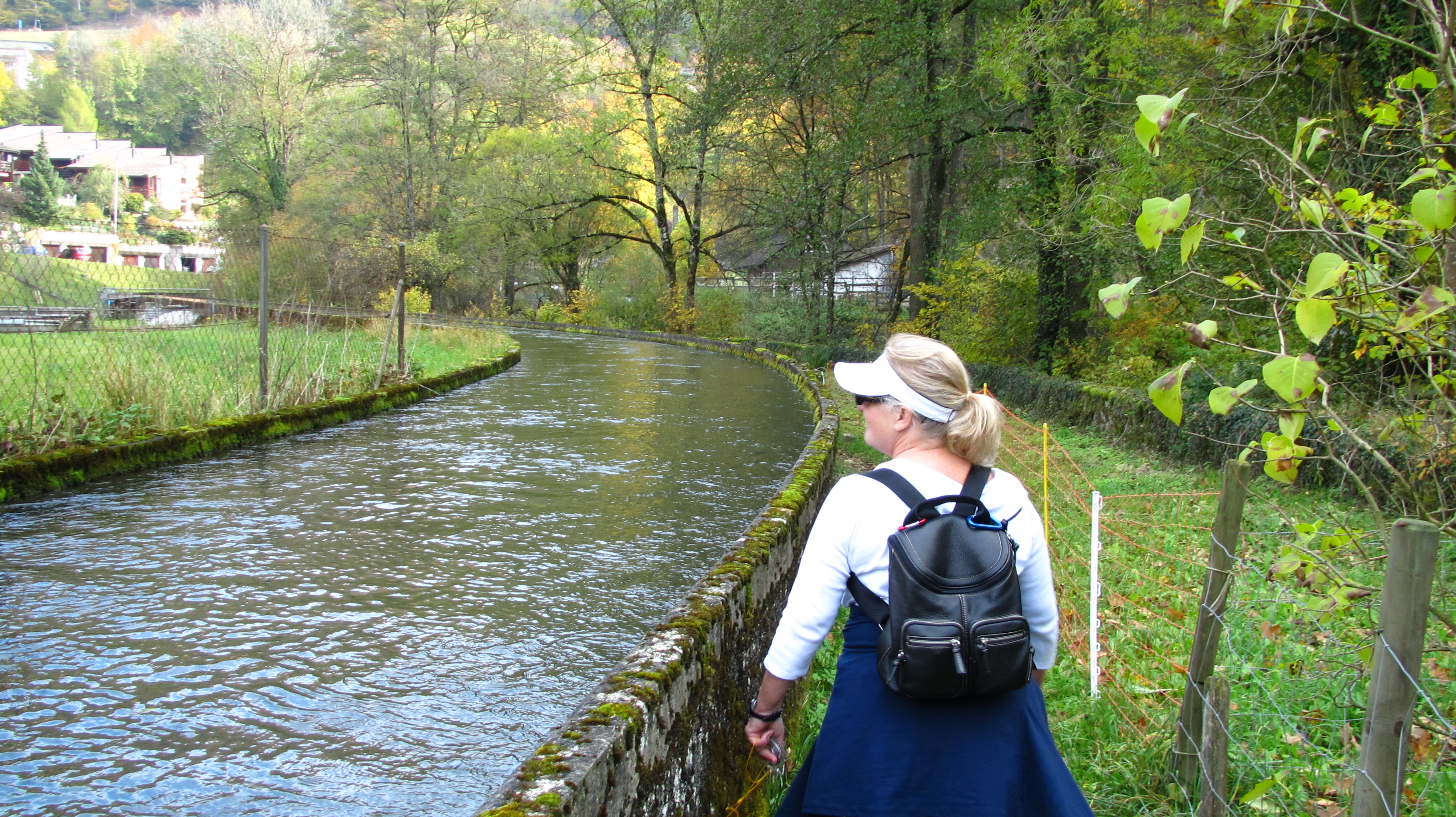
A word to the wise: The zoo features a huge jungle greenhouse called Gondwanaland. Do not go inside unless you don’t mind walking in a slow river of humanity for upwards of 45 minutes through jungle heat and humidity.

Do not turn your camera on, the humidity will mess with its lenses. The path winds through the forest where monkeys swing loose, and if they land on you, don’t make a fuss, just wait for the monkey to move along. There are plenty of signs warning against feeding or trying to interact with them.

Also, beware of dropping bird poop.

The path eventually winds up to the rooftops. It is very cool, but also very hot so I put on my reporter-face and zoomed through the crowd to get the heck out of there. It also features a river boat ride, which looked good if you wanted to melt off about 17 lbs. in 30 minutes.

It all looked amazing, but the only drawback is that it’s difficult to find a shortcut out, although I eventually did do just that. If I had not, my estimate is it would have taken 1.5 to 2 hours to make it through the building.

My only criticism: There should have been more staff in Gondwanaland to direct the crowds. Sometimes it wasn’t clear which way they should go, and certainly it was nigh unto impossible to find an early exit.

You can learn a lot more about the zoo by clicking here. Get your Google page to translate it if it turns up in German or Ukrainian.

Click on a gallery photo to get an enlarged view. 

Trains, Planes and Automobiles to Leipzig

This cannabis drink was in the vending machine at the Zürich airport. We are at a loss to explain this. No. We did not buy any. I have enough trouble keeping things straight without wandering away from sobriety.

Getting to Germany from Switzerland can be an easy thing if one is travelling between major cities, but a slight jostling off the beaten path changes everything. We had two choices on our trip to Leipzig from Biel.

Choice 1: Take the seven-hour train ride.

Choice 2:

  1. A.Take a 90-minute train ride to Zürich airport
  2. Find unhelpful airport attendant who looks like she speaks fluent English, but turns out to only know how to direct people to one of two lines, which would have been fine except that neither of those two lines would have brought us closer to our gate
  3. Storm airport in semi-frantic manner while trying to not look like terrorists with time bomb until appropriate gate is located. This is harder than it sounds.
  4. Get through security where they ask Dave if he has any liquids in his carry-on luggage to which he says no, because he doesn’t know I stashed a bunch of liquids in there just before leaving for the train (see #2.1 above). This creates consternation on part of security staff until Dave rolls his eyes and blames his wife. “I’m not taking the fall for you,” he says.
  5. Security staff chuckle and wave us through. I am a middle-aged potentially menopausal woman and they are not about to risk messing with me.
  6. Wait in terminal where only food kiosk charges 4.90 Swiss Francs for a banana and an unprintable amount for a cup of coffee.
  7. Line up with 200 eager Swiss/German travellers all of whom jump up when the gate staff announce they are boarding Rows 23 through 28. In Switzerland, this means nothing. It’s a race to see which passenger can travel most efficiently by boarding the plane earliest so he can arrive at Berlin at the same time as the rest of the passengers.
  8. Crowbar our way into compactly arranged SwissAir flight where even I at only five-feet in height have to crunch my knees up against the seat in front of me.
  9. One hour later, arrive in Berlin where we join in passengers enthusiastically elbowing their way off plane so as to be first to step into Berlin.
  10. Wander airport in daze trying to find rental car agency, which is indicated only by small sign with a picture of a car key and car on it. It could mean “this way to parking lot,” or “car rental desks.” We don’t care. Either way, we’re leaving with a car.
  11. Drive through crazed Berlin roadways, then German highways to Leipzig, risking life and limb as German motorists zoom past us at speeds of 160 km/h and higher.
  12. Arrive in dark town, convinced we are about to get mugged. I remind Dave to try to not look so Jewish, and “Remember, don’t mention the war!”
  13. The entire span of this “quick” flight to Germany is seven hours (see Choice #1 above).
Of course, we took Choice 2. Why just take a train when we can gain a new sense of the fragility of life and perhaps acquire a fresh set of values by travelling German highways?
Needless to say, if another trip to Leipzig comes up, we’ll just take the seven-hour train ride.

Swimming in the Rhine

Swim here if you like/dare.

This will fascinate no one but those who enjoy swimming in natural waters, as opposed to chlorinated, salt or ozone pools: We discovered that the Rhine is open for public swimming.

Being that it is such a major river, traversing more than 1,200 kilometres or 766 miles from Switzerland through Germany, Austria, Liechtenstein, France, Belgium and the Netherlands all the way to the North Sea, it might be thought natural that some of it is swimmable, however, it is precisely the Rhine’s enormous lengths that makes me averse to taking a dip, owing to the tremendous chance that the river’s current might just take me to places I had not intended to go, the worst being the bottom of the river, the second-worst being Liechtenstein, mostly because I have to repeatedly refer to other sources to spell it correctly.

Some signs you ignore at your own peril. This is one of them.

Other more bold swimmers than I might be a little put off by the swimming advisory signs to be found near the Swiss/German/French border city of Basel that show two broad lanes for swimmers, while the rest are for big boats. You don’t want to cross the invisible line into the boat lane. Just think of the propellers. On the positive side, the chances are almost nil that you will be overwhelmed by the flailing arms of other swimmers as happens so often in city swimming pools.*(see addendum)

Every August, at some horrifically badly concocted event, however, about 3,000 swimmers brave the Rhine, protected by boat-escorts.

Swimmers are advised to go with the current, a piece of useless advice if ever there was any, as from our vantage point along the shoreline, the strength of the current was such that it could not be challenged by any swimmer save those capable of strapping a 15-hp outboard to their backs. Ocean swimmers/divers might disagree with me.

Testing the Rhine’s waters is recommended only for “good swimmers,” for which I qualify, but for three near-drowning incidents that I do not tell my mother about. Nevertheless, it’s unlikely I’ll take a dip in this hallowed river, which, by the way, is reported to not be “too polluted.” I believe the Swiss on this count. They pride themselves on keeping their waterways clear, and the water sure looks clean.

If you go:

  • Only good swimmers should attempt the Rhine
  • Water temperatures are reported to be bearable only at the height of summer.
  • Numerous entry and exit points are recommended, but none by me. Visit the Tourist Office in Basel for advice. Never swim alone.
*Addendum: Despite my scepticism over the Rhine as a swimming hole, it turns out that I was wrong about that. Locals say it is a popular spot with swimmers. Go figure. 
Later this week: More on last week’s trip to Germany. 

Chocolate Champions

German chocolatier working at his craft.

Mercy is called for when judging chocolates, because all chocolate is good, aside from some hideous holiday-related confections that seem to be made primarily of wax and some brown food colouring poured into bunny and poultry moulds.

If you grew up in the United States or Canada, you will know of which chocolate brand I speak, but because I am a trained journalist and therefore familiar with the laws and statutes under which I could be sued, although unsuccessfully, because I know I’m dead right about this, I am not going to reveal the manufacturer who may or may not be based in Mississauga, Ontario.

So, to all the chocolate manufacturers of all nationalities who did not win my The World, Nay The Universe Best Chocolate Ever competition, don’t feel bad, and if you do feel bad, eat chocolate. It ups your serotonin levels, leading to a feeling of well-being. And while you’re feeling so good about yourself, maybe you can concoct a better chocolate recipe for the next time I’m in your country.

And the winner is: Leysieffer of Germany, with Canada a close second.

Leysieffer’s every chocolate is a revelational experience  from their champagne white chocolates to their mocha truffles and onward. It’s the sort of chocolate that can make a person rethink their life goals. They have even redeemed orange-cream chocolates, a flavour to which many chocolate-makers add too much sugar.

Leysieffer had some tough competition in the form of Canada’s Chocolat de Chocolaterie’s caramel-filled chocolates, which by themselves are better than anything Leysieffer has to offer, but when taking each chocolatier’s ‘menu’ as a whole, Leysieffer has the broadest selection, all of which are very good indeed. At Chocolat de Chocolaterie, anyone not a big fan of caramel will still come away happy with the other offerings, but not quite as much as if they had jumped on a plane and headed to Germany, or maybe just gone online and ordered some at Leysieffer’s website.

The French, whose Paris and Besançon chocolates were sampled, will also be very ticked off to learn that not only are the Germans amazing with chocolate, they also make the best croissants on the continent. Possibly, they stole a few French secrets during the Second World War, showing that the real reason Germany invaded France was not in a bid for global domination, but to grab their recipes. But let’s not mention The War.

Judging criteria included texture, taste, body and flavour mixes.

The runner-up is Canada, with Chocolat de Chocolaterie* at 703 Fort Street in Victoria, British Columbia serving the best chocolate in that nation, with their buttery caramel chocolates melting so blissfully in the mouth that it is not safe to operate a vehicle while enjoying them. Even people who do not like me become fast friends when I feed them Chocolat’s caramel-filled chocolates.

Sorry Quebec, but Chocolat de Chocolaterie is Canada’s best, after a three-decade-long, coast-to-coast taste-testing tour. Quebec can take consolation that they had the best cheesecake in Canada, found at Dunn’s Famous restaurant in Montreal. To be truthful, though, that part of the taste-testing tour took place at the beginning of the tour in 1981, so things might have changed since then. **

Switzerland is a natural home to fabulous chocolates, but testing the products of numerous independent chocolate shops in countless Swiss villages, as well as giving their top name brands a fair test (Merkur, Cailler, Lindt), nothing could be found to carry the same fine balance of sweet against cocoa on a bed of creamy fats.

Further testing of Swiss product is ongoing.

It should be said that even though Switzerland did not obliterate the Germans in this contest, Swiss chocolate is still mighty fine, and there is no question that the widening distribution of their homegrown brand, Lindt, has upped the chocolate experience of North Americans who up to recent times were making do with some rather diluted product.

I won’t name names. Remember, I am avoiding a lawsuit.***

*Canada owes its second-place finishing solely to Chocolat de Chocolaterie. Its chocolate are better than any we’ve found in Switzerland, however, Swiss chocolatiers beat all other Canadian chocolates.

**France and Quebec can still claim a moral victory, because I suspect the owner/operator of Chocolate de Chocolaterie is actually French. I don’t know this for sure.

*** In my last post, I promised to reveal a never-before realized source of unbelievable chocolate. Here it is: The Church of Jesus Christ – Latter Day Saints in the little town of Kenora, Ontario, Canada. Yes, the Mormons. They’re not just good at choral singing. This church at one time had a women’s fundraising group that produced boxes of homemade chocolates that could make a Baptist rethink their views on Mormon theology.

German versus Swiss versus French versus Canadian Chocolate – Who wins?

Chocolate - what the world needs more of.

That is the question on the minds of all chocolate-lovers, which means that it is on everyone’s mind, because who doesn’t love chocolate? Despite the fact that at least one friend thinks I am on perpetual holiday, I have been using our travel time to undertake extensive research on the varying qualities of chocolates.

This does not refer to the average check-out shelf chocolate bar, but to handmade, in-shop chocolates in quaint little chocolateries in three locations in Canada, one previously unknown source of exquisite chocolates, two locations in France, two shops in Germany (and maybe more – I haven’t left Germany yet) and an ever-expanding number in Switzerland. This is the kind of research that just can’t stop. After all, chocolate shops in Italy, Austria and Belgium are still waiting our arrival.

I will be off-line tomorrow for travel (another exciting day on German highways!), but will report back on the chocolate question when I return to Switzerland.

Morning in Leipzig

When prayer meetings go viral .....

When prayer meetings go viral ...

I’m just back from a two-hour stroll through Leipzig, now seated in our rather functional and tiny hotel room at the Ibis on Bruhl, munching on fresh strawberries purchased at the local open-air market for the amazing price of 1 Euro – about 1/5th of what I pay in Switzerland for strawberries of a similar quality. They are delicious.

A Syrian sold them to me. He runs what looks like a very profitable produce stand, his name may be Mr. Lofo, but I’m not sure about that. He was a friendly chap. Told me he had been in Germany for 15 years, and that Syria is in a bad way. That’s an understatement.

Does he miss home?

Yes, he said.

Would he go back if he could?

Not even a heartbeat passed and he said yes.

Although, he looked very healthy, very well-fed and by the line-up of customers, I would say he’s doing brisk business. His produce was the best stock I’ve seen anywhere. There wasn’t a bruise in the bunch.

I visited St. Nicholas Church – a place famous several times over, first for its association to Johann Sebastian Bach, whose work played and premiered there, and then more recently in 1989 and 1990 when it hosted Monday night prayer vigils at 5 p.m. An innocuous sounding hour and day of the week, but they prayed and prayed about freedom and East Germany’s political oppression.

More people gathered every week, until the authorities did not know what to do, the numbers were so large – reaching as high as 320,000 with some reports saying 500,000, from a city of 600,000. It happened shortly after Tiananmen Square and the possibility of a wide-scale slaughter of the citizens loomed, but the military held back, with there now being some debate on who ordered the troops to withdraw and just watch.

Churches all over reportedly started Monday night pray meetings and the crowds were huge, eventually leading to a spectacular goof-up where a reporter asked an Eastern Bloc bureaucrat when movement restrictions would be loosened and the bureaucrat mistakenly said, “Immediately.”

Next thing you know, Tom Brokaw, U.S. television journalist gets a message that the Berlin Wall is opening, and he broadcasts that erroneous message, which was picked up by the Eastern German population who then flooded and overwhelmed the checkpoints. The soldiers, unsure of their orders did not shoot.

At least, that’s what I’ve gleaned from various sources (media, etc.).

Standing in the alabaster pews of St. Nicholas Church where it began with a prayer meeting, I was struck by a song I heard a long time ago with words that went something like this,

“Not by might, not by power, but by my Spirit says the Lord.”

Indeed, not a bullet shot and the wall fell, freedom was achieved. An amazing testament to the power of God.

Christopher Hitchens, my favorite atheist curmudgeon who claims that the world is the worse for having religion in it, can put that in his pipe and smoke it.

Photos to come later in the week. Leipzig is lovely.

High-stakes games on the roads of Berlin & East Germany

We’re in Leipzig, Germany, after a somewhat dramatic day of travel yesterday getting through Berlin traffic.

While we waited in our rental car to make a left turn at the remaining piece of the Berlin Wall, a lime-green motorcycle sped around us, using a marked bicycle lane to get into the intersection where he plowed straight into a car that was also waiting to make a left turn in the opposing lane from us. The motorcyclist flipped high up into the air and landed on the pavement past the car. The woman driver in the car’s face was one, not of surprise, but of annoyance.

As far as we could tell, the motorcyclist had not touched his brakes (there were no telltale tire streak marks on the pavement), so he impacted at full speed. We got our car out-of-the-way and raced back to check the motorcyclist who lay unmoving on the pavement, with a crowd of people around him and cars still speeding past. He lay facedown across the lane, in a posture as though he had just fallen asleep there, one knee tucked up toward his stomach, in faded-black loose pants and, if I remember right, a green motorcycle jacket that matched his bike.

Two Chinese men were knelt down at the inert man who mercifully was wearing a helmet. His mangled bike, front end spun off sideways from the body, was still where it crashed about 10 feet from where he lay, but in a few minutes someone would drag it off the road and onto the sidewalk. A German woman, speaking English, was standing over the men who were trying to move the unconscious motorcyclist. She said, “Do you know what you are doing?”

It turned out they did. They were Chinese doctors on vacation, and they were moving him so they could make sure he was breathing, although moving anyone, however, gingerly after such a landing, had to be very risky business indeed.

The man remained motionless the whole time we stood there, but it seemed that he was breathing. People were on cell phones calling for help, and when it was clear that we could be of no assistance, we left. Dave was shaken. I was concerned for the man, thinking of his family who would be getting a very sad visit from the police that evening, and of the terrible gamble he made and lost rushing into that intersection.

The police and ambulance took a long time to get to the scene, which surprised us even more later when we drove away and saw how close to a hospital the crash took place.  The ambulance did not hurry away afterwards, but was there for almost 30 minutes. In Canada, that would be a worrisome sign, but we understand that in Europe, there’s more critical care equipment in ambulances, so it may be that they were working on the man and didn’t want to move him too quickly.

It seemed odd to Dave, but I photographed the motorcycle – my old newspaper instincts kicking in, I suppose. The lingering feeling is the wish that there was some way to go back to that instant before the crash, to tell the man, slow down. The chance you’re taking is not worth it.

Intersections and left turns – they are the most dangerous places you might find yourself on the road. Be careful out there.

Berlin

Dave working on our trip to Germany.

Traveling always sounds like fun, but the truth is that it begins with work, the work of figuring out where to go, how to get there and what side of the road everyone drives on. In our little household, this task falls to Dave. We’re heading to Berlin and then Leipzig this week, and so while I fiddled about on the InterWebz, Dave spent hours studying maps, reading up on the Berlin Wall and how a church in Leipzig was the nucleus of activity that tore it down.

Should be fun.

Getting lost in 20,000 easy steps

I get lost almost everyday, so poor is my sense of direction, but Dave is of another breed, a type that innately knows where he is all the time. This is one of the reasons I married him. He works better than a compass and comes with the added bonus of holding my hand when leading me around. Compasses are not so compassionate. Also, I keep losing my compass. Dave is a foot taller than me, so I can usually find him.

In a rare moment this weekend, however, Dave was as lost as I, and I blame Basel for this. Look at this map:

Which way is north and south is hard to say when you're in this maze.

We ended up turned around somewhere near Bartusserplatz, a name that to the English ear sounds like a bit of a joke, and that is what we thought the tourist office was playing on us. We roamed the streets in the rainfall, in something of a daze trying to find the city gates, which really are worth finding. They are classical medieval gates that bring to mind Europe’s castle-storming history.

Basel Spalen city gate dating back to sometime between 1080 and 1398.

The city was once surrounded in walls and splendid gates, but in 1859 a city council decided to demolish the whole works but for a few gates, which goes to show that the stupidity of city/municipal councils is a time-honoured tradition that carries on in a lively manner even today, especially in Victoria, B.C., where the regional overseers allowed a crazy-8 traffic circle configuration on an uncluttered highway that serves the airport and ferry terminal, giving tourists heart stoppages in unknown numbers. But I digress…

We often walk about 12,000 to 14,000 steps on a single day of touring, but in Basel we went over 20,000, marching almost 9.5 miles, of which at least six miles were spent completely mystified over our location.

We have come back from this fog with advice for those aspiring to visit Basel. Here it is:

  1. Find the river and make it your reference point. There is no help in making an intersection or any roadway a reference point because they are as thick as the wool in a tight-knit scarf, not to mention that the Swiss are quite lax about street signage (this is probably in case Germany decides to invade, in which case the German army would have to ask for directions; quite an embarrassment for an invading army).
  2. The tourist office will tell you to take a bus from the train station to the historic quarter. Ignore this advice. The walk is less than 10 minutes and goes through a charming park and some pretty streets.
  3. Do not ask a local to place you on the map. We tried. They don’t know where they are either.
  4. When lost, just keep walking. The saving grace of all old-town districts is that they are not that large and eventually you will come out on either a freeway, at the train station or possibly in Spain, all easily identifiable on a map.

Bi-polar Basel

Looking north from a bridge over the River Rhine.

Despite the many beautiful medieval sites to be seen in Switzerland, it is a modern country loaded with modern industry including two of the world’s five largest pharmaceutical companies – Novartis and Roche, which happen to have their headquarters in Basel, a split-personality city that is perhaps best seen from this bridge where a look northwards shows a modern city, and a look south reveals a medieval metropolis complete with the red sandstone Basel Munster.

Looking south from the same bridge and it's like being in a different century, as well as a different city.

Instead of launching into my usual diatribe about the horrors of modern architecture, even though my point is so well-illustrated in these photos,  let’s discuss the church.

The Basel Munster was originally built between 1019 and 1500, and  if you’ve ever served on a church building committee, you are now reeling back in horror at the thought of how long the Baselite building committee meetings must have lasted. There must have been some argument over the colour theme in the stain-glass windows.

It didn’t matter anyway, because it all came down in a massive earthquake in 1356, which may have been an Act of God of which the Swiss took note because they hurried up the rebuild and consecrated the church’s new altar by 1363, with much of the building proper completed by 1500, which is still more than a 100 years in the making, but a darn sight faster than the first 337 years of construction.

Shard from the pre-earthquake church that stood on this site. We don't know what that inscription is beneath it - possibly it marks a crypt. If you speak German or Latin, please enlighten us.

For those surprised to learn of a 6.2-richter earthquake capable of taking down a stone church as well as reportedly every castle in the area, occurring right in the middle of Europe – me, too. I was stunned. Hence, Switzerland has a Seismological Service, because if the Swiss are capable of anything, it is being prepared for the next natural disaster. They don’t have enough of their own, which is how they come to export their disaster teams/philosophy in the form of the Red Cross.

There have been 10,000 earthquakes here over the last 800 years, say the Swiss seismologists, that’s about 12 a year or one a month. We have not felt any as yet, although of those 10,000 only six have registered over 6.0 on the Richter scale.

Jesus with a shovel. Someone please explain this to me.

Speaking of stain glass windows, we found one depicting Jesus holding a shovel, and while Dave and I are not Bible scholars, we have both read the Bible making us something of a rarity in some social circles, and we cannot bring to mind any scriptural reference to Jesus shovelling, gardening or ditch-digging. And yet, here in a medieval church that started out as Catholic and eventually moved on to become Dutch Reformed is Jesus with a shovel. I can’t explain it. If you can, please comment.

Street talent

The Kuziem Singers in Basel, Oct. 2011

Switzerland has no shortage of street talent, a fact proven again on our trip to Basel where we ran into the Kuziem Singers, a family gospel band performing under the shelter of the city hall arcade during a rainy Saturday. My camera battery was running low so I captured only this small clip (click here), but you can see, hear and read more about them at their website here.

Between songs, Beryl Kuzi told me that they are from Angola and they sing on the streets most days. They speak French, with only a smattering of English, although their repertoire does include a lot of English songs. Beryl and Meki (daughter and mother) Kuzi’s beautiful voices reverberated inside the brick and stone arcade with an orchestra of rainfall and street noise in the background, something that my humble digital recorder did not pick up well enough to do justice to their performance.

Not too far away stood a lone accordion player. Accordionists are everywhere and they make walking into a Swiss square feel like walking onto a movie set. It’s enchanting.

Street performers here fall in the whole musical range from a roaming cowboy gig to violinists. They are all amazingly good. I’d like to be more critical, but I can’t.

I’ve been pretty shy about approaching street performers to ask the questions we really want to know: How much do they make? Is it a decent living? Do they do other work? Why are they here? What drove them from their home country?

That last question is one triggered by the sight of the Kuziem’s traditional African garb – it doesn’t often come to mind when watching Canadian street performers, although perhaps they have stories, too.

Maybe I will get bolder. I used to be bold. I asked street performers all of the above questions when I was a reporter.