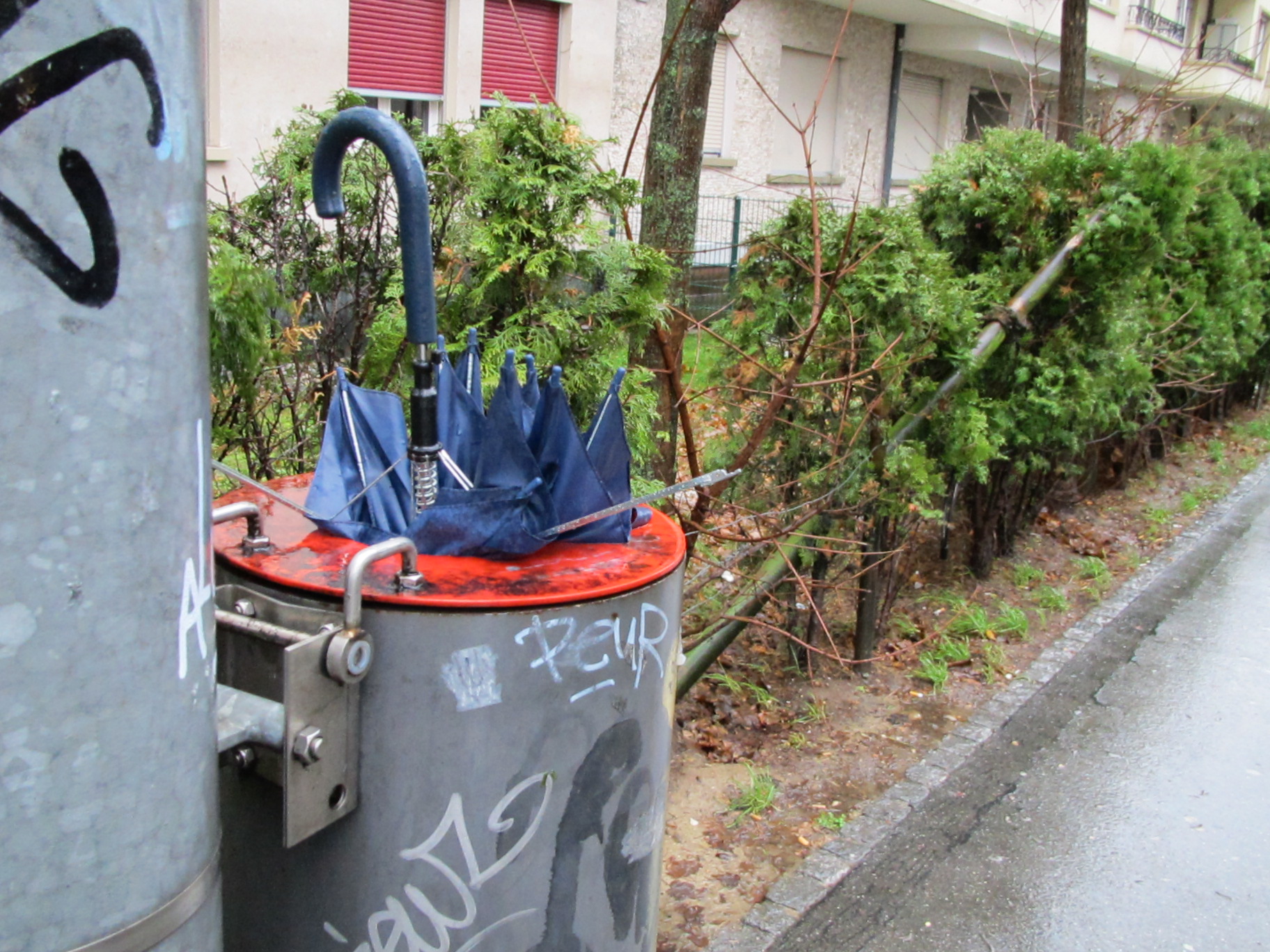
103 Days – Not meeting Coetzee.

I stood up author J.M. Coetzee and now he is ticked. Photo from Reuters. Reuters editors, don't worry, I am not making money off this photo, but if you want to bill me or send me threatening lawyer note, please write through this blog-site's contact form.

There are some things I thought I would do while in Europe (go to cool writing workshops) and some things I knew I would not (high-altitude skiing). It turns out my Do list is sliding over on to my Don’t list.

This epiphany has come to me twice, most recently this morning when another Zürich Writers group email popped up in my in-box informing me of a writing workshop in Amsterdam to which it is almost certain I will not go, and a few months earlier when I decided against a 90-minute-train-ride to meet J.M. Coetzee.

That last line would make some of my former editorial colleagues gasp and burn my form in effigy. Passing up a chance to have coffee with Coetzee is about as heretical an act as a professional writer can go, but I have my reasons. Coetzee was drifting through Switzerland at the same time I was in the final throes of writing my novel so the balance scales were Coetzee versus Completion.

In making my choice, I let former university creative writing instructor and author Peter Such be my guide. In class he surveyed we eager, insecure budding authors and said, “What are you doing here?” What followed was a brief lecture on how writers write and doing anything else is a supreme waste of time, including taking his class. You have to love Peter, a fascinating, generous kind of mentor who was raised in one of England’s post-WWII massive orphanages.

I was in the writing homestretch, and if you will forgive my race analogy, there is no moment of more intense focused energy in a race than in the final 100 metres. I worked seven days a week, five-to-10-hours a day at that point and breaking off to see Coetzee would have thrown me clear off the tracks. No good.

So, I did not meet Coetzee, but I did finish my novel. Peter would be proud.

In the meantime, there’s this Amsterdam workshop email for me to consider.

The countdown continuation …

On March 23, this blog celebrates its first birthday. Since then:

250 posts have been tapped out, of which 221 made it to publication.

350 comments were submitted of which 345 were approved. That puzzles me – what were the five unapproved comments that I deigned not fit for readers’ eyes? I will do a search on those later.

1,203 spam comments were filtered out, thank you to WordPress’s gatekeepers

815 tags were attached to the posts, proving that I am a lazy blog-tagger.

10,972 people have visited HoboNotes

67 nations visited (it’s getting crowded in here)

10 Top Countries to visit are:

  1. United States
  2. Canada
  3. Switzerland
  4. Mexico
  5. United Kingdom
  6. Australia
  7. Indonesia
  8. Morocco
  9. Italy
  10. Slovakia

10 most infrequent country visitors are:

  1. Ireland
  2. Hong Kong
  3. Moldova
  4. Sri Lanka
  5. Syrian Arab Republic
  6. Viet Nam
  7. Libyan Arab Jamahiriya
  8. United Arab Emirates
  9. Lithuania
  10. Georgia

The most popular post of all time is (drum roll please)(click on titles to read): Paris food – Can you eat lamb’s kidney without having to sell one of your own? At 405 hits, it outpaces the second most popular post by a whopping 145 hits. The second was Switzerland’s “Toronto” (260 hits).

This surprises me, but if I learned anything in my tenure as a reporter, it is that boredom has no correlative factors between the writer and the reader. I once wrote a story on the social ramifications of high winds sweeping through our neighborhood on the day we put out our recycling bins. I didn’t think anyone would read it, but it turns out that having one’s neighbor’s personal mail getting snagged in the shrubs is a topic of endless fascination to Canadians.

But I drift from my numbers game here.

The least read post was Swiss air quality not as pure as the government says, which garnered only two hits. I guess only two other people are as repulsed by the copious cloud cover of cigarette smoke on Switzerland’s streets as I am.

104 is the number that most fascinates me today. It is the number of days we have left here in Switzerland, and in the spirit of writing anything that comes my way, no matter how boring, I am going to post something every one of those 104 days, even if it is just a photograph. It is not that great an accomplishment – I wrote almost daily for most of our time here up to January 2012 even while writing a novel.

This will be of interest only to writers, but whipping out pages of fiction did nothing to slow down my blog-posting, however, the minute I turned to editing and then agent-searching, finding something to blog about became more challenging, likely because those are very inward mental tasks focused entirely on the novel and how to present it, whereas fiction-writing is at once all about memory, interpretation and observation – very outward-looking brain functions.

And so 104 days, here we come. Or as they say in Japan where my readership numbers are weak:  104日は、ここでは来る

Travels with kids

Many years ago I was at a journalism conference where a much-decorated former staff reporter at a large Canadian newspaper, I think her name was Anne Mullens, said that she had quit the high-pressure newsroom life for one as a freelancer, whereupon she discovered a  thriving market existed for travel-with-children articles.

I am not surprised. Traveling with kids is not for the weak-of-heart or head, takes planning, patience and more pounds of luggage than a childless person could ever imagine.

Mullens came to mind yesterday as we took a relatively easy train-touring day with our friends and their two daughters, the elder an alert four-year-old, and the younger a seven-month-old stroller-bound darling. It was a reawakening to the all-consuming life we once led as parents where the search for washrooms, decent diaper-changing locales and a ready supply of snack foods and entertainment were essential components to the travel plan.

Compared to every other trip we’ve taken this past year, yesterday’s day-trip through Switzerland’s Golden Pass was a tour-de-force. I grew up the older child in a large family and a larger extended family of cousins, spent countless hours volunteering at schools, plus raised two boys who both survived past the statistically dangerous age bracket 17-25, and so while I am not a childcare expert by any stretch of the imagination, I know a thing or two about children, namely: Thing One: They cannot be trusted to behave in a manner consistent with self-preservation. Thing Two: Thing One to the power of ten.

Gstaad, the uber-rich Swiss ski town of $80 Kleenex box cloth covers, $115 coat hangers and $192 polyester scarves where confessed pedophile Roman Polanski was finally arrested in 2009, much to the disappointment of everyone who forgets exactly what he did.

And so I spent most of my day tethered to the four-year-old because if a child wandering away is a nightmare,  even worse is a scenario where a child wanders away in a foreign country where 911 is not keyed into the nation’s telecommunications infrastructure (every zone and emergency service has a different phone code here), and where we do not know how to say in German, French or Italian “Aiiiiiiiiieeeeeeeeeee, help us find a little girl with black hair, brown eyes dressed in a pink plaid kilt and rose-coloured turtle-neck sweater!!!!”

Okay, we know how to say “aiiiiiieeeeeee,” in any language, but the rest would be very challenging to translate.

The four-year-old, understood well the importance of hanging on to her adults – if she had a blog she would probably be writing about how absent-minded old people are and need to be clutched constantly lest they drift off into a souvenir shop, but she understood more than that. In Gstaad, she spied another little girl threading solo through the crowd.

“Where are her parents!” the sage four-year-old declared, more than inquired, as she spun her head around looking for the loose child’s corresponding adults. She spied a likely couple and made a derogatory remark about their lax supervisory skills.

She’s four, but she’s already showing signs of genius.

Good things come to an end, Part Two

We are about to give up the greatest ground-transport deal going in Europe: Our beloved SwissRail half-pass cards.

These blue translucent pieces of plastic have been with us on all our travels, halving our transportation costs, thereby giving us the endless impression of getting a great deal, and so travelling even more. And more.

In fact, we have been to so many places that my achilles are in a permanent state of near-rupture and my knees are filing complaints daily – because along with train-transport comes trekking a la foot once we arrive at our destination. We love walking, but in this case, the saying “love hurts” applies.

The half-pass, available to Swiss citizens and foreigners bearing a residency card, costs 165 CHF for one year. We handed our 330 Francs over (U.S. dollar equivalent $589,000)* for two cards on April 2nd last year, and through the magic of a rigorous touring schedule, quickly recouped the cards’ cost.

Those happy days are coming to a close as our cards expire in three weeks. To quote Prince Charles: Gloooooom.

As an example of how lovely this card is, our four-hour trip through France’s countryside to Paris cost about 600 Francs for two comfy first-class seats with an elegant supper service. Without our cards, the cost would have been 1,200 Francs. The card extends to bicycle rentals as well, so when we go out for a pedal, it costs us 25 CHF for the pleasure of a day on the bike trails instead of 50 CHF each. Not bad. A quick zip to Bern costs about 30 CHF return for the two of us, instead of 60 CHF. I have not tabulated how much we have saved over the past year, but it has been considerable.

The card can be renewed, but only in 12-month or greater increments, so it is a wash as to whether we will make up our costs by the time we depart this lovely continent in a few month’s time. But if the above math creates this air of sorrow, maybe some more math is the fix. **

Our little town is only 40 km from Bern, about the same distance as Sooke is to Victoria back in Canada, which we used to drive in about 40 minutes.

Biel to Bern via train:             $20 x 2 passengers = 1 return trip @ $30

Sooke to Victoria via bus:     $5  X 2 passengers  = 1 return trip @ $10

Sooke to Victoria via bike:   $0 x (infinite number of pedaling passengers) = $0 return trip ******

Sooke to Victoria via car:      $40 for a tank of gas x (1 to 5 passengers) x (8 to 10 return trips) = Feathers! The Swiss are ripping us off!

Now I feel better.

$589,000 is a joke. All other figures in this post are real.

**All currency in Canadian dollars as it is near par with Swiss Francs at the moment.

*** CHF is Swiss Francs. How do you get a “CH” from Swiss? By calling Switzerland’s currency by one of the country’s many names, in this case, the Confederation of Helvetica. Yes, Swiss Cheese, Helvetican Cheese – go on, make your cheesy jokes. 

**** Switzerland – German: die Schweiz; French: Suisse;  Italian: Svizzera; Romansh: Svizra; in its full name the Swiss Confederation (Latin: Confoederatio Helvetica, hence its abbreviation CH). 

***** In high school history classes, our teachers often lauded Switzerland’s neutrality as though it were the only well-behaved child in a class of fractious European nations. As usual, it turns out closing the geographical gap between us and Switzerland reveals that maintaining neutrality was not a given, but a hard-earned negotiated position. Switzerland shot down both Allied and Axis fighter planes during WWII, and at one point were so sure the Germans were about to invade that they were preparing to literally head for the hills, that is, a portion of the Swiss Alps that they were more likely to be able to defend from attack. There are still people alive here who remember that. 

****** Bicycle travel drawback: It takes five hours to cover the 100 km/h trip, which is a lengthier Sooke-to-Victoria trip through Vancouver Island’s Galloping Goose trail, a trip that is so enjoyable that it is one of the first things I plan to do when I get back to Victoria.

******* I just like asterisks. 

Good things come to an end, Part One

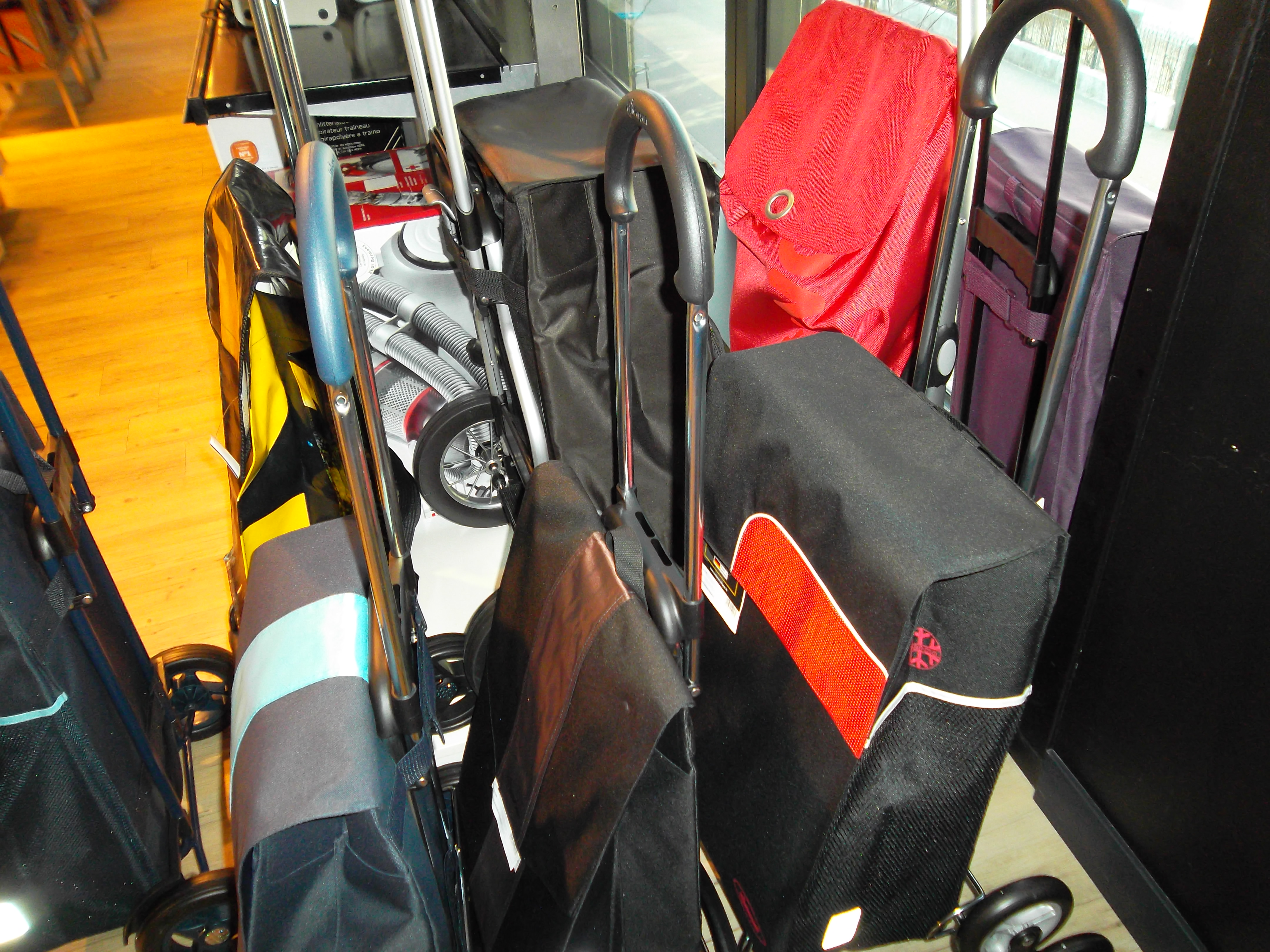
These are not the high-end shopping carts. They are the "I'm thinking of going to the over $200 cart range, but I'm not there yet" selection. Prices in this batch are in the $150 neighborhood.

We are still more than three months away from our European exit, however, the disengagement process has already begun.

Yesterday, I took one of our two grocery pull-carts out to the canal, dropped it by the shrubs and said good-bye, I won’t be needing  you any more. We have not actually needed it for about nine months, since we replaced this $20 item with a $30 cart. But I drift: My point is that this marks the inauguration of the jettisoning of ballast.

In Canada and the U.S., personal shopping carts are looked upon as a sign of age, but here they can be a sign of status. True, the under-30 set stride out from the stores still carrying their goods in arms, but somewhere around 35 they realize that an easier life free of shoulder-strain is available to them in the form of a pull-cart. That’s when it starts.

But how do the suave make room for an appendage associated with arthritis and decline? They look to status pull-carts, the ones priced over $150. The under-$30 black wire carts clash with those Louboutin pumps. They will not do.

The pricey ones come with telescoping swivel handles, sleek brushed nickel and black finishes, large swiveling shock-absorbing wheels, light high-end metal tube framing, multiple pockets and privacy-protecting tops – you get the picture. Money.

The cart speaks for its owner, saying: I may be over 35, but my cart costs more than your grocery bill for the week. That’s the statement the well-heeled are looking to make in Europe this season.

Signs are popping up that the black and nickel Mercedes look may be on the way out. Yesterday, a silk-scarfed woman in a designer asymmetrical-hemmed  trench strode down our town’s retail corridor pulling an open-top green and cream polka-dot cart, a snappy convertible in the pull-cart world. She was making a statement: Yes, I am toting a shopping cart; don’t you wish you were, too?

It wasn’t too hard to imagine her giving the Audrey Hepburn flip of her scarf and squealing those wheels.

In the meantime, my abandoned cart wasn’t lonely for too long. By this morning, it was gone, perhaps adopted by one of the town’s elderly dog-walking ladies, a group particularly fond of pull-carts. Bet she wishes I had dropped off a Prada version on the pavement.

Free Plane Ticket Home Comes with Cuffs and Diapers

It's immature of me to think this, but what the heck. If I saw these costumes coming at me from over a ridge, yes, I would be easily subdued, mostly because I'd be blinded by tears of laughter. No disrespect to the Swiss, a fierce and highly organized warrior state.

Through the magic of poor research by elementary textbook authors and a marketing/public-relations campaign that included the export of copious amounts of Swiss chocolate and cheese, the entire world skates along on the notion that the Swiss are neutral because they are just so danged nice, and they happen to inhabit an impassable mountain range that no other country really wants.

It is true the Swiss are very nice, but it is not true no one else wanted their territory. France, Germany, Austria/Hungary, everybody has tried to take a bite out of Switzerland. They probably could smell the chocolate. They were all, however, ably rebuffed by the people who were in the middle-ages renowned for being a “warrior nation.”

Not much has changed with Switzerland’s national character since then. It’s not an accident that the Pope is still guarded by the Swiss. They are a precise no-nonsense lot, and if you don’t think so, talk to Geordry

Geordry, a Cameroon refugee who overstayed his welcome, was summarily diapered, handcuffed, helmeted, and tied inside a special flight taking him home to whatever uncertain future awaited him back in the country being run by the man who was Geordry’s assassinated father’s political opponent.

Of course, you cannot talk to Geordry any more. He’s been swallowed up inside one of Cameroon’s prisons that is allegedly notorious for torture. (Note: I am awaiting a response on Geordry’s current status).*

The Swiss government does not speak specifically about Geordry, but it doesn’t deny it orchestrates forced deportations. In September 2011, Swiss Minister of Justice and Police Simonetta Sommaruga explained its deportation procedures that are alleged to have played a role in three deportee deaths to date, including one that occurred on an airport tarmac.

Sommaruga is quick to point out that Switzerland does not drug its detainees to subdue them, and it now allows impartial observers to monitor the practice. She says Switzerland gives illegal residents ample opportunity to depart voluntarily in the form of the usual administrative reminders, a free flight out of the country, and that the incarcerated deportees can leave the facility with police escort to depart the country any time they choose. The implication is that the manacled and diapered deportees are those who physically resist boarding the airplane.

Sommaruga emphasizes that the forced evictions are a last resort and the only way the country can preserve the integrity of its refugee system.

Why am I writing about this now? I just realized I’m an idiot to have paid for our return tickets out of Switzerland. They would have flown me home for nothing – although, I’d be risking the diaper-and-handcuff special. Dave thinks we shouldn’t chance it, but it would certainly liven up this blog.

Learn more about Switzerland’s deportation facilities and procedures here. 

An unconfirmed annual estimate on the cost of deportation is at almost 2-million Swiss Francs. Detainees can be held on administrative detention for 18 months without a hearing.  Switzerland’s deportee legislation won widespread support in a 1994 referendum.


Loveless Lausanne

Sculpture on the waterfront at Lausanne's Olympic Museum.

By all counts, we should have fallen in love with Lausanne, but it did not happen.

Lausanne, parked on the north shore of Lake Geneva is part of Switzerland’s “Swiss Riviera.”  What does it have?

Okay, Lausanne's waterfront is not without merit. It has many charming wharfs.

Old town? Check.

Castle? Check.

Thousand-year-old cathedral? Check.

Lakeshore walkway complete with bobbling marinas, beaches, views facing south to the French Alps?

Check. Check. Check. Check.

And yet, something was missing. We mused that we had reached that saturation point again where the sight of one more soaring buttress produces only a yawn and the notion of climbing castle steps makes us check our watches and review the outbound train schedule. It doesn’t seem possible but it happened even during our time in Spain, which possibly is home to the most amazing architecture and somewhat intact bi-millenial Roman structures on the continent. As Dave says, it’s a sign that it is time to go home. But we are still four months away from that.

And so, for those of you who have stumbled on this blog through a Google search on Lausanne, here is a word to the wise: Skip it.

This is the more walkable portion of the Lausanne lakefront promenade. It got narrower than this and was surfaced partially in uneven flagstones, making the 4-8-foot possible drop onto the rocks below all the more exciting.

The lake-shore walks along Montreux are wider and prettier. The medieval old-towns in Neuchatel, Bern and Zürich are more intriguing. The castle Chillon, near Montreux is the one to see. For inspiring cathedrals and churches, head to Solothurn. For bridges, cafes and more entrancing waterfronts, see Lucerne and Thun.

If you cannot stop yourself from going, the waterfront settlement Ouchy, which is actually Lausanne’s original townsite that was moved uphill to a more defensible position, is okay, although be wary of your footwear. The concrete walkway is surprisingly narrow and lacking in guard rails.

Lausanne is also home to the Olympic Museum, which was closed for renovations when we were there. The gardens are still open, where visitors can check out outdoor statues that confirm that the quality of public art definitely took a dip in the 1970s and 1980s.

Switzerland is regarded as a relatively safe place to travel, but as always, the rule for tourists is do not hang around train stations and do not give money to  panhandlers who may be part of a troop watching to see where you keep your wallet. Lausanne was one of the few places we’ve travelled in this lovely country where we had the sense we were being pegged by pickpockets. It has a more active street population than other towns, which takes away from some of its beauty.

Some loitering Lausannites gave us the creeps.


A Countdown Queen + Her Calendars

Blame Christmas. I am a Countdown Queen.

Growing up, we didn’t have much money, which meant we didn’t have many toys, at least not compared to the other kids on the street, but what my brothers and I lacked in material possessions, we made up for with a hyperactive state of anticipation ratcheted up by our countdown vigilance toward Christmas day – our once-a-year toy haul. This may have been responsible for my mother hanging the phone receiver upside down for months at a time. No one knows for sure why she did this, but I think she was experimenting with it before twisting it around our necks.

As soon as Christmas rolled over we sprinted the countdown to New Years dinner at Grandma’s house, an unembarrassed snatch for hot homemade apple pies and tourtieres.

Then the marathon countdown to Easter was on, when we counted 100 days and more to the morning we would each get one chocolate rabbit. One. That was okay, because as soon as Easter was finished, the count was on to summer holidays. Lent? We didn’t need Lent. Deprivation was our natural state.

I was a somewhat above-average distance runner in my youth and here too, counting was the thing. Bouncing on my toes at the start line, I counted the racers who historically had been faster than me, counted those slower, counted down to the starting gun shot, counted the number of runners ahead of me, the number I passed, the number who passed me, the number of meters/yards we had raced, the number yet to come, and the magical final 300 metres/yards, my favorite part of the race when I passed as many on the track as I could (I have no ‘sprint’ in me so I had to drive hard over a longer distance at the end to come in the top three). Naturally, I counted down as I went. Racing was simply a living mathematical equation. It was lovely.

Catch me at any moment and I am counting down to something. I counted down the days to get to Switzerland, and as soon as I arrived, I started counting down the days to my return to Canada. This is only a microcosm of an entire life dedicated to countdowns.

Oprah counselled people to “live in the moment,” but what is the point of that? It can only be lived in once, and then it is done, but the moments ahead that can be looked forward to for ages, those moments are the ones stretched out. Why deprive myself of this joy?

And now, I’m at it again, counting down the days to our return to Canada, the land that I love, where I have half a clue what is being said to me, where I can afford to buy whole straps of beef tenderloin, where there is the best ice cream on earth, endless prairies, boundless skies, unfettered rivers and creeks, untamed ocean shorelines, lakes barely touched, and people who say sorry when they accidentally bump into you. I might just count them all.

This is not to say there is anything wrong with Switzerland, despite the fact it is a tad overpriced. It is a lovely country with wonderful, kind people, eye-busting vistas, and possibly the most punctual train service in the world, best expressed by the horror the Swiss display when a train is two minutes late. Two minutes. Maybe that’s why I like these people so much. They like to count, too.

Culture Chasms in the Change Room

Swiss fitting room - this convenient viewing deck faces onto a bank of mirrors, adding to the viewing pleasure (or horror) of people standing outside.

Just when I think Switzerland has nothing left to surprise me with, someone tries to break into my fitting room.

The store clerk did rap on the change room door first, then quickly rattled the door lever a la Jurassic-Park-velociraptor style, then shoved her hand through the makeshift drape of t-shirts I had over the rectangular hole in the door that the store architect designed to make women nervous. This is in the same tradition that pre-2010 McDonalds architects designed uncomfortable seating to make people hurry out of the restaurant. Somewhere, there is a Cruel School of Architecture, I am sure of it.

The t-shirts hanging from the door still belonged to the store, although I was considering adopting them, but first they were serving as a makeshift curtain because I have a thing about disrobing in front of an audience.

The clerk prattled in Italian while peering inside the coffin-sized fitting room, then tried German.  I opened the door to see she was one of those model-lish retail clerks who could walk down the aisles in her underwear. It would not bother her a bit for with her cinched waist, it would be a catwalk audition, and so she might not understand that women who long ago lost “definition” in their armpits are a little more shy about fitting-room break-ins. She tested out a few other languages on me before explaining in English that

  • The viewing panel into the mirrored change room must always be kept open because
  • the sales staff protected the store from theft
  • by watching the customers inside the “cabines.”

And there you have it. One more reason why Canada looks better every week.

Bratislava bathroom: What the heck is that?

Watching customers undress is the sort of the thing that makes headlines in North America where despite the public’s horror at such a thing, fitting room surveillance is not necessarily illegal. A recreation centre in Calgary has surveillance cameras in their mens and boys change rooms, a fact that they unblushingly defended when a patron went to the media about it.

Retail theft is rampant, so store owners say they are just protecting their business, but it is still discomfiting to think of the minimum-wage  perv leering just outside the fitting room possibly with the iPhone camera at the ready to entertain his or her friends with later.

I put the tops back on the rack and left. Good-bye H & M clothing store. I am sorry to leave behind your lovely fashions and sweet sales, but there are some things I’d just as soon not share with you.

Note: Yes, I have complained about European changeroom culture before.

Second Note: I am positive I saw a video camera in a Bratislava restaurant’s bathroom. Ugh.

Okay, maybe this isn't a camera, but it sure looks like it could be one. Commencing bladder-freeze sequence.

Maid in Switzerland, or Jennifer Lopez makes it look all sparkly, but really it is not. And, our weird worries about maid-theft.

I sit here wrapped in a silk leopard print wrap, a stained white tank top, over-sized fleece shorts, a black guard on my overworked right wrist, and floor debris on the bottoms of my bare feet. My hair, strapped into a ponytail last night, has evolved into a tropical island assemblage complete with the dreaded ‘palm tree’ up top.

This is normally a private moment in my day when I take in my required caffeine dose (a quart before 10 a.m.) and align my cranial synapses, however, five minutes ago a woman tapped on my door. I am not normally in the habit of opening my door this early in the morning, but it is a hotel and I’ve heard the cleaning staff puttering down the hallway for the last 30 minutes. I was pretty sure if it was some freakoid, the maids would make short work of him.

It was not a freak at all, but a maid, speaking Spanish and French, which is a lot better than a maid speaking German and Italian. This way I have a 20 per cent chance of communicating, as opposed to the .03% chance with the latter. Armed with towels, she said something about the bathroom.

Housekeeping and maintenance is constant in the hotel – they change vent filters, tinker with the plumbing, install new smoke detectors,  upgrade the phones, and so forth. They’re busy people, and so I loathe to send them away. I let the woman in thinking she was going to replace the towels in the bathroom.

I was wrong about that. As I sit here like the Queen of Sheba, she is engaged in all-out housecleaning, scouring the bathrooms, doing the floors, the sheets and so forth.

I don’t speak enough French/German/Spanish/Italian to tell her we get maid service once a week on Saturdays, not daily, and to send her away might distress her, so I tidied up the kitchen in an effort to stay out of her way while giving the appearance that I am a contributing member of society. Now I am out of things to do, so I just sit here and tap away on my keyboard.

I am always a little uncomfortable with maid service. It is because I expect them to be something like the first maid all of us know: Our mothers. Maybe I am waiting for the scolding about leaving the sink full of soapy water soaking socks or failing to pick up after myself.

We have employed maids twice in our lives. In Spain, we hired a Filipino maid who spoke not a word of English, except to state her hourly rate, which was quite steep. We had a yellow labrador at the time who shed buckets in the Madrid heat (no air conditioning) and I could not keep pace, so we tried out the hired help route. It turned out that maid was worth every penny. I have never seen, or even aspired to the standards that she set.

Google the word "maids" and up will come a lot of images of sexy short-skirted women, but the truth is most maids look like this. We have a friend who for a time worked full-time as a maid, and she had muscle definition that would make Jillian Michaels' jaw drop. It's physical work.

She also gave me the weirdest and most delightful moment I have ever had in my housekeeping career – when she came in the house, I only had to point at something and she would set on it like a doberman on a rabbit. I had spent more than 18 years trying to get my own children to do house chores on command, so it was a singular experience to assign a task without having to apply a tremendous amount of argumentation, pressure and browbeating. I don’t even remember that woman’s name, but I adored her and recommended her widely to all.

We hired our second maid in Victoria when the boys were in university and Dave and I  both worked full-time at demanding careers. She had a house key and came during the day when we were away. That felt odd to us, but it was that or perish in a bacterial stew of our own making.

Then one of our sons came home early to find the maid’s five-year-old daughter and teenaged son hanging around while she worked. That did not feel good to me, although I could certainly understand the pressures a working mother feels. I wished she had asked me first. The five-year-old made me nervous because I have never trusted a child to not swallow bleach, or pull things down from the counter onto their heads with dreaded effect. Having heard emergency doctors exclaim, “Hi Jo, what’s he done now?” more than once, my apprehensions are valid. My house at the time was not childproof.

Jennifer Lopez, all starched and pretty, but if she saw what our hotel maids saw this morning, namely me in my sleepwear, she would have looked for other work.

The teenager made me nervous because who isn’t nervous around teenagers? What is to say he wouldn’t scope out the place and then return some night with his friends and a pick-up truck. I’m not saying all teenagers would do this, but I would like to have eyeballed the kid first to make my own appraisal.

We tolerated this for a while, but then some DVDs went missing. Too mortified to make accusations, we discharged the maid on the grounds that we just felt weird having a maid. She was very gracious and went on her way. She was a fabulous maid. We had two labrador retrievers at the time, so our house’s shed-fur content had reached factory-rated levels.

We fumed about the suspected theft, until some weeks later we found all the missing DVDs in a laptop bag. Our guess is that the five-year-old fiddled about while her mother worked, and just put them there, probably to be helpful. We were very glad we had kept our suspicions to ourselves.

The hotel maid is now done. Someone will probably tell her she did the room for nothing. I haven’t seen her before, so she must be new. I know all the maids here – they school me in French and Italian every time they catch me in the hall. It is a lot like having a dozen mothers, waiting to correct me, improve me and appraise me every time I leave my room. They are adorable, and they work hard. We should respect them, just like we should respect our mothers.

Post-note: The Head Housekeeper is now in my room. She has discovered the new maid’s mistake and is rattling on in French that curiously I understand. My mother is French. I’ve heard this tone many times before. She is put out that the new maid goofed. The Head Housekeeper, Isabella, runs this hotel with an efficiency that NASA administrators could appreciate.  Amid profuse apologies over the mistake, she has explained that the room will not be cleaned tomorrow.  Just as when my brothers were in trouble with my Mom, I am glad that I am not the one under fire.

Can we get out of here?

Thank you Wikipedia for this photo. This is an F-15 Eagle. This is not the bird anyone wants to see soaring overhead.

Our trip to the “police’s stranger population” office as it is word-for-word translated, passed without incident, except for the part where they took our residency cards away.

I am not normally alarmed by this, except that the last time I took a flight out of Switzerland, the border control officer scowled at me until I produced that same card. I understand Switzerland’s insistence on seeing my residency card on the way in, but why on the way out? Can I leave here without that cute little pink-and-powder-blue plastic-coated card?

I am genetically tuned to flight. While one side of my family engaged in a slow migration across Canada, taking over 400 years to get from the St. Lawrence Seaway to the prairies, the other side wears the motto, “Let’s get the heck out of here now!” or as my father once described it “Run!” He was a man of few words, but that was because he was saving his breath for the big sprint out of Eastern Europe.

But I digress a little. Exit visas are a little-known dirty secret of some countries. I do not believe this will really be a problem in Switzerland, although if it is I will happily skip across the border into France, even if I have to walk the Jura Mountains to do it.

We hope these guys aren't waiting for us.

A friend of ours discovered the importance of exit visas when he and his young family landed in one of those little-known Middle-Eastern nations that form a mere fingernail on the map. Unfortunately, in his wake came the U.S. Army and they were ticked.

Now that I think about it, I can’t remember if he and his wife had children yet. No matter.

So while Saddam was getting kicked around the block by his mom for inciting the infamous “mother of all battles,” (at least, I hope she was kicking him around), our friend, let’s call him Sam, decided there really was no place like home, especially as home did not have any  Combat F-15 Eagles soaring overhead.

That’s when Sam found out he had an entry  visa, but not an exit  visa. Even though both begin with the letter “e,” they are very different, especially in the minds of border agents.

How long would it take to get an exit visa? Well, all the bureaucrats were busy hiding under desks, so visa processing was somewhat slowed down.

Sam, who happens to be a published author, does not realize this is his best story ever, mostly because he is emotionally incapacitated while retelling it. How he escaped remains sketchy, although he does recall an embassy official chiding him for not bringing two passports with him so that he could use the one without an entry visa stamp to flee the country.

We do not see much of Sam any more. Our lives have gently diverted away from each other, but I still count him among my friends, because it is very cool to know someone who has once sincerely uttered these words: “I want the next flight out of here. I don’t care where it’s going.” *

Which leads us to the important question: How do we get two Canadian passports, and is it too late to ask?

On the other hand, if we are stuck in Switzerland, which I’m sure we’re not, at least we will have plenty of chocolate to calm our nerves.

*He ended up in Greece, which at the time of the Kuwait invasion was okay, but today would not be so much fun, so I hope we don’t run into similar problems.


Eeny, meeny, miny moe

Mitt Romney, going for the gusto.

A special beauty is attached to living overseas, and that beauty is the avoidance of regularly repeating national outrages, namely elections and occasionally referendums.

We were happy to abscond to the Deep South during Quebec’s separation referendum from the mother ship Canada. It was a riveting time, covered in-depth in the Atlanta Journal Constitution in a three-line story buried deep in the world news section. That was exactly enough coverage to suit us.

Harper knocks the Liberals right off their high chair.

America was not fussed about any Canadian fissures, partly because they were obsessed with Cochrane, Kardashian and Simpson, and I don’t mean the musician, the gown-sheathed Kardashian descendants or the hapless but lovable cartoon Simpsons.

Romney likes to point.

Being down south, where there was some secessionist flavor in the earlier century, led our American friends to puzzle over our nation’s leaders’ lax attitude toward the separatists. Why does Canada put up with it? they wondered.

Here is why: It is endlessly amusing, especially when the northern natives volunteered to lop off the top two-thirds of Quebec in their own separating-from-the-separatists bid. Quebec roared, but the rest of Canada sat back smugly, trying not to say, “So, how do you like it?”

And now that the U.S. is deep in primary season, the usual grumblings are burbling about leaving the country should (insert political candidate name here) get (re)elected.  I can assure them that it is fun to leave the country in a snit, but the problem is who will take them.

I did not know my own country's official opposition leader until I looked it up just now. Ignorance is bliss. This is not to diss the NDP. This woman, whoever she is, looks like a very nice person.

This is why it is good to not be around during election/primary season. TMZ posted this 'topless' photo of Newt Gingrich asserting it was reason enough to not vote for him. It is reason enough to not pay attention to TMZ, and its adolescent (albeit lucrative) version of election coverage. It is not the politicians that annoy us. It is the media. Okay - some politicians do annoy us, but not as much as TMZ and Sean Penn.

It surprises some people to learn this, but showing up at another country with the intention to stay past their regular tourist-trap allowance can attract the attention of bureaucrats, the world’s version of bullies-with-briefcases.

This comes up now, because tomorrow Dave and I head down to renew our visas, and if there should be any hiccup, we could end up with an escort to the airport, which would be kind of nice as I’m sure the helpful Swiss officers would lend a hand with the luggage.

That is okay with us. We have already missed Canada’s federal election and as far as I can tell, there won’t be another for four years.

*Note: I do not own the rights on any of these photos. Relax vigilant editors, I am not making any money off of them.

Not THIS Kardashian.

THIS Kardashian.

The Book is Our Friend

No one is lonely as long as books are around.

We are heading into a conundrum. During our time here, we have amassed a small library, one that I assumed would be absorbed into our hotel’s library upon our departure. I may have been wrong about that.

Dave has declared his intention to lug T.C. Boyle, J.D. Salinger, Jennifer Egan, Alice Munro and the rest of the gang to Canada when our time here is done.

That will be some fun, because our Swiss library is gaining weight at a pace that frightens even me. A forest of book stacks is growing on a corner chair as I write this, and paperbacks are forming a mossy sheath over our desk space. Were we to extend our stay here another year, there is no telling if the hotel cleaning staff would be able to find us amid our fecund library.

And yet, we cannot stop our cheesecake-for-the-brain indulgences.  The Swiss ‘buch haus’ community draws us in with not only their English shelves, but also the German and French.

Through some mystery of distribution rights that elude us, German titles of English books appear to predate releases of those same books in North America. By recent example, consider Steven Job’s death, which sent booksellers sprinting to deliver his biography to store shelves. I can report that the same biography was in our little Swiss town’s bookstores – in German – well before the Canadian and U.S. press issued their reviews of same.

And yet, it takes months for Europe to catch up to North American film releases. I cannot explain it except that it suggests Europeans are still avid readers.

But I drift from my point, which is that books are our friends, and come the end of our term here, we’re going to bring as many of them home as we can. “Leave no bound pages behind” will be our motto. I just hope it doesn’t cost more to ship the books than it would to buy replacements for them once back in Canada.

Where our European-bought books will be if Dave has his way.

Paris food – can you eat lamb’s kidney without having to sell your own?

Sweet treats and good rib-sticking eats all in one shopping spot at French bakeries and patisseries.

This post dating back to the Easter weekend 2011 repeatedly floats to the top of this blog’s hits (scroll down).

Staring at the text in the file listings, it made no sense to me, but now that I’ve opened the post and seen that it comes with a photo of a lovely pastry display case on top, the world has once again fallen into its correct order.

In the meantime, our little plateau in Switzerland is experiencing the spring-like joys of the Canadian prairies, that is to say the sidewalks are ankle-deep in grey ice and slush.

Yesterday, I met another writer for the literary version of a jam session, and uncharacteristically, the Swiss railway system failed, so she had to complete the last part of her journey by bus. That was okay, until she landed in our little slush-ville.

As it happens, both she and I are from Winnipeg, although we met here, not there.

This is another oddity of Winnipeggers – they/we are everywhere, and strangely, we all recognize one another. I think it’s because we smile so much.

Why do we smile? Because we’re not in Winnipeg, the hometown everyone loves to hate but will die defending.

And so, the two of us pretended the weather was just fine, even though we both had slipped into some decline by the time we connected at the train station with our moppy hair and weather-mashed countenances.

We entered into the Women of Winnipeg pact, which is that it was a ‘given’ that we both had started our day with fabulous hair and in the most beautiful of states, regardless of all the evidence to the contrary. She shared that while waiting for the bus she had met another Winnipegger. Neither of us is surprised by this.

Then we marched through the slushy streets, pushing against the wind and pelting snow, feeling the slush ride up our pant legs and ooze ice particles into our shoes. Actually, I’m speaking for myself here, but I have to assume she was experiencing similar discomfort, but, of course she did not complain because she is from … Winnipeg, and by all bio-bred Winnipeg-weather standards, this was still a fine day weather-wise, although a little too warm for cross-country skiing. Pity. If only the temperature had dropped another eight degrees, it would have been a perfect day.

By the time we arrived at Starbucks, my jeans were soaked up to my knees and I couldn’t feel my ankles.  We were both in high spirits, and not just because of our proximity to caffeinated products and cheesecake, but because there’s nothing like an ice-dousing to make a prairie gal feel alive, or at least so numb that the absence of pain makes us feel alive.

It took me about six  hours to bring my core body temperature back up to normal. I should point out that in Winnipeg, it would have taken me six days.

But enough of that. Here is one of Hobonotes’ top five postings – actually, it is usually in third spot, but I just can’t believe it.

Dining in Paris: Can you eat lamb’s kidney without having to sell your own?

The first question is why would you want to eat a lamb’s kidney anyway? Gross.  That aside, French food enjoys a reputation that tops all others, but do they deserve it?

It’s easy to trot into France’s finest restaurants and emerge satisfied that the nation’s cuisine is all that is claimed. But what about those of us who blanche at $75 lunches? What is French food like for the mid-to-low range diner? Does Paris even have a mid-to-low-range dining echelon?

We-the-cheap conducted an in-depth 48-hour study on this topic. Here is what we found.

Patisseries/boulangeries, that is, combination pastry and bakery shops, are great sources for not-so-expensive, but still delicious, day-time meals, and these shops are everywhere.

Aux Armes de Niel, the  boulangerie (photo above)  at the corner down from our hotel sold soup-bowl-sized take-out quiches and other sustaining  foods (mini-pizzas, although I don’t know if they called them that) for under $10 each.  The alternative was our hotel breakfast at 20 Euros, that is,  over $30 Cdn. each. No thanks.

400-year-old French cafe. No one was there. We're not saying this suggests that its age corresponded to the length of time customers waited for a meal, but you have to wonder.

It also sold fabulous overfilled cream pastries, if such can be said to be truly over-filled. After all, this is whipped cream. There’s never too much of it, so the French seem to think and, after sampling the goods, we agree.  The pastries themselves were heavenly- flakey, light, everything Pilsbury dough-boy claims, but is not. French pastry is a perfect jacket for French fillings and toppings.

If you’re deciding between French ice cream and French pastries as your guilt-food for the day, pick the pastries. The ice cream is good, but ice cream tops out at a certain point anywhere in the globe and I can prove it by producing homemade ice cream at my Ontario cottage that could stand up alongside the French’s. Note to cottage guests: But I won’t do that, because summer is the time to laze on the dock – not a good place for churning ice cream.  Note to those searching for the greatest scoop of ice cream: Head to Atlanta, Georgia. Break into any home-kitchen and demand the contents of their churn. Seriously. You will not be disappointed.

San Remo Pizzeria in Paris; artichoke, olive and pepper pizzaBut I digress.

We scoured the streets for under-$30/person fare and found a few places, such as the San Remo’s Pizzeria near the Place de Marechal Juin roundabout and Pereire metro station.  There, I had a delicious vegetarian pizza with artichokes that did not appear to have ever graced the insides of a jar.

Dave had the grilled salmon and spaghetti alla chitarra, a substantial thick spaghetti noodle cooked to just the right degree of resistance and subtly seasoned.

With a glass of the house wine and a beer, the total came to $36.90. Shocking, all the more so for having been so delicious.  The atmosphere on this Paris sidewalk cafe was great, too. The staff (probably Italians) were nowhere near as snooty as French servers’ reputation suggests.


Change room etiquette

This Frenchman, coming to a fitting room near you.

I heard the low rumble of the Frenchman’s voice seconds after I peeled off my shirt.

What the heck? I was in a woman’s fitting room. What was a man doing on the other side of the curtain?

The change room was the same size as an airplane washroom, putting me in very close proximity to this stranger, while also reaffirming that males still dominate the world of retail architecture.

I snapped my shirt back on and left, getting a friendly smile from the Frenchman on my way out.

In North America, a few women drag their guys into fitting rooms. What is wrong with these women? Can they not make a simple clothing purchase without a man in tow?

Maybe their guys are accessories and the women want to see if they color-coordinate properly before making a commitment to either the outfit or the man? I don’t know, but I do know the practice is more popular here in Switzerland.

I’m still learning the local standards of fitting room etiquette, which so far has appeared in a sideshow-like manner, with the women being the show and the guys cheering from the side.

Yesterday, a 60-ish woman in her underwear flitted in and out of her fitting room into the adjacent hallway, chatting with her husband. She had not yet tried on any new clothes. Puzzling.

The hallway ended before her fitting room and angled onto a window over a street, giving everyone in the store and on the sidewalk a fine view, so to speak, but no crowds massed.  As I said, she was over 60.

Some extol the relaxed attitude other cultures have toward women in various stages of undress, as though this is evidence that these cultures do not over-sexualize the female form.

Those people should have been in a clothing store one block over two weeks ago when a new shipment of swimwear came in. Wide-eyed men with tongues hanging out exchanged approving glances as women trekked into the fitting rooms with bikinis tucked under their arms. These particular change rooms have doors, but the doors happen to have windows that are set at such an angle that presents a wealth of ogling opportunity for any guy standing over five-feet six-inches tall.

Swiss fitting room - this convenient viewing deck faces onto a bank of mirrors, adding to the viewing pleasure (or horror) of people standing outside.

I settled in to watch the guys watching the girls. It was fascinating, like watching sharks circle. A few men were allowed into this inner sanctum with their girlfriends, grinning all the way.

Then, as another slender attractive young woman walked into the fitting room area with her man at heel, another man slipped into their jet-stream. Seconds later, there was a commotion and the second male scooted out of the area, red-faced, wide-eyed and very happy. The other oglers restrained themselves from high-fiving the offending interloper.

In other more innocent revelations in the next shop over, a four-year-old girl made her way down a bank of fitting rooms, ripping aside curtains as she went, announcing, “Hello, I’m Lily!” exposing a half-dozen clients, all while her mother cooed over her daughter’s adorability.  No one seemed terribly upset.

I don’t get it.

Postscript: Since writing the above, I visited a few women’s clothing stores in France where I discovered the number of men in the fitting rooms was equal to the number of women. One young woman left the curtain pulled aside so her young man, seated across the hall, could offer his opinions and record her dressing and disrobing on his iPhone. Their matter-of-factness, along with the lack of attention this drew from the other shoppers and their male companions suggests this is business-as-usual.

Postscript the second: This post is being re-published. It is one of my most often-hit posts. I would like to think it is because my writing is clever, but more likely it is because it includes women in various stages of undress.

Switzerland’s see-through public washroom + toilet tips for travelers

Lausanne see-through washroom - at least it appears clean, probably because no one will use it.

If there’s one thing I learned in my ten years as journalist, it is that there’s no telling which stories will capture the reading public’s interest.

That has been true in this blog. The posts that I found somewhat ordinary have turned out to garner the largest number of hits. As unexpected, see-through washrooms, changeroom etiquette and French cuisine topped the lists.

Here’s the glass-walled public washroom post. It is not, by the way, the only somewhat exposing washroom archetype in Europe. We’ve seen a few that have led to bladder-freeze. But enough about that.

________________

Switzerland’s See-Through Loos


I’m sure the Swiss have a perfectly good explanation for installing a see-through public washroom in Lausanne, but I cannot imagine what it is.

Don’t believe me? See the 17-second video here. 

I haven’t actually seen it in person, and if I do find it on one of our weekend jaunts,  it’s a good bet that I will not use it, because even though the crystal-glass walls can be made opaque with the touch of a button that allegedly sends an electric current through it, I don’t want to be in there should the city’s power grid fail at the wrong moment.

I don’t want to be walking by it either when someone else is using it, because apparently the opaque-function is optional. It seems like a voyeur’s dream, a voyager’s nightmare. Ugh.

A similar transparency idea was floated in the internationally acclaimed Basel Art Fair in 2004, when a one-way-glass public bathroom was installed outside of the gallery so that people could use the washroom without “missing a thing,” on the street said the Basel Art people, who we now suspect of living a seamy underworld life after-hours.  I can’t prove anything – I’m just saying. And what is going on in the streets of Basel that one can’t his eyes off the street for even a minute?

City of Victoria, British Columbia public urinal

The Swiss are not the first to come up with the idea that they are missing some great show when they are ensconced in the private walls of the lavatory. The City of Victoria in B.C. installed a door-less urinal to offer a less offensive option to its public-urinating night-time bar populace.

The idea here, one can suppose, is that this washroom is not likely to become a shooting-up zone for the city’s drug population, and users (bathroom-users, not drug-users) can keep a watchful eye for any would-be approaching muggers.

Cottagers have long had an affection for outhouses with a view – a troll through cottage-country will reveal a few outhouses with half “Dutch” doors or generous screen cut-outs.

I also own a cottage, but I enjoy the views when I am on the deck or looking out the living room window, boating, swimming, and so forth. I don’t see the need to expand the number of minutes-per-day I get to stare at trees, water and squirrels.

The problem with looking out is that others can look in, so I’m hoping the Lausanne see-through unit doesn’t catch on. I still dread visits to Australia where multi-stalled public washrooms are not always gender-specific – a situation that also exists in some parts of France, we recently discovered. No details will be provided here on how we found out.

Everyone needs public washrooms, but no one writes enough about them, much to the frustration of travelers trying to anticipate foreign bathroom customs.  I am about to change that, at least for those visiting Switzerland.

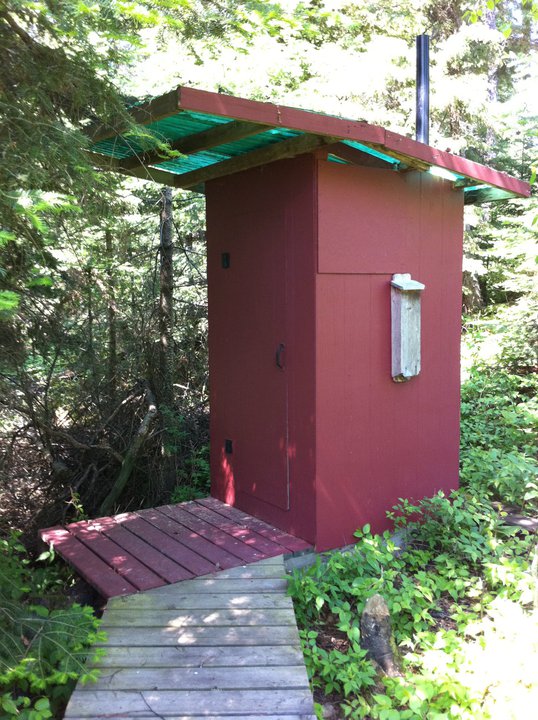
Look at that beautiful outhouse with a full-door and no windows! I'll bet it cost less than Lausanne's glass monstrosity.

Pay washrooms can be found on the streets, sometimes in shiny stainless steel stalls with a vending machine-style pay pad. Train stations frequently have them as well, and any bitterness a Canadian or American might feel about having to pony up a franc or two for a washroom quickly dissipates when inside the stall. They are kept spotless. In fact, the Bern train station has staff on hand, constantly rotating through the stalls in an never-ending sanitizing cycle.

I would not like that job, but I am happy to see someone else do it. I hope they are well-paid.

Washrooms on trains are free, but as trains are heavily used, they are not as clean as one would like, especially when trying to manage while the train rocks and sways, sometimes in unpredictable ways. I will elaborate no  further.

Tourists can get by without using a pay washroom – in fact, we’ve used them only a few times in our travels over the past few months. Many towns have free public washrooms in parks, along promenades and trails, which are kept to a high standard of cleanliness.

If these cannot be found, stop in for a break at a street cafe’ – for the price of a cup of coffee, you can use the restaurant’s washrooms, which we have also found to be unfailingly clean.

Sometimes only pay-washrooms will be located near cafeterias and malls, however, these provide a voucher for a ‘free’ coffee in the cafeteria.

Museums and art galleries generally have free washrooms.

So far, we haven’t found a pay-washroom charging over two francs, so carrying just a few one and two-franc coins should suffice.

A rumour circulates that it is forbidden to flush a toilet during certain night-time hours, out of courtesy for condo or apartment block neighbours. We haven’t heard anything about flushing restrictions yet, but have heard that running a bath late at night is frowned upon.

In the bathrooms-worth-visiting category, when at the Aescher cliff restaurant at Ebenalp, in Switzerland’s eastern Appenzell region, check out the washroom architecture. The mountainside wall of stone is exposed, allowing visitors both a view, and privacy.

Good to know if you go:

  • Carry one and two-franc coins for public washrooms.
  • To see the mountain-wall washroom, which is presumably not the only reason you would visit Switzerland, click here for hiking information about the area and mountain.

Spectacular ice show

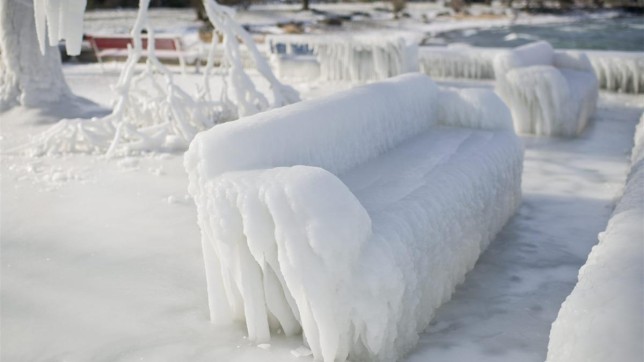
Have a seat. It's ice outside.

Switzerland’s cold snap drags on, but a “deep freeze” that hovers around -15 C does not exactly excite terror in this former Winnipegonian to whom -15 C is a perfect temperature for all-day cross-country skiing. Seriously, Europe, wake up and build a better infrastructure for winter. It does come around every year.

There is one thing, however, that is hard to beat and it is ice-cladding, which frankly, scares the daylights out of me.  Not much to do about this but break out the blowdryers and chisels. Here’s a photo from a photo-fan website. Click here to see more. 

NOTE: I’m having trouble with the ice-links, however, here’s another go at it. Hope these come through. 

Switzerland's ice storm: Showing New York that a "boot" is not the worse thing that can happen to your car.

Lake Geneva transformed into frozen landscape, literally, by blustery winds and freezing temps.

Switzerland's deep freeze.

Snow and ice and everything nice is what Canadians are made of …

A fountain's spray freeze-frames the greenery around a park pond.

Europe is in a deep freeze, with temperatures dropping to minus 18, a number that our hotel staff speak of in hushed tones, and then only with a shudder of horror. Horror indeed. The average February low is -1.3 C. What is happening now is something along the lines of an advancing ice age.

Even when it is cold, Swiss swans maintain order (it had not snowed yet when this photo was taken, but aren't the swans pretty?)

We would huddle inside our little hotel room but now is the time for action. Canada’s national security depends on it. Everyday, we bundle up and head outside for a seemingly relaxing stroll. I say “seemingly,” to conceal the serious business that is afoot: The business of perpetuating our greatest national myth – That Canada is a barely inhabitable fortress of ice.

Canadians don’t walk; we skate, ski or snowshoe. We don’t have cars; we have snowmobiles and sled-teams. We don’t have central heating: We have bonfires that we dance around to keep ourselves warm. We don’t live in buildings, we live in igloos, although thanks to one Quebec hotel, some think we live in ice palaces. That is okay. They still look really cold and uncomfortable.

It is this myth of enduring winter that keeps Canada safe from invasion and foreign aggression.

If you disagree, consider this: The only country to make a real land grab from Canada lately is Denmark, a nation that doesn’t mind a little snow now and then.

This photo doesn't really have anything to do with Europe's cold snap. We just think this is Little Red Riding Hood, and look! She's made friends with the wolf, who also sports a red collar.

Even terrorists, the most unevenly tempered lot of the global bully bunch, work primarily outside of the arctic, subarctic and boreal climate zones.

Invade Canada? Who would want to?

And so, to keep the rumours alive, everyday we put on a big show of going outside to ‘enjoy’ the cold, brisk air. We return to the hotel exclaiming about the mild weather, and regale the Swiss with stories of horseback riding at minus-20 (true), jogging at minus-25 (also true) and cross-country skiing for hours in just about any temperature.

We keep it secret that we’re out for such long stretches because our brains have been rendered senseless by frostbite such that we can’t find our way back home.

Canadian ex-pats: Keeping Canada safe from afar.

Teddy Bears: The Swiss’s Secret Weapon in the Event of a Nuclear Disaster

That teddy bear will teach that nuclear monster a thing or two.

A somewhat shaky grasp on the management of natural gas leaks isn’t all that excites us about Switzerland. There’s also the threat of a nuclear disaster.

We get a good view of a nuclear silo on the train ride between Zürich and Biel, but I talked myself into believing it’s just a grain silo, a very wide and somewhat oddly shaped one, but still one that would be good place to store wheat, or perhaps, nuclear stuff.

That little personal myth melted away this week. In the mail, among all the usual sales brochures was a German, French and Italian  square blue and white packet from our Canton police, military, population protection and sports – yes sports – branches.

This Czech Republic nuclear plant is ready for disaster - see, it's next to a chapel, cause if it blows, there will be a prayer meeting like the Czechs have never seen before.

It was the sports part that got me nervous – were they suggesting only the athletic would survive whatever warnings were coming from the police, military and sports divisions?

A quick run through Google Translate revealed that we are within 20 km of a nuclear power plant. The opening line, intended to have a calming effect, declares that nuclear technology is very safe, but the authorities want to minimize any “risk of prejudice in an accident.” What does that mean? In the event of a nuclear meltdown, a little bit of prejudice might be a good thing, seeing as prejudice means to “pre-judge,” and if pre-judgment means I’ll be stocked up on food, water and iodine pills, well, I’m all for that.

The brochure details the rules of behavior in “an increase of radioactivity.” I don’t need the Swiss to tell me that. My rule of behavior will be to run madly in circles, screaming “Oh no, oh no oh no!!!” It may be ineffective, but it’s straightforward and simple to follow.

Swiss authorities to nuclear-fall-out residents: Grab your teddy bears. This is going to get a lot worse before it gets better!

According to the pamphlet, the first thing to do is to listen to the radio and follow the authority’s instructions. The second thing to do is – and I’m not kidding about this, it is in the brochure – is to continue to listen to the radio and continue to follow the authority’s instructions. 

This suggests that the authorities don’t really have any other bright ideas to follow up their first recommendation.

There’s also advice to not let pets outside and to head for your cave or abri. I’m not sure what an abri is, but the accompanying illustration suggests it is a reinforced subterranean bunker, as depicted by a very thick black line that is about 6 times the width of the black lines depicting the house or regular basement. Obviously, it should have no ventilation, but heck, who wants to breathe when the air is full of isotopes or other deadly nano-particles.

But it will be a fun time down in the bunker as the Swiss authorities mandate that we should all bring toys for children. It’s going to be a regular play-date. Yes, a teddy bear will get us through a nuclear meltdown.

Now we are in Switzerland, not Russia, so I don’t really worry about a nuclear disaster, but if I had been in Japan, I would have said exactly the same thing, and I would have been wrong. Cue nervous jitters.

Stumblebum

We’ve been laying low over January, recovering from our Christmas jaunts and mapping out our “should we go there” list as we round into the last leg of our time here. In the meantime, I am discovering more wonderful things about the Swiss that I would never have guessed from afar.

For one thing: They are not as worried bout natural gas explosions as are Canadians. I know this for a fact. When I was a reporter, any sign of a natural gas leak brought out the police and fire departments who would evacuate entire city blocks rather than deal with flying body parts should the leak turn lethal.

Not so with the Swiss. Walking down one of our town’s beautiful canal strolls, I saw police cars and other emergency vehicles arrive at a building. I say “arrive,” because to suggest they sped up and raced from their vehicles would just not be true. The officers and emergency workers strolled up a building that had several windows open. There were no signs of smoke, fire, or rabid protesters, so I thought maybe it was just a training exercise. Then I walked past the vehicles and noticed several with the word “gas” on their sides.

Sure enough, a few feet past the building I caught my first whiff of natural gas in the air. I turned back to see how the emergency workers were doing, and they were busy scratching their heads, which is maybe how they signal to the population to “be calm.” I just hoped no one decided to light up a cigarette (this country is packed with smokers).

Pass me a wrench, wilya?

I went my merry way, walking faster than I normally do until I reached the distance I estimated Victoria police would have cordoned off, and then I relaxed and waited for the boom. It didn’t come, which goes to show that sometimes everything works out just fine.

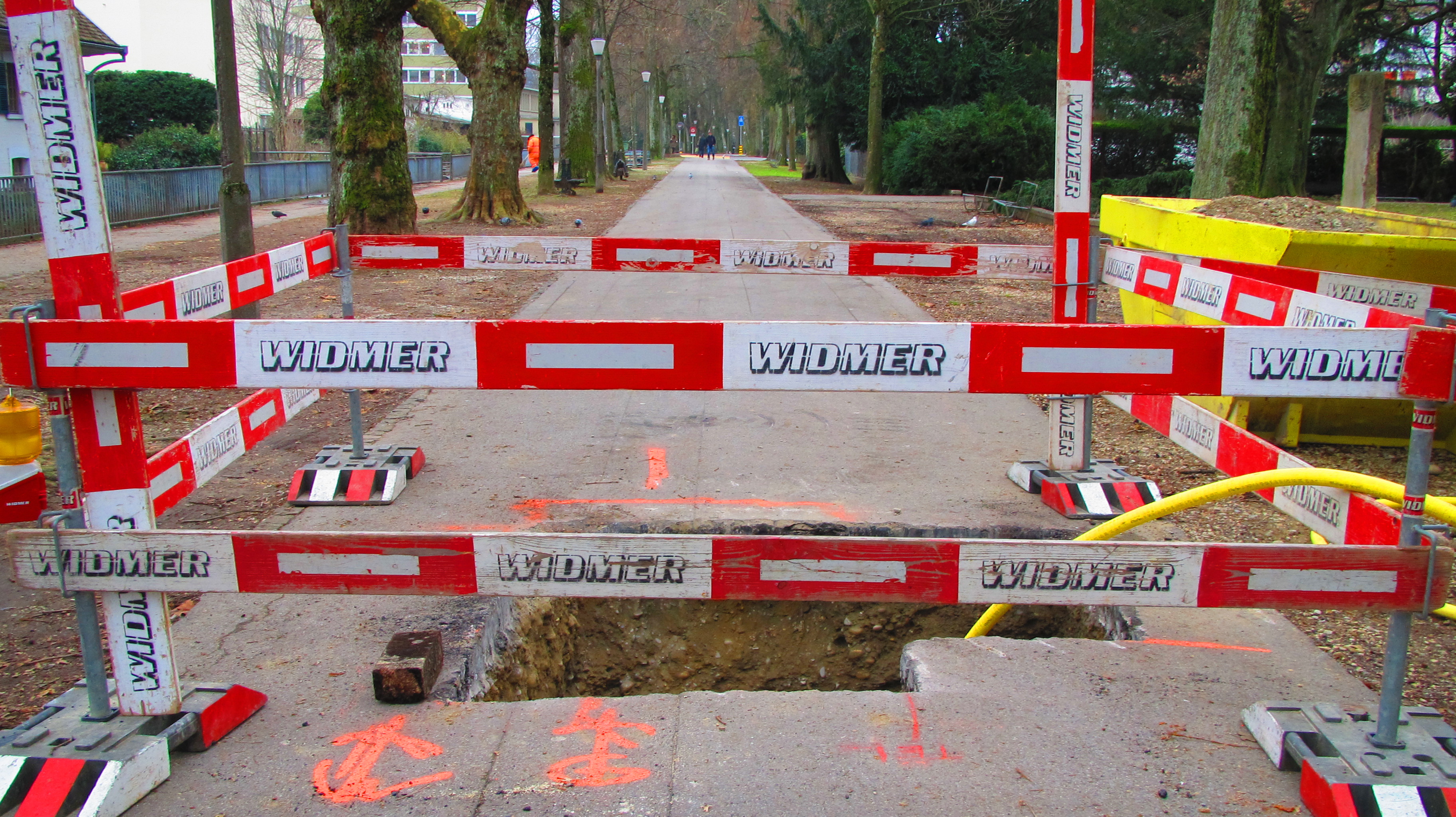
Later, I checked out the site and discovered a giant hole dug into the sidewalk and in that gaping hole lay pretty yellow gas lines. To leave a gas line exposed is another thing that Canadians are fussy about.

The hole has been there since January 12th, unguarded, unsealed and just unsane. No dogs or small children have plunged in, but that’s because it the workers erected rails around it, which by Swiss standards is high-security. They normally just dig holes and leave them unmarked for unwatchful walkers to fall into.

Note: This post is not to suggest the Swiss are in any way lazy. They are not. As proof, the grounds keeping staff in our lakefront park have been mowing, leaf-clearing, debris-disposing, pruning and showing a degree of industry that is impressive. Maybe they’re getting the place ready as a refuge centre in the event of a natural gas explosion.


Chocolate Supremacy in Surprising Places

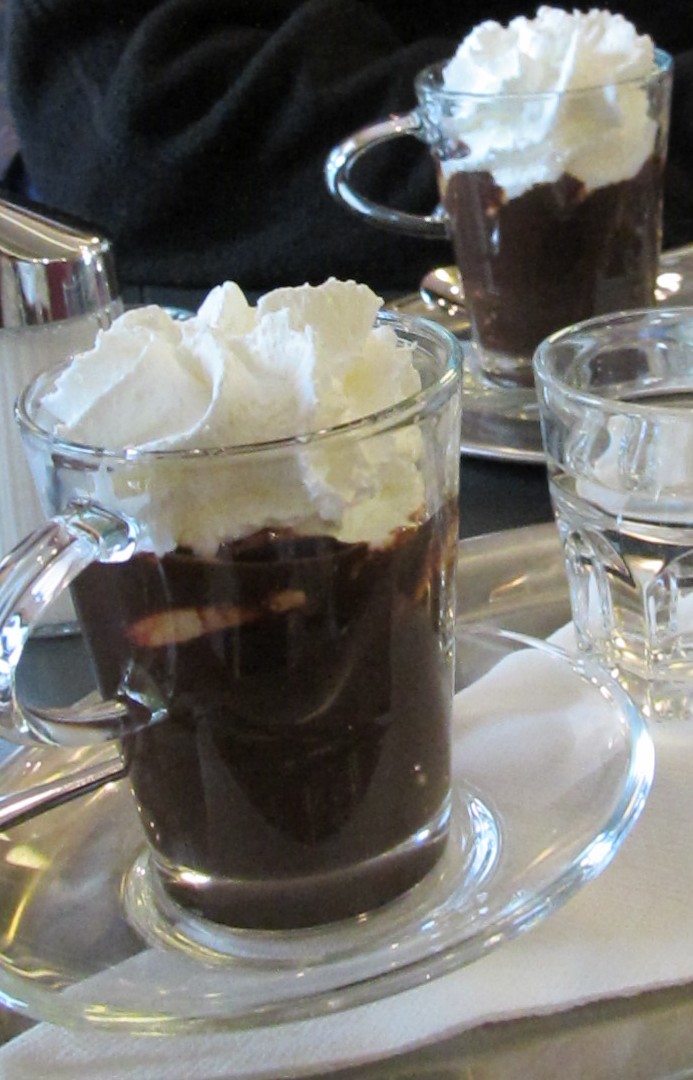
The best hot chocolate ever. If you know the recipe for Slovakian hot chocolate, please share!

German chocolate, Dutch chocolate, Swiss Chocolate and the top-of-the-world fabulous chocolate caramels served up at the little-heralded Chocolat shop at 703 Fort Street in Victoria, British Columbia – these are few of my favorite things.

After swooning to the wonders of German chocolate, I was not expecting to find anything comparable in Europe, much less Slovakia, but it turns out I was wrong about that.

Seated in the snug Cukraren na Korze in Bratislava’s historic district, we devoured the best chocolate ever. I use the word “devoured,” but it could just as easily be said that we sipped on it. The chocolate was a hot chocolate beverage topped in genuine whipped cream, and while many have used the term “you could stand a spoon up in it,” only as a descriptive for richness, Cukraren’s hot chocolate really can support a spoon.

It raises the question: Is it hot chocolate? Or pudding? I don’t know. I don’t care. I just love it. I’ve been trying to figure out the recipe all this month, but so far it eludes me.

My father was Slovakian by birth, and he went to school in Bratislava, but of all the great food he put on the table, he never produced a cup of hot chocolate like this. I think he knew I had a weakness, and that bringing Bratislava’s hot chocolate too early into my life could lead to things, like not being to find a bathroom scale able to register my weight.

If you go to Bratislava, you’ll find Cukraren (with more accents and strange squiggles on its signage that my keyboard will allow) on Michalska, just a few doors down from St. Michael’s Gate and across from these ugly gargoyles. I don’t remember what the hot chocolate costs, but I didn’t particularly care after tasting it.


This little guy obviously wants more hot chocolate.


Bratislava the Beautiful

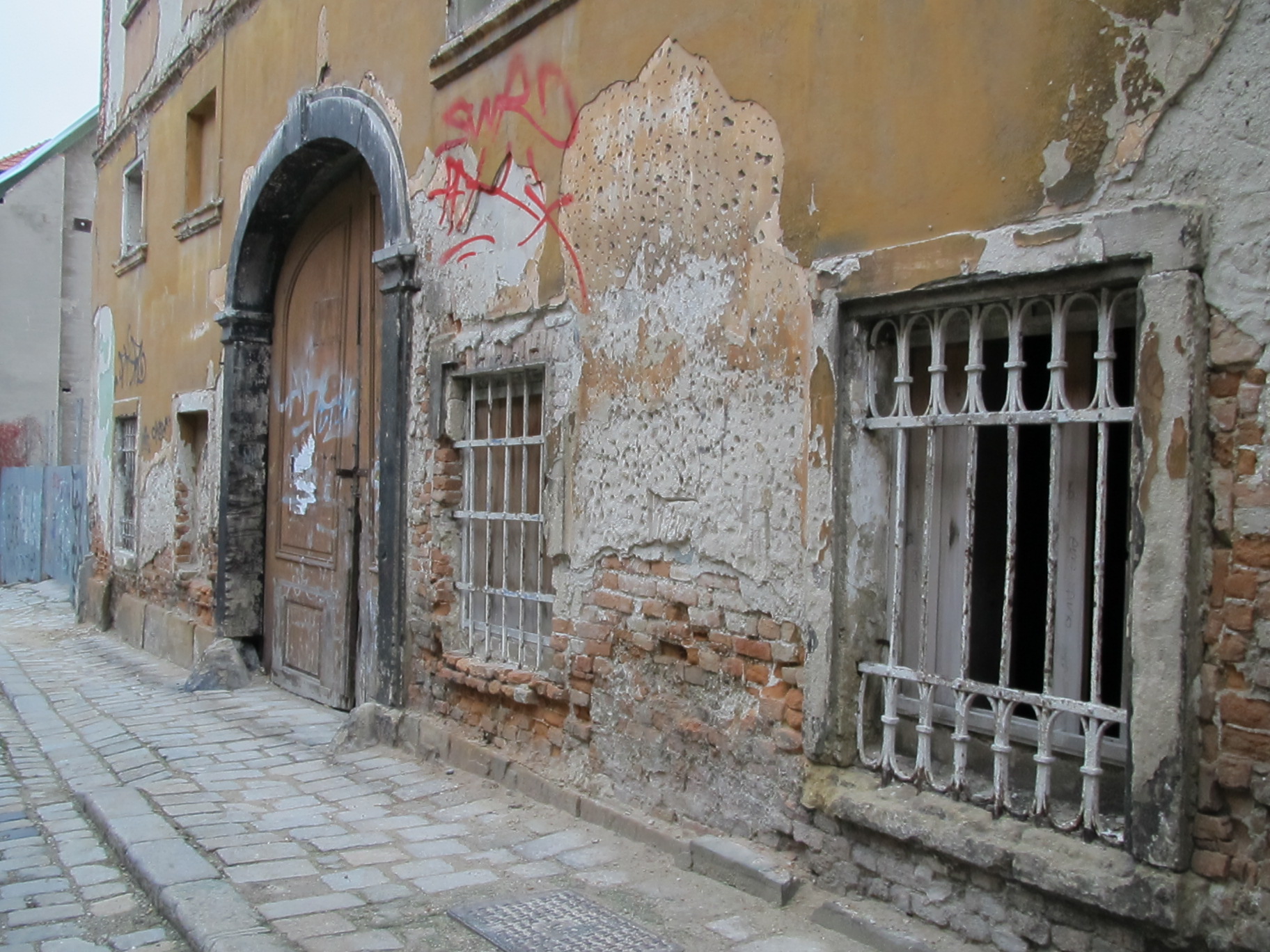
Despite rampant graffiti, vacant streets and widespread signs of urban rot, Bratislava is a European city and therefore, still rich in magnificent architecture. What makes it outstanding in some measure is that it is a living urban museum of its past. Like all European cities, attempts are ongoing to wash out signs of WWII and the economic trashing it produced, so if you want to see something before municipal planners hit the “delete” button, go to Bratislava. Slovakia may be in the economic basement, but there are signs of an upward swing. And if the money should present itself, it might start facelifting-away those markers of its sad history. Why not? The Berliners did it, eradicating all but a small strip of the Berlin Wall? Still, as an anti-revisionist, I hope they leave some scruffy bits.

This slideshow requires JavaScript.

Bratislava + Territorial Tiffs

Dropping down into Bratislava after visiting the grandeur of Vienna is a paradigm-shifting experience. To get you started on what it was like, check out this clip (sorry for some of the ‘adult’ references in it).

Bratislava, seriously still messed up.

The difference between Austria and Slovakia is sharp, which is something of a feat considering that they have historically been at one time or another joined into one country combined with Hungary, Moravia, Bohemia, the Czech Republic or any number of assemblages of this hastily put-together list. It brings the more recent collapse of Yugoslavia into some perspective, as in that the former Yugoslavia is now about 13 countries. As Rodney King laments, can’t we just all get along? Apparently not.

We tend to think of national borders as somewhat permanent, but they’re not. They are always under pressure to move, which may make you feel a little better about Israel’s current territorial arguments. This is business as usual, although it is a very scary business indeed.

Not all border disputes erupt in gunfire, random rocket-launches or global war.

At the moment, the United Kingdom and Spain are in a restrained and polite spat over a little appendix of land called Gibraltar.

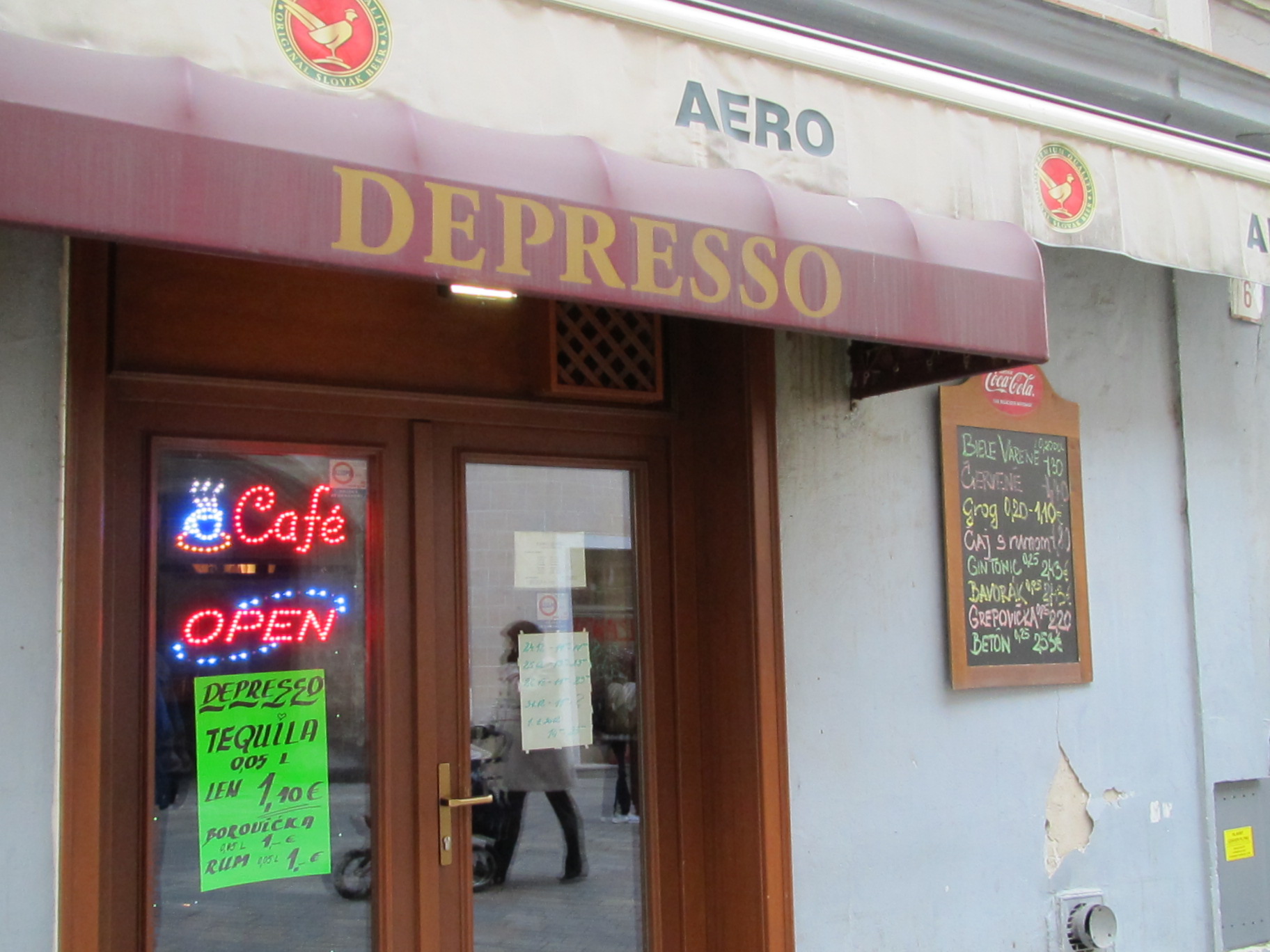
An aptly named coffee shop.

Canada is rebuffing Denmark who’d like to grab hold of Hans Island, not because Hans Island is such a catch, but because if softies like the Danes  can cow your nation into relinquishing land, your country will become a grab-bag garage-sale for the whole world. Canadians do not want that. It’s like getting beat up by the captain of the Chess Club.

Canada and the U.S. have at least seven territorial disputes.

No one wants to get in a real fight, so these countries posture like kids during school recess. There’s no saying the argument could not erupt, but it is soothing that it does not. Would it not be nice if the whole world worked like this?

But what does that have to do with Bratislava? I’m not sure, but here are some photos to show what a country looks like even almost 30 years after communism and over 70 years after the Second World War. Austria, notably, looks a lot better than Slovakia although it, too, was annexed by the Nazis,  so my wager is that communism creates more lasting damage on a country’s economy and the mindset of its population than does all-out conflict.

Next post: Photos of beautiful Slovakian architecture, cause it didn’t all get wrecked. 

A fixer-upper!

It will take more than a coat of paint to fix this.

A monument to the Russians for "liberating" Slovakia from the Nazis. Yes, thank you very much. We appreciate your sacrifice, but "liberating" the Slovaks would mean setting them free, not putting them into another cage. Interestingly, this photo was not shot in black and white, although it looks that way.


Bratislava, or as the Italians call it: Brateeslaaaaaahva. It sounds nicer that way.

This slideshow requires JavaScript.

To look at travel brochures and economic reports, one would think Slovakia is on the upswing, and that would be true. There is nowhere else to go but up when buried in the economic basement of post-communist rule. The Soviets have been long-gone but their legacy lingers in the form of extremely ugly architecture and decaying urban districts. This does not mean Slovakia is not worth a visit: It is its very grittiness that make it a welcome contrast from Europe’s posh locales.

How to get more blog hits and a little on locked churches.

I have learned something about blogs and how to get more hits. Just in case you’ve ever researched this topic before, there are plenty of sites that give you tips on this, but none of them work. Just saying.

What does work, however, is posting a picture of an attractive young couple, as I did earlier this week. I had no idea it would have the impact that it did. My web-hits zooooomed upwards. But that is a cheap and tawdry trick, although many successes are built on such (People Magazine, ET Online to name a few).

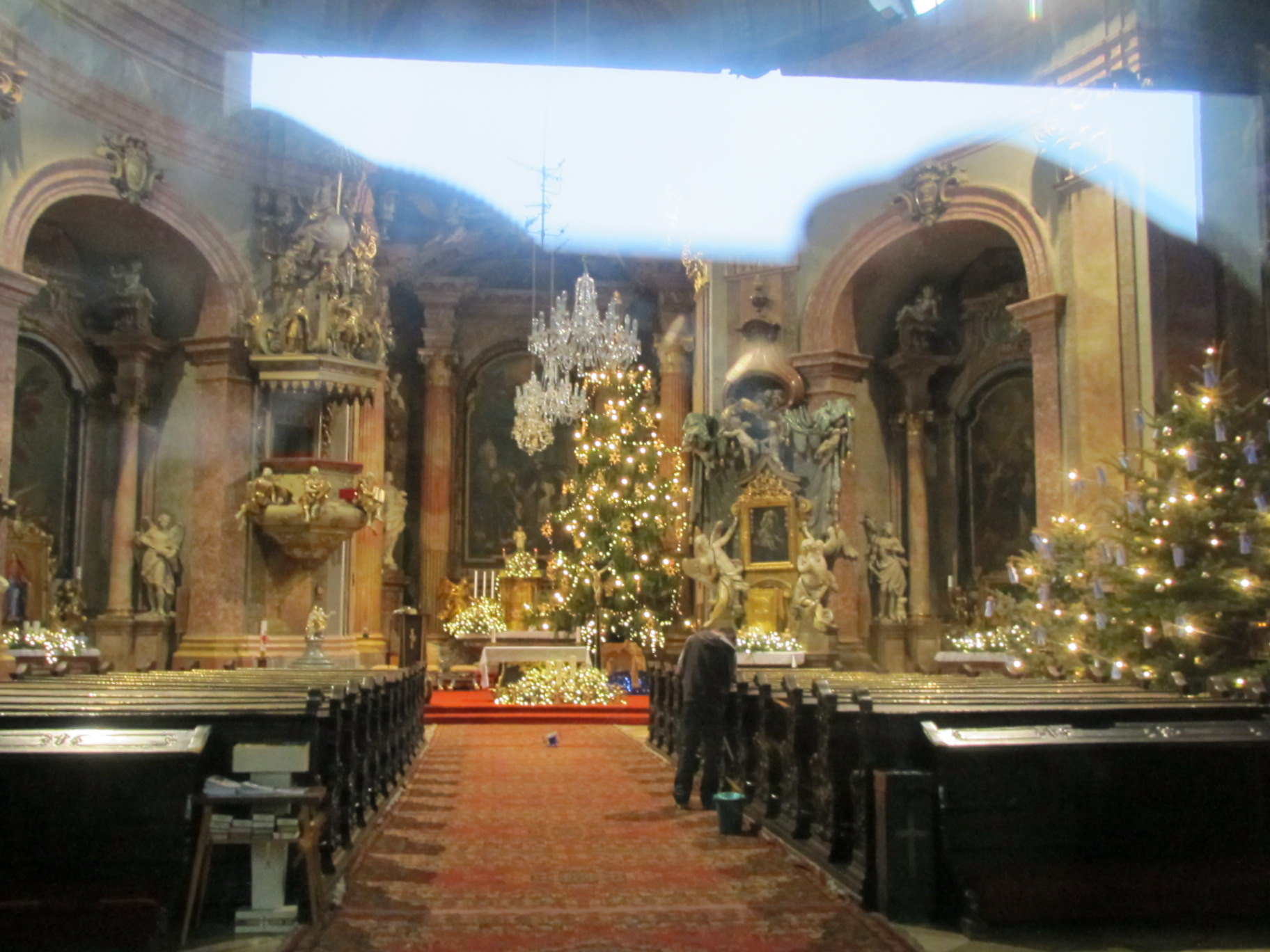
So, today, we are back to our regular programming, which is photos of old buildings. Some of them aren’t even pretty. Here’s a start with a photo of a Catholic church in Bratislava, Slovakia. You may notice a glass sheen in front of it. That is because the church was locked. In fact, Bratislava is the first European city we have visited to have locked churches. A look at the streets told us why: The place looks impoverished, and so it’s  fair guess that vandalism might be an issue. We did sneak into a church, however, immediately after a small group celebrating an infant baptism was let out. Dave was a little antsy about doing that in a country where the last time they saw someone in my bloodline, they shot at him, but I say, what the heck. Just go for it. And no one shot at us.

This is what is outside.

This is what is inside.

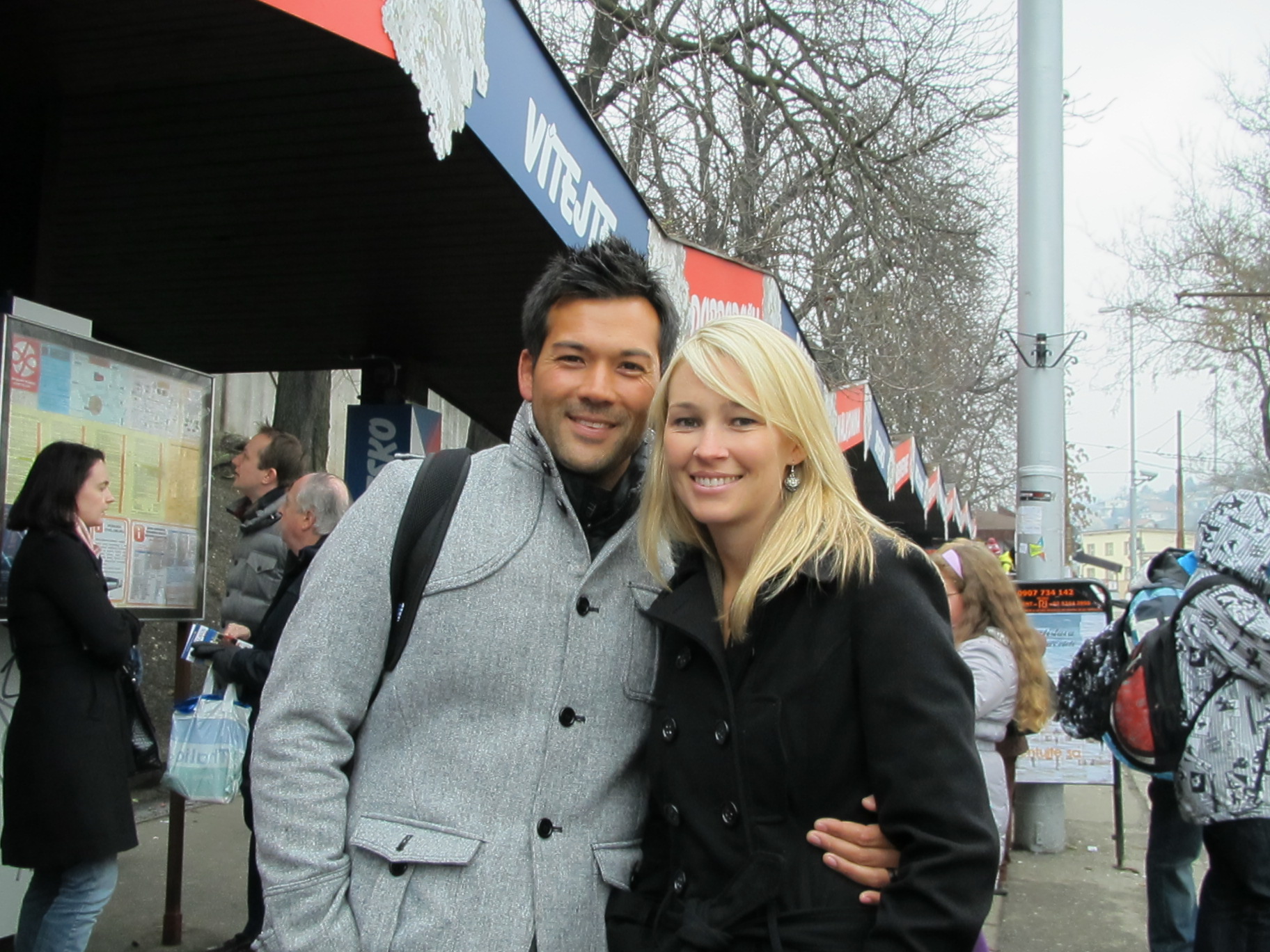
Aaron & Ginny Tredway

See this gorgeous couple. They are not us. They are a couple that we met on the train between Vienna and Bratislava. They had just flown up from their home in South Africa where they were escaping the tourist hordes. As their trip was impromptu, they didn’t have any real plans, so seeing us with our maps, they asked if they could tag along cause they had no idea where they were going.

They did not look like stalkers, so we said yes. Go with the flow, I say. Actually, I never say that, so I always keep a wary eye out on new acquaintances.

We were three minutes into our inaugural conversation when we broached the required question: Where are you from? When we said British Columbia, Aaron, a former pro-soccer player, said he has friends in British Columbia. They’re involved with a non-profit association for soccer players. This was starting to sound like a Christian outreach program we know about, and so we mentioned that we had friends involved in this organization.

You know what happened next. We both blurted out the names of those friends, and very soon discovered that Aaron was inspired to get into the ministry by the same pastor (Bob Roxburgh) who had performed our wedding service in Winnipeg almost 30 years ago. His soccer-playing buddies were Roxburgh’s sons, one of whom Dave taught Sunday school.

Just to play out the geographic links for you. We were born in Winnipeg. Aaron was born in San Francisco. Bob Roxburgh was born in England. All of us have roamed such that we could almost safely say combined, we have covered much of the globe. Aaron moved to South Africa, his wife’s homeland. We normally live in B.C., but now live in Switzerland. There’s a stretch of oceans, nationalities and decades between us, and yet somehow we were seated across the aisle from each other on a ride from Austria to Slovakia. What if we had chosen different boxcars?

I am not a big believer of coincidences – it’s nothing I can prove, but it was sure fun to trek around with these two. We don’t doubt that we will see them again.


Slick St. Stephens Cathedral

Vienna's St. Stephen's Cathedral

The Viennese are not the sort to sit back on their ancestors’ architectural laurels.

We visited the massive St. Stephen’s Cathedral that dates back to the first half of the 1100’s, first laying our  eyes on it in daytime. It’s an impressive sight with its cavernous Romanesque and Gothic design. That beauty was amplified when we happened across it at night and discovered virtual paint cans of colour splashed on the building, both inside and out, and by “virtual,” I mean not real paint cans, but a light show that casts the entire edifice in a rainbow. Adding to our amazement, the pipe organ blasted into this cornucopia of colour. Austria. You must love it. You have to. Awesome Austria.

Just to prove that Europeans don’t just build on North American aboriginal graves, they did the same here. The site was originally believed to be an open field, but in 2000, plumbing problems led to some excavations that yielded graves. Yes, you discover the most interesting things in the aftermath of plumbing foibles.

And for those interested in a little Bible history, St. Stephen was an early Christian evangelist preaching to the Jews, who was summarily martyred  by stoning. That was savage indeed, and the weirdest thing is that this ancient form of execution continues even to this day.

This is not to pick on the Jews who in St. Stephen’s case were the ones doing the stoning, because it has been practised nearly worldwide as a ‘legitimized’ death penalty. Today it is prescribed in Islam’s Sharia law and practised in Islamic states. A recent case came to global attention where a 13-year-old girl was sentenced to die in this manner for being raped by her brother. Yes, that’s how backward Islam is towards women. Her sentence was altered, but reportedly other stonings continue.

North America appears to be the only continent free of execution-by-stoning. I could be wrong about this so if any archeological/anthropological/historical experts care to correct me, I will add their comments in here.

Just because the practice is barbaric does not mean it doesn’t have rules. Everything has rules, and so it is with stoning that even the size of the stones must conform to standard, lest a single large stone kill the victim too quickly.

Surprisingly, some tried to introduced Sharia law in family courts in Canada. Read here to learn more about it. In the spirit of multiculturalism, some people tried to take a non-judgmental aloof attitude toward this campaign, but frankly, any culture that tries to import a system of law that in some places includes stoning rape victims is just stark-raving mad and I for one would be happy to deport anyone trying to import it to my homeland. I’m just saying.

But that is another thing. Here are some more photos of St. Stephen’s Cathedral, an ancient Christian monument that brings to mind a modern Islamic practice. Who would have guessed it?


Languishing in a linguistic laguna

Don't be fooled by this photo. This blog post is not about the Vienna Opera House.

What do these people have in common?

A blond long-haired woman with a man in a blue-and-black sports coat chattered their way down our town’s main retail avenue yesterday. They were speaking English, but more than that, the man’s coat colour screamed “North American” to us. Swiss men usually wear black, grey or brown coats. So do Swiss women, now that I think of it.

In our hotel lobby, we overheard a man trying to get a French translation from our hotel desk staff to explain kitchen drawer and cupboard liners.

In the same lobby shortly after, another man approached the desk and asked in an American accent if the staff could tell him where to find a good German restaurant, to which Jean Philippe, one of our affable front desk staff, held up his chin, reflected, then said, “No. There aren’t any.”

What do all of these people have in common? It’s not only that they were fluent native-English speakers. They were also all besieged by us.

Yes, we have reached the point where we will talk to anyone, anywhere at any time on the sole qualification that they are native English-speakers. And, it doesn’t matter whether they want to talk to us. This is a matter of social conscription.

Looking up at the Vienna Opera House. This photo has nothing to do with this blog post, but I am trying to get through all our holiday photos.

We’ve been here for about 10 months, which is a long time to go before breaking into this uncontrolled yammering, but that’s because English is not so rare here. We enjoy conversations with many, but those conversations still hang up on cultural reference points, a fact under-scored when we make a joke that fails to hit its mark.

When we lived in Spain where English was more of a rarity, we entered this yammering phase within the first week of arrival, just to give you an idea of how starved we were to hear our own language.

It changed our perspectives on immigrants who are often accused of forming their own insular communities in Canada. I know now that if I showed up in Toronto fresh from China, I’d head for Chinatown, too. There’s no intention on the immigrant’s part to stand apart from their new country – they just need that fresh drink of water that is conversing in a language in which they can be their eloquent, witty selves… or in which they can be jerks, if that happens to be what they are in their home country. Being a jerk in your own language is still more fun than being a jerk in someone else’s.

In the meantime, the man looking for the French translation came and sat with us. He’s also from New York and is transferring here for a 10-month work assignment. We thought he was American, but he corrected us on that count: He is Indian. Nationality matters not a whit, of course. As he said, “English! It’s so nice to hear English!” We’re getting together with him later today at Starbucks. Where else would we go but to our own English version of “Chinatown.”

As one other English-speaking former Manitoban’s husband, a couple who is also “stuck in Switzerland,” might quip: The English colonial beachhead has been established.

If you grasped the flow of that last sentence, and you show up in our town, you just might become one of our best friends.

Note: It turned out the man in the blue and black jacket was Swiss, but his shopping friend was from New York.

While were at the Vienna Opera House, the stage workers were prepping for an evening performance - the stage itself is an impressive engineering feat that is essentially a rotating elevator that can shift 40 tonnes 28 feet before and 10 feet above. This picture does not do justice to the size of the stage either. Those Viennese - where opera is concerned, they are not just kidding around.

Vienna the beautiful

Vienna wowed us; maybe because we planned it as stopover to another destination. What can I say? We are uncultured idiots.

I am busy these weeks with editing a novel, so don’t have much time for writing in this blog, but I do have time to post photos. I have noticed that my web-hits spike the days I don’t write. I do not take this personally.

Hardship of note:  I had repeatedly look up Lipizzaner in order to write the captions for these photos. It’s harder than it looks. You can click the stop button to read the captions if you like. I’m sorry that sometimes the text is white on a light background, but I am not smart enough to fix that. More to come.

This slideshow requires JavaScript.

What to Skip on Your Trip


I could have missed this, but I'm glad I didn't.

Every destination we eye brings forward the ultimate travel question: What sites can we skip?

It runs counter to the usual travel query – what are the must-sees.

That is the wrong question. It works backwards in that it assumes an infinite amount of time is available whereas even the most summary of polls will pile on a backlog of tourist-to-do’s that at the end of your journeys will evoke a haunting suspicion that you have left the “must-sees” unseen and for years to come as you ruminate on your travels, it will be in an air steeped in the stench of bygone opportunities.

And that is not what you paid for when you ponied up to the travel web-site and booked your holiday.

So edit your list.

The ultimate travel satisfaction is not in aiming high, nor low, but for somewhere between mediocre and medium. Forget those travel-writers who make it sound possible to see it all in 36 hours (a la New York Times travel section).

We have taken serious runs at seeing cities in 36 hours, but to keep up with the NY Times version would require copious consumption of Red Bull and absolutely no sleep (although this would save on hotel bills).

And so, I have been to Paris, but not the inside of the Louvre (long line-up).

I have lived in Spain and not gone near the lauded Camino del Santiago pilgrim walk (I read the Bible and learned that heaven does not require hiking, although if you like a good walk, go ahead).

I have been to Germany and not seen a holocaust museum (although I heartily believe that everyone who complains about Israel being knee-jerk over-defensive should visit at least five holocaust museums).

But I drift from my point, which is, what can you skip on your trip? Well? What can you skip?

More ramblings on this later.

A view of Vienna from the hill overlooking Schoenbrunn palace is beautiful, but could I have missed it? Yes. I could have.

I am always glad to see any statue that was not created between 1940 and 2010, so I am happy I did not miss this. On the other hand, Europe has about 893-gazillion horse and warrior sculptures, so if I did miss this, I would not mind terribly.

And now, something for the economists…

Dave emulates his economic-theorist hero Adam Smith.

Economic theorists, heads-up. My hubby Dave has walked by many works of fine art, concert halls and astonishing vistas with only the barest nod in the attraction’s direction, which is why I was stunned as we walked through the business section of Vienna to hear him say, “Oh, Adam Smith!” as he walked past this statue that, you will notice, only says A. Smith. How did he know the statue honoured Adam Smith? It turns out that Smith is the author of An Inquiry into the Nature and Causes of the Wealth of Nations. It was a pioneering work of political economics. I did not know this, but it goes to show something. I’m not sure what, except that it underscores that Dave knows a lot more about monetary systems, economics and investments than do I.

Schoenbrunn Park

Solo statuary was sheathed against the weather, but the garden pavilion's scultpures were on display.

The great thing about Schoenbrunn is that while you must pay to get inside the palace, the grounds function as a city park. Joggers, strollers, sightseers, pondside ponderers all linger quite happily on the spacious grounds.

The park is almost square at 1 x 1.2 kilometres and has been on the Unesco World Heritage Sites since 1996. A brief word about Unesco: What the heck? We visited a Unesco site that called into question the merits of Unesco designation. This, however, was not that site. Schoenbrunn is definitely Unesco-worthy.

As we noted with other-things-Austrian, everything was tidy and well-kept. Litter was at a scant minimum and we did not spot a single drunk lounging on the park benches.

I know this sounds very snotty to look down my nose at public drunkenness, but nothing can upset the day’s happy balance quite the way that having a drunken wretch glare menacingly at you while muttering something in German. It is even less pleasant to have a drunk stagger behind you, casting his alcoholic breath over your airspace and waving his cigarette a little too close to your coat.

Am I saying this has happened to me? Of course it has, but not in Austria.


Schoenbrunn's garden rises upward, so it gives a beautiful view of Vienna below.


An unimaginative, but informative perspective on Schoenbrunn's garden pavilion, which houses a very nice and surprisingly affordable restaurant.


When the Austrians say they want high ceilings, they mean high ceilings, dangit.

Schoenbrunn Sights

Low sun in Schoenbrunn gardens, which are crisscrossed with pathways wide and narrow - lovely to spend a whole day in.

We saw Schoenbrunn and its gardens one on of those cold, bright winter days when most of the marble statues were wrapped in bisque-coloured tarps.

That is not always so bad – it gave us an appreciation of the precise geometry of the garden’s design. There is also something poetic in the bare brown tree branches against a blue sky. I’ll add more pictures as the week goes on.

Sun paints shadows across the gravelly grounds.

Schoenbrunn in autumn leaf, courtesy Rebolusyon blog.

Backtracking + Schonbrunn

Yup. It is a palace, alright. This is one of Schonbrunn Palace's large ballrooms, and the site of the Vienna summit between U.S. President John F. Kennedy and Soviet Premier Nikita Khruschev on June 4, 1961 in the aftermath of the Cuba Missile Crisis. Just as amazing, it is also the place where Dave developed an attachment to audio-guides. I still preferred to read the plaques. Anytime an audio guide starts out describing inane material, such as elaborating on the formation of the society that provides the audio guide, my brain goes into cold storage.


I’ve lost track of what I’ve posted and what I’ve not from our recent travels eastward, so I’ll start with the beginning: A visit to Schonbrunn Palace in Vienna.

Our overnight train from Zürich arrived in Vienna at 7:30 a.m., and despite our hopeful queries to the porter, it was clear that we had to vacate our cozy little sleeping compartment within 5 minutes of arrival, 10 minutes at most. We staggered into the almost empty Vienna train station, which is possibly the most polished, clean and criminal-free train station we have happened upon thus far in Europe.

This is one of the palace's many wood stoves that is fed wood from the rear, so as not to mess with palace decor. These are huge - eight feet in height by my estimation.

One little shop was open, so we scurried in that direction, but it turned out to be a book shop, leading us to believe the Viennese fall into seizures if they are without reading material. Clean train station, devoted readers – we liked Austria already.  The book shop gal directed us to the tram stop just outside of the station where we caught a tram to Schonbrunn palace, arriving there before opening, so we wandered the grounds a little, then discovered the palace doors were open so we were able to wait in warmth.

The royal bed.

Schonbrunn is the childhood home of Marie Antoinette who along with her surviving siblings (16 children in total, not sure how many died at birth) was given fairly free rein in the palace and its 20-acre grounds of marble statues, troops of trees, trimmed gardens and ponds. They were also encouraged to play with non-royal children. Shocking.

Despite some historical writings saying that Marie Antoinette’s parents had married for love, the palace audio-guide said the opposite, that her  mother Maria Theresa reportedly did not like her father, so she was absent most of time. Only one of Marie Antoinette’s siblings was allowed to marry for love, the rest were all political liaisons. It explains so much about the dysfunction seen in royal families. It may also explain why so many were named Maria – Maria Theresa, Maria Josepha, Maria Carolina, Maria Amalia. The imagination must have been bred out of the family. On the other hand, when a woman has 13 to 16 children it might be economical to be able to just shout Maria when summoning one or more of the flock.

If this were your "comfy" summer home furniture, you might name 11 children Maria, too. The edifice in the corner is another wood stove.

The palace is worth the trip – it shows heavily ornamented Viennese design, and a few surprises in that most of the royal family’s private living rooms are surprisingly small, for a palace, that is. Schonbrunn is also the location of what the audio guide said is Mozart’s first concert at the age of six, but a quick run through the Internet suggests he had other notable concerts before that. I will rely on some music history buff to correct me.

Plan on taking at least 45 minutes for the short tour of about 20 rooms, another hour or more for the gardens. A lovely garden restaurant is behind the palace, but the hike up to it is a steep one. The truly curious could spend an entire day at Schonbrunn.

The palace was packed with stunning chandeliers.

Where Mozart performed before Austrian royalty.

Zip-trips

We have been on the road, or more properly, on the European railway tracks for the most part of the last eight days. Maybe seven days. I don’t know. The concept of time has lost all meaning. Travel does that to a person.

It is very tough work. Tourists are all about seeing things, photographing things, experiencing things, buying things, doing things. It is an artificial existence, and so it is really hard to keep up for a long time.

No need to shovel snow on these 'streets,' but wouldn't it be fun if they froze over? It would be the greatest ice-skating in the world.

We should all feel sorry for those tourists who blithely book a six-month excursion. They have no idea what they are letting themselves in for. I can tell them: It will be a lot of pain and suffering, all while trying to look like they’re having the time of their lives so as to justify their investment of money and time.

But I ramble. The point of this blog is to show a little of what it is like to move to a place, as opposed to just visiting there. But for the last little bit, we have just been visiting. It is tougher than we remember. We’re almost grateful to get back to work.

There are no motor vehicles on Venice or Murano avenues, so everything gets hauled by humans. This cart is designed to take stairs easily. It works beautifully.

10 things we have learned so far:

  1. The best hot chocolate in the world can be had in Bratislava, Slovakia. This is a true fact.
  2. Vienna is much more fabulous than anyone could guess.
  3. Sorry to say, but Italian food tastes better in Canadian ‘Italian’ restaurants.
  4. The landscape between Milan and Venice looks a lot like Saskatchewan.
  5. Venice has a regrettable spewage smell to it. I say spewage, because I doubt they would admit to it being sewage. We may have seen a spewage outfall directly into a canal in the heart of the city.
  6. It is worth the extra money to book a full sleeping compartment with private bathroom and shower on Eurail lines in Switzerland, Austria and France.
  7. It is questionable whether it is worth it to pay extra money for first-class on Trenitalia (Italian Rail). Their seats are a little like Mussolini – hard to put up with.
  8. Italy’s train service Trenitalia also recently laid off their senior staff to hire a bunch of cheaper new staff, putting people out of work who have been with the railway for 20-25 years. Boo Trenitalia. A handful of middle-age guys are protesting this in front of the Venice train station. They have been there for 25 days. Trenitalia is a real name. Check it out by clicking here.
  9. If you want something done, get a Swiss, German or Austrian national to do it.
  10. Venice hotels are ridiculously expensive, but everything else is reasonable from food to souvenirs to boat taxis

    This Slovakian hot chocolate can permanently alter a person's mood to "upbeat."

    .

Venice

Venice. It’s pretty.

More gondolas that we could shake a stick at.

San Marco Campo - or as we might call it, San Marco Square or Plaza.

The waterways and lanes are so jagged, it's easy to get lost, even when paying attention to the map.

From Vienna to Venice, or is the other way around?

We’re off to Venice, but in the meantime, here’s a few pictures from our time in Vienna. Vienna, Venice – I keep mixing those names up. Maybe actually seeing these places will cure that.

Inside Vienna's famous Opera House.

St. Peter's Church in Vienna.

Vienna is still the city of horses and home of the Lipizzaner stallion riding school.

The view from behind the Neptune statue (see header photo above) looking over Schonbrunn Palace and Vienna

Garden pavilion at Schonbrunn Palace in Vienna, Austria

Train versus Plane

Our first stop in Vienna: Schonbrunn Palace, where we arrived shortly after 8 a.m. due to our early morning train arrival. It turned out to be a good thing, because even in December, the place was filling up by the time we left a few hours later.

Only 25 Euros to fly to London? I’ll take it. 50 Euros to Rome? Okay. 47 Euros to Barcelona? Not bad.

Also, not really true. Yes, there are fabulous flight-deals to be had, but here’s the fact: Even a one-hour flight will take a 1.5-hour train ride to the Zürich airport, which itself takes 2-3 hours to navigate thanks to the presence of line-ups like we’ve never seen before. Also, for some reason the Swiss believe that taking a direct route to anything only allows too much lounging among its passengers, creating an air of sloth, and so the guided march through Zürich airport is something of a maze that loops passengers through much of the airport, only to end up back in the same zone from which they passed through 20 minutes earlier.

I wish this were not true, but it is. I like a stroll as much as the next person, but not so much when toting luggage, worrying about border officials, and getting the impression from the forced march that our gate is in the next Canton. If it’s rough on me, a daily walker, I can’t imagine what it is like for those whose fitness level lags. Possibly these marches are a survival test to weed out the weak.

Dave in our "grande" train compartment complete with overhead windows. Small, but very comfy.

But I drift. All of the above explains why we favour train travel, even though it appears to take longer than fly-time, which it usually doesn’t. For example, the total train, plane and automobile trip to Leipzig from our hotel is about eight hours – the same amount of time as it takes to take the train alone, with much less stress.

Our trip to Vienna and Bratislava was made on the overnight train that departs Zürich at 10:30 and arrives in Vienna at 7:30 a.m. The whole price for two adults to travel return was 700 Swiss Francs (CHF) to ride in the luxury compartment that has its own bathroom complete with shower, a double bunk, plus a small seating area with a cafe-sized table and two chairs in front of large picture windows to enjoy the views. To ride in the compartment without a private bathroom costs 24 CHF less. We only know this because Swiss Rail messed up our booking and we ended up in the second-rate compartment on the trip home. It was a sardine-can experience, but not too bad.

A note to the weighty and heighty: The bunks are very narrow.

700 CHF is a lot of moolah, but here’s a little market comparison on our upcoming trip to Venice (I am too lazy to figure out what it would have cost for a flight to Vienna). We are taking a day-time train leaving at around noon from Biel, switching trains in Bern with a short stop in Milan, then on to Venice for 630 CHF for two return tickets.

If we were to fly, the total cost would have been 500-580 CHF. We would have missed the chance to stroll through Milan, and the fun of a train ride through the Swiss Alps. The total travel time on the train will be seven hours (including the one-hour stop in Milan).

The travel time by air with the train to Basel (where we could catch a flight), plus the requisite two-hour airport-waiting/marching time and fly-time would be five-to-six hours, not including the time it would take to find our hotel on the other end, which would probably be an hour, bringing the grand travel time total to, you guessed it, seven hours.

Pack as lightly as possible for train travel. Even luxury compartments are small.

Part of which would include the indignity of passing muster at airport security.

This is nothing to say of the varying environmental costs. I admit, I don’t pay attention to the environmental impact when I’m travelling, but I’ve noticed rigid environmentalists travel as much and more than I do, so I don’t feel bad about that. But if an environmentalist is reading this, shame on you for travelling by air. It sucks up the fossil fuels to a Suzukiesque-screaming degree.

Note: If we lived in a big city with an airport, we might fly more often, but we’re 1.5 hours away from major airports by train.

Second note: Another intriguing aspect of train travel is the immersion into local culture. When riding in the regular cars, you are surrounded by the locals as they go about their regular lives and it is something of a sight to see. For some reason, air travel has a socially insular quality to it, perhaps because the seats all face forward. On trains, passengers face one another, allowing for easy observation and the opportunity for conversation.

Fuhrich on the Second Go

This is Fuhrich's upper dining room where we ate the first time we visited there. Grizelda would not allow us back upstairs on our second visit.

My former Times Colonist newspaper colleague, food-writer Pam Grant, gives restaurants a second chance when things go wrong on her first visit there. But, sometimes the ones who get it right on the first go need a second visit as well, just in case that first visit was a fluke. That’s what we learned the second time we stopped in at Vienna’s Fuhrich restaurant.

Two days after our first divine dinner there, we returned to find the restaurant jam-packed, as was expected. The food is exceedingly good, after all.

A waiter pointed us toward a table along the wall on the main floor. If I was having doubts that I could squeeze between the other patrons in that row, I wasn’t alone as I could see from the aghast expressions on the faces of those very patrons.  I said no thanks and pointed to another empty table by the front of the restaurant, overlooking the street.

And that is when I fell in the path of the maitre d’ pit-of-doom. As the waiter hesitated, a woman of about 45-55 swept in, her black pixie* all hard-edged with her dark eyes flashing angrily. She indicated another table in the centre of the room that looked to be sized to suit pre-schoolers.

So I said no again. I had this crazy notion that as a customer, I should enjoy a reasonable degree of comfort, and not be forced to relive the cramped wooden-desk epoch that was my Grade 4 school year.

Of course, this was a mistake. She put us at a third table that did not bank along with other tables, so we were away from the crowd, but it was straight in the line of wind gusts from the front door (which was kept open as they were dealing with a delivery).

At this point, I still assumed the professional decorum of wait staff was in effect, but seconds later, I realized my error. The woman, let’s call her Grizelda, came to our table and dropped two menus down before us.

It was the kiss of dining death.

Allow me to explain: The custom at this restaurant is for the waiter to open the menu and present it to the patrons. The closed menus on our table telegraphed that their good graces were closed to us as well.
Good food at Fuhrich - Weinerschnitzel.

In the meantime, later diners came in and took the coveted window table. They spoke German. Not that this had anything to do with it, but I have noticed that sometimes people take out their xenophobia on non-German-speaking foreigners, such as at a bakeshop two blocks from our Swiss hotel where the server grabbed a croissant with her bare muggy fist and dropped it down the bag as though it were dog excrement, instead of using tongs or wearing gloves.

Where was I?

Oh yes, Grizelda. Another waiter appeared to take our order.

That is the second sign of dining disaster – the relay. The relay is what happens when things have got off on such a bad foot, they transform your table into a baton that gets passed from one server to another. It is, pardon the pun, a recipe for disaster. In theory, however, it does present an opportunity for the incoming waiter to help the customers forget the ineptitude (or hostility) of the outgoing waiter. There’s no reason why this should not work, but Grizelda’s ugly mood cast a pall over the other waiters who all looked jittery and frightened.

When this server brought our bread, I asked where the spread was. Two days earlier, our bread came with a tasty spread of butter, creamed cheese, parsley, garlic and some un-named but heavenly spice (I am taking a guess at the ingredients). He said he would look for some.

Having worked in a restaurant, I know that spreads and such are prepared earlier in the day when the restaurant is quiet, and then usually sit in a fridge waiting to be dealt out to diners with as much speed as can be seen at a Las Vegas blackjack table. I’m not saying this is how this restaurant works, but fetching a condiment is not exactly a massive undertaking. If it were, how could they ever manage the volume of complexities in running the deep-fryer?

After a decent interval, I headed toward the kitchen, just outside of which I found our waiter standing next to Grizelda. When I asked about the spread, they flustered and then he said, ‘night time only.’ He gave a long convoluted explanation on why serving this condiment would be on par with demanding everyone eat from upside-down tables. I asked him to find some anyway.

I knew I would never see it. Grizelda’s mouth was pursed, her nose upturned, her lids lowered. She was furious.

I returned to our table. A third waiter brought us our food, signifying we were now in the third leg of the race and barreling quickly toward the finish line.

I am happy to report that the food was again absolutely fabulous. Obviously, no one had taken the time to inform the cook that we were miscreant patrons.

We finished our food and when the bill arrived, it had a 4-Euro charge for the absent spread. This is a neat trick. When we actually received the spread two days earlier, we didn’t have to pay any extra for it, but when the spread does not come, it costs more. Possibly because it was invisible spread.

Happily, we did not have to argue over this as Waiter #2 came over and explained the error, then produced a correct bill. Even though he was Waiter #2, this latest handover signalled that we had entered the fourth leg of the relay, and it was time to go, which we did.

Later, Dave and I mused over what we might have done to avoid such an uncomfortable situation, when we suddenly remembered we were the customers. It’s not our job to worry about Grizelda. It was her job to worry about us. In short, the only cure for such a train wreck of a meal would have been to leave as soon as Grizelda’s disapproval showed itself. But we couldn’t do that. Remember, the food is fantastic.

Rating (ranked twice, with the first number for the first visit, the second for the second, you get the drift.  1 is low, 10 is high)

Location: 8 and 8 – Just a hop off Vienna’s lovely pedestrian shopping thoroughfare.

Setting: 8 and 8 – The restaurant is clean, and decorated in rich woods, reminiscent of a well-to-do English pub.

Food: 10 and 10 – There is nothing disappointing in the food here. The portions are sizeable and everything is delicious.

Service: 10 and 0 – If you avoid Grizelda, you should have a fine time.

*It’s possible that she had her hair done in an updo, but I think it was a pixie cut. I cannot say with certainty because I had to keep my eyes averted most of the time to protect them from getting lasered out by Grizelda’s glare.

 

One Restaurant, Two Meals

Hands up if you’ve ever gone to a restaurant after hearing a glowing report from a friend, only to experience a dining disaster?

Did it lead you to question your friend’s gastronomical judgement? We sometimes wonder about our friends, too, but Vienna has taught us to wonder no more.  It is has nothing to do with your friend, my friend, any friend. It’s the restaurant or more specifically, the restaurant staff.

We rarely go on dining guidebooks when choosing a restaurant in a strange city – we prefer to wander the streets, scrutinize the posted menus, and then peer inside the windows to check out:

  1. The age of the diners – a crowd of mostly under-25s are not likely to share our restaurant-experience goals. They are probably there to see the other under-25s of the opposite gender. We are somewhat over-25. We are just there for the food.
  2. The facial expressions and postures of the patrons: Do they look ticked? Bored? Do they wear the cavernous visages of the starving-to-death-while-inside-a-food-establishment? All of the above is very bad.
  3. Cleanliness: If we see a smidgen of filth, we stay away. We do not go on travel-holidays just to spend time getting fluids pumped into us intravenously in a hospital ER.

To get to the point, we employed this rigorous selection-method in Vienna, landing here, at this restaurant pictured above – the charming “Fuhrich” eatery.

The place was packed, but the waiter directed us upstairs where we found an

With European cuisine, the secret is always in the sauce. Even remembering Fuhrich's creamy wine sauce from a "reduction" still makes my mouth water.

empty dining room with windows overlooking the street. Perfect. We love eating in an empty dining room, which is almost impossible to attain because of our deep suspicion of empty restaurants.

Our waiter, a charming fellow with a perfect sense of timing, proceeded to usher us through a wonderful dinner. Dave dined on Wienerschnitzel, which I protest out of pity for the poor calf, while I had a tender steak, not feeling quite so sorry for the fully grown cow. The food at this establishment is fabulous. The setting is dreamy at the end of Führichgasse, a quiet lane off Kamtner Strasse, one of Vienna’s main pedestrian avenues.

We left happy, confident that we could heartily recommend this restaurant that was a delight on all levels.

Two days later, we went back. That turned out to be more of an adventure dining-wise than we expected. I’ll write about it tomorrow and the importance of watching out for the overworked and testy maitre’d.

The Travails of Travel

We’re just back from a short skip eastward to Vienna and Bratislava, a study in contrasts if ever there was one. The former is a well-monied and polished cultural centre; the second is a national capital still getting up on its knees from the Second World War and Soviet occupation or communist rule (take your pick). That’s even though the communists were elbowed out in the 1980s. Ouch.

We’ve got our feet up, the laundry drying, and the fridge restocked, but I’m not up to speed yet.  I’ll write more when my circulation hits my toes – three days of standing/walking has taken a toll.


Christmas without the clutter

The Christmas Eve congregation at Biel/Bienne's Alstadt Reformed Church, Dec. 24, 2011

Christmas Eve, we walked up narrow cobblestone alleys to a church dating to the early Middle Ages, our minds anchored to the remembrance of all the generations that made this same trip on this same night through centuries past.

The church is set in the uneven footings of the Jura Mountains, an impressive Gothic building with high ornamented vaults, a massive pipe organ, polished stone floors and faded murals high on its clerestory walls.

It tests the nerves to sit through a service in a language we have yet to grasp, with customs to which we are clueless. Would the congregation do cartwheels? Sing a Las Vegas show-tune? Expect us to stand up and explain ourselves? Test our mettle by demanding we sing Handel’s Hallejulah chorus? Make a public confession of some sort?

The people were quiet – in a building fashioned from stone and stained glass, one expects to hear echo, but it was hard to pick up even a scratch. The service started precisely at 11 p.m. – we are, after all, in Switzerland, the land that guards time. The only decoration was an evergreen tree, adorned only with electric candles, a small wreathe on a flat-cut stone altar and a single burning candle.

A white-haired man in a black suit stepped slowly from the front of the church, not in an air of pomp or down the centre aisle, but in a subdued manner, off to the side, unfurling a beckoning solo from a woodwind instrument. The pipe organ chimed in and this went on until a small man in a black clerical robe with a white bow took the podium.

Mural on the clerestory walls at Biel/Bienne's Alstadt Reformed Church

He started reading, and although it was in German we recognized it as the Gospel narrative. He read of Mary’s visitation from the angel, Bethlehem with its paucity of hotels, Jesus’s birth in the grit of a Middle-Eastern stall. The reader paused  now and again, at which the pipe organ filled the church with sounds very much like a steady wind moving through a forest.

And so the service went, woven between a single human voice,  answered by the pipe organ’s choral timbres.

In the silent moments, there was not a sound to be heard, making us wonder about the difference between North American and Swiss Christians. North American churches are alive with noise, shuffle, chatter, even the more stoic ones. This is the first time I’ve sat in a church where there was literally not a sound, a cough, a swish of fabric or the scrape of shoe against the floor. It was as silent as though we were not there.

We sang four songs from the hymn book, beginning with A Mighty Fortress is Our God. As midnight approached, the minister came into the congregation with a candle with which he lit the candles that we had been given at the door. There was no music or reading, just the sound of people tilting their candles one to the other, so that the drops of light slowly spread back into the dark.

When all were lit, the churches lights were turned off altogether and we sang Silent Night.

The pipe organ sang one more piece and then without benediction or comment, the congregation rose and drifted outside, some still carrying their candles into the tranquil night, painting amber pools against the grey cobblestone.

_____________________________________________

Where are we?

We may be entering an electronic cone-of-silence over the next few days as we travel east by train to check out Viennese pastries and Bratislava’s …. well, whatever it is that makes Bratislava what it is. Auf wiedersehen.

Bratislava Old Town

Vienna: Because we haven't seen enough cathedrals, castles and cobblestone ....

When Chinese Food is not Chinese

This is not Fondue Chinoise. It is just a stock photo from the web that I am using because I don't yet have a photo of the fondue in question.

The words “fondue chinoise” have appeared in numerous restaurant windows, causing us to ruminate on the multiculturalism of the Swiss.

Not only do they have four official languages, they also embrace Chinese cuisine in the form of some kind of fondue.

Turns out we were wrong about that: Daniela, our ever-helpful and apparently omniscient* front desk gal, explained that these signs appear to advertise Chinese fondue, but it is in fact a Christmas fondue of thinly sliced meats. There’s nothing Chinese about it.

This will surprise the Québécois who use exactly this term for Chinese fondue, but then they’re not here, so maybe it doesn’t matter.

This fondue is the grand culinary showcase at the Swiss’ Christmas dinner. Daniela says it is preferable to a giant turkey, because diners have to spend a lot of time cooking their meat at the table, forcing them to converse with other guests and relatives.

She did not use the word “forcing.” I did.

The prospect of staring at one’s relatives over an open flame and pot of boiling oil, each guest armed with their own 12″ two-pronged stabbing implement, seems to be exactly the type of scenario that could lead to serious injury, death and perhaps a visit from a SWAT team.

Better to have a 25-lb. turkey on the table. It’s very hard to achieve lift when trying to chuck one of those at my brothers, not that I’ve ever tried that.

______________________________________________________

* I don’t actually think Daniela is omniscient, but her manager suspects she might be owing to a recent exchange we had in his presence.

I was passing the front desk and said, “Oh Daniela, that ….” then  I ‘drew’ a little square in the air with my fingers.

Daniela said, “Of course,” and immediately made a note. Her manager demanded to know how Daniela could possibly decipher my meaning from such scant information.  We laughed him off, because he is a man and therefore not privy to the Secret Code of Women, and even lesser privy to the Secret Code of Blonds Who Everyone Else Thinks are Stupid, But Really We Communicate in Another Dimension.

Could this be a Swiss recipe?

This tastes better than it looks.

A few have asked if I’ve discovered any unique Swiss cuisine in my wanderings across this lovely country.

That is hard to say, because Switzerland has so excelled at exporting its food culture all through my life, that many things I thought were Canadian have turned out to be Swiss. I will spare you the list.

I am working on some recipes while here, however, and so maybe they are genuine Swiss recipes by virtue of geographic origins. But then, maybe not. Here’s the latest:

Swiss Curry Mango Cashew Chicken

Ingredients:

  • 2-4 chicken breasts, skinned and boned
  • Heinz curry mango sauce (yes, I’m cheating)
  • 1 red pepper
  • 1 zucchini
  • 1-1.5 cups pineapple chunks, canned (sorry, this does not work as well with fresh pineapple, which tends to be dry over here)
  • cashews – as many as you like
  • butter
  • salt

This is a basic stir-fry with two tiny twists to add more flavour. It’s also all cooked in one pot, keeping the clean-up time to a minimum.  Here’s how it goes:

  1. Heat wok or large cookpot (at high setting).
  2. Melt butter and add chicken breasts whole. Pan-fry til done. Remove breasts and cool. Do not be afraid to undercook a little, because these will go back into the pan for a longer simmer later.
  3. With the pot still at high heat, add cashews to the same hot pot and brown. While this is going on, chop zucchini and pepper into bite-size pieces.
  4. Dice cooked chicken breasts.
  5. Return all of the above to the hot pot with the cashews.
  6. Drain can of pineapple, and add pineapple to the hot pot. Stir.
  7. Add curry mango sauce. How much depends on what brand you’re using. If you’re employing Heinz’s sauce, use about 1/2 cup.
  8. Add salt to taste.
  9. Cook at high heat for about 5 minutes, stirring often, then turn down to a simmer. Cover. Simmer until liquids have steamed off (cooking time depends on the ingredient’s moisture content and the temperature of your stove elements. I can’t give precise advice for a North American kitchen because I am working with a state-of-the-art Euro-cooktop that is also possessed by the devil and makes no sense).
  10. When vegetables have softened and chicken is tender, turn up heat and stir around to brown ingredients.
  11. Here’s the twist. Just before serving, stir in another half-cup or more of mango-curry sauce (to taste). It will amp up the flavour beautifully.
  12. Twist #2: Do not be tempted to chop the chicken before cooking it. This works well in some instances, but the chicken in Switzerland leans towards toughness, so it will cook to a more tender texture if cooked whole beforehand.


So I walked into a Swiss bank with a fistful of cash …

I hope the money doesn’t get soaked.

Winter has slid off the mountains and into our valley. Snow falls in mean pellets. Slush rides up pant-legs, soaking the calves. Shoppers move along at a crabbish gait, picking their steps carefully over the ice-slicks.

At the lake, the water is chalk-green from the silt washed down from the Jura’s limestone slopes.

Mysteriously, the swans have lined up alongside the shore,  parked horizontally in rough waves only a few feet from the sharp rocks and cement bulwark, paddling madly to keep themselves from smashing aground.

Seagulls hang suspended in the air by a walking bridge, dropping down to try for the snug spots beneath, but the mallards will not allow them in.

And in the midst of all this froth, I walked to our Swiss bank with a fistful of cash, more than I think I’ve carried down a public road before. I feel like I’m in Mission Impossible, surrounded by suave German and French-speaking clients, striding across marble floors, hoping that the teller does not ask where I got all this money.

Changing money doesn’t have any real tension to it, but we’re in a foreign country where we don’t have a clue what the laws are regarding moving money around – and there are rules. We  have only the vaguest recollection of them, however, so I dive into the bank and take my chances that I won’t be arrested for some monetary misdemeanor.

Of course, no one raises a brow. This is Switzerland. They think nothing of changing large Swiss bills into a stuffed envelope full of U.S. cash.

What fun. And that’s all there is for today.

Drunk Grabs Girl, Dave Grabs Drunk

Ludwig: The town's leading drunk ramps up his abrasiveness.

Dave saw the drunk first as he careened about shouting belligerently on a downtown steet.

The drunk – let’s call him Ludwig – staggered over the curb, and fell to the pavement.  We eyed him for signs of distress, as if there weren’t enough signs already of a protracted, continual, non-stop distress.

It may be due to Christmas, a season that can be rough for even the sober, but Ludwig’s pitch has risen this month. He’s gone from public nuisance to a one-man fright-night show. He clears city streets wherever he goes – an entire block of shoppers in our downtown district vacate when he shows up.

None of this is illegal. Public drinking is tolerated here, as is public intoxication.

Ludwig started rolling around, so medical assistance was not required, and we wavered on our course, deciding first to head back and take a long circuitous route, but then, seeing how the crowds responded nonchalantly to Ludwig, we guessed it was safe to pass, but with a wide berth. We were right next to him when three things happened in rapid succession.

Thing one: A bus stopped and a girl of about eight-years of age stepped out.

Thing two: Ludwig came to.

Thing three: Ludwig lunged at the girl, grabbing her full-on by the shoulders.

He pressed his squashed mug right into her face, leaving only the slenderest of air margins between him and her. These things really do happen in a flash. Dave, my evenly tempered, unassuming computer-wizard husband shouted, “Hey!” and darted in, grabbed Ludwig’s sleeve and gave him a quick shake.

These are moments I live to avoid. I was a crime reporter, and know too well how such interactions can quickly spiral into a life-changing stabbing, but at the same time I feared for Dave, I knew there only one thing to do and he did it.

Ludwig released the child who, as the cliché goes, ‘beat a hasty retreat,’ and fixed his waxen eyes on David.  Then he staggered on to the bus, to what fate we do not know, but we can certainly guess that the passengers were in for a Christmas shopping day like none they had seen before.

That was Saturday. Sunday, Ludwig was not to be seen anywhere. We imagine his bus ride ended in arrest. We hope so, anyway. Christmas in the slammer is not a bad thing compared to what was going on on the street.

Unlauded Swiss Chocolatier Gives the Germans a Run for the Title

Looking down from the ride up in the funicular at Biel.

Inside of the span of 24 hours, we weathered a windstorm that pushed over giant trees, rain that fed the canal waters to the point where we mused about what would happen if the water spilled its banks, and then snowfall.

We almost felt as though we were back on the Canadian prairies.

All this lousy weather meant that we were honour-bound to head outside (really, we were – click here to see why).  We hit the Jura Mountains for a hike, powered by the greatest food combination known to the modern Euro-world: Knoblauchbrot. It is a half-loaf of French bread (or, should we say Swiss bread?) saturated with butter, garlic and herbs. We’re not sure of the recipe, but my guess is a half-pound of butter goes into every serving.

Then we took a funicular ride up the mountains north of our town. Yes, I said we were going hiking, but it’s steep up them thar hills, so we ride up and hike down. It was at the steeply pitched village of Evilard where we discovered a chocolate maker who just may have bumped Germany off its pedestal as best-chocolatier.

We found the chocolates at Lanz Baclerei Konditorei  (a pastry and bakery establishment) in an unassuming corner of what appeared to be a white plaster apartment building, its chief decorative element being a rolled-up orange and brown awning.  The shop gal assured us the chocolates in their display case were all made in the shop. Having discovered a true family/boutique chocolaterie, I was not about to miss out on an impromptu taste-test.
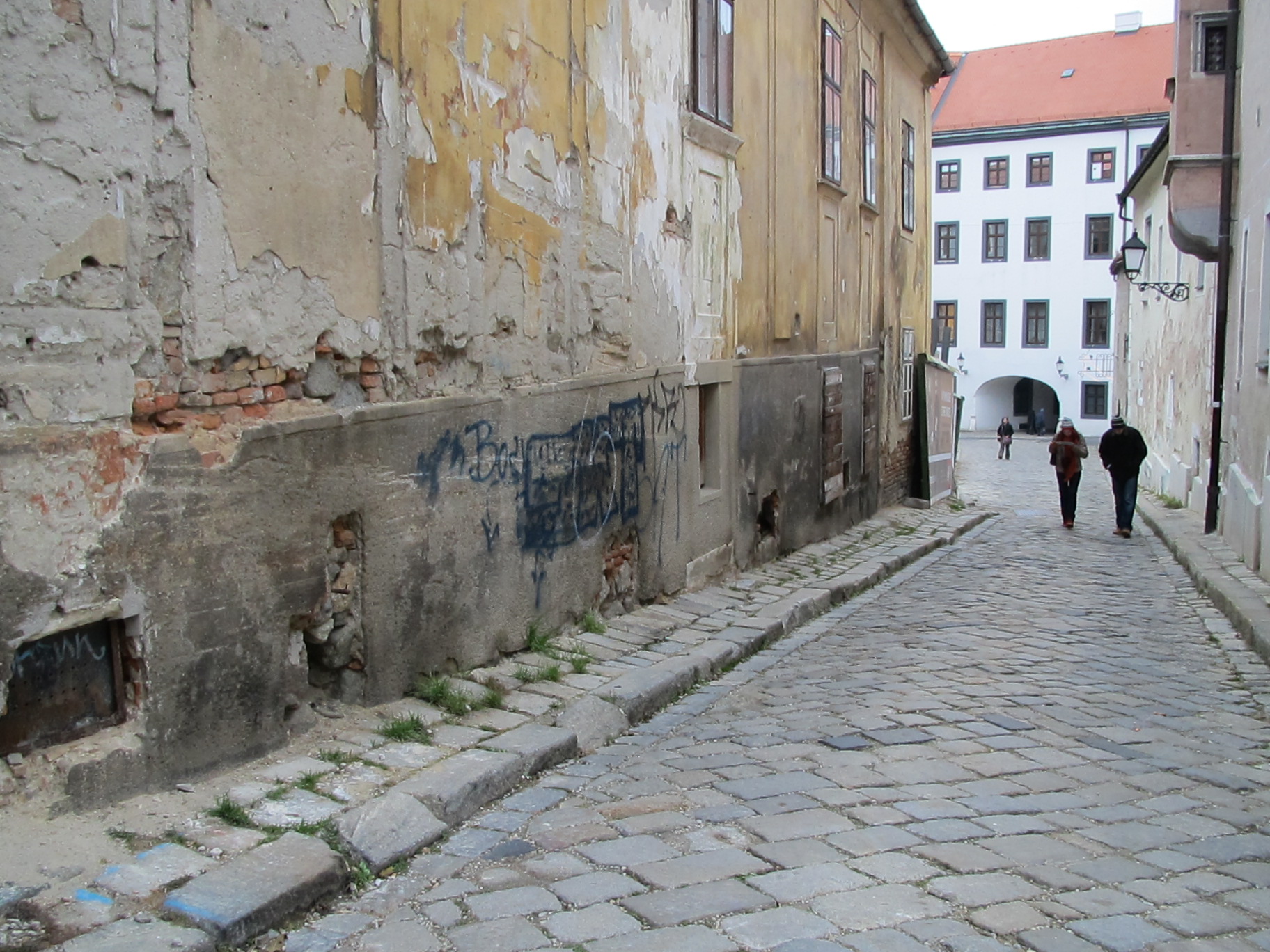
Note to the wise: When the Swiss label their liquor chocolates, they mean it. It’s not just liquor-flavoured, it’s a quarter-shot of booze in every bite. Adjust consumption levels accordingly.

We bypassed the serious liquor chocolates and had truffles instead. Their ranking: Fabulous. Maybe even better than the German chocolates but in the interest of judicial impartiality and rigour, I would have to go back to Germany for further testing. It would only be right.

This slideshow requires JavaScript.

Going Around the Bend

You can never have too many antler decorations.

Being an obsessive planner, I already have a foot in the door on 2012. In just a few days, the earth tilts to that lovely point where the days will grow longer, Christmas will come and then boom, the New Year begins and we enter the last trimester of our time here.

With all that in mind, I’ve tightened up the blog page a bit – I noticed it was getting too wordy. I blame the fact that my employment of English is stifled here, so I just let’er rip at any opportunity to play with my language of choice.

In the meantime, Dave and I trolled through two nearby tiny villages, Le Landeron and Le Neuville. The latter has taken Christmas decorating to a point not often seen on a municipal level. Obviously operating within a budget, the town’s numerous collection of Christmas trees are decorated with funky handmade ornaments made from soup cans, CDs, stuff like that. Very nice. Very unique. Very Swiss.

This slideshow requires JavaScript.

Whistling Winds

Santa's in trouble!

Santa hangs over our town’s canal, atop a white reindeer, and he is in trouble.

When he was first strung across the Suze (not Suez) Canal that runs through the centre of our town, he was a good 20 feet above the water.

The only safe place for an umbrella in Storm Joachim.

Not any more. Wind gusts of up to 150 km/h, the marker of Storm Joachim, arrived last night, bringing with it a good gulp of rain. The canal waters are up, Santa’s reindeer is tilting nose down toward the rising water and any kids who believe in Santa would have their nerves rattled to see both him, and their gifts, in such peril.

In a rare move, the Swiss have cancelled boat travel on Lake Geneva. Meanwhile, a train struck a fallen tree, injuring 12 passengers, but not too bad. It raises the question of why trains don’t have seat belts.

No other reports of devastation have come in, but Joachim reminds the Swiss of the 1999 Boxing Day storm, Lothar, which uprooted mature trees and chucked them in the air, as much as 80 metres high, forester Forester Jakob Zaugg told a local news site.

It's a storm? Let me at it!

10 years later, he says the storm was good for Switzerland’s forests, which were becoming, gasp, too old, rendering them unstable. The storm weeded out the dangerous trees and now Switzerland has an abundance of new growth. Zaugg should not visit Canada’s west coast where asserting there is such a thing as a tree being “too old” is like advocating euthanasia at a conference of Catholic Bishops. It would not fly.

But lots is flying around here – branches, signs, umbrellas. Being a Canadian, I was out enjoying the storm. The Swiss think I am crazy, but I do it for Canada’s national security.  One of the primary reasons no one bothers to invade Canada is our legendary weather, which they believe has our ground in a suspended state of permafrost.

This is okay with me. It’s cheaper than ramping up our armaments, but it comes with a solemn duty on the part of all ex-pat Canadians, and that is to go out in the worst weather possible, greet people with a happy smile and exclamations over what a beautiful day it is. They can only conclude that if hurricane-force winds are a refreshing breeze to  Canadians, then they don’t want to see what our weather is like on a bad day.

As the saying goes: There’s no better national defense than a good offensive weather report. Or something like that. We can keep Canada all to ourselves.