Watch your step

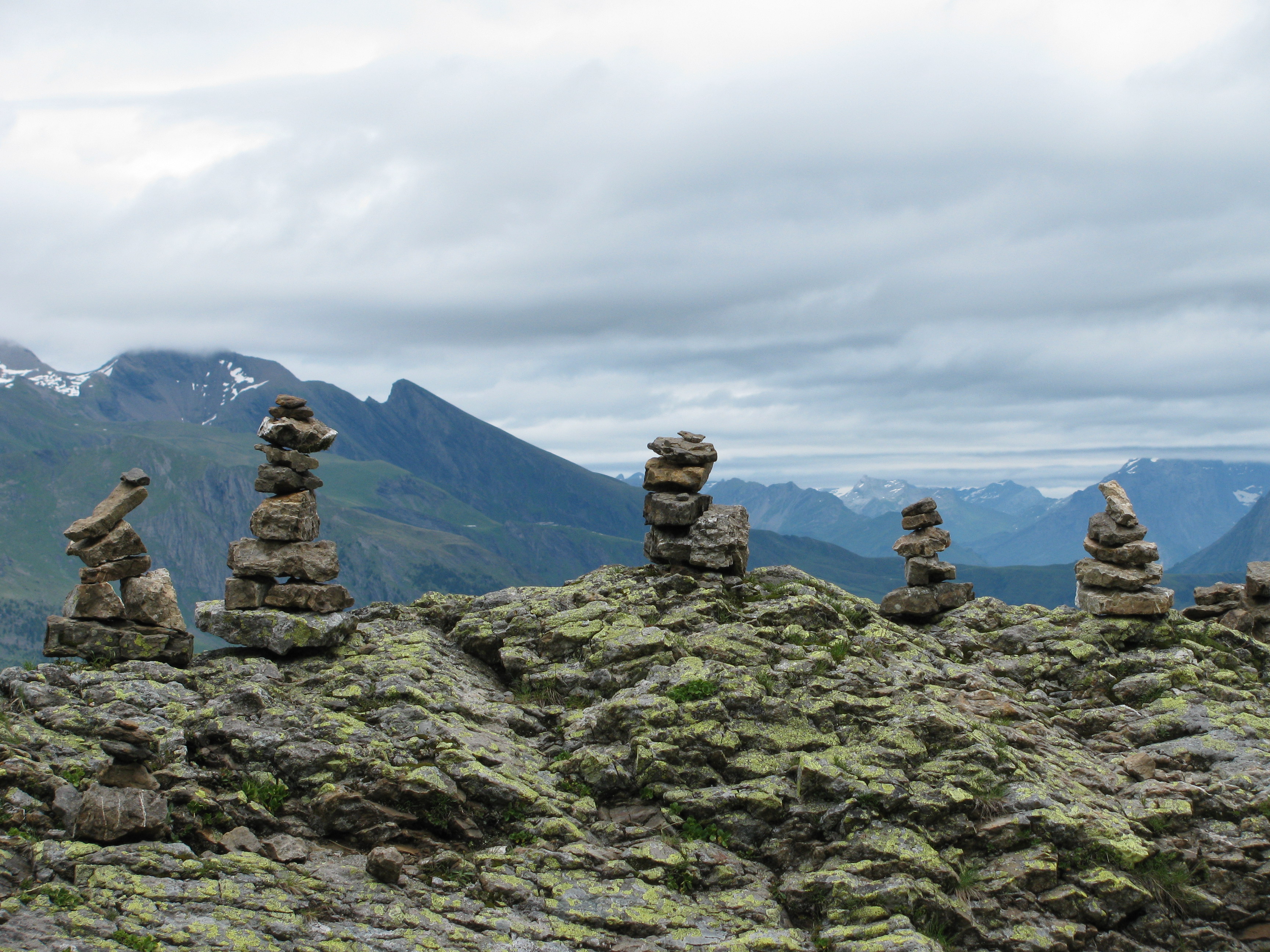
The Swiss version of Inukshuks - a more stream-lined design, lacking in pretension.

We turned away from the Mannlichenbaln look-out with the satisfaction that came from knowing that the rest of the hike would be a gentle downhill stroll,dropping from 2,342 metres to 2,061 metres over a 4-km (2.5 mile) trail.

The problem is that a good piece of that drop appears near the beginning of the journey.

I could be wrong about that – the pitch might be only a 30-foot drop over about 50-feet, but as a borderline acrophobe, it looked pretty bad to me. Remember, I’m only five-feet tall – the slightest undulation in the earth’s surface looms larger at my height, or lack thereof.

Every time Dave sees an Inukshuk, he threatens to kick it down. It is his schoolboy playfulness that makes him say that, but as soon as he got within range of a stone-statue field at Kleine-Scheidegg, he started fixing broken statues. What the heck!?

Dave quickly covered the worst of it owing to his long legs and impeccable sense of balance. I, meanwhile, scurried down crab-like, sideways with my fingers clenched to the rope bordering the steepest part of the slope. I would have got down on all fours and crawled, but there were Swiss everywhere and I was mindful that they not see me fall to such depths symbolically, even as I feared falling to worse depths literally.

The path gradually tilted back into a reasonably level grade as we headed south.  Looking back from the glory of relatively level ground, the pitch did not seem so bad, and I decided to adopt a non-chalant attitude towards this mountain-hiking business.

The trail winds along the ridge, without benefit of a single guard rail, which as I pointed out before, is how the Swiss “thin the herd,” and also thumb their noses at safety-conscious Canadians.

I am not wrong about Canadians and their national obsession with safety. As a three-term parks commissioner, I had the unfortunate experience of sitting through meetings listening to shrill arguments against accepting a particular piece of oceanfront parkland from a developer because it featured a narrow rock gorge, the very thing that I asserted made it a steal-of-a-deal while other commissioners fretted over how to protect the public from it by installing concrete blocks, high fencing and an abundance of bright yellow signs depicting human figures falling from great heights with a crown of exclamation marks about their heads as they contemplated their surprising and very imminent deaths.

To listen to the phobic commissioners, one would such think such a fatality occurred weekly, but there have never been any recorded deaths at that site.

I lost that vote, but I am not bitter.

I do wish, however, the Swiss considered guard rails with a more generous eye.

The beetle was clearly coming after me!

As we made our way along, we spied a sparkly hued beetle picking across the path. As I photographed the beetle, it crept gradually in my direction and so I took a step backwards, then another and still one more.  At that point Dave started to twitch and say “Jo!” with an air of urgency.

We have raised two boys, one of whom put us on a first-name basis with the emergency room staff at a hospital in a town where we had then lived only eight months, so Dave and I have both developed immunity to airs of urgency, not because we don’t care, but because they are so common and the ensuing trips to the hospital so much a regular and predictable part of our lives.

I was unknowingly within a spit of going over the edge, and as is always the case in these matters, things got complicated. An elderly undoubtedly Swiss couple – and I say “undoubtedly” because people of that age from any other nation would wisely stick to golf or some other sport that keeps one within a reasonable proximity of sea level – where was I? Oh, the couple – they were just readying to pass between us, and Dave wasn’t sure if any sudden movements on his part, such as grabbing his wife before she started a new life as a quadriplegic, would cause everyone to flinch and thereby more assuredly send me, and maybe a few others over the edge.

He repeated “Jo!” to which I said “What!?” in irritated tones.  I did not see anything to worry about, but then I never do, primarily because I never look where I am going. I leave that to Dave, so you would think I would listen to him. But I don’t.

It suddenly occurred to me that we were in the Swiss Alps and that if Dave thought I should stand still, it might be a fine idea, so I stopped and disaster was averted. The Swiss couple passed by, commenting that the beetle was of the Schoenborgh valliagnachtunggesselschaft variety, which I asked them to spell, but they only repeated the name as though its spelling was as self-evident as the spelling for the word wow. I suppose they did not want to embarrass me by treating me like a second-grader incapable of mastering a simple 17-syllable word.
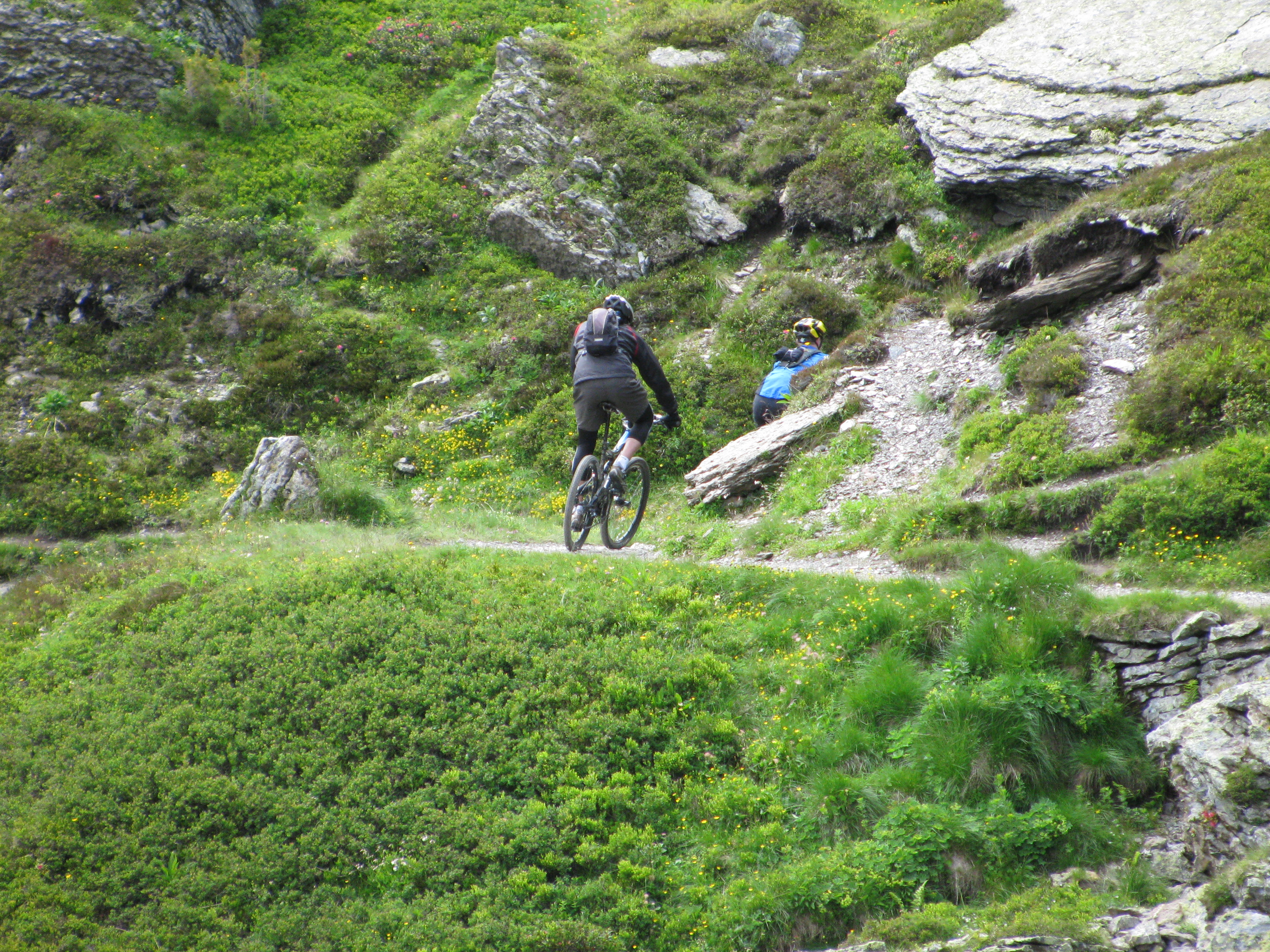
We did not expect to see cyclists up on the Kleine Scheidegg trail, but there they were.

We made it to the end of the trail, once having to duck out-of-the-way of speeding cyclists, their presence and velocity suggesting their own ends were nigh. One bump of the wheel and that would be it, although they appeared to be Swiss, and so having attained adulthood, were likely not of the accident-prone variety.

By way of interest, while the Kleine Scheidegg trail is long-famous for its dramatic mountain topography, this has been added to in more recent times as it is the model for the Gran Turismo video race-driving game series.

If you go: The trail is mostly level with a well-maintained gravel-and-soil-packed surface that would likely hold well even in wetter seasons. Hiking boots are recommended, but sports shoes are okay. Going at a relaxed pace owing to my burned-out achilles tendons, we covered the 2.5-mile trail in 73 minutes.

Food & Water: Eateries are plentiful at the base of the gondola leading up to the Kleine-Scheidegg trail, however, stopping in at the local grocer “Coop” to purchase a submarine sandwich and a bottled beverage is recommended, particularly if you choose to hike the trail in the hotter season. Cafeteria-style food is available at the end of the Kleine-Scheidegg end of the trail, but not at the Mannlichenbaln gondola station.

Curious about the cost? 

  • 95 CHF Return train travel from Biel/Bienne to Wengen
  • 25 CHF Gondola between Wengen to Mannlichen
  • 16 CHF Two sandwiches purchased from the grocery store
  • 20 CHF Two more sandwiches purchased at another grocery store
  • 22 CHF Lunch at the Crystal Bar Cafe Wengen
  • Total: 178 Swiss Francs (CHF) – or $204 Cdn or $211 US

Tomorrow: More photos from the Kleine-Scheidegg trail and the cogwheel train trip down the mountain.
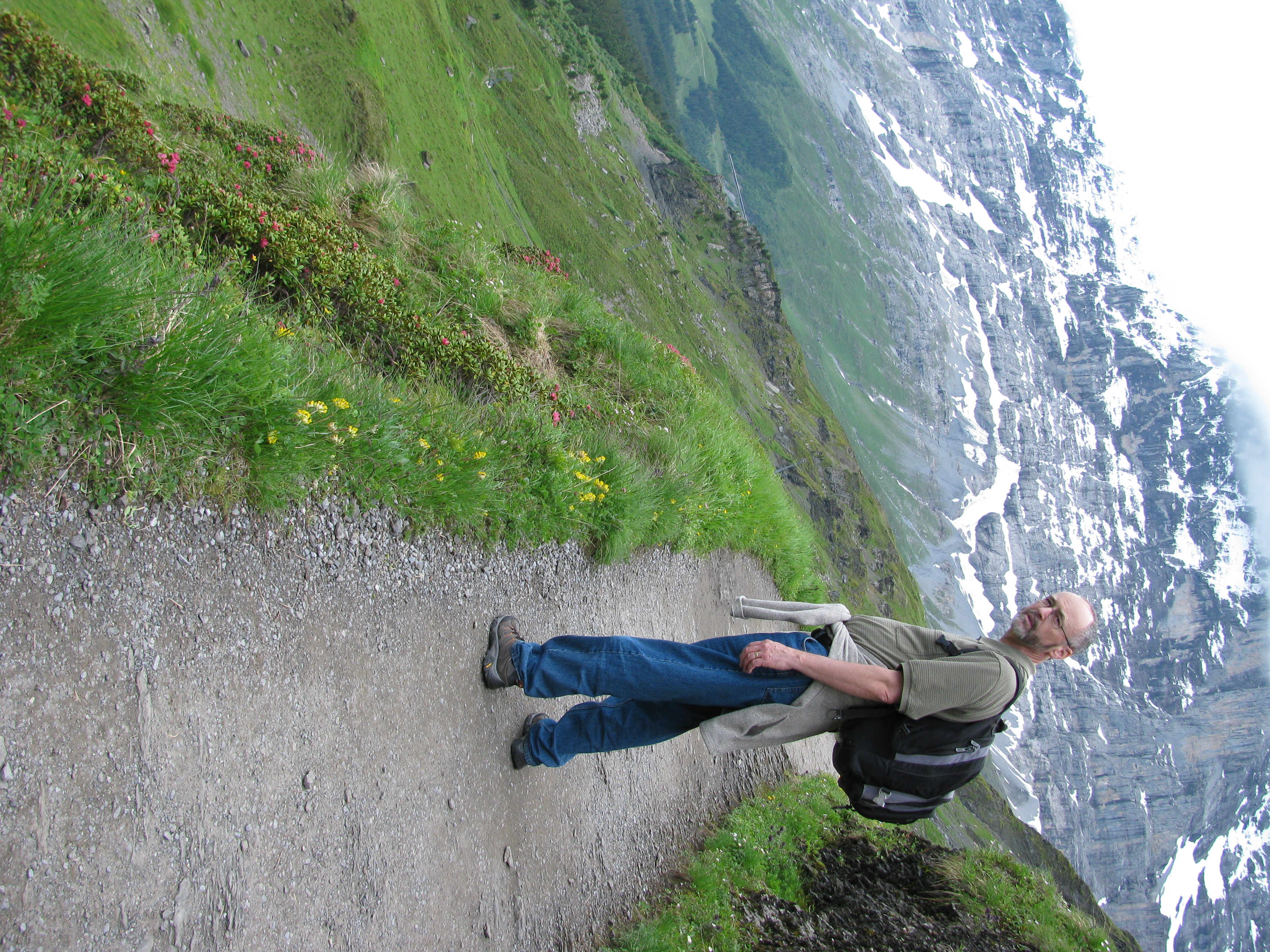
Dave does not trust me near steep drops. Yes, he is right to not trust me.

Kleine-Scheidegg trail, Swiss Alps, Jungfrau region
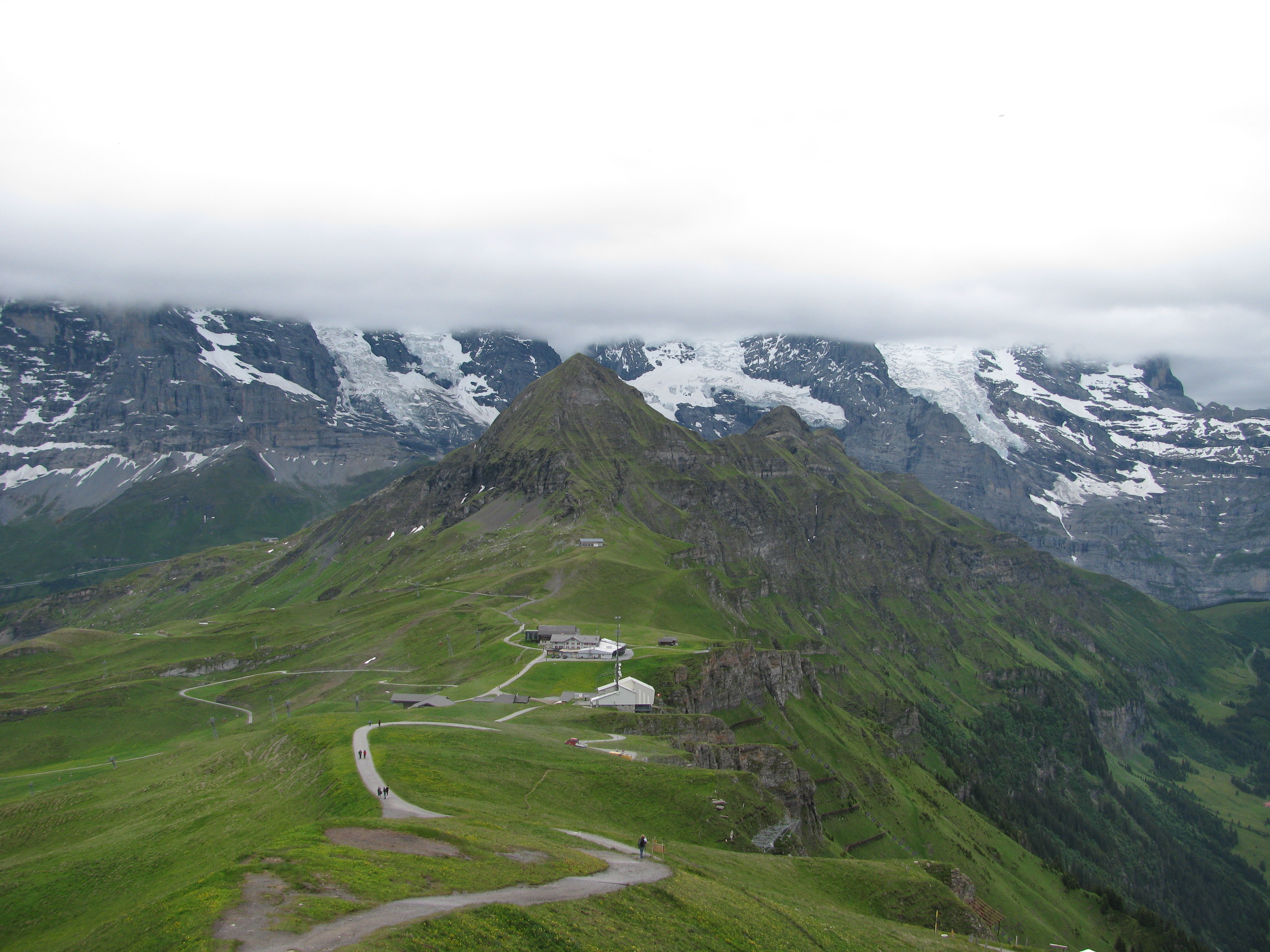
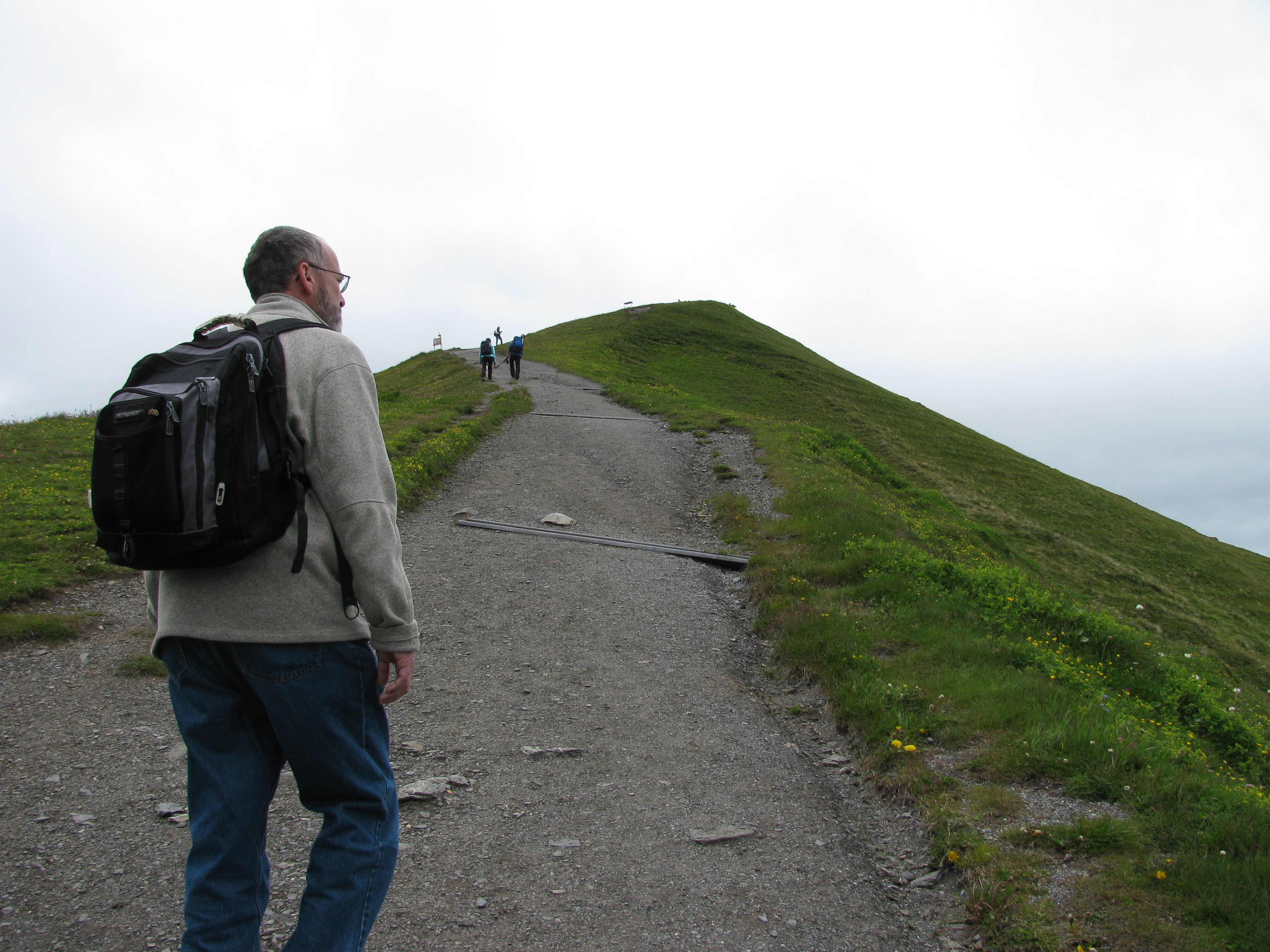
Higher still in the Jungfrau mountains

The view from Mannlichenbaln looking south toward the Jungfrau mountain range.

Stepping off the gondola that runs from Wengen to Mannlichen, one turns right and is immediately confronted with doors to washrooms. This is a pleasant surprise and likely a necessity for anyone suffering an intestinal reaction to the gondola’s final bump and sway before docking.

A chunky wooden bench outside the station allows visitors a moment to pause and reflect on the heights they have attained. How high were we? We were looking down on Murren, where we had lunched weeks ago, and at 1,660 metres, we then thought that was pretty darn high. Mannlichen’s upper station is at 2,230 metres, and from this vantage point, Murren looks like a pretty play village of the sort that can be purchased to accompany miniature train sets.

Appearances are deceiving. A wide mostly even surface makes it look easy, but this trail is at a rather steep pitch.

The air thins out here, which is unfortunate, because a steep uphill climb to Mannlichenbaln still waits for those intrigued by a nearby look-out and if ever there was a need for oxygen, this is it.

Here is an important note for travelers making decisions under the guidance of Rick Steves, our favorite travel guru. Steves’ guidebook says the walk is 10 minutes, which sounds like a breezy lark, but it’s closer to 20. Now 20 minutes still comes across as a brief stroll that is worth the price of seeing the Unesco-marked site at the top, but it is a steep climb, made all the more tricky by the fact that it appears to be a friendly gravel road.

Do not be fooled. This is no mountain back lane. As we made our way slowly up the mountain, I thought of important things I had left behind at the hotel, things like steroid inhalers, Aspirin and nitroglycerin, all handy in the event of a heart stoppage – mine or some fellow hikers.

Of course, while I cautiously paid heed to internal signs of protest from my heart, I watched with great annoyance as chunky elderly Swiss with those cursed walking poles strode about. They are everywhere, vigorous, mountain-climbing, cross-country-bike-riding, cheerful Swiss. How they sicken us all with envy.

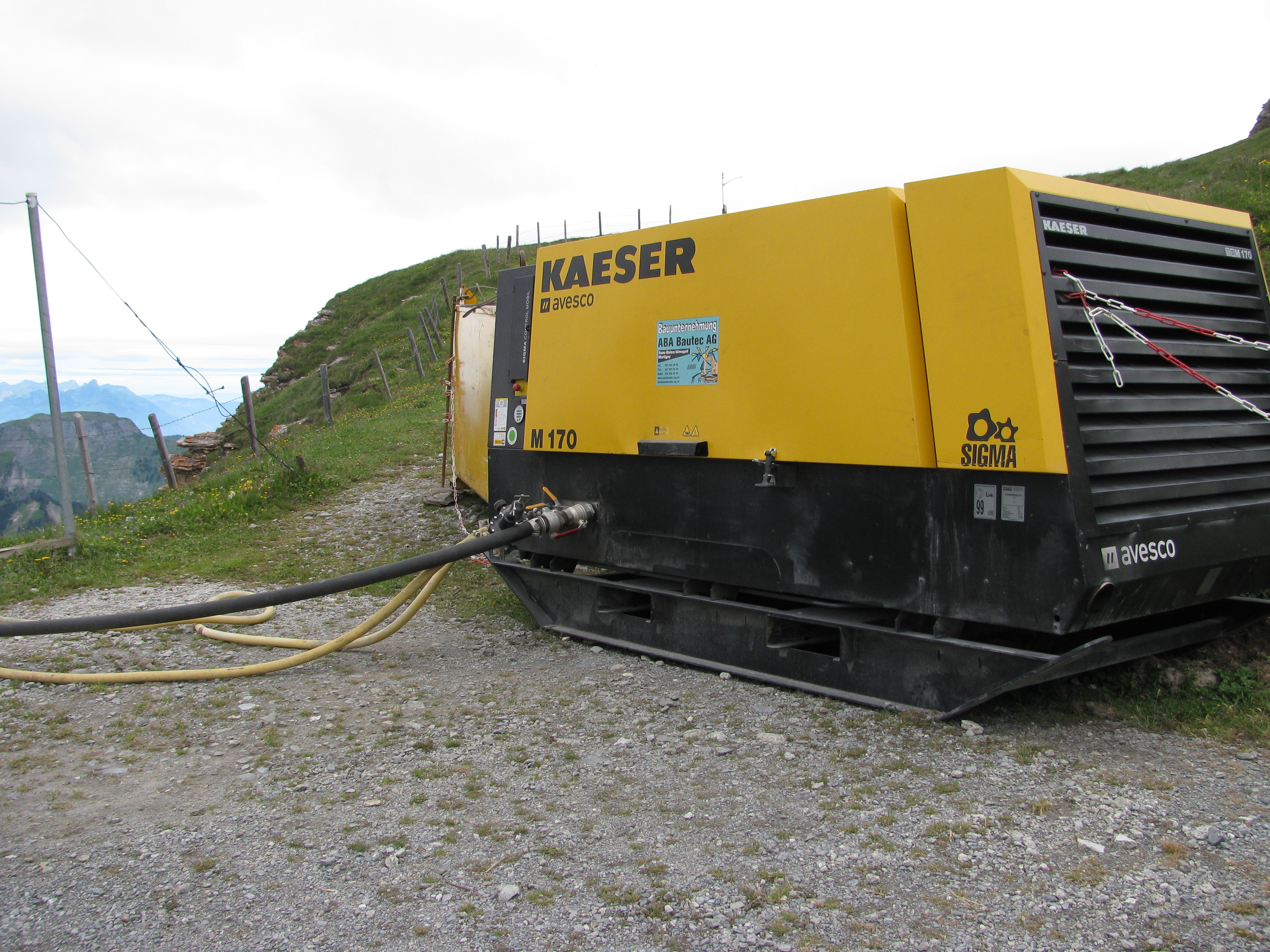
We could discern no actual use for this piece of equipment except to signal that the Swiss have no problem plunking heavy equipment anywhere, even on mountainsides.

While en route, we came upon a loud piece of heavy equipment strung with hoses – we peered over the edge to see what the contraption could possibly be siphoning or pumping out from such heights where there were no signs of any buildings, but the hoses disappeared down the slope. The only hint of its function was a lingering septic aroma wafting in with the mountain air. With no machine-operator in sight to explain this, we shrugged and continued the near-death march up the mountain.

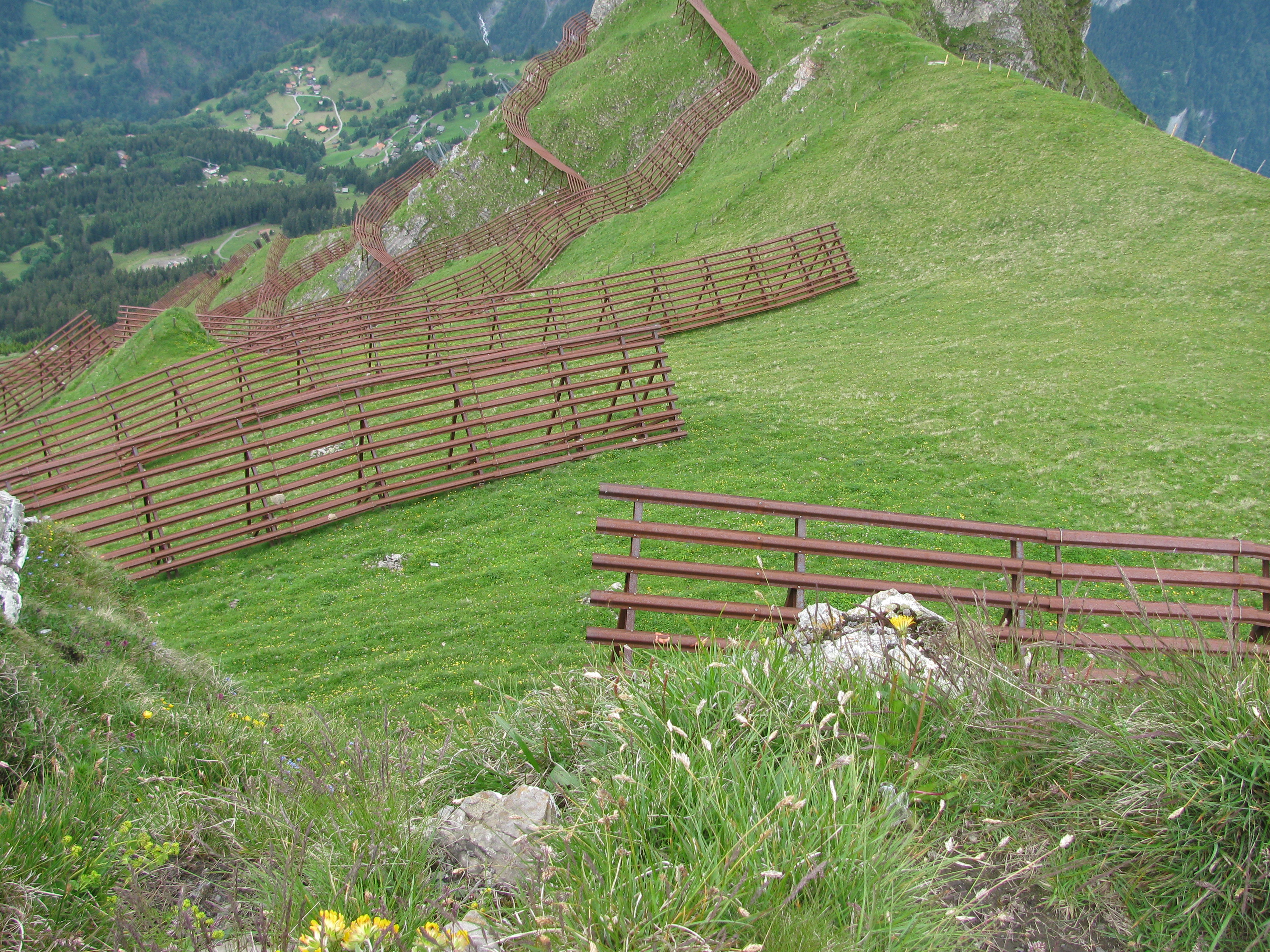
If you stumble, these will stop your fall. Note: The challenges of capturing perspective on camera means that this slope is much steeper than it appears. Yes, as much as the fall will hurt, the landing will be worse, but still better than going the whole 2,300 metres down to the valley floor.

The final 40-60 feet of the climb is over uneven rock so the Swiss have fashioned a few metal poles strung together with rough rope for visitors to grasp for safety. Those fearful of plummeting need not fret – they will soon be caught in the teeth of steel snow-stoppers that flank the mountainside like the brims of stacked hats, and so the fall will be brief, but likely still fatal and certainly extremely painful.

At 2,342.6 metres, we rounded the top and were treated to a lovely 360-degree view stretching all the way to  the waters of Brienzersee and the Lauterbrunnen Valley. This is not the top, of course. The enormous mountain peaks of Jungfrau, Jungfrauloch, Monck, Eiger and Schreckhorn still towered beyond.

Tomorrow: The Mannlichen-Kleine Scheidegg trail. 

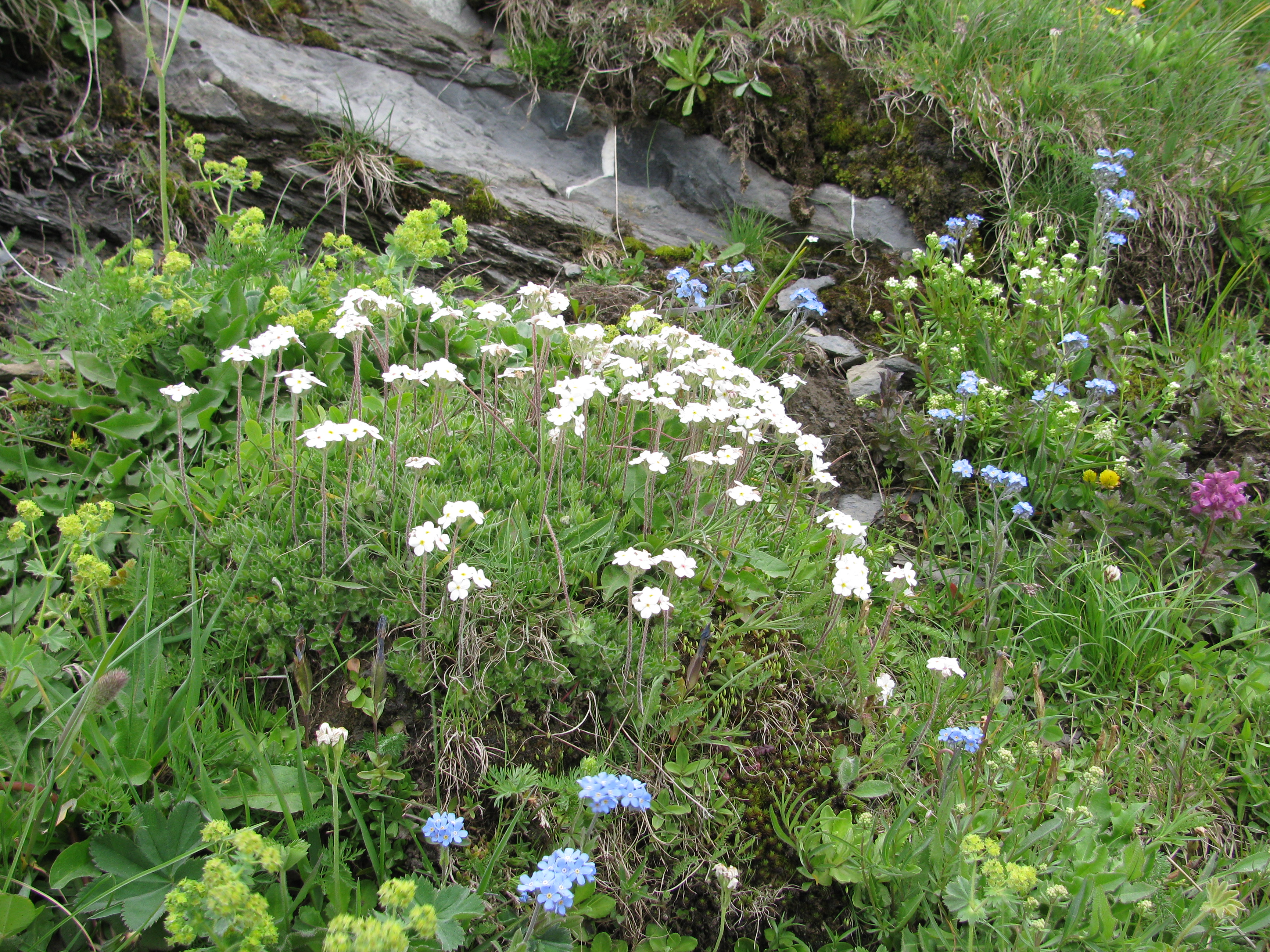
Alpine flowers at Jungfrau.

Looking north toward Lake Brien or also known as Brienzersee.

At the look-out - benches, another trail to another look-out, not a single safety fence in sight. This is not Canada. If you fall off, it is no one's fault but your own. The Swiss say: You knew they were mountains, right?

Swiss cheesecake

On the cogwheel train ride up from Lauterbrunnen valley to Wengen in Switzerland's Jungfrau region.

This place is makes me feel good about myself, mostly because I’m running into people more abrupt than me.

Saturday, Dave and I returned to Switzerland’s Interlaken region to see what was on the other side of the mountain range we had admired weeks ago and to see if we could make it to the “top of Europe,” that is “Jungfraujoch,” which stretches 3,454 m into the sky.

It’s  a mystery why Jungfrauloch is called the top of Europe when it sits in the shadow of  Jungfrau, a 4,158-metre colossus. My only reckoning is that the cogwheel train that grinds its way up this mountain only goes as high as Jungfrauloch, so it might as well be the top.  I can imagine the railworkers reaching the tip of Jungfrauloch, only to see greater heights beyond them, and in their exasperation they put in the last railway spike as a way of saying, “What taller mountain? We don’t see any higher mountains around here. This is the top of Europe and if you want to say any different, you pound a rail track to it. Until then, this is it.”

I don’t know this for sure. I am only guessing. Another mystery is why the region is called Jungfrau, which translates into young woman, or someone told us “virgin.” Perhaps it was virgin territory at one time, but now it is a playground criss-crossed by tour buses, trails, trains, gondolas and the like. Nevertheless, it is massive enough to absorb these human tracks without losing it’s grandeur.
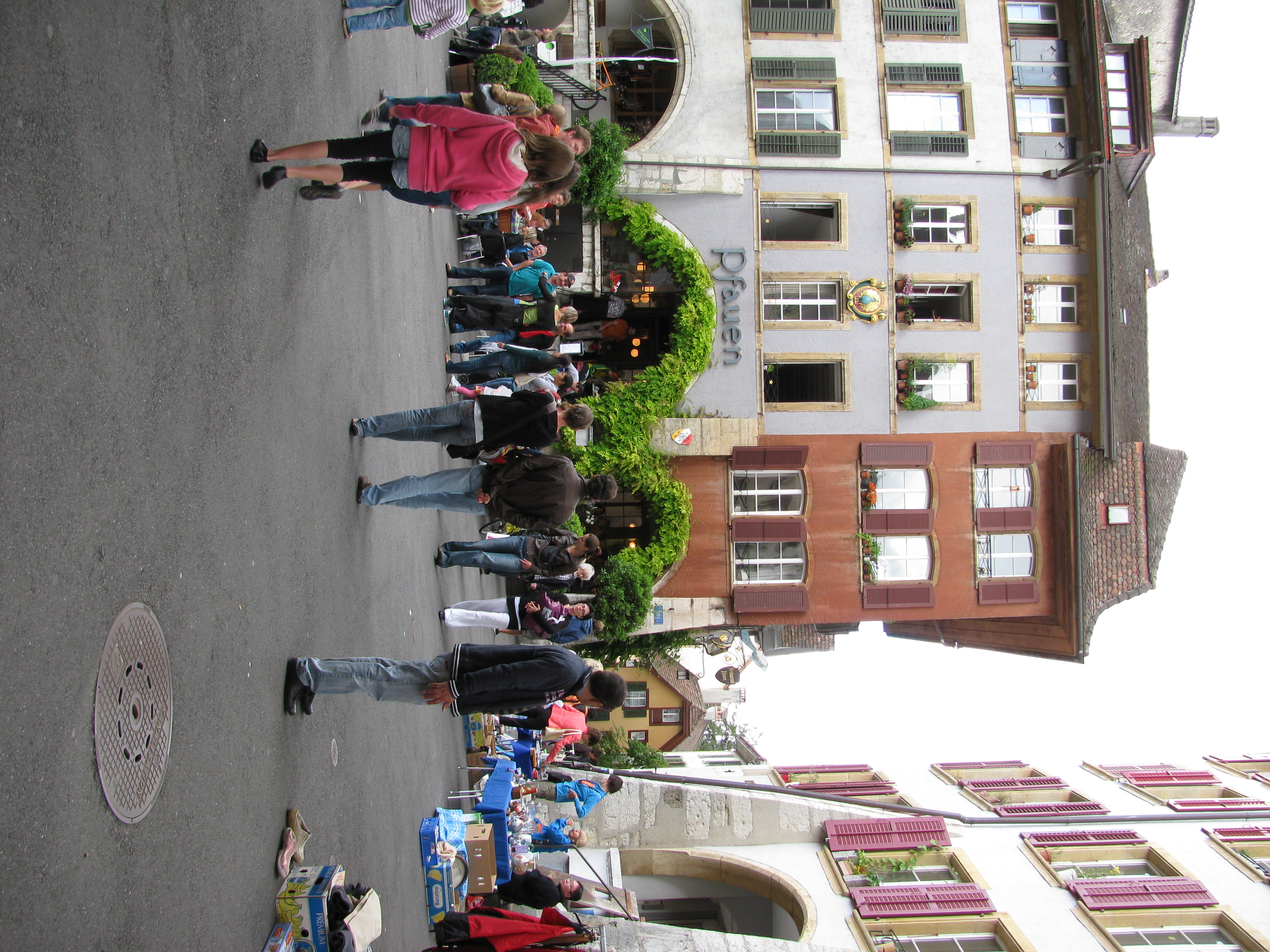
Hildegard, hard at work. Time waits for no man, and Hildegard waits for no customer, although technically, she is a waitress, so you would think she'd wait around while we figured out our order.

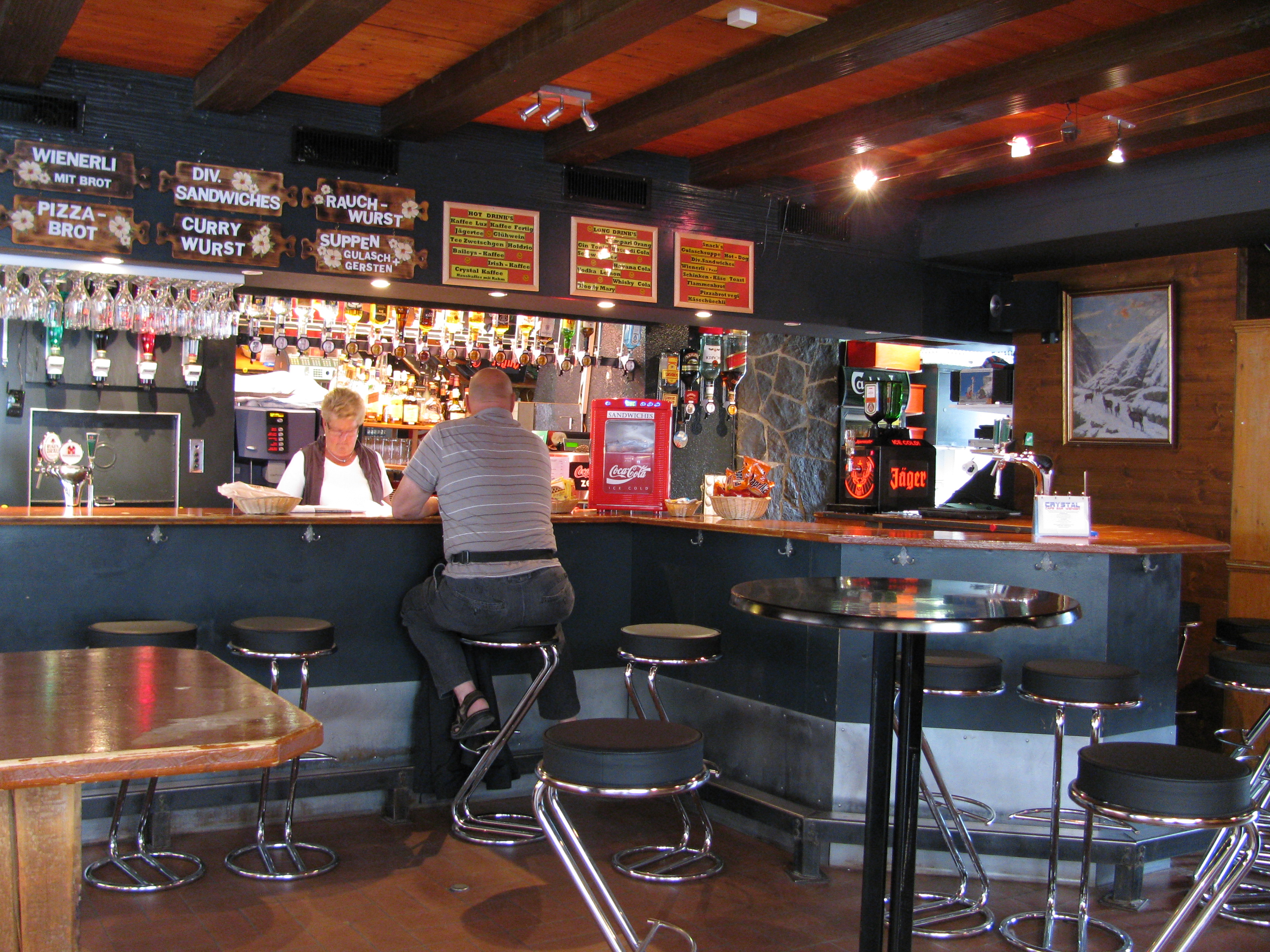
We got off the train in Wengen and stopped in at the Crystal Cafe Bar, a place that looked and felt eerily like Hideaway Tavern in Redditt, Ontario, which is run by a robust family of Icelandic extraction.

Hideaway no longer functions as tavern, although the family is still there and they still run hunting and fishing excursions, as well as rent cabins. We half expected to see them when we stepped inside Crystal Cafe’s honey-beadboard wood interior with plain, sensible furnishings. I am not making up Hideaway Tavern, which is now known as Hideaway Outfitters. Click on Hideaway to check it out.

The operator, an older woman who looked as though she might have just topped the mountain herself that morning and would do it again at the slightest suggestion came to our table. Let’s call her Hildegard.  I asked for a croissant and Hildegard said, “No croissants! All gone!”

Okay. So I asked about danishes and she said, “No!”

A little abrupt, but not in a rude way. I suddenly realized I was staring at a person who had taken my level of abruptness and doubled it up. She was to me, as I am to most Canadians, that is, just a little sharp. It was refreshing. After all, I am in some oblique way related to these quasi-Germanic tribes. Obviously, the plain-spoken gene is dominant.  Hildegard tried to escape then, but we hailed her back and managed to put in an order.

Cheese cake in theory; quiche in fact. Lousy cheesecake. Good quiche.

We watched her work other tables and she had the same manner, which roughly went along the lines of  “what do you want?” and if the customers didn’t know what they wanted right away, she wasn’t about to coach them along. She would just leave while they sorted out their problems on their own. She had enough work to do without babysitting customers.

Dave ordered a grilled ham sandwich, which was good, and I ordered cheesecake. Cheesecake is not exactly recommended for lunch in accordance with the Canada Food Guide, but it is loaded with protein and I am ever curious as to the form cheesecake takes in other countries.

As a side-note, about 28 years ago Dave and I sublet our townhouse to a Swiss family. The wife invited me over for cheesecake one afternoon, and what with her being Swiss, and this being a cheese-laced dessert, I expected great things. What a disappointment. It was the worse cheesecake I had ever had. I think she was from the German side of Switzerland and so did not brook any nonsense that would dilute the cake’s cheesy character, such as by adding whipping cream, eggs or sugar.

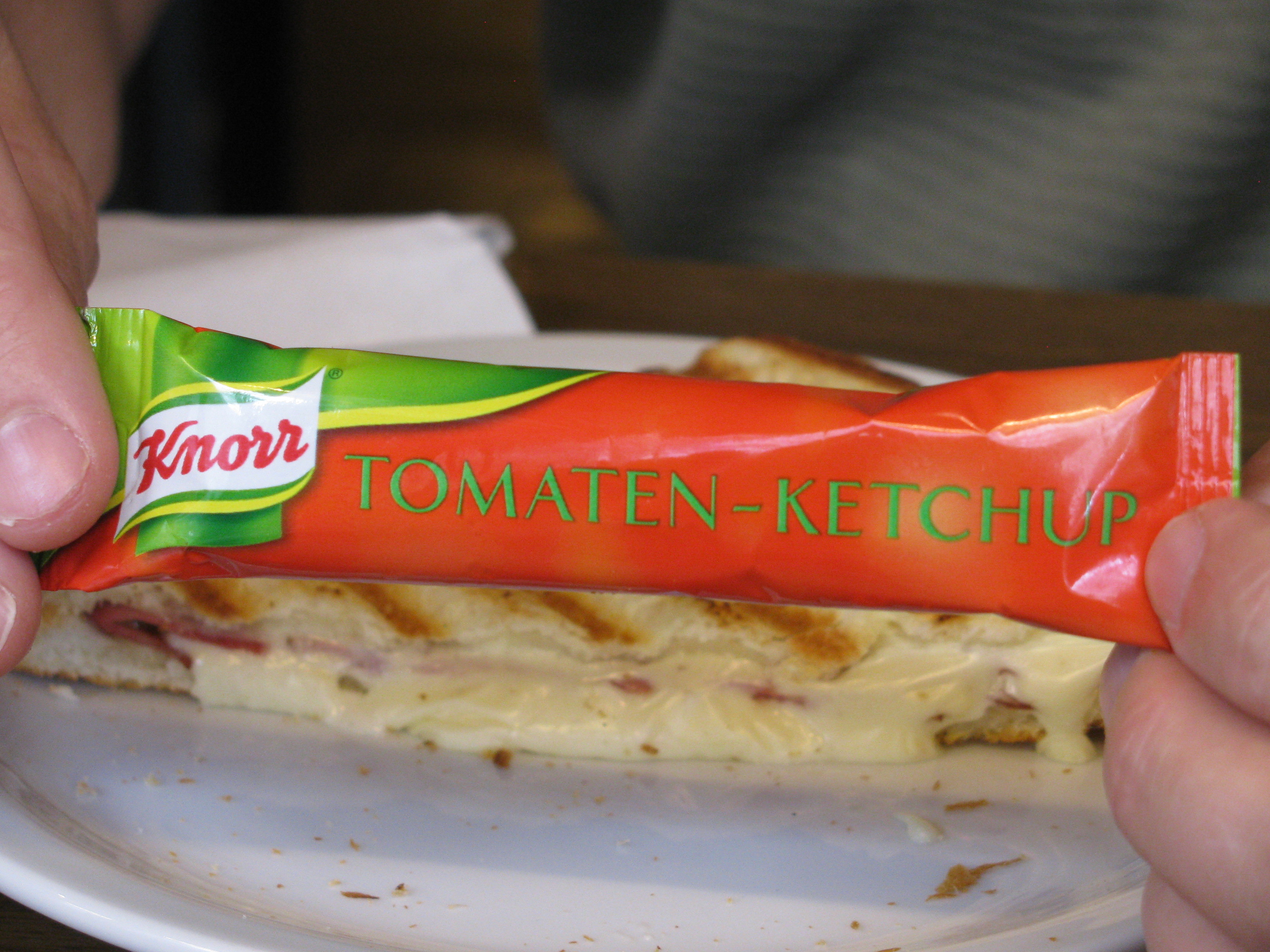
We were surprised by the dimensions of the ketchup packet. We think it says, "If you don't like your lunch, just spray it with this."

But no mind. After a 28-year interval, I was ready to try another Swiss cheesecake.

Hildegard returned with two small cheesecakes with scorched black tops. This made me feel at home and I silently blessed Hildegard for correctly reading me as a person familiar with burnt offerings.

As cheesecakes go, these were infinitely worse than my last Swiss cheesecake. In fact, they were not cheesecake at all, but quiche. Very cheesy quiche. And, as such, were excellent. It was exactly the right thing before trying a mountain hike.

Tomorrow: Heading up the mountain.

Swiss people and parks

Biel/Bienne beach gets a summer face-lift.

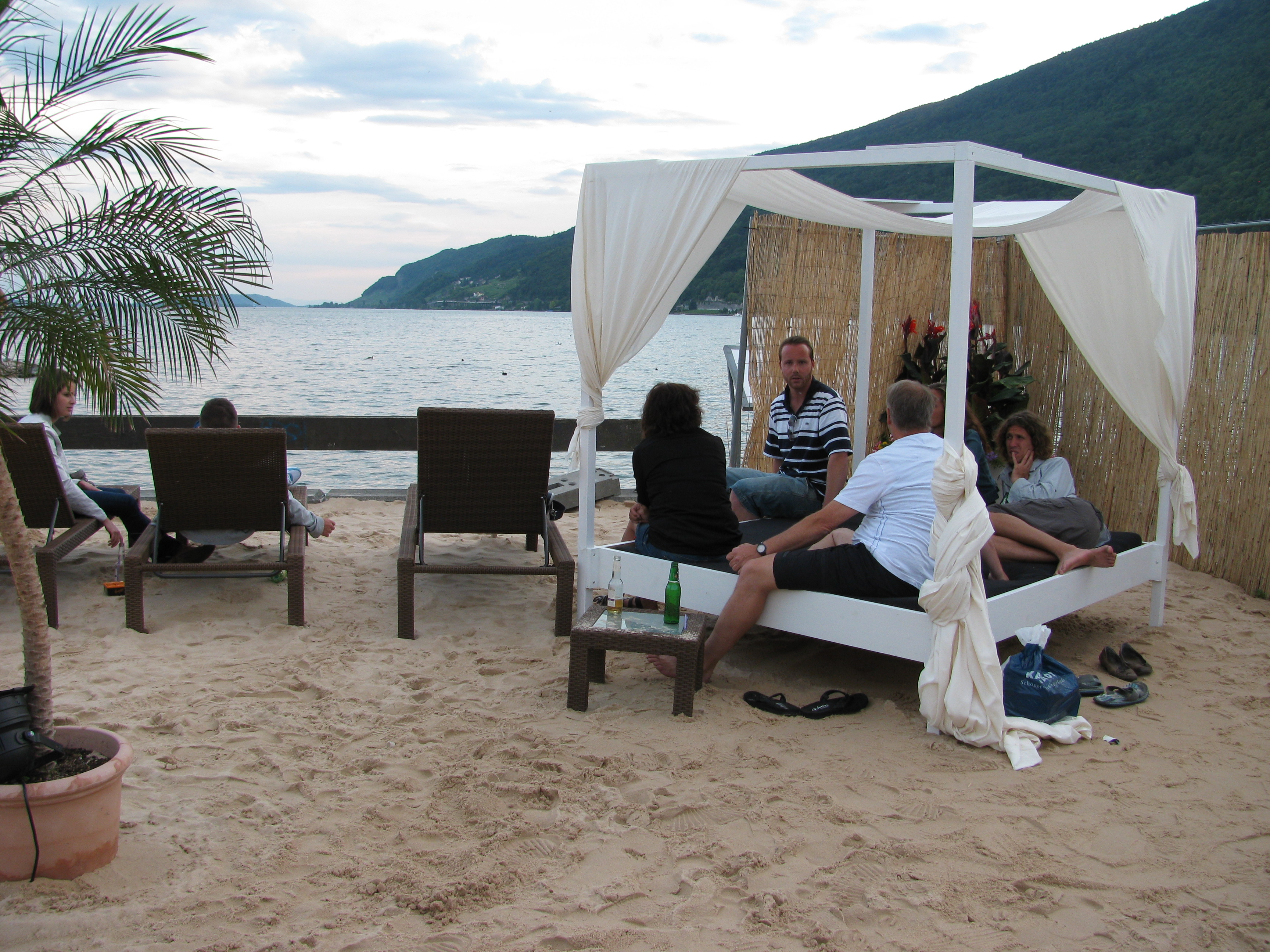
We took a 15-minute stroll down to the lake last night and discovered it had gone tropical.

Ordinarily, the waterfront looks similar to North American urban shores with wide green stretches of parkland, towering leafy trees, shrubs hugging wood benches and paved promenades.

BEFORE: How the park usually looks - asphalt, lawn, shrubs, rock-line shore.

Last night, we found a corner had been barricaded behind unpainted plywood walls, its pebble and asphalt ground topped with 132 cubic tonnes of fine quartz  sand four-inches deep. The park benches had disappeared, to be replaced with potted tropical trees and rambling open-air wood cabanas serving up food and drink.

Wood boardwalks already made gritty with foot traffic led past a discreetly tucked-away public washroom trailer. The sandy spans between the boardwalks were furnished in wickery loungers, tables and chairs, as well as what can only be described as beds. It was all lovely.

AFTER: Palm trees, sand, lots of people.

I am not enthusiastic about alcohol-service in a park, however, the clientele looked dignified and sober, but that was at 9 p.m. I cannot say what it looked like at a later hour.

For those Victorians reading this, imagine the screaming that such an undertaking would create back home in Victoria where a good stretch of the urban waterfront is paved parking lot, and should an ice cream kiosk dare to brave the virgin cliffs along Dallas Road, it would be met with the city’s version of a lynch mob, that is, a preservation society that would quickly douse the vendors in letters-to-the-editor and petitions.

While we’re on the topic: Victoria and its neighbouring communities are home to almost 100-km of trails that run through rainforest, oceanside and farmland vistas, and yet only two public washrooms can be found along the trail. It’s as though the whole population gets by without bladders.

Meanwhile, the Swiss look at a beautiful lake, and think “wouldn’t sand be nice right here, along with some place to get a snack,” and then they do it.  No protest, just plenty of Swiss out along with two Canadians,  enjoying the lake air on a hot summer evening.

Addendum: I have since learned that the city of Biel/Bienne funds this seasonal oasis. It is set up every year and taken down in the fall. The city usually removes the sand, but sometimes spread it out over the pebble base, instead of trucking it away.

Large cabanas with long ship-hull-inspired bars serve food and drink.

Dave wanders into the park and wonders, where the heck did all this sand come from? And the beach furniture? And the hot dog stand?

Switzerland’s see-through public washroom + toilet tips for travelers

Lausanne see-through washroom - at least it appears clean, probably because no one will use it.

I’m sure the Swiss have a perfectly good explanation for installing a see-through public washroom in Lausanne, but I cannot imagine what it is.

Don’t believe me? See the 17-second video here. 

I haven’t actually seen it in person, and if I do find it on one of our weekend jaunts,  it’s a good bet that I will not use it, because even though the crystal-glass walls can be made opaque with the touch of a button that allegedly sends an electric current through it, I don’t want to be in there should the city’s power grid fail at the wrong moment.

I don’t want to be walking by it either when someone else is using it, because apparently the opaque-function is optional. It seems like a voyeur’s dream, a voyager’s nightmare. Ugh.

A similar transparency idea was floated in the internationally acclaimed Basel Art Fair in 2004, when a one-way-glass public bathroom was installed outside of the gallery so that people could use the washroom without “missing a thing,” on the street said the Basel Art people, who we now suspect of living a seamy underworld life after-hours.  I can’t prove anything – I’m just saying. And what is going on in the streets of Basel that one can’t his eyes off the street for even a minute?

City of Victoria, British Columbia public urinal

The Swiss are not the first to come up with the idea that they are missing some great show when they are ensconced in the private walls of the lavatory. The City of Victoria in B.C. installed a door-less urinal to offer a less offensive option to its public-urinating night-time bar populace.

The idea here, one can suppose, is that this washroom is not likely to become a shooting-up zone for the city’s drug population, and users (bathroom-users, not drug-users) can keep a watchful eye for any would-be approaching muggers.

Cottagers have long had an affection for outhouses with a view – a troll through cottage-country will reveal a few outhouses with half “Dutch” doors or generous screen cut-outs.

I also own a cottage, but I enjoy the views when I am on the deck or looking out the living room window, boating, swimming, and so forth. I don’t see the need to expand the number of minutes-per-day I get to stare at trees, water and squirrels.

The problem with looking out is that others can look in, so I’m hoping the Lausanne see-through unit doesn’t catch on. I still dread visits to Australia where multi-stalled public washrooms are not always gender-specific – a situation that also exists in some parts of France, we recently discovered. No details will be provided here on how we found out.

Everyone needs public washrooms, but no one writes enough about them, much to the frustration of travelers trying to anticipate foreign bathroom customs.  I am about to change that, at least for those visiting Switzerland.

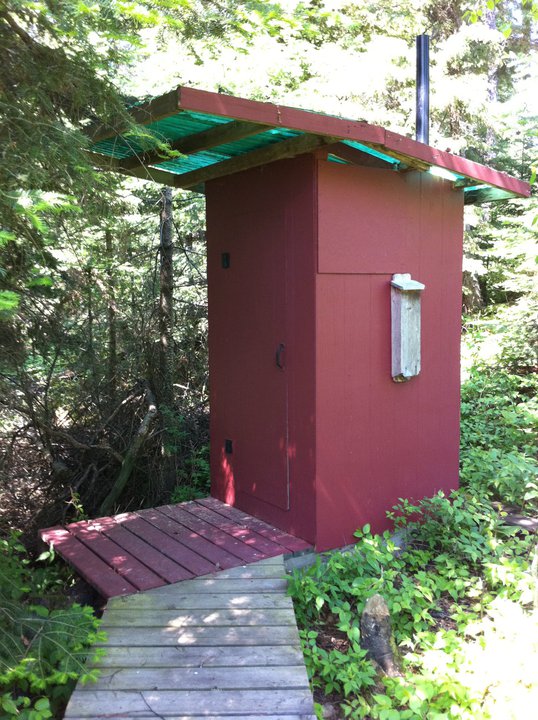
Look at that beautiful outhouse with a full-door and no windows! I'll bet it cost less than Lausanne's glass monstrosity.

Pay washrooms can be found on the streets, sometimes in shiny stainless steel stalls with a vending machine-style pay pad. Train stations frequently have them as well, and any bitterness a Canadian or American might feel about having to pony up a franc or two for a washroom quickly dissipates when inside the stall. They are kept spotless. In fact, the Bern train station has staff on hand, constantly rotating through the stalls in an never-ending sanitizing cycle.

I would not like that job, but I am happy to see someone else do it. I hope they are well-paid.

Washrooms on trains are free, but as trains are heavily used, they are not as clean as one would like, especially when trying to manage while the train rocks and sways, sometimes in unpredictable ways. I will elaborate no  further.

Tourists can get by without using a pay washroom – in fact, we’ve used them only a few times in our travels over the past few months. Many towns have free public washrooms in parks, along promenades and trails, which are kept to a high standard of cleanliness.

If these cannot be found, stop in for a break at a street cafe’ – for the price of a cup of coffee, you can use the restaurant’s washrooms, which we have also found to be unfailingly clean.

Sometimes only pay-washrooms will be located near cafeterias and malls, however, these provide a voucher for a ‘free’ coffee in the cafeteria.

Museums and art galleries generally have free washrooms.

So far, we haven’t found a pay-washroom charging over two francs, so carrying just a few one and two-franc coins should suffice.

A rumour circulates that it is forbidden to flush a toilet during certain night-time hours, out of courtesy for condo or apartment block neighbours. We haven’t heard anything about flushing restrictions yet, but have heard that running a bath late at night is frowned upon.

In the bathrooms-worth-visiting category, when at the Aescher cliff restaurant at Ebenalp, in Switzerland’s eastern Appenzell region, check out the washroom architecture. The mountainside wall of stone is exposed, allowing visitors both a view, and privacy.

Good to know if you go:

  • Carry one and two-franc coins for public washrooms.
  • To see the mountain-wall washroom, which is presumably not the only reason you would visit Switzerland, click here for hiking information about the area and mountain.

Hotel-living

A local jazz band performs at our hotel's fundraiser for a horse camp for children with disabilities.

Our hotel threw a fundraiser to  send kids to camp this week. I am all in favor of sending kids away, but am fundraiser-event averse – that is to say, I would rather throw money at a cause than throw away a perfectly nice quiet evening at home in support of it.

It’s partly due to my feeling that the amount of money spent on throwing a party or auction is wasteful; that all that money should go directly to the needy organization.
But I am wrong about that, and I know it, because as a sometimes-reluctant fundraiser, I have seen the payback on gimmicky auctions, balloon-lotteries, bake-sales and so forth.
This does nothing to alter my affection for avoiding fundraisers so I can devote my evenings to other worthwhile endeavors, such as watching the entire 30Rock season on DVD without interruption. Is there something wrong with that?
Nevertheless, when the hotel staff invited us to their fundraiser, we had to go.  While our relationship is essentially a business one – they provide us with a hotel room and we provide them with money – these are still the people with whom we have the most contact. They are in the most practical sense, our neighbours.

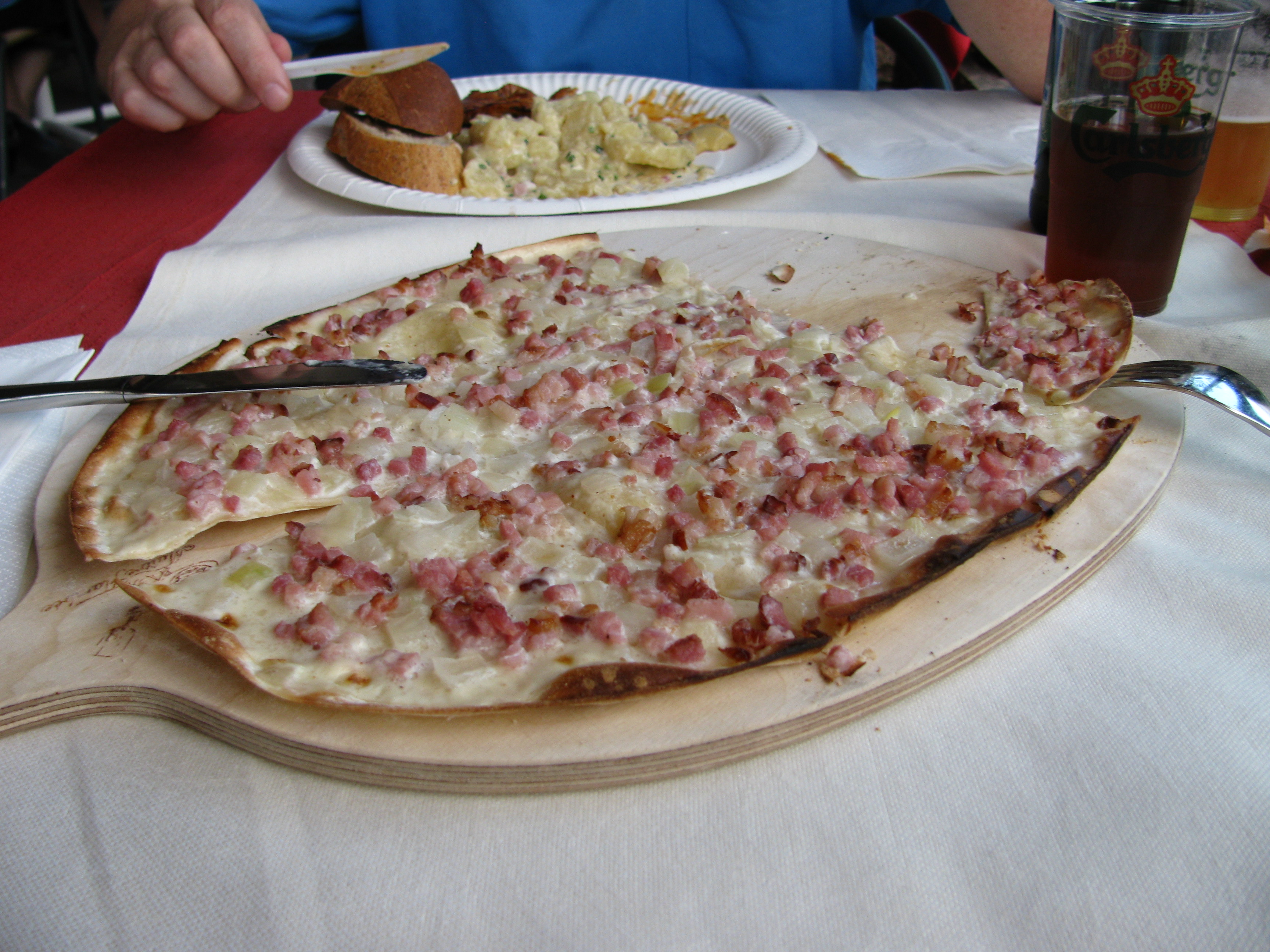
I was going to order BBQ pork steak, but the staff talked me into a Swiss favorite - Tarte flambe', which is not a tart at all, but an oval tortllla-like shell topped with bacon, onions and sour cream. It was pretty good.

When I leave my room, Theresa and Isabelle, our floor’s cleaning staff, coach me in French, much to my agony and their despair.

When I hit the street I pass a favorite smoking-break alcove and the staff (who shall remain nameless on this point because what is spoken of in the alcove stays in the alcove) always invite me to stop for a chat, the latest topic of which was marriage: Whether one staffer should do it and why another’s failed.

The overall professional distance adopted between hotel staff and clients evaporates when you check in for over a year. It is still there, but when the manager is not around, the staff relax their language, displaying an impressive command of English expletives.
And so we gave up an evening for the fundraiser, which turned out to be more fun than expected, possibly because it was held in the hotel, and therefore, we did not really  have to leave home to go to it.

Does Dave work?

Today’s topic: Does Dave work?

For decades, I have asked him the same question every weekday: “What did you do today, Honey?”

Undone again by the Swiss rail system.

The answer always sounded something like, “We couldn’t get 1100 01010011 111011010000 to 0001 01011 and 000111 was really nasty 000011 010101.”

Dang it. He was speaking in binary. Things didn’t get better as new computer languages evolved: Cobol, SQL, CSP, DRDA – they were all French to me.

The truth is, I have never fully understood Dave’s work.  He traveled a lot, dressed in dark  three-piece suits and carried a black leather briefcase. He could have been a hit man for all anyone knew.

Fearful, I sent one of our boys off to university, ostensibly to study computer science, but really, he was there to acquire enough knowledge to investigate his father’s occupation.

Then he graduated. He started wearing designer jeans, taupe popped-collar jerseys, and carrying an expensive backpack – the latest uniform of computer tekkies.

“What did you do today at work, Mark?”

“%: post.php?post=1543&action=edit&message=10,” he replied. “Boy, I am tired! I’m going to unwind with some rlz=1C1SKPL_enCA410CA410&aq=f&sourceid=chrome&ie=UTF-8&q=nintendo.”

Dang. They got to him.

Turning aside from the huge investment of time (raising child) and money (partial payment of university tuition, room and board) I had invested in my now-double-crossing spy, I recognized I would have to investigate Dave’s work myself.

Dave “workplace” is a 25-minute train-ride away, so after obtaining detailed directions from Dave (my first mistake),  I set out determined to uncover the truth. I arrived at the station just as a sleek train pulled in. It was on the first platform, as per Dave’s instructions, and it was marked for Chaud de Fond, just as Dave said it would be, although that is not the name of the town where he “works.”

I was suspicious, but he assured me the town is too small to merit a sign on the train, but it is on the same route as the Chaud de Fondue train.

I had nestled in for a pleasant ride when a young man took the seat across from me.  I asked him if this train stopped in Corgemont. It turned out he is one of the few under-25-year-old Swiss who cannot speak English, either that, or he is a Frenchman. His response did not include the words  “c’est bien,”  “oui” or “d’accor.”

After getting lost on the train to Murten/Morat (click here for a refresher), I promised myself I would never again leap up from my seat to race up and down a train frantically pushing random buttons in an attempt to stop the train. It turns out I was wrong about that.

What a cute train station. What a pity it's not the one I wanted.

A young man of Arabic descent pursued me … this is the great thing about Arab boys, they really do love their mothers and by extension are disposed to helping hysterical women in the over-40-years-old age group, which would be me.  As I clawed at the auto-locked door, he assured me that the train would stop in the town before my destination, where I could get off and wait for the next train.

It’s hard to regain one’s composure after such a public display. The rest of the passengers gave me sympathetic smiles as I returned to my seat where my not-so-helpful French companion eyed me warily, weighing the odds that I might burst into another psychotic episode.

The Arab boy helped me off the train at Sonceboz-Sombeval and explained the next train would arrive in 40 minutes.

“Just stay right here, here on this platform and it will come. Do not go to any other platform or get on any train other than the one arriving here at 4:10 p.m. ,” he said, looking at me with the earnest anxiety of a man about to leave his grandmother to fend for herself at a giant international airport and not in a three-track Swiss village train station. “Remember, the train will be going that way,” he added, pointing in the direction of the train we had just left, as if I did not already know that.

Lost among livestock in a Swiss village.

He left, looking behind him several times as though I were a dog that did not often obey the command “stay.”

Which I didn’t. I popped out the cell phone and called Dave (the rogue) and informed him of my misadventure.

“It’s only a 30-minute walk away. Take the road that runs along the train track,” Dave said. Forgetting his track record – no pun intended – I decided to walk.  I meandered past a cowyard, some horses and goats and found a pothole-pocked yellow gravel road next to the tracks.

Funny thing is, Swiss roads don’t have potholes. The Swiss are picky about these things.

The road is long, with no real winding turns, but it turned out not to be a road at all. Dang.

I went along, hoping to not run into any territorial farm dogs, until I saw a large barn-like building in the distance. Weird that a barn would look as though it is at the end of a road, but the Swiss like to arrange things compactly, so maybe it was just right next to the road.

As I drew near, I saw that I was wrong about that. I was not on a road at all, but a long driveway. There was no road beyond it. There was no road on the other side of the tracks either.

I checked my watch. The next train was due in about 13 minutes and I had been sauntering for about 25 (including the time I stood on the train platform debating whether to walk).

I booked it, making it on to the next train just as I had got off the last one, hair frizzed, sweat pouring down my face, laboured breathing, leading my new fellow passengers to give me a wide berth.

I arrived in Corgemont to see snug barnyards, dairy cows, chickens and geese – hardly the setting for the international giant firm that allegedly employed Dave.

Dave appeared on the platform, apologetic for the train mix-up, and admitted he had left out some information from his directions on the grounds that it might confuse me. I will get him for that, but first, I wanted to see his place-of-work.

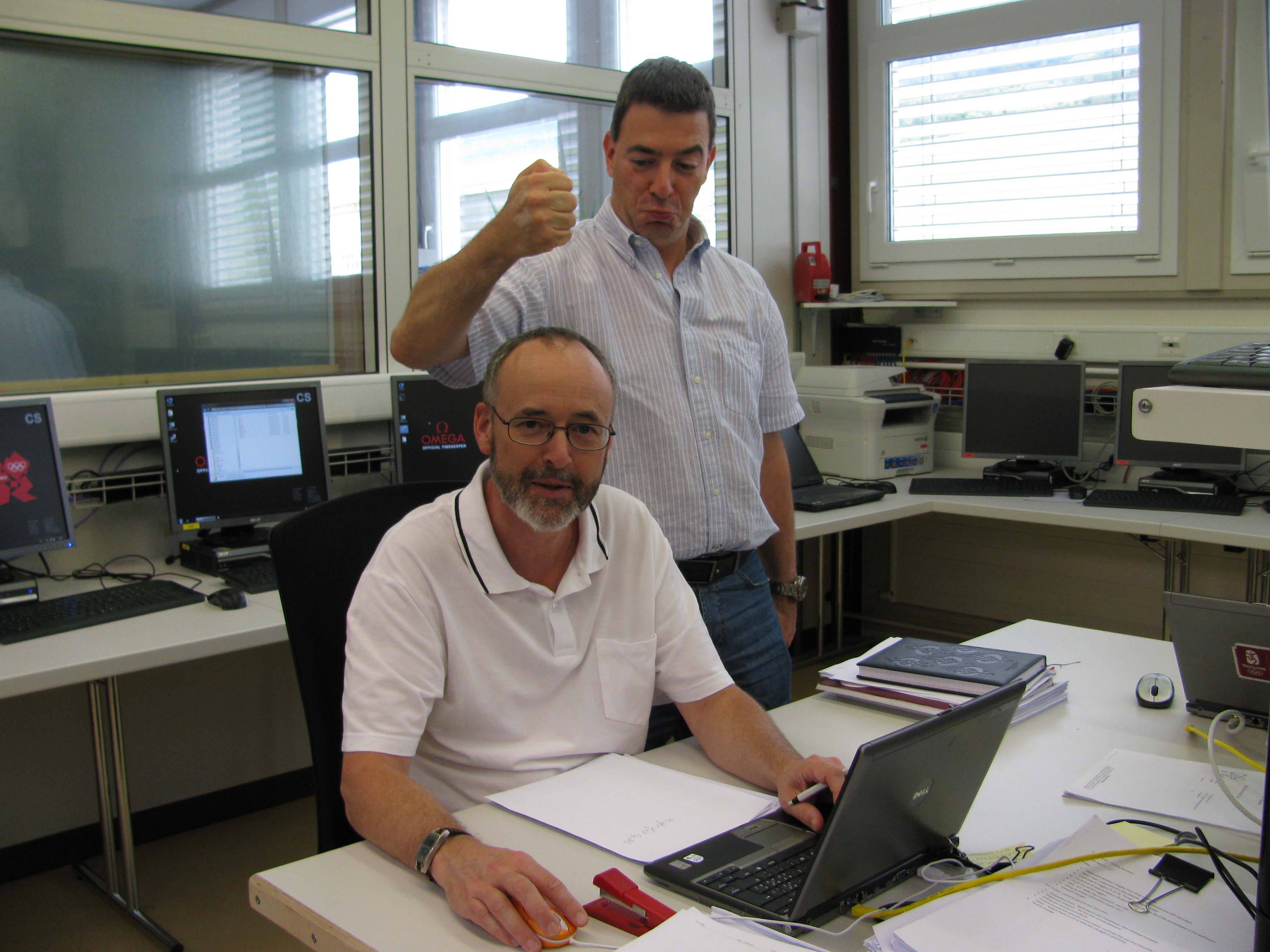
Dave and his boss model what an ordinary work day looks like for Dave, but let me point out - they are posing, raising the question: Does he really work? Or are the people I met all hired actors? A hit man could afford that.

Dave led me past more livestock and gently aged Swiss village buildings  to a modern facility where he introduced me to people who looked like they knew him, and then to a friendly Swiss-German who claimed to be Dave’s boss, along with a Croatian coworker. There were computers, timing devices, a massive shipping department. It seemed Dave’s story checked out.

“You really do work,” I said.

“Does he?” muttered the Croatian. “Have you seen him actually do anything since you got here?”

It’s a good question, but I am not chancing another solo train ride to find out.

Biel/Bienne Market

We made up our minds where to go yesterday, but no time to write about that. We’re off to Bern and Fribourg in a few minutes. Before we go, here are some more photos from the colours at yesterday’s Biel farmer’s market.

The contrary thing about the Swiss is how they support their local farmers’ markets, not out of a sense of duty or economic inbreeding, but because of an ingrained belief that no product, grown or manufactured, can best a Swiss one. I say it’s contrary because buying local food in Canada is an act whereby the buyer is making a statement about themselves, more than saying what they actually think of the product.

I could be wrong about this, but also, I could be right.

Consequently, in Switzerland’s stores the high-priced local Swiss strawberries (5.50 to 8.50) appear to sell out as fast as the lower priced Italian/French/Spanish ones. (2.50 to 4.50), and so it is for everything else – at least, that’s what I’m told.

We haven’t visited the local farmers street market in more than a month, and it seems to have grown as summer nears.

Later this week, we’ll tackle the question of whether Dave really has a job here.

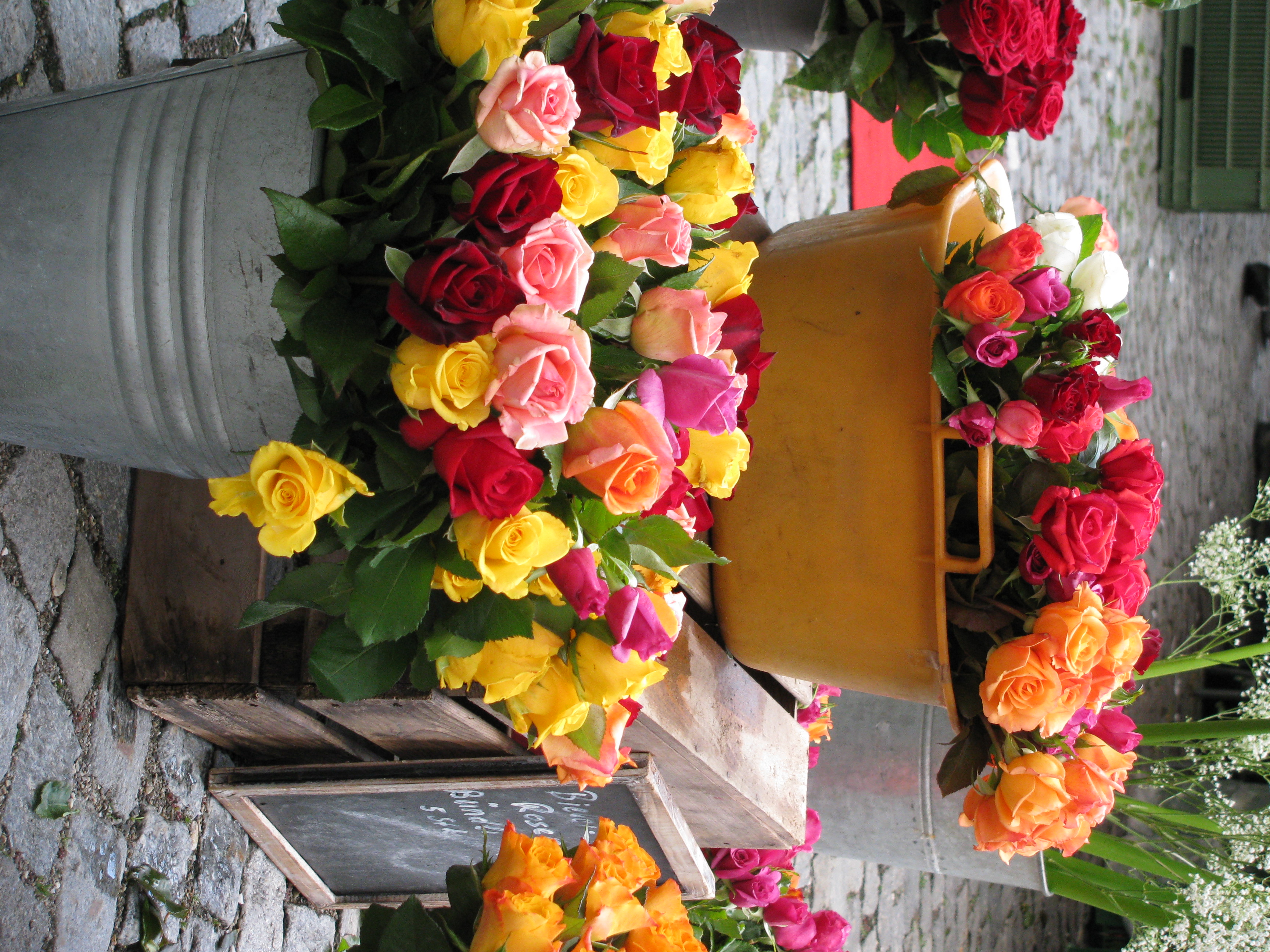
Buckets and buckets of flowers.

Carrots caked in Swiss dirt.

I've never warmed to the idea of dining on meat left to hang out on a hot day for hours. Also, what the heck is that amber coloured stuff on the right?

An IBM Selectric - vintage 1978, if memory serves. We saw a lot of old junk at the market, but not a lot of people buying it.

I would love to bought this Monarch typewriter with a French keyboard, but that would have gone against our "pack light" motto for our time here.

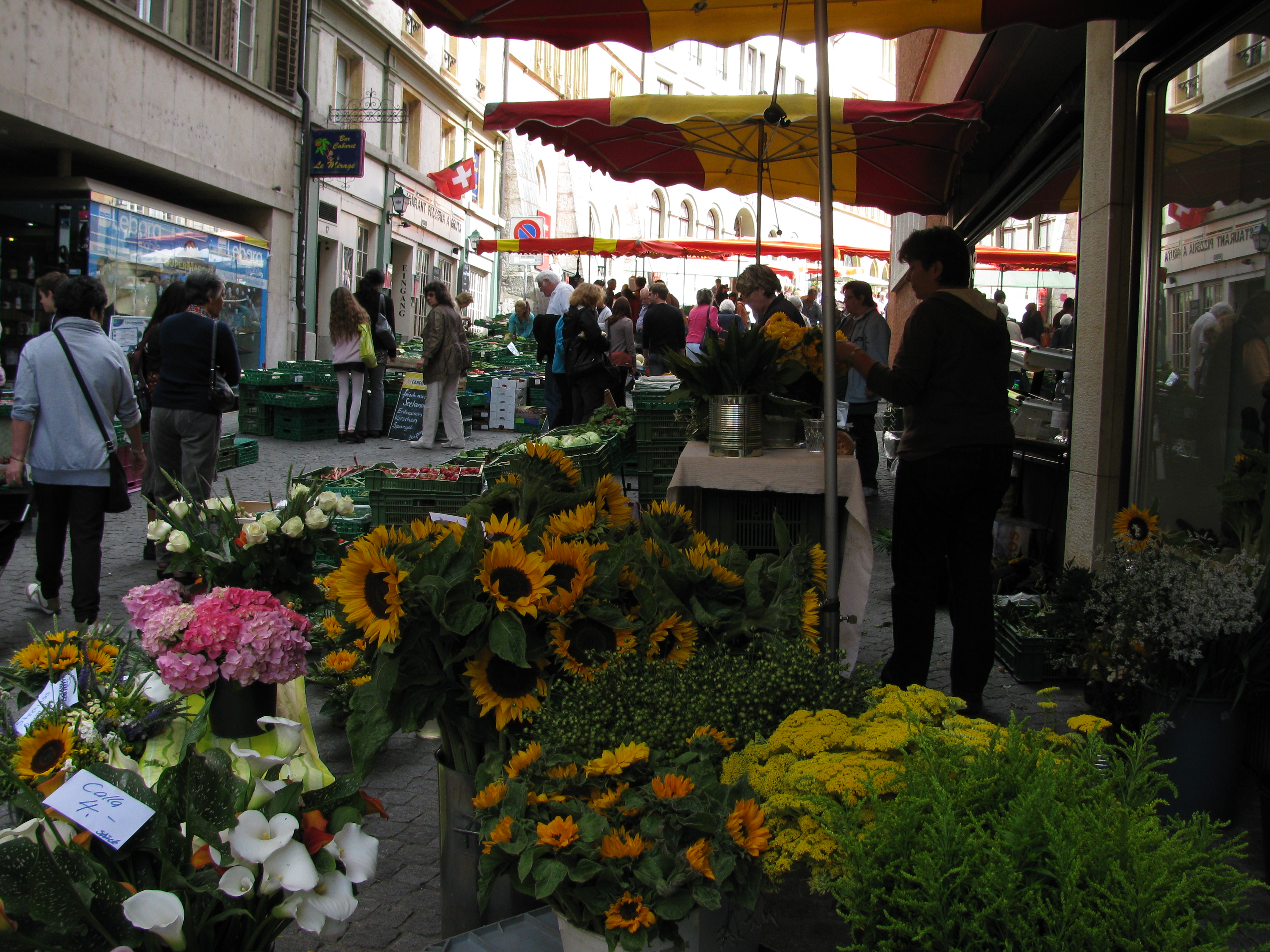
The market has expanded higher up the 16th-century cobblestone streets as summer nears.

The grey metal roundish thing on the right is an old-fashioned bed heater/water bottle (for only five franks). Oooh, comfy. The market has many vendors selling old stuff - some looks vintage, some looks like junk.

Biel/Bienne's farmers market.

Three varieties of cherries at Biel's Saturday farm market.... they are probably all Swiss, but it is possible they allowed a few Italian or Spanish ones in.

In Switzerland, the garlic knows enough to fall into formation.

I don't know what the 3.50 is for, but we saw loaves priced at eight franks. Yikes.

No live plucking

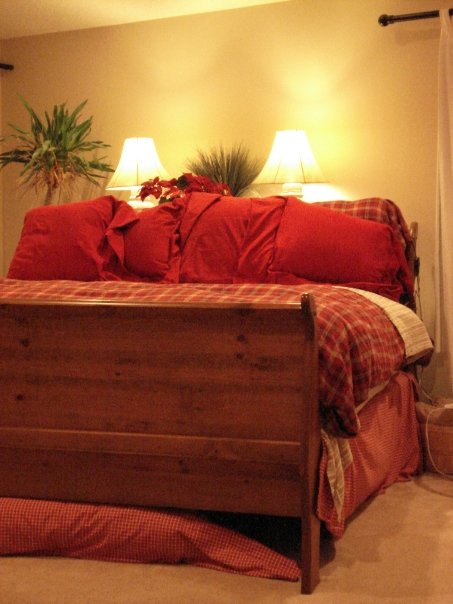
Pillows: You can't have too many. This photo, taken years ago, is of when my pillow-compulsion was under restraint. Only 30% of this bed is now visible, thanks to pillows!

In a foreign environment, you notice things.

For example, the last time I read  the tiny print of a manufacturer’s pillow label with any degree of scrutiny was in 1968.* Feathers, down, synthetic – what else is there to note? Since the advent of Martha Stewart, Nate Berkus and their legions, pillows have become more sophisticated, but not enough to attract my attention for longer than 0.7 seconds.

Sure, their thread-counts are ever-escalating, they boast various origins of cotton, hemp or bamboo, they have adopted political mantras, and they no longer content themselves with merely  snuggling your head, they promise a better life through better sleep. Okay, I’ll buy in.

And I admit it, I’m a pillow nut. Dave sleeps with one skinny prison-issue pillow that is flat, hard, punishing. I sleep with a carousel of pillows: Feather, down, square, rectangular, memory foam, enormous, not-so-enormous, decorative, functional, neck-soothing, pillows designed to stay cool, pillows that insulate. The list is endless.

I have never counted my assortment, but I have so  many that there aren’t enough beds for them all, so I rotate them through storage closet to bed and back, depending on the season and my mood.  A conservative  mental tally leads to a 50-count, not including the ones I hide on my sofas by stitching them into decorative cushion slipcovers. My husband will back me up on this.

Obviously, pillows are the comfort-food of bed linens. That is, until now.

Dieter Sprockets is alive and working in a Swiss 'house & home' department.

As mentioned before, we live in a hotel, so we are sleeping on hotel pillows. In North America, this suggests New Yorkish elegance, but the industrious Swiss have discovered sleep is economically unproductive so they do what they can to discourage it. Bless their hearts. If you are from the southern U.S., you will know that when I say “bless their hearts,” what I really am saying is, “What the heck? Who thought of this?!”

So our pillows here are closer in dimension to Dave’s single prison-issue pillow back home than to the generous, plump pillows that I crave.

This sent me into our town’s quaint shops in search of a single giant pillow, one pillow to compensate for all the pillows I am doing without. I found such a pillow on sale for about $40, and I was about to buy it when a sales clerk descended upon me, horrified that I would lower myself to the sale-price pillow, and ready to hold an intervention right there on the store floor.

He had a Sprockets wardrobe, accent and demeanor. For those too young to recognize this NBC show Saturday Night Live reference, click here.

“Yooo do not vhant dese pillow,” said Store-Sprockets smacking his palm against the pillow as though to punish it, his dark eyes wide in horror. “Dese pillow has Scheeneese feathers und down. It ees not Sveisse! You! You vant Sveisse!” Okay, so Sprockets doesn’t like Chinese feathers and even suggested through a series of eye rolls, nostril flaring and upward-chin-tilts that Chinese feathers were plucked by Chinese inmates, possibly from other Chinese inmates.

He went on to show me a wonderful selection of Swiss pillows, the cheapest of which was over $100. The most expensive I cannot print here, because it doesn’t seem possible to charge that much for what really is just leftover material from a roast goose dinner.

Right: Swiss concept of adequate pillow. Left: Joanne concept of adequate pillow.

Recognizing that to purchase the cheapest pillow might cast aspersions on Canadians everywhere,  I left the store empty-handed.

Culture Clue: Sprocket quickly deduced my Canadianess when I reeled back at the most expensive pillow. This is how Europeans differentiate between Canadians and Americans – by how much money we are willing to spend. Note: Not how much money we have; but how much we spend.

In the weeks that followed, I was at the mercy of our tiny hotel pillows, that are, by the way,  large by Swiss standards. I have seen small square pillows in the stores that measure 12 x 12 inches. One sales clerk said, “Your head is not so big, so why big pillow? Wastes space.”

I wish I was making this up, but I am not.

Eventually, I returned to Sprockets’ store, sneaking to the sale bin again. Even from the linen department, I could hear Sprocket lecturing another customer who was about to make the fatal fashion error of purchasing an unreliable lime-green hand mixer from Germany, when a perfectly good Swiss brand was right next to it.

Thus able to deduce Sprockets’  location and so avoid a follow-up intervention, I plucked the pillow from the bin and snuck off on an evasive route through the toy and sports departments. At the check-out, as I slid my debit card into the slot, I heard Sprockets approaching.  Sweat erupted all over my face. This was no mere hormonally induced hot flash. I grabbed the receipt and fled the store.

At the hotel, I chuckled to myself at getting the pillow I really wanted.

No live plucking!

Then I looked at the label.

Label-reading is part of my informal language-immersion at which I am doing very poorly, so when I saw the words “pas plume’ a vif,” I was sure I was reading it wrong.  A quick online trip to Google translate showed I was not. The label reads in German, French and Italian: No live plucking.

I did not know such a practice existed as plucking a bird while still alive. I am hoping it is a translation problem, and not a fact, but I am afraid to do an online search for fear of learning of new horrors in the world.  In the meantime, I should comfort myself that this pillow was not made from tortured birds.

This is what you notice in foreign countries: Labels. Fear them.

* 1968 is not a randomly picked number**. That’s the year I realized  my grandparents had a bunch of pillows with no labels. They were homemade, from their own poultry stock. I still have one, but keep it in a closet for fear of the bacterial count that could be living inside it. It could be 50-70 years old.

**Okay. Maybe it wasn’t 1968. It could have been 1965.

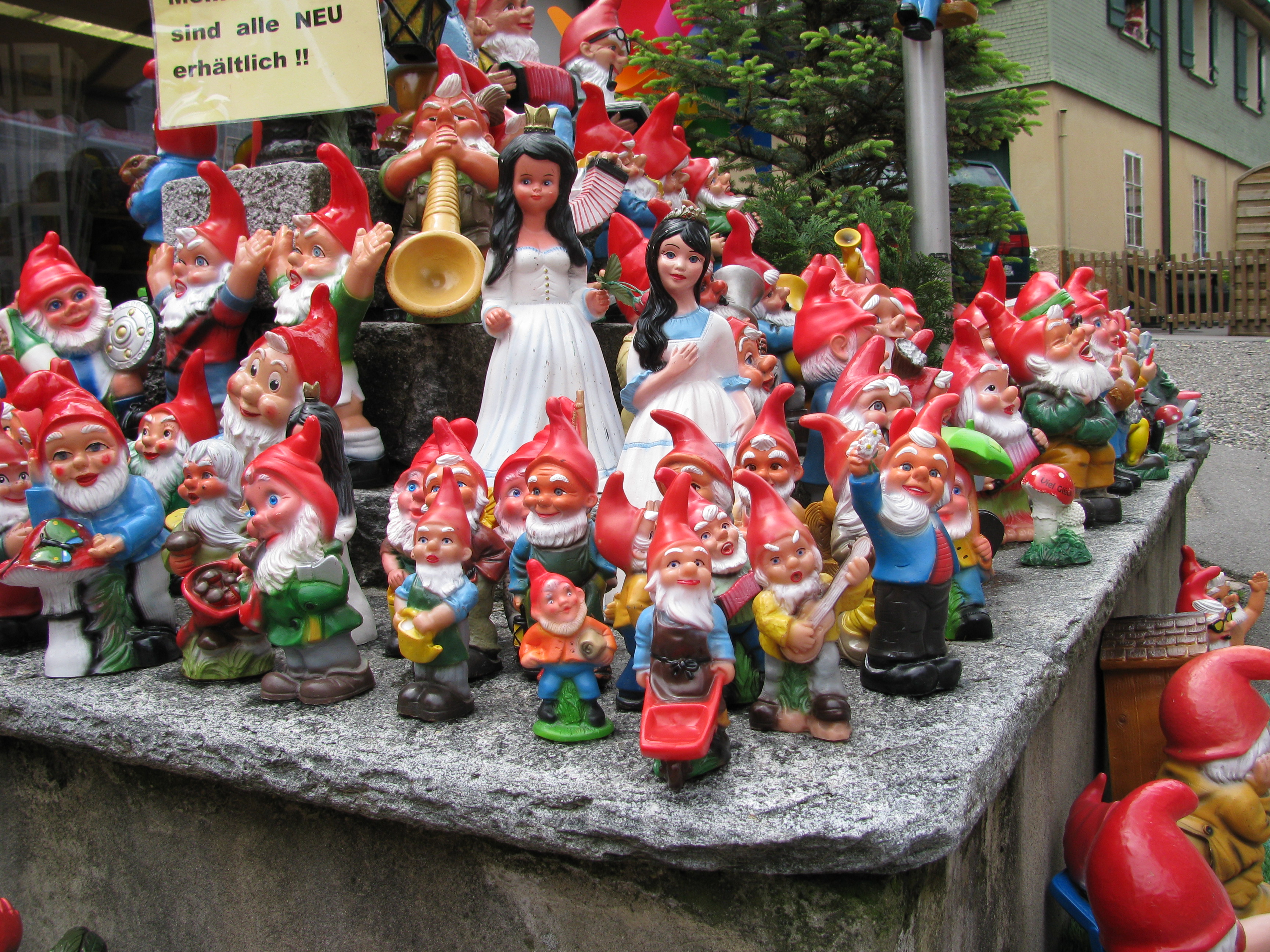
Knowing gnomes

Gnomes dig ebony-haired gals in long flowing gowns.

The modern garden gnome springs from German ceramic artists (circa 1900), but a lesser known fact is that  Swiss doctor Philippus von Hohenheim (1492-1541) revived ancient mythologies around goblins and dwarves in the form of gnomes,  that he asserted moved through earth in the way that humans move through air, and were possibly always at war with migrating cranes (the birds, not the machinery).

This illustrates how messed up the medical establishment was in the 16th century.

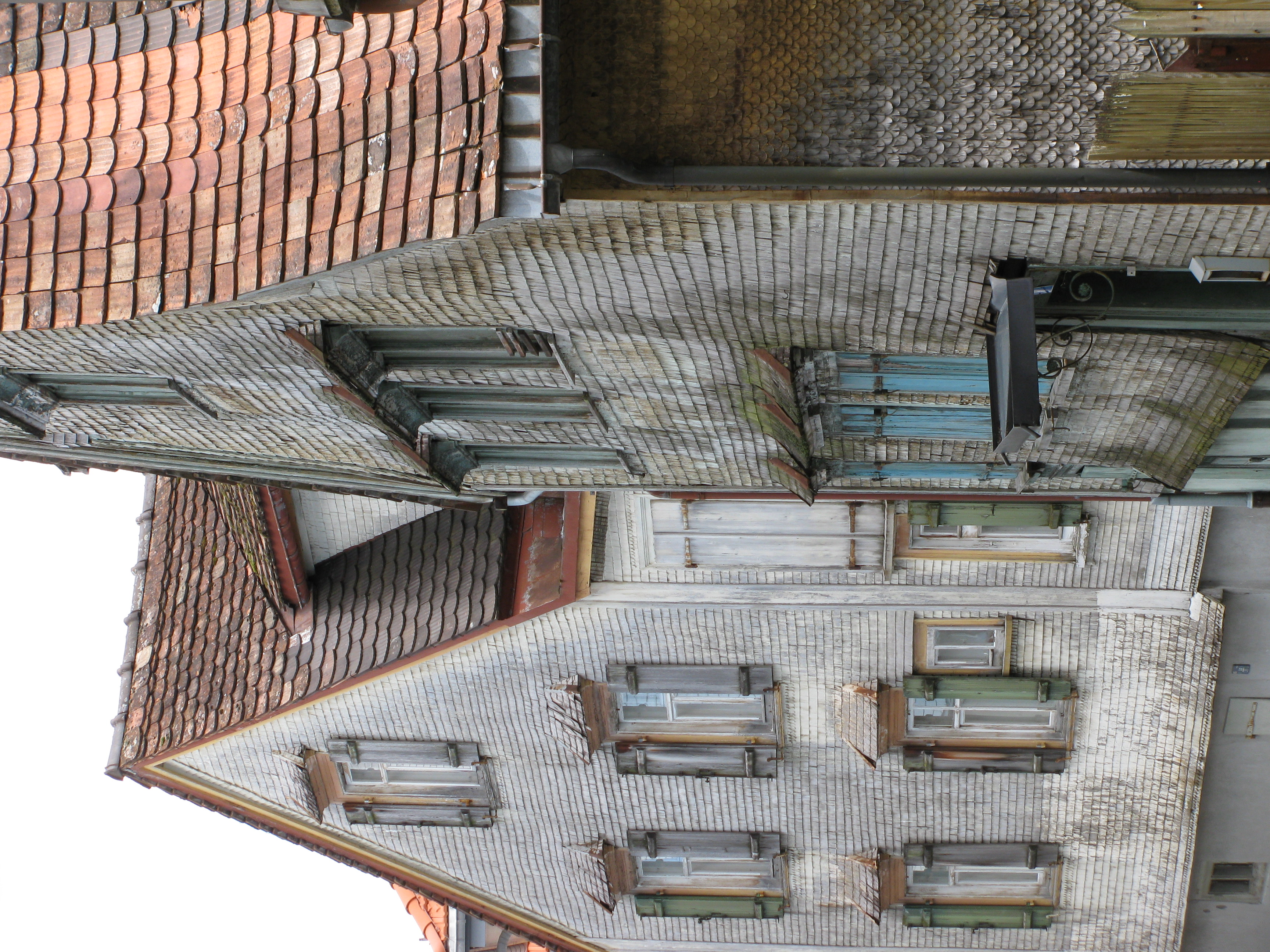
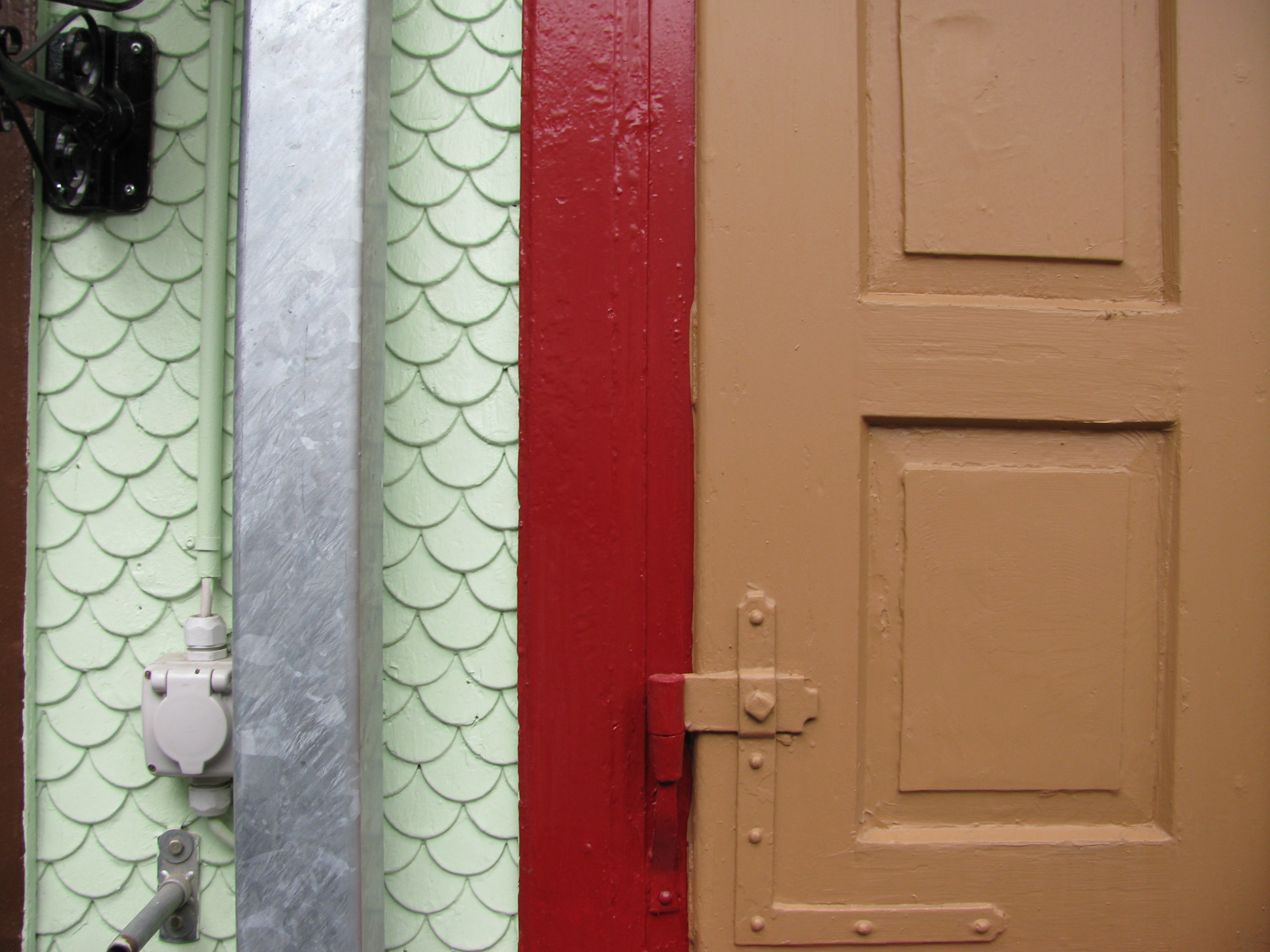
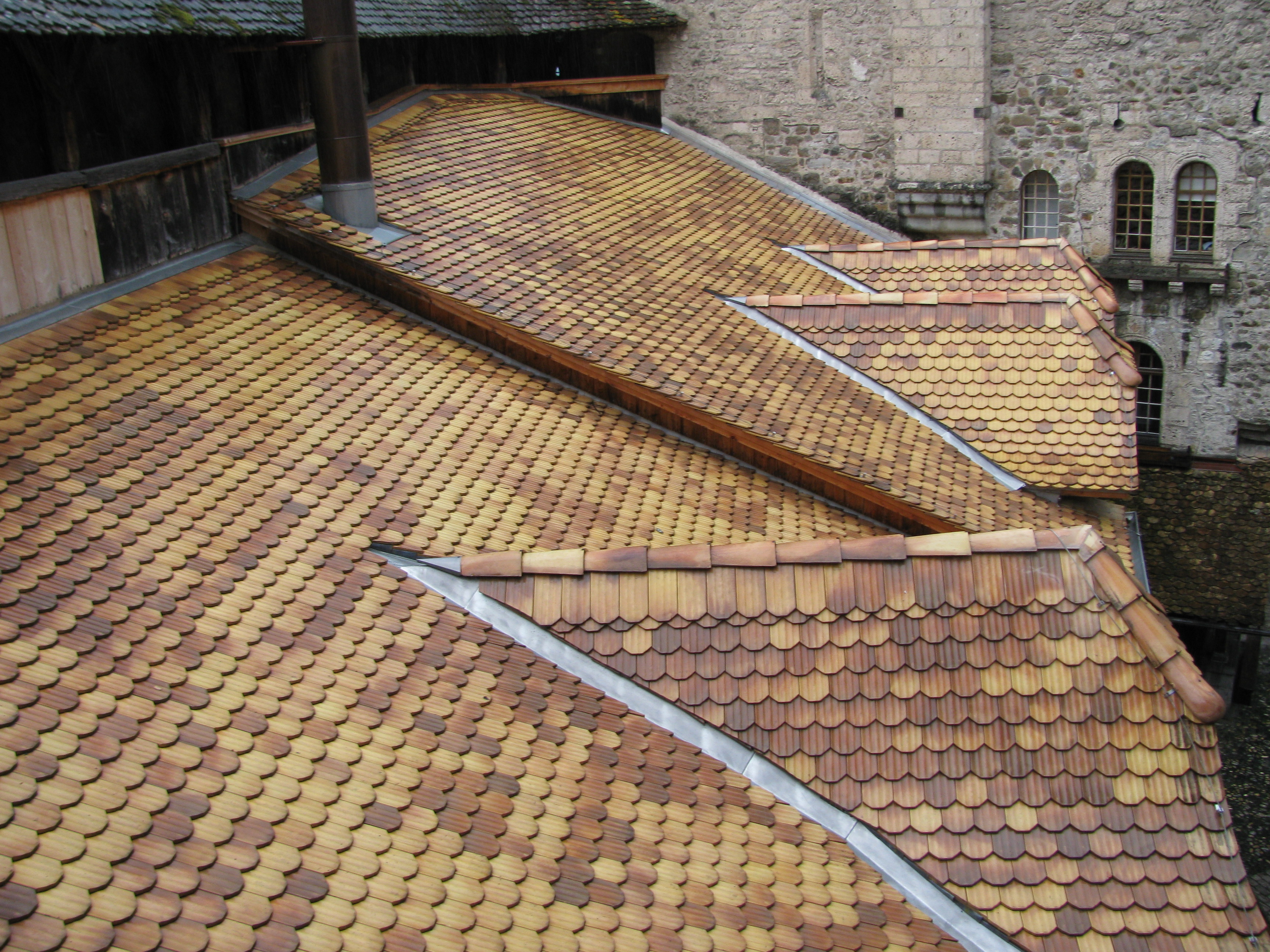
Please write to me if you see any paint splotches in this wall of fishscale shingles.

We ran into a few gnomes in Appenzell. Not as many as that which  populated Canadian gardens in the 1960s, but a few. We did not like them then. We don’t like them so much now, but they are okay if they stay in Switzerland where they match the decor.

But we liked Appenzell, which differed markedly from Switzerland’s big-city architecture that is dominated by stone (we like Switzerland’s big cities, too).  Appenzell buildings were almost all wood-clad, many with round shingles that I scrutinized for paint dribbles. I couldn’t locate so much as a thumbnail-splotch. Coincidentally, Switzerland has the world’s 23rd highest suicide rate.  These two factors may be related.

Appenzell is called cowbell country, and rightly so, because there are lots of beat-up cowbells in baskets outside gift shops, but not so many on the cows, who were mostly naked.  Had these bells ever seen the underside of a cow’s jaw? My skepticism kicked in and I sniffed one of the bell’s weathered leather collars and did not catch the tiniest whiff of barnyard life. Dave made sure to stand far away while I smelled the collars, as though there was something unusual about this.

We also saw sheep with bells, but could not find “sheepbells” at the gift shops.

Dave says go big or go home!

Most Swiss fountains are topped with statues of local heroes or historical figures. Appenzell has a cactus. We don't know what to make of this.

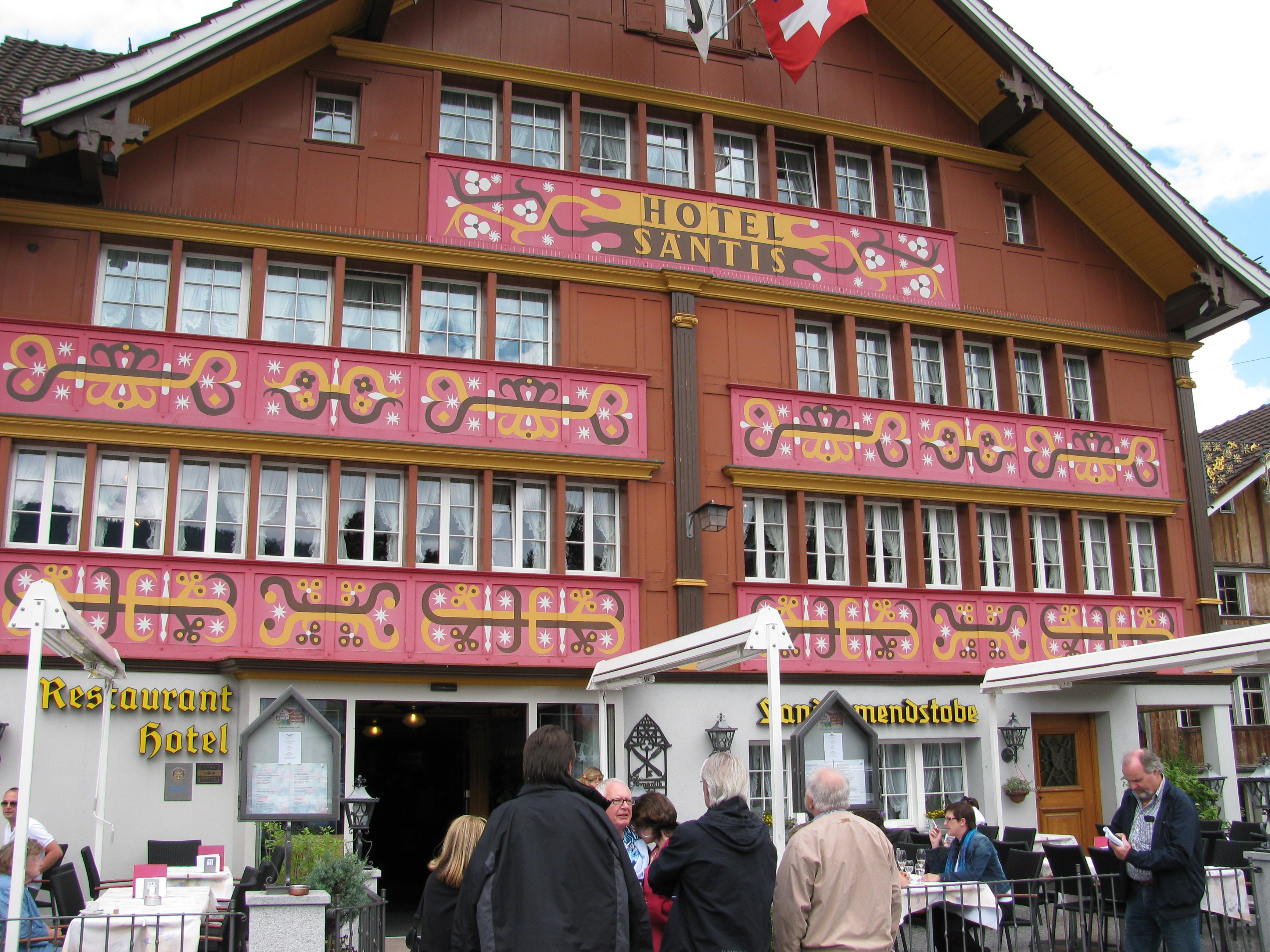
The Hotel Santis paint job looks a look like British Columbia's Coast Salish murals. I'm just saying.

No one can compete with Switzerland's patriotism and flag-waving - not even the U.S.

Even beaten-up buildings retain their charm.

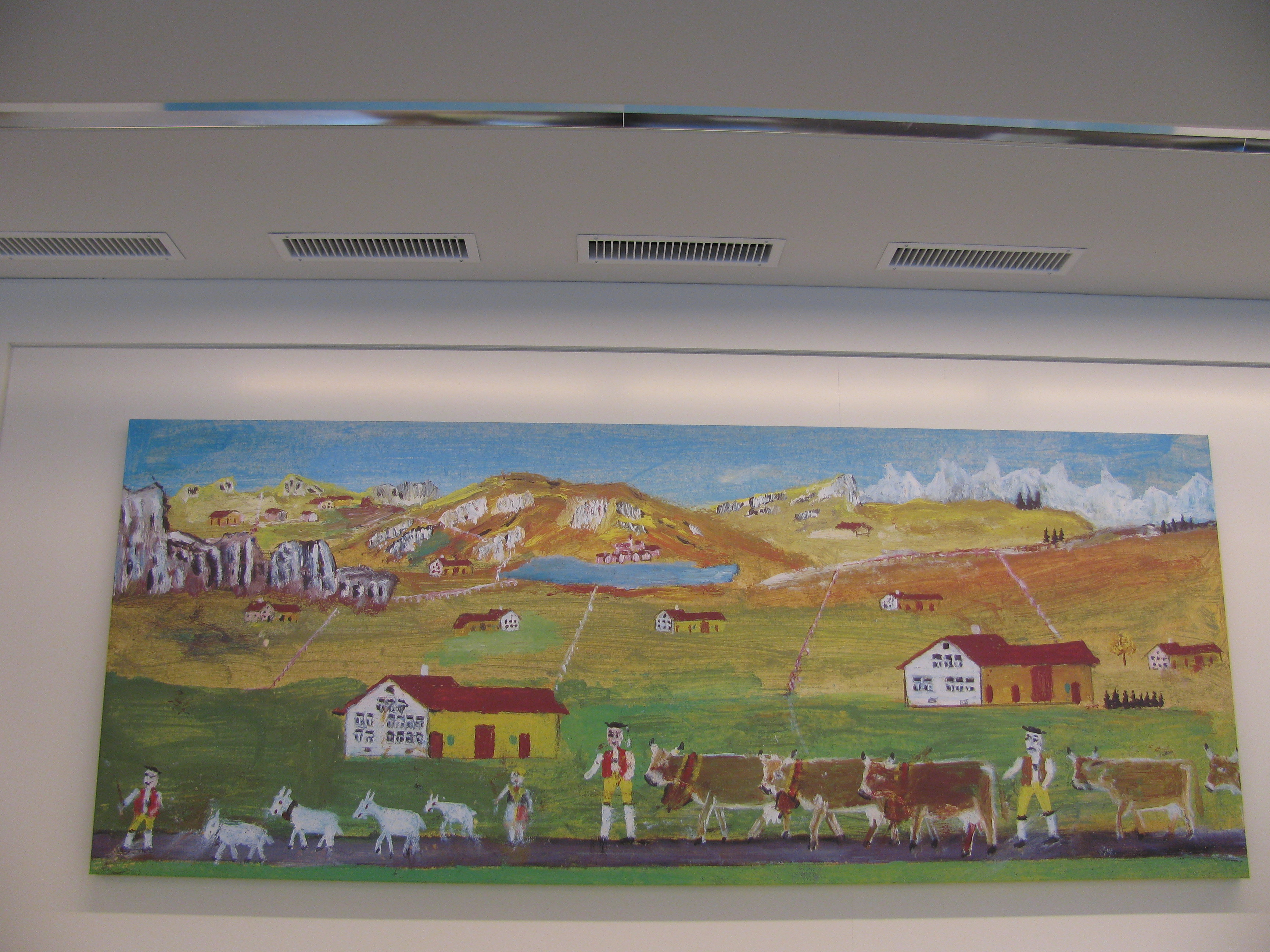
After a three-hour train ride, we did not visit the cow museum, but we did go into the lobby and take a photo of this cowesque art.

Humble buildings line the village streets, but they are no less charming than those found in bigger cities.

Entrance to hardware store ... looked like the way to someone's garage. We don't know how this affects their business.

Aha! The paint job is not so perfect at the hardware store.

Another clock tower. We are still in Switzerland, the land where tardiness is without excuse.

Eating like Europeans

A rarity in Europe: Water served automatically. Usually it must be ordered and it costs as much as any other beverage.

We stumbled into a delicious find while visiting Appenzell, a village in the Alpstein limestone range, near Mount Santis  in Switzerland’s Northeast corner.

We arrived off the tram from Kronberg hungry, as we always are after an invigorating ride over the rails, so finding a restaurant was foremost in our minds. There are different ways to find restaurants, and we have developed our own methodology. We check our favorite travel guide-book – Rick Steves’ Switzerland, then wander the cobblestone streets in a confused manner as though we don’t have a guidebook at all, all while staring at the guidebook’s map, then at the buildings.

Lokal takes its gelato seriously. Mmmmmm .... gelato.

As though foreordained, a shop catches my eye and Dave, trying to hold to our original gastronomic purposes, waits outside to study the map/guidebook while I peruse the store shelves where I always find everything is much too expensive. It is true, I am cheap, but when I find a pair of shoes that sell for $267 while I am wearing the same make for which I paid $110, I am none too impressed. Shopkeepers perceive this and pretend to speak no English. Either that or they are insulted by my harmless questions about their retail ethics.

By the time I exit the store (or stores), our hunger reaches the fussy level, our pace increases, my interest in shopping diminishes and our path takes on a pinball trajectory, that is to say, we hurry from one Rick Steves-recommended restaurant to another, finding some minor flaw with each one that sends us on our way again.

We go through about a half-dozen restaurants in this manner, judging them by the shallowest, yet truest of means: The customers at the outside cafe look sick of each other’s company and there is no food in front of them, suggesting a long wait and tardy service; a funny smell comes out of the kitchen; the posted menu is only in German, stoking our fear that we will accidentally dine on horse or rabbit meat; the place is empty; the low lighting through amber glass windows prohibits suitable scrutiny of the food and the list goes on.

We look for places populated by locals on the grounds that they are the best judges of a restaurant’s fare, so it may be that a bistro we came across named “Lokal” twigged a subliminal familiarity, predisposing us to looking favorably on it, and then we found a mention of it in our guidebook, where Rick Steves labels Lokal’s offerings as the opposite of Swiss fare. That seemed like an endorsement to us fearers of horse meat, so in we went.

At this point, we were starving and a little glassy eyed, which the server may have recognized because she spent a lot of time explaining the menu to us, which was very kind, however, it prolonged the ordering process and we weakened even further. Eventually, I ordered a crepe filled with banana gelato, which shows just how vulnerable we had become.

Dave using the classical pointing method to order his lunch. He has no idea what he is pointing at.

Dave pointed out sandwich fillers from the display case in such a random manner that by the time we sat down he could only identify his sandwich contents by their colours – “red things,” “green stringy things.” If there was horse meat in it, we would not have known because we are unfamiliar with the colour of cooked horse meat (when raw it has a burgundy tone not often seen in beef).

So we sat down and accepted our fate, only to find that it was all good. Lokal happens to specialize in its focaccia bread, and it was superlative, soft and not too chewy as is too often the case with North American focaccias. The preserved tomatoes and peppers were lightly seasoned and bit back just enough to tease the tongue.

The crepe was perfect, although I did feel weird having a frozen dessert wrapped inside a hot crepe. Maybe this exists elsewhere but I don’t think I’ve ever ordered it. This is the beauty of being a fussy eater – I’m easily impressed and look on old staples as crazy new concoctions.

We took on the attitude of Europeans who when they take a table are practically leasing it. We ate everything, then jumped up and ordered some more, lounged, ate more, enjoyed the relaxed atmosphere along with other loafing diners as though we were hanging around in our mothers’ kitchens. The two women servers – who may have been proprietors, they looked that engaged in their work – were pleasant and helpful, unobtrusive, but ready to deliver more goodies at the slightest sign of hunger pangs.

The gelato is made in-house of local dairy and “Alpstein” water, which pours down from the limestone Santi Mountain  – and is without any artificial dyes. I sampled the chocolate, walnut and banana. The chocolate was fabulous, but I am a chocolate addict so am rarely disappointed. The banana gelato was strikingly intense; the walnut gelato was unique, subtle, and very very good. In all, Lokal offered about 16-20 varieties and if I lived there, I would have tried them all.

Check out the restaurant’s (German only) website here or enter Lokal Appenzell into Google and click on “translate this page.” I give this understated eatery the thumbs up. Sandwich: 8 out of 10. Gelato: 10 out of 10 (yes, a 10!). Crepe – undecided. It wasn’t really filling as a lunch item, but it was delicious. Price: $37 for a continuous stream of food for two, very reasonable for Switzerland.

Weekend wanderings – Off to Appenzell, also known as cowbell country

A Swiss cow, WITHOUT a cowbell. What is the land of cheese coming to?

I did not make up the nickname “cowbell country” for Switzerland’s Appenzell region. The Swiss did that all by themselves.

How the cowbells earned higher billing than the cows themselves is beyond me, but we aim to find out. In the meantime, we wonder what kind of conversations dairy farmers have out there. Instead of discussing how many heads of cattle they oversee, maybe they discuss the pitch and tone of the cowbells.

“Good chiming on the up-pasture trip yesterday,” Franz says.

“Yah, yah, it vazt gutt!,” Johann replies.

My goal will be to see the cow museum. Woo hoo!

Dave’s goal will be to get me to ride the Kronberg bobsled ride. Click here to see it. Skip to the 20-second mark to get straight to the ride. Skip to the 1:20 mark to see how close the “bobsleds” get to each other at the bottom of the ride.

Dave says, “What could go wrong?” and I have to admit it looks not-so-bad, except that is the same thing he said just before I slid down an enclosed waterslide tunnel at Whitewater in Atlanta, minutes before I got lodged in said tunnel, which eventually spit me out in a tangled glob of humanity. I will only tell you what that ride was like if someone asks me. It’s better not to ask.

In the meantime, this blog will likely pass the 3,000 mark some time today. As one editor told me, “It’s the photos, dummy. Nobody cares what you write. They care about the pictures.”  Editors. You gotta love’em.

Happy weekend!

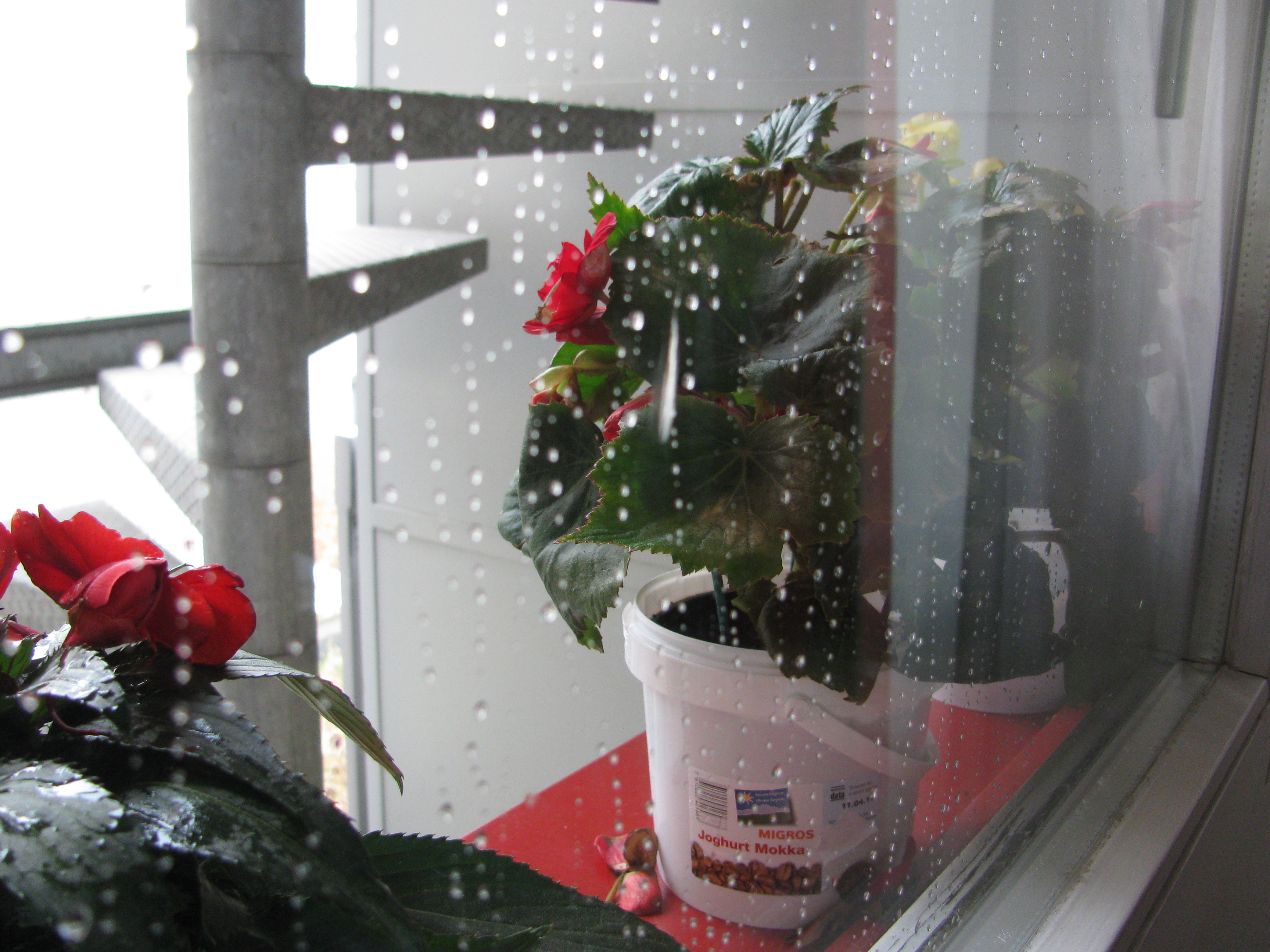
Rain

Rain, rain please do stay. I can't take another hot day.

In non-news, yesterday we watched a never-seen-anywhere-else-we’ve-lived  weather-induced phenomenon (I am trying to break a hyphenated-sentence record).

While out on our evening stroll through downtown, heavy rain started pouring, driving many shoppers to line up execution-style, their backs pressed tight against the buildings for shelter in that miniscule 18-inch ribbon of dry pavement next to the wall.

Witnessing this led me to reflect on what this unique behavior would lead to in other parts of the world.

Do this in the Pacific Northwest and you’ll be waiting for the weather to clear from November til April. Try it in Manitoba or North Dakota and soon a sheath of ice will form over you, rendering you immobile until spring.

Lining up in this fashion in a giant American metropolis will lead criminals to assume you are volunteering to be relieved of your wallet or purse, getting you mugged within two minutes. The good news is that ambulance attendants will arrive to get you out of the rain, although you will be in a prone position, likely for quite some time. If you are single, this is even better as you are about meet a lot of doctors, just as your mother always hoped. You might not look your best, but the doctors will be too busy checking your intubation tube to notice. See how a little rain can change your life?

In Victoria, British Columbia, muggers are more polite and will ask for your money instead. Many would-be robberies are aborted in this way as the prospective victim is often unaware he has a role to play. And in true Victoria form, the mugger will be too polite to point out this faux pas to the victim, and let it pass. This happens dozens of times a day there.

In Australia, line up against a wall and someone will hand you a beer. Do this in Spain’s Plaza Mayor and locals will assume you’ve had too much beer,  search you for it and take it away.

Our view: Not very attractive, but not so bad. The buildings absorb the sound of ambulances screaming down our street. I'm not joking. We rarely hear them from inside our courtyard-flat.

I did wonder how long the Swiss would stand there, but as it turned out, the locals knew what they were doing. Within a few minutes, the rain paused in an orderly polite Swiss manner (just  as it started, quickly and on time) and the crowds meandered back onto the roadway. I should point out, this area is a no-car zone, so no tremendous traffic excitement ensued.  In the meantime, the Swiss had a sociable time chattering with their fellow rain-refugees,  presumably about the weather.

In other news that matters to no one in particular, yesterday I was told twice that I speak French very well, proving that you can get by in a foreign language on only two sentences, as long as you pronounce them very well.

And finally, I’ve been told I am living a rich-lady-life, which sounds pretty glamorous, but in the interest of truth, allow me to dispel that myth by sharing the view outside of our flat.

Plants that I plan to neglect.

Say Cheeeese

The source of so much goodness: Cheese, fondue, ice cream, taco fillings ...

I’ve been rough on Swiss cuisine, writing some very nasty things about their chocolate, their cheeses, their ice creams, their relaxed attitude toward refrigeration. Today, Switzerland fought back.

Well, at least one block of cheese bought at a Swiss store fought back by stumbling out of the refrigerator while I was going in for the strawberries, nearly striking my leg, but it was a soft cheese, so not much harm could have been done. Seeing as it volunteered, I decided to take a slice, and steeled myself for the usual olfactory horrors to unfold when the plastic wrapping came off.

This did not occur. The cheese was almost odor-free, and even as I cut into it, I could tell this was going to be different. It did not embrace the blade as would a gooey Brie; neither did it fight back in the way of a stiff cheddar. It was in the middle, resisting a little, with the edges crumbling away in niblets, but still cutting rather clean.

The taste was mindful of butter and cream, which turned out to be correct as the cheese is 75 per cent fat, a content earned by the addition of extra-heavy cream during processing. You might be able to find a chunk in North America – it’s called St. Andre’s and it is made in France.

Which means that I just wrote something nice about French cheese, as opposed to Swiss cuisine, the latter of which being where I was going in the first place. But to be fair, it was purchased in a Swiss store, so that has to count for something.

The Swiss are big on beef, cheese, chocolate, fondue, muesli, quiche and tarts. I love all of these. They also steal a lot of ideas from Italy and France, whose foods I love, and from Germany, whose foods, their sausages in particular, I do not love so much. Actually, I really dislike those fat-chocked sausages. And yet, I know so many great Mennonite cooks – they must be of Russian extraction.

But to get back to the Swiss: Their strawberries are now in full season, which means the prices are dropping while the quality is rising. They are fabulous. Fabulous Swiss strawberries. See,  I can say nice things about Swiss food.

And I did say nice things about Movenpick ice cream, although that was before I sampled their cashew cinnamon ice cream, which had a lot of cinnamon and not so much cashew. It didn’t help that the cinnamon was augmented by some unknown spice, possibly curry, that made the whole experience a deeply moving one of disappointment; this especially after trying their chocolate ice cream, which was divine.

You may remember I had nothing nice to say about Polarfuchs ice cream, but I’m still looking to try their fresh strawberry flavour, which may have redemptive qualities. Nevertheless,  I can’t find it anywhere, even though there are strawberries everywhere at the moment.

Clearly, I have mixed feelings about Swiss food. This is where many food writers would make a joke about having to keep testing more food so as to more fully comprehend the breadth of the national cuisine.

I can’t joke about it, because I can’t promise it. I approach every plate with trepidation.

We had an unpleasant experience with Swiss ground beef early on, and it took me seven weeks to brave it again. The good news is that the second attempt was greatly improved, leading me to believe that the first clump of ground beef I cooked was on the edge of spoiling, which returns us to my first paragraph and my biggest beef with Europeans, and that is their lack of regard for refrigeration.

In the meantime, I just learned the St. Andre’s cheese in my refrigerator is highly perishable, so should be eaten as soon as possible. That, I am going to do.

Mom told me not to talk to strangers

Every day from 1960 to 1976, my mother warned me against talking to strangers, sometimes upping the warnings to four-times a day. She knew I wasn’t listening. Then between the years 2003 and 2010, on more than a few occasions I saw Times Colonist columnist Jack Knox exclaim, “Stranger danger!” before fading chameleon-like into the walls, making himself invisible to newsroom visitors. I suspect he was on my Mom’s payroll.

Despite these admonitions,  I keep talking to strangers, but now, I’m thinking of quitting.

In a downtown grocery store, I was minding my own business when cold chalky fingers snaked around my forearm. It would appear there was no one there, but when I looked down I saw a withered white-haired woman with large brown eyes standing next to me. I want to point out: I was looking down.  The number of times I have looked down to see another adult is embarrassingly low, and in fact, it only happened twice in North America. The other three times were here in Europe, where women smoke a lot, leading to stunted growth.

The woman rattled off something in French, shaking her cane menacingly at me, then, with her hand still cuffed around my forearm, she led me to another aisle where she used her cane to point out items from the top three shelves that she wanted. It’s a rare experience to be the “tall” person in the crowd, so I didn’t protest. I retrieved the items, she released me, and I went on my way.

Only, I was flummoxed. I left my grocery basket in the aisle where she had abducted me, along with my senses, forgetting what I was at the store for in the first place. I picked up some yoghurt, just to look like I was there on legitimate business and headed to the line-up where I found the old woman in front of me. Again, she took charge, demanding in French that I go in line in front of her with my paltry purchase, but I, in a bid for self-determination, steadfastly refused.

“Je suis un idiot,” I said, “Je ne comprends pas.”

She was somewhat crippled, frail-looking but obviously used to being in command. I’ll bet she had 15 children and they are all still terrified of her.

A tall, lean couple shuffled into the line-up and I thought I heard them speak English. I turned to them, indicating the old woman and said, “She’s a feisty one,” so they would understand that I was a total stranger to her and not her mentally deficient grand-daughter.

The couple glared at me, and I realized they did not speak English, but that might not have made a difference anyway.

The woman, her long hair dull and scraggly, motioned toward one arm as though injecting a phantom syringe, let her tongue loll out, wagged her head back and forth with her eyes careening about in their sockets. It was the international sign for, “I am a heroin addict, I’m out of my mind, and I don’t know what you’re saying.” The man, tattoos covering his arms, grunted in agreement.

Okay, Mom. You win. No more talking to strangers. At least, not for today.

Montreux

The wet walk between Chateau de Chillon and Montreux, along Lake Geneva.

Bus or boat will take visitors from Chateau Chillon to Montreux, but why bother when a world-famous “Swiss Riviera” promenade waits just outside the castle drawbridge?

Whether we actually voiced such a lucid question is a mystery even to us, as a cleaving wind and pelting rainfall drowned out our conversation. Despite the storm, we decided to walk. The word “decided” is loosely applied here.

A mansion overlooking Lake Geneva on the riviera promenade toward Montreux. Why do the Swiss call this is a "riviera" when it is on a lake?

Part of the problem lies in the “Well, we’re here, why not do it?” syndrome that besets Dave and I in all our ventures.  It eclipses all cognitive thought, which means that we rarely decide anything. Dave knows this, and he uses it to his advantage as was seen when he got me onto the Gondola-Ride-From-Hades up a mountainside. I put my foot down, declaring that said foot was staying within reach of the ground no matter what, but Dave slyly coaxed me into walking near the gondola, hence I ended up on it, because of the dreaded “Well, we’re here …” travel tic.  I wish there was a cure for this.

A sign outside the château claimed the walk to Montreux was 45 minutes, which might be correct, if you’re going at a good clip and not leaning into gale-force winds while keeping a watchful eye on Lake Geneva for signs of rogue waves that might sweep you away to the French side of this massive body of water, all while keeping your ear tuned to the tree branches above for the sound of cracking limbs that might break off and grind your body into the quaint promenade pavement where the Swiss might mistakenly leave you on the assumption that you are some form of modern art. The Swiss do love statues.

Even in the storm, the promenade is worth the walk – it starts out narrow with an uneven surface and rather ordinary hedging, but quickly opens up to a wide mall flanked with mansions on one side and a trim botanical garden on the water side. My guess is that this walk is packed on a sunny day, but with the storm in full voice, Dave and I found ourselves alone but for the occasional daring youth biking past and one very wealthy looking man walking his golden retriever, who gave us a friendly (by Swiss standards) hello, probably on the thinking he might see us at “the club” later, because who else would volunteer for this walk but a well-heeled and eccentric local?

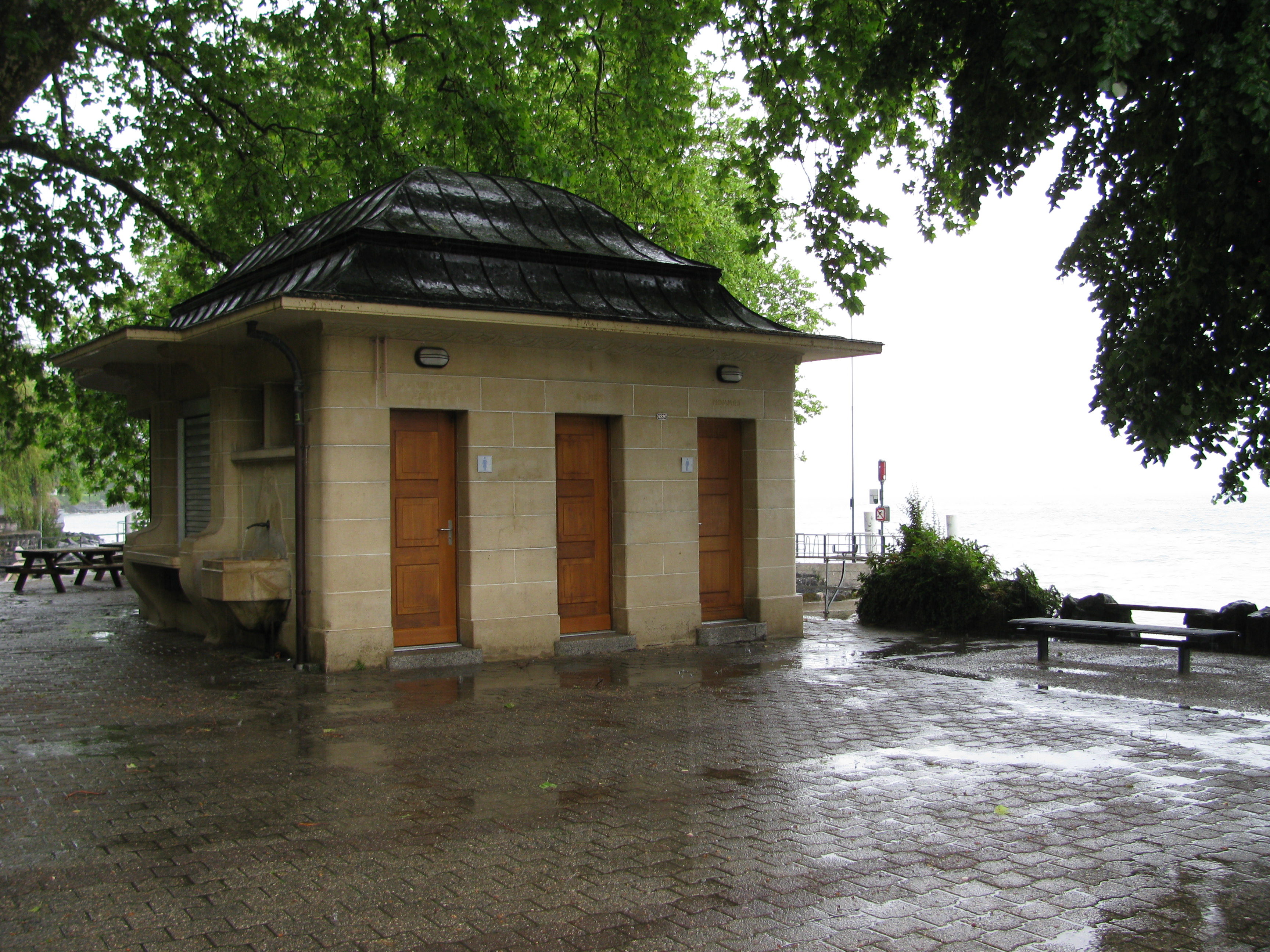
Even the public bathrooms have a stately look in Montreux.

By the time we found ourselves alongside the wharf from which we had started our day’s journey, we had walked a total of 5.5 miles weighted down with rain-soaked clothing (the distance includes tramping through Chillon castle) and were ready for some real food. We stepped up to the restaurant La Metropole, also oddly signed “Caesars” by the wharf, where we had earlier seen a rather elite-looking crowd noshing away at tantalizing dishes. If the rich eat here, we thought, the food must be reasonably good.

As we folded our badly abused umbrellas, a very French-looking waiter rushed out from the restaurant and motioned us towards one of the outdoor cafe tables, even though the weather was still rather exciting. A glance through the windows told the story – the interior showed off elaborately set tables, sparkling wine glasses, perfectly starched tablecloths, while the reflection in the glass informed us of how poorly equipped we were for such surroundings, my hair whipped into a Medusa fright, Dave’s tanned face now bearing the weather-worn visage of a salty sea-captain. We humbly took our place outdoors, just like the dogs we appeared to be.

We counted out our children’s inheritance and figured there was just enough to pay off one’s law school debt and enjoy a steak lunch at this establishment, so we braved it. I am not exaggerating when I say “braved it.” We had an earlier unpleasant encounter with Swiss beef, an experience that surprised us both as the Swiss enjoy a cultural association to beef that is perhaps unparalleled worldwide, except in those countries where the cow is looked on as a deity. Consider the widely known Swiss cheese and Swiss chocolate, and the less-famous Swiss fighting cows (a true phenomenon according to guide books), and so forth.

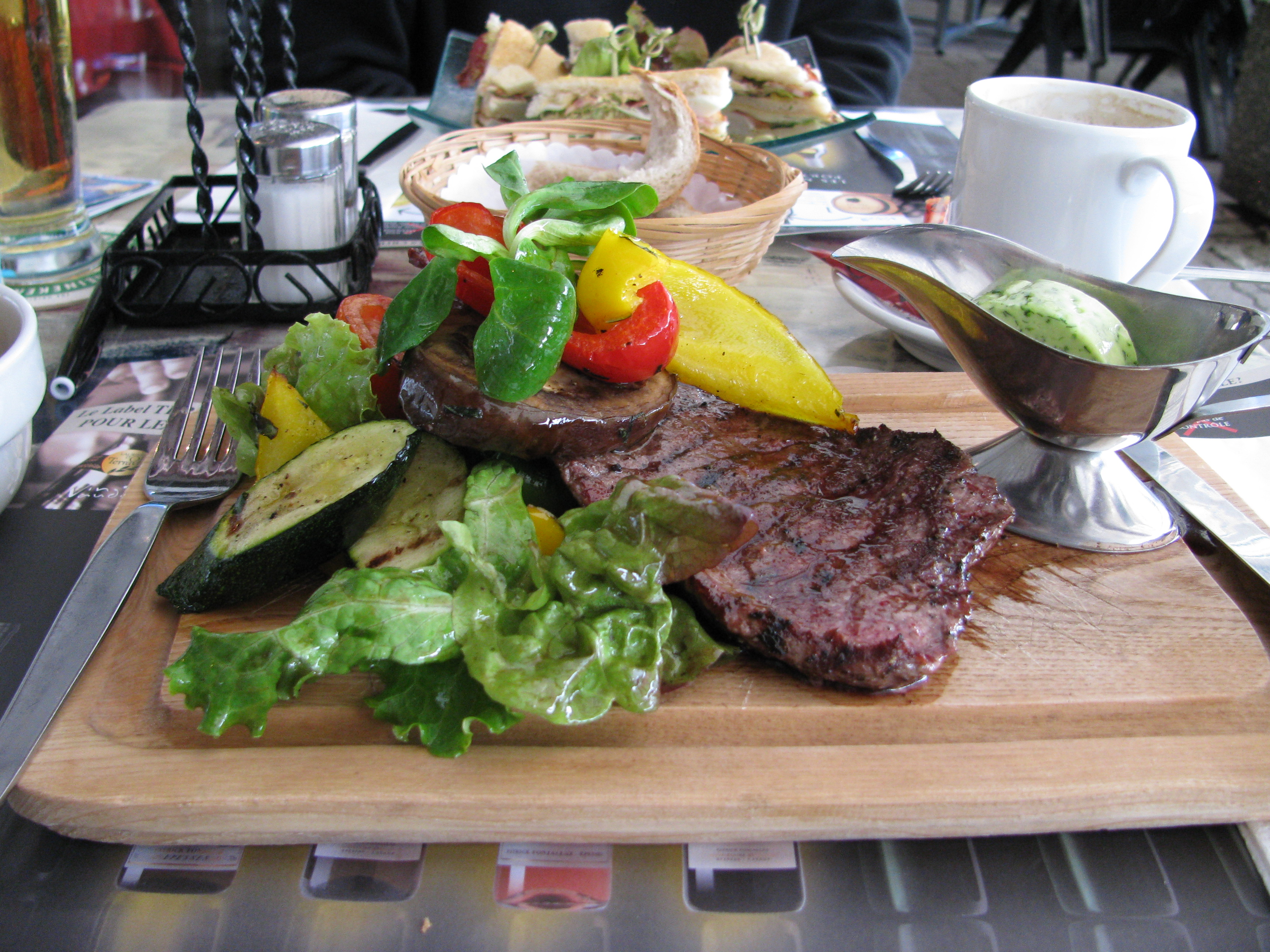
The delicious "Steak de boueffe" grilled to "medium" at Montreux's "La Metropole" restaurant, which also has the sign "Caesar's" above it. We think the dual-name is a byproduct of multilingualism.

I passed up the $45 filet mignon, on the grounds that no one can grill a tenderloin better than my husband and it was unlikely the chefs would let him into the kitchen, and opted for the $35 steak lunch. Dave, still mindful of  our children’s inheritance, wisely ordered a sandwich. We then settled in with our lattes to wait the requisite four hours for the meal to show up. Imagine our surprise when our waiter swept up with our dishes before I had worked a quarter-way down the cup.

The waiter had taken matters in hand and ordered the steak doneness to medium, which meant that it still quivered on the plate, and chose as its companion, a Cafe de Paris sauce. There are waiters whose instincts are unfathomably correct. This man was one of them.

The meat was perfect, tender, and seasoned just so. The Cafe de Paris, which appeared in a dollop of green aspic in a gravy boat carried the steak’s seasoning from wonderful to beyond-heavenly. Our waiter waved away any notion the sauce was extraordinary. “Just parsley, garlic, butter and (indecipherable spice name),” he said. The grilled vegetables were cooked to perfection, lightly buttered, the red-leaf salad was crisp, and the roasted potatoes, which came in a separate bowl, were as good as potatoes can get, which is just to say that no one recognizes a truly great potato dish, yet one only makes note when it is done wrong. This was done right.

A pricy meal, but very enjoyable with excellent professional service overlooking Lake Geneva. It was a perfect end to our blustery walk, and restored our sensibilities and bravado so that we were able to march up Montreux’s steep slopes to enjoy its 16th-century quarter.

What do you think? Does our waiter look French? I think he does and he had a decidedly French accent.

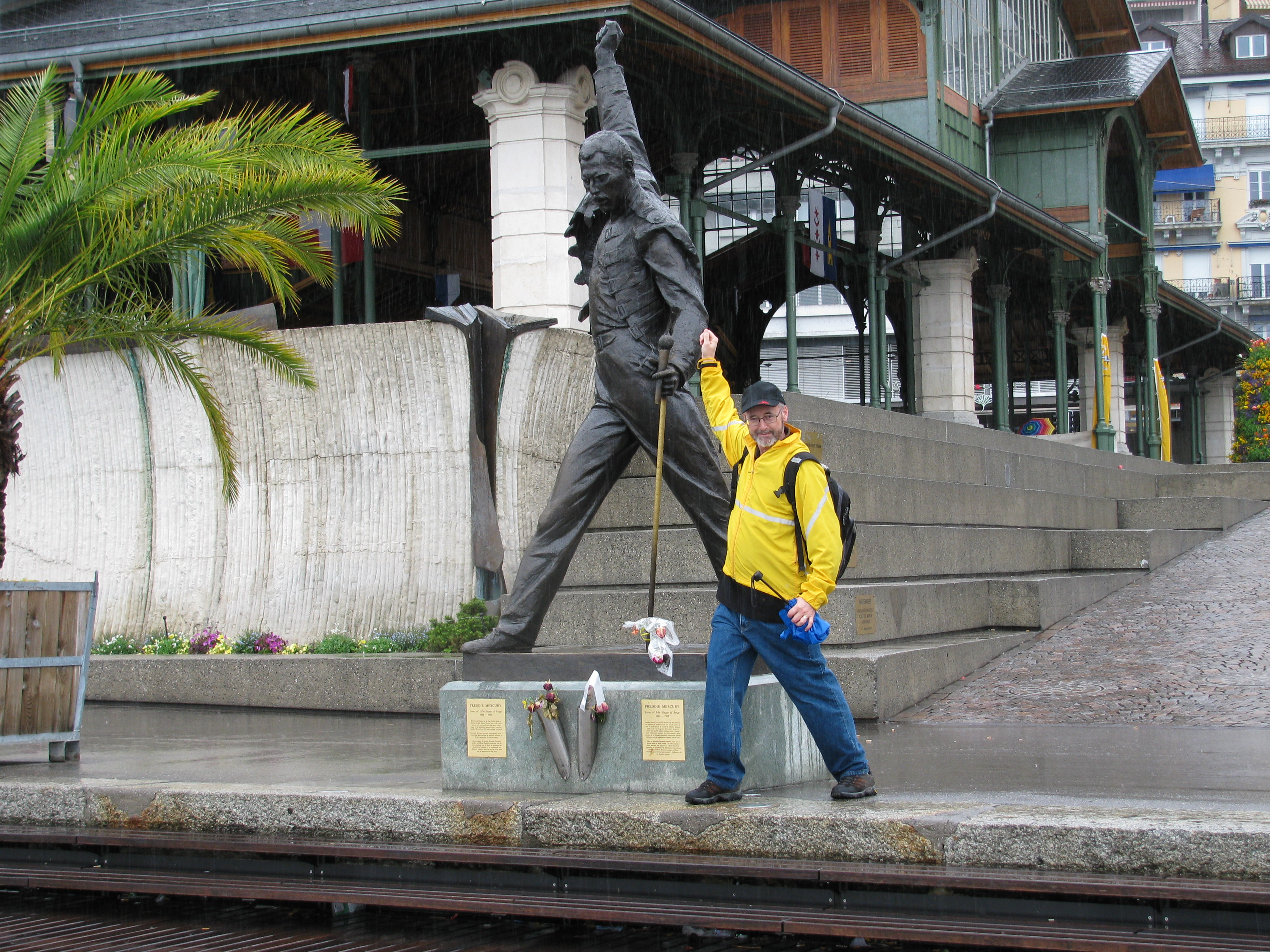
The requisite pose with Freddie Mercury statue.

Chillin at Chillon

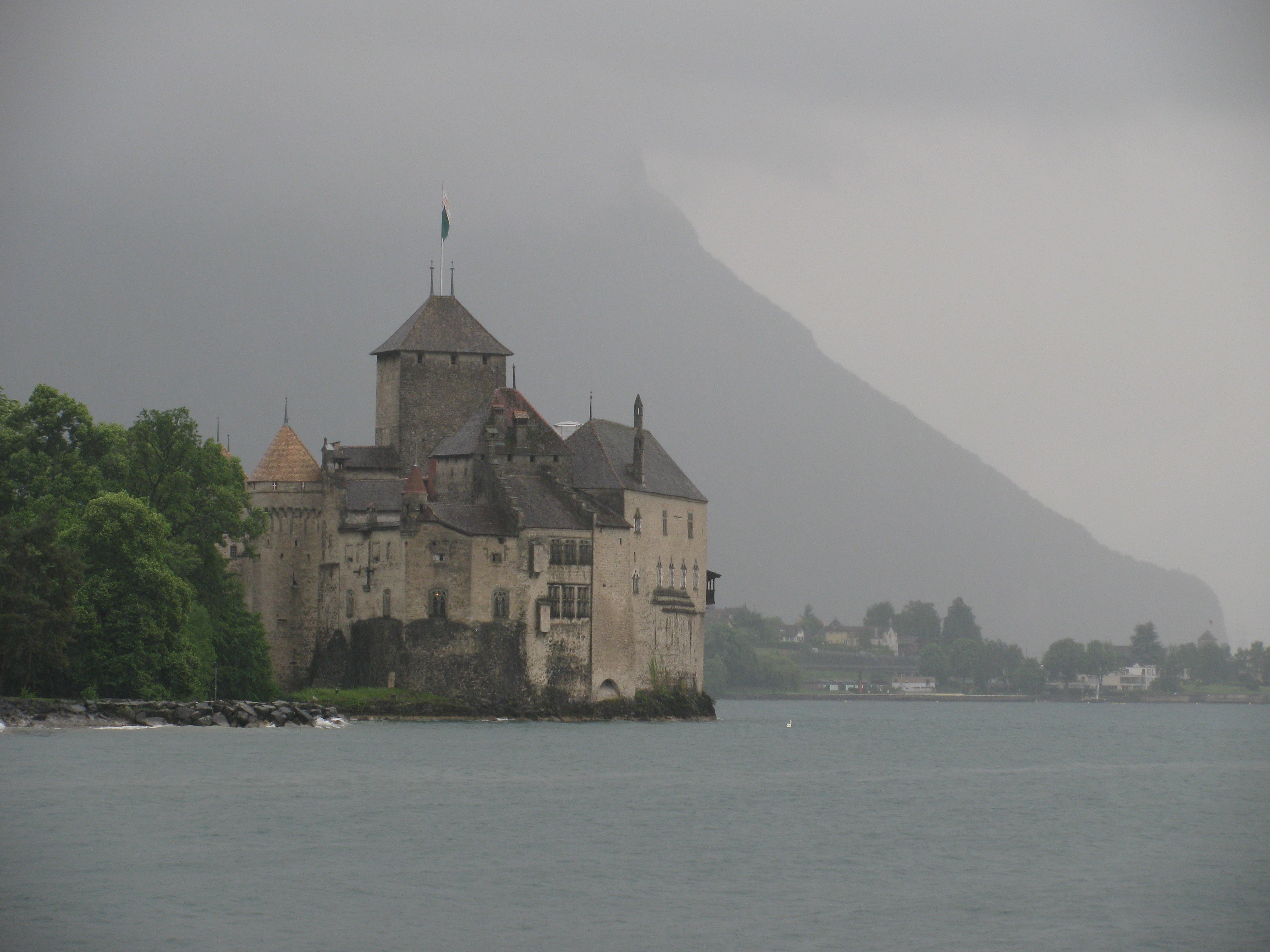
Chateau de Chillon

As cottage owners, and therefore owners of an old-fashioned outhouse, we were fascinated to learn of 700-year-old toilets inside a Swiss castle near Montreux. What design, what wood choices, what the heck …. how did the French/German/Swiss make a toilet last this long when all over Canada, wooden outhouses are sagging at the floorboards?

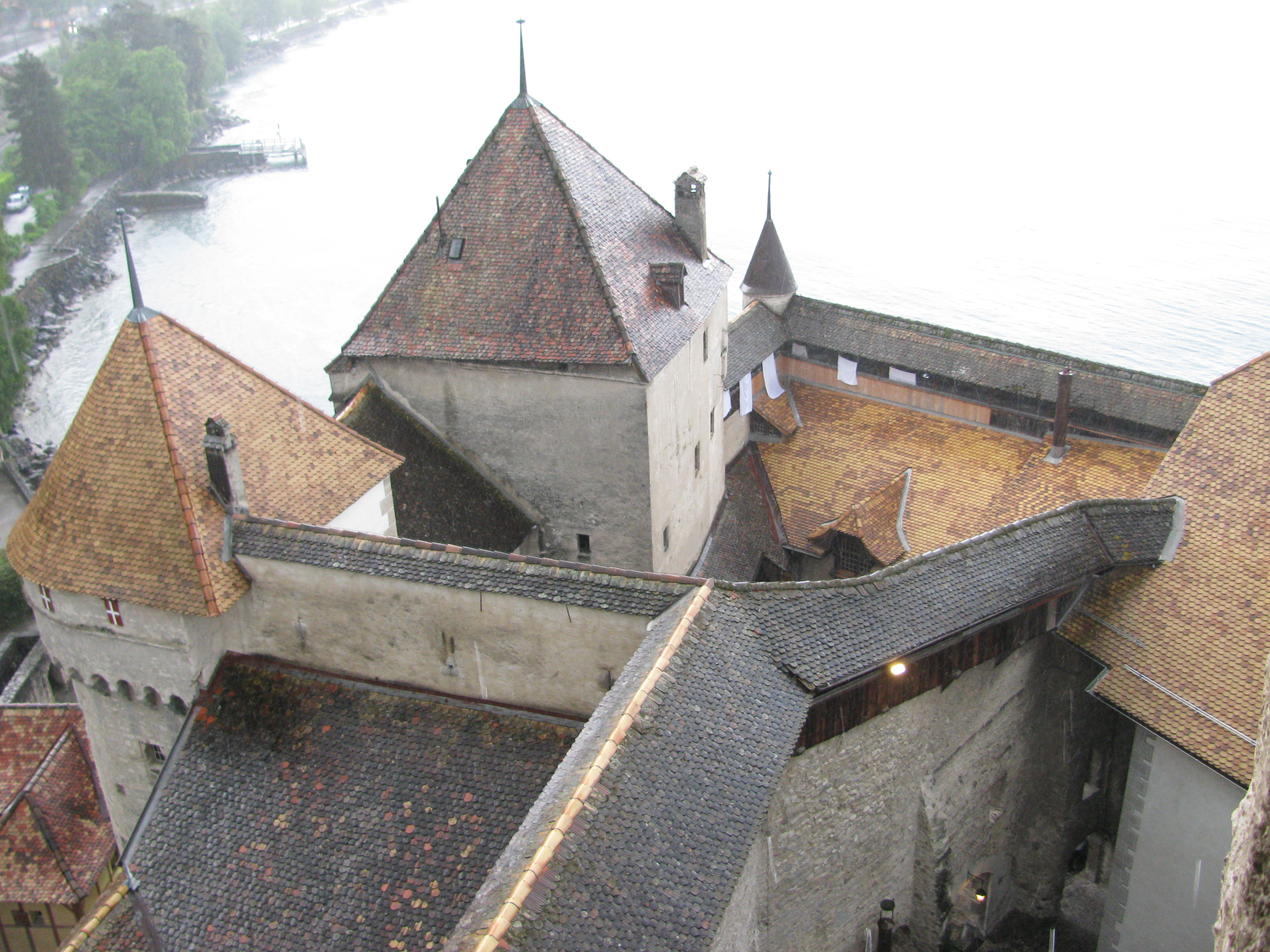
And so we went to Chateau de Chillon, built on a rocky island on the shores of Lake Geneva (locally known as Lac Leman) over the centuries. The site was held by the French Savoys since the 13th century until 1536, when they skittered away in the night after the Germans shot two rounds at them.

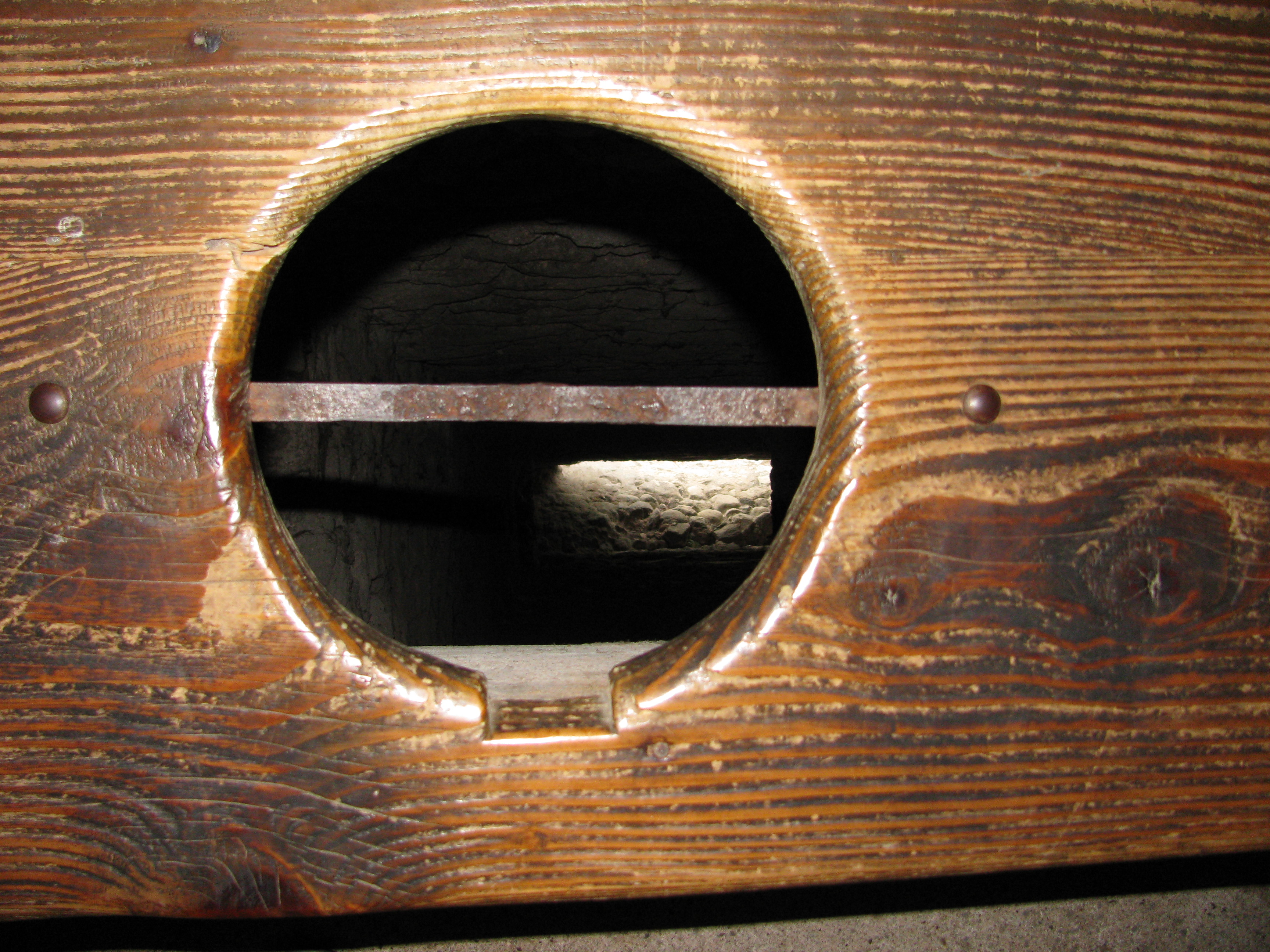
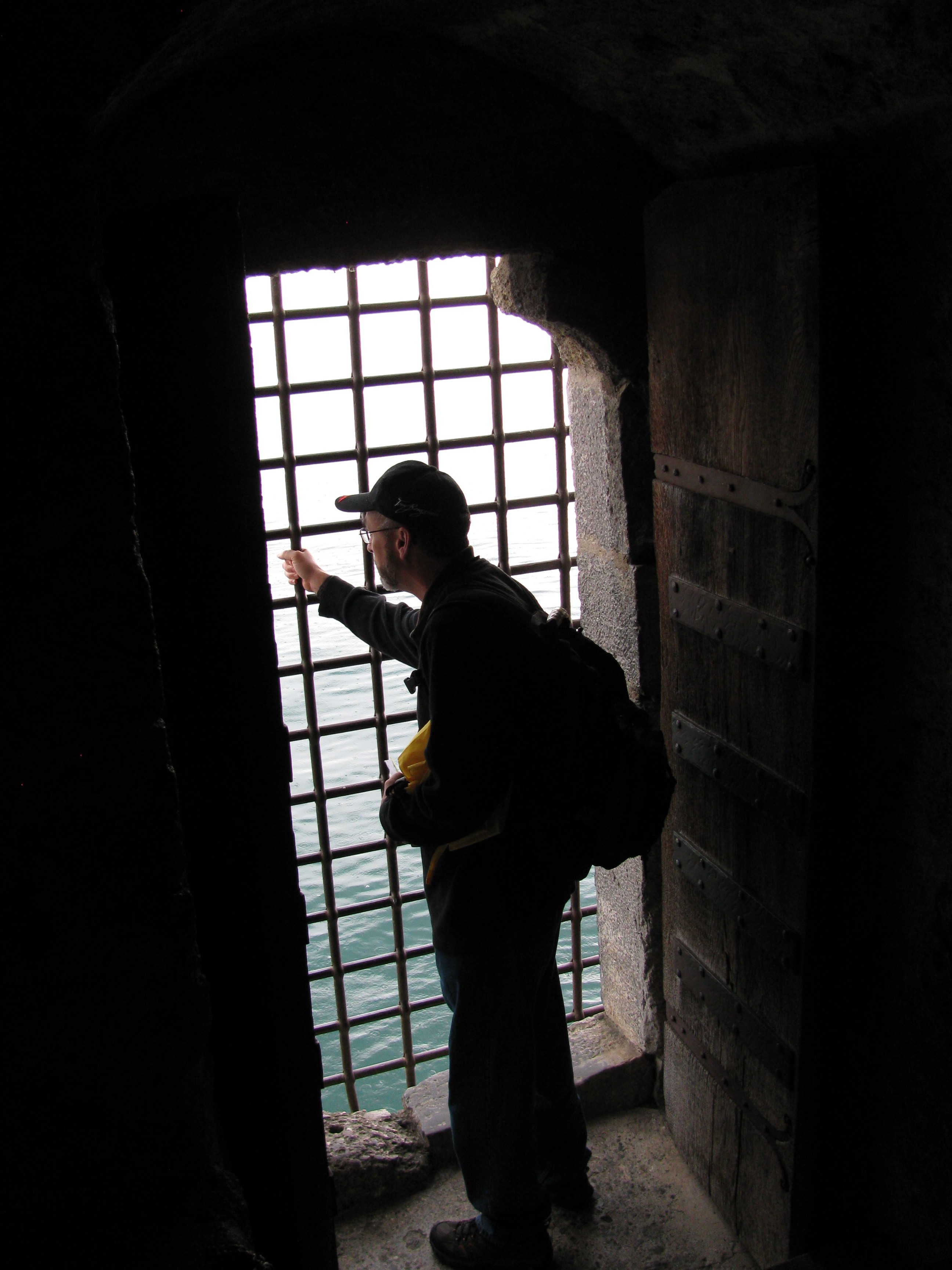
Dave checks out secret exit through which French escaped. They had to have run right by their torture chamber prisoners to do it, among whom was Francois Bonivard (1493-1570)who was jailed for being a political upstart. He was made famous by English poet Lord Byron in the poem "The Prisoner of Chillon."

The French, some how forgetting their position’s military advantage (the castle was considered impenetrable), decided they needed to be elsewhere and snuck out through a secret passageway during the night, effectively  handing the keys over to the Germans who must have been a little disappointed to have dragged their cannons all that way when they could have simply showed up and shouted up the castle ramparts.

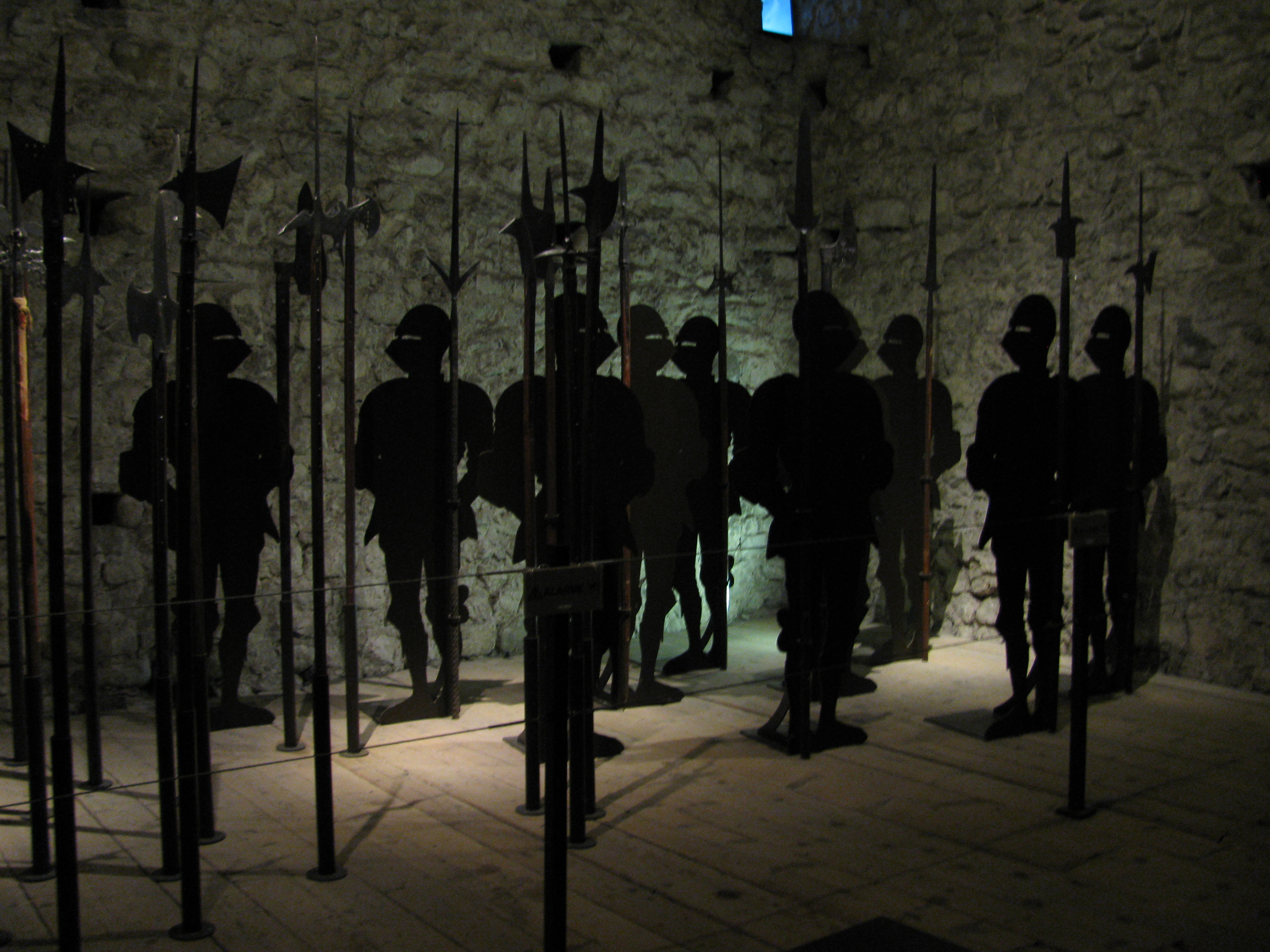
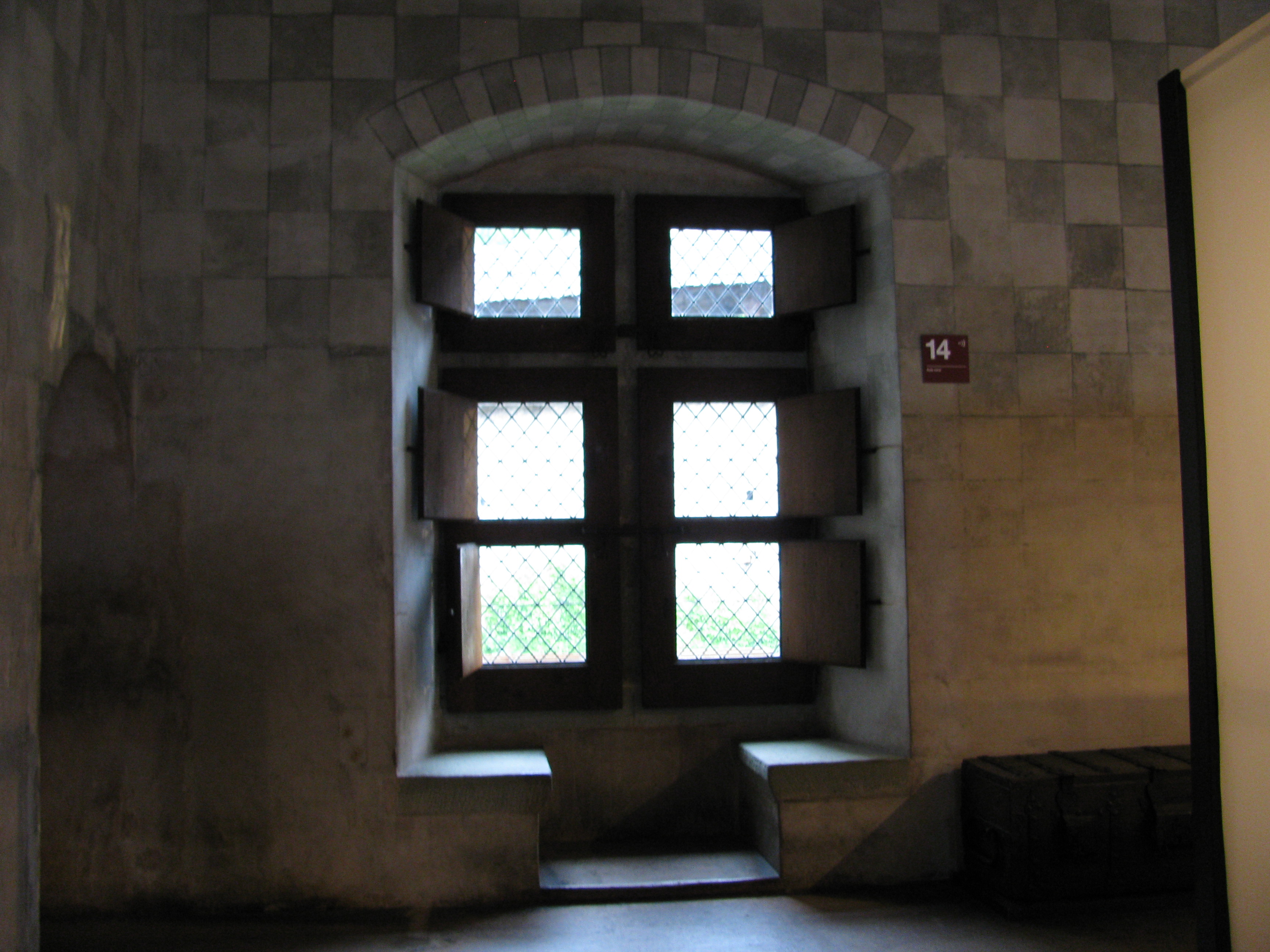
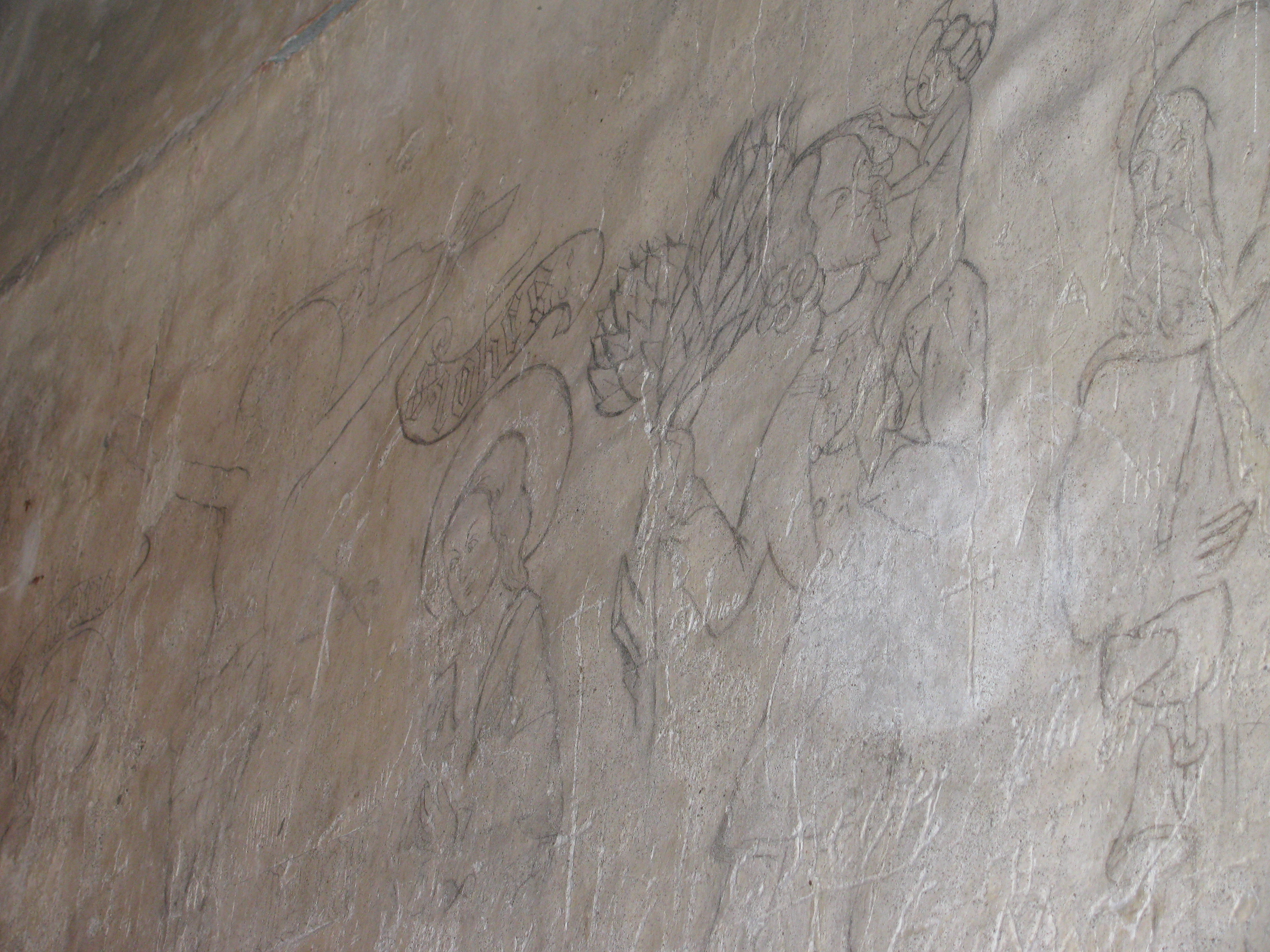
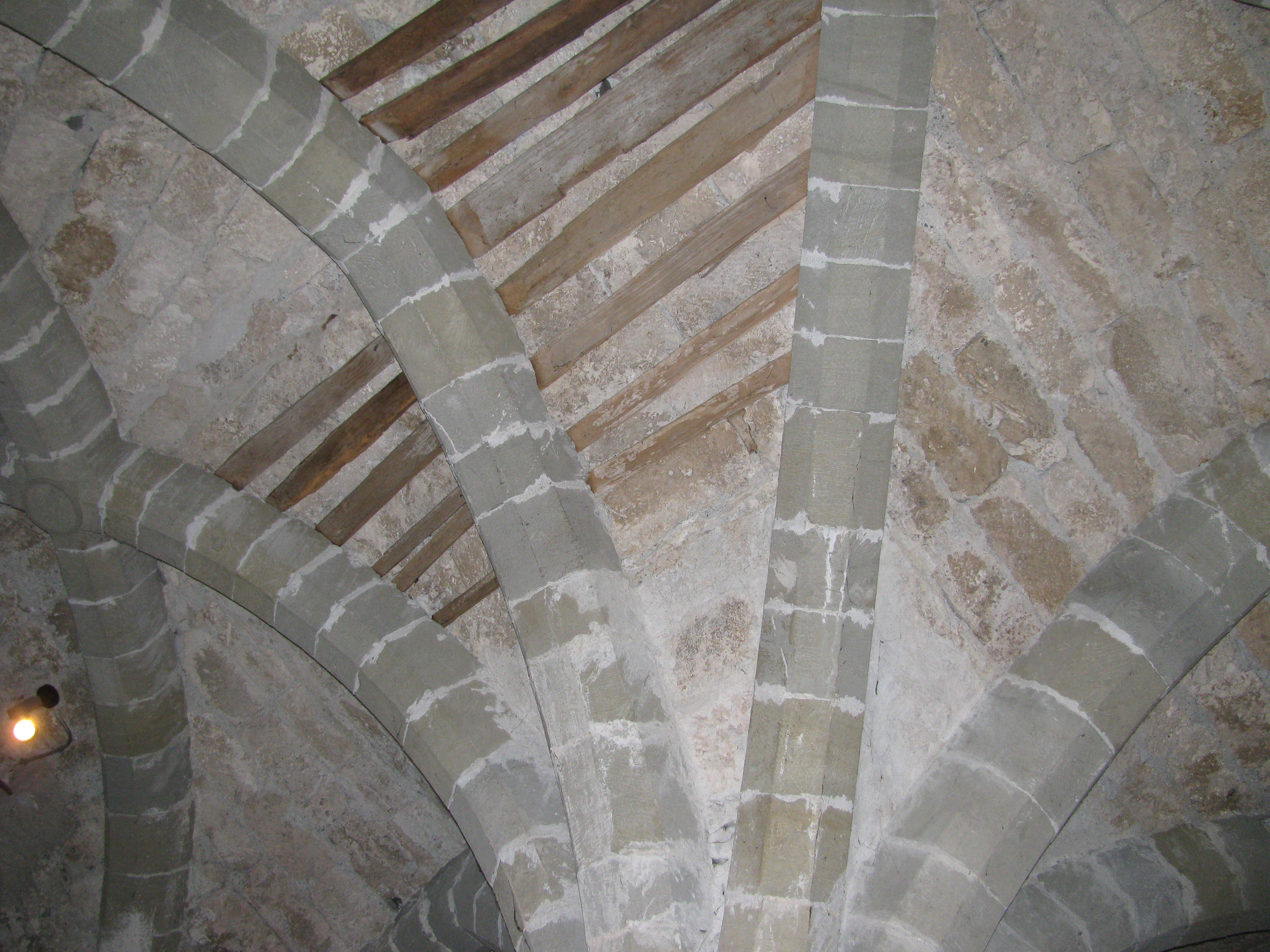
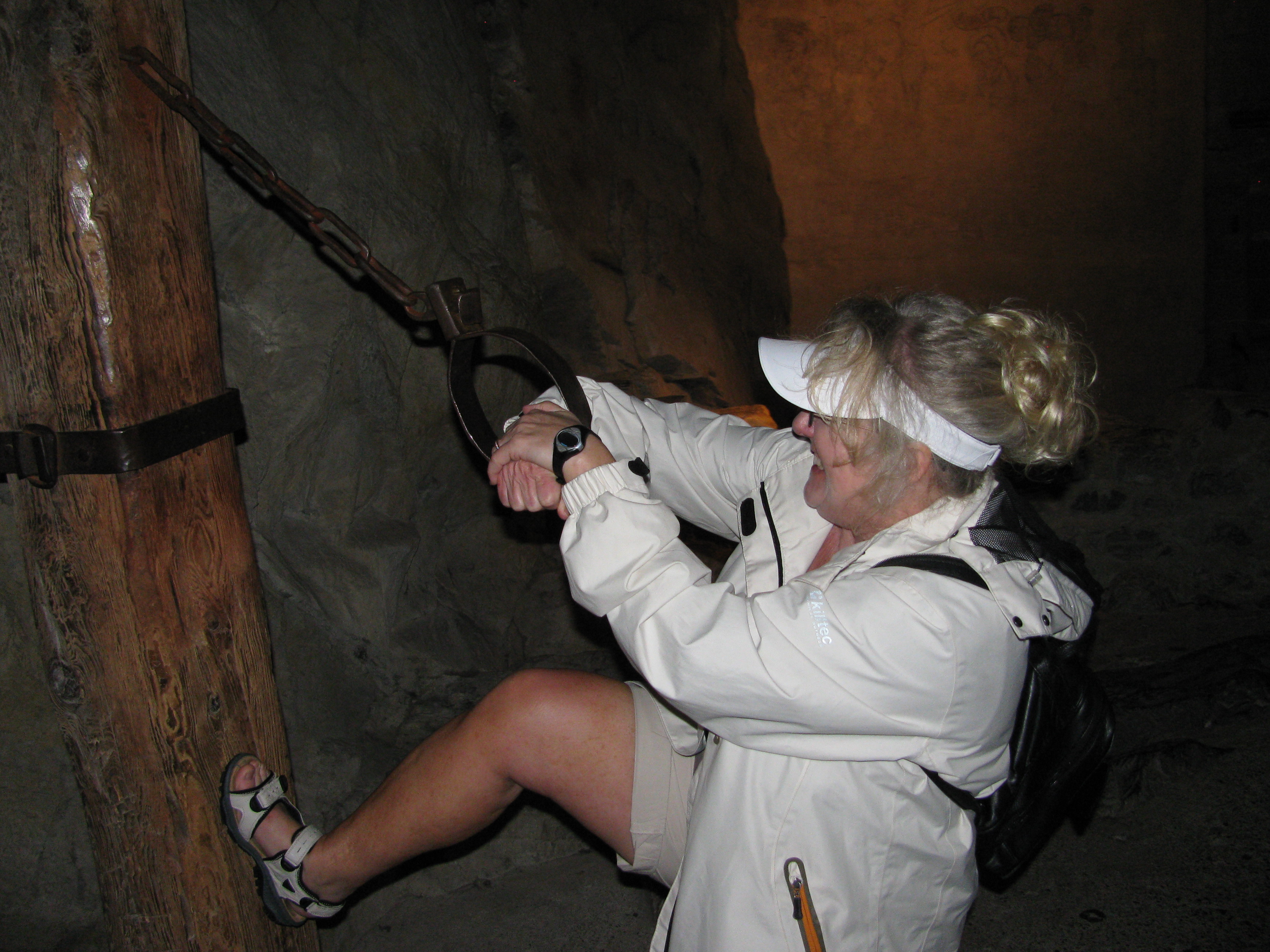
The castle is the melding together of a conglomeration of structures, and it shows as it weaves and bobs around the island. Despite it’s four grand staterooms, it lacks the palatial air of Spanish castles. Nevertheless, it was more fun to troll through because it had the air of a real working fortress, although that unfortunately included a torture chamber, complete with original etchings of biblical figures on the wall, scratched in by the hapless victims imprisoned there.

Pretty sober stuff that struck home as we toured the castle during a smashing thunder and lightning storm, with waves crashing outside against the island.

Rugged, beautiful, cruel.

But definitely worth seeing. Admission is only $12 an adult, a very decent fare.  It took us two hours to tour the entire castle, which appeared small, but it curves up and down, to the point that visitors quickly lose their orientation, and the only way to be certain of your location is to keep checking the numbered rooms, all 46 of them, which are handily described in a brochure that comes with admission.  According to my pedometer, we walked about 2.5 miles, which doesn’t seem possible, but my pedometer hasn’t lied to me yet.

Yes, I photographed the 700-year-old toilet. I have no class.

The toilets, by the way, were indoors, and simple wood planks set into the stone walls. The “refuse” would tumble down a large stone chasm that curved and eventually opened to daylight, by which we can only assume the refuse ended up in the lake.

Indoor plumbing was tricky back then, because the opening into the wall could be used by an attacking army as a way to crawl inside.

Maybe it was the thought of soiled Germans emerging from the latrines that made the French think they would just as soon not fight, which some might say, has become intrinsically entwined in France’s military history.

If you go, a happy little sign outside of the castle says it’s a 45-minute walk to Montreux along the waterfront promenade. It took us 60-minutes in a pouring rain and cutting wind, however, it was invigorating. For one thing, we were the only tourists on the promenade, which meant we didn’t have to do a two-step to navigate through a crowd. Secondly, it’s a lovely walk that starts out through some nondescript

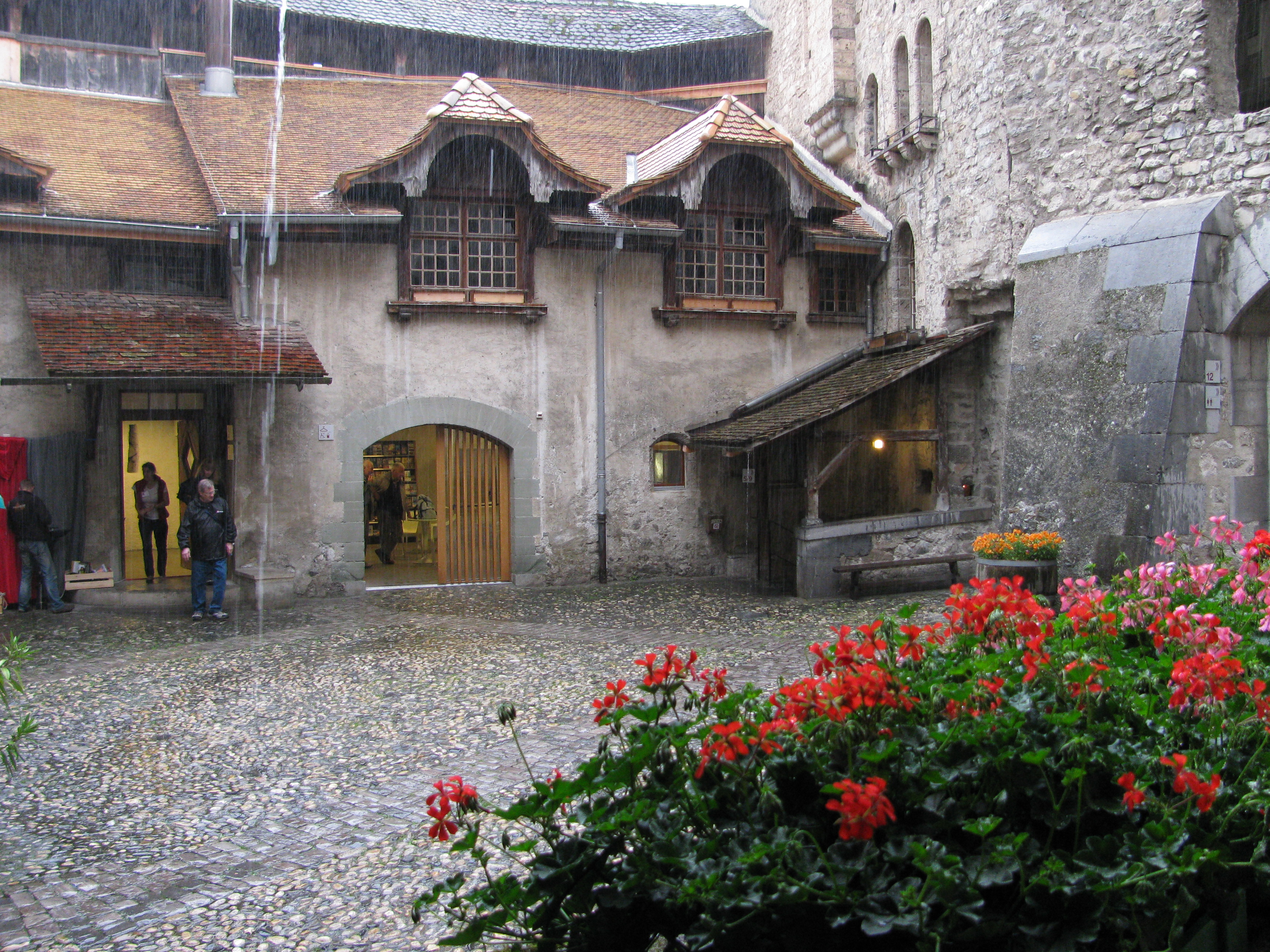
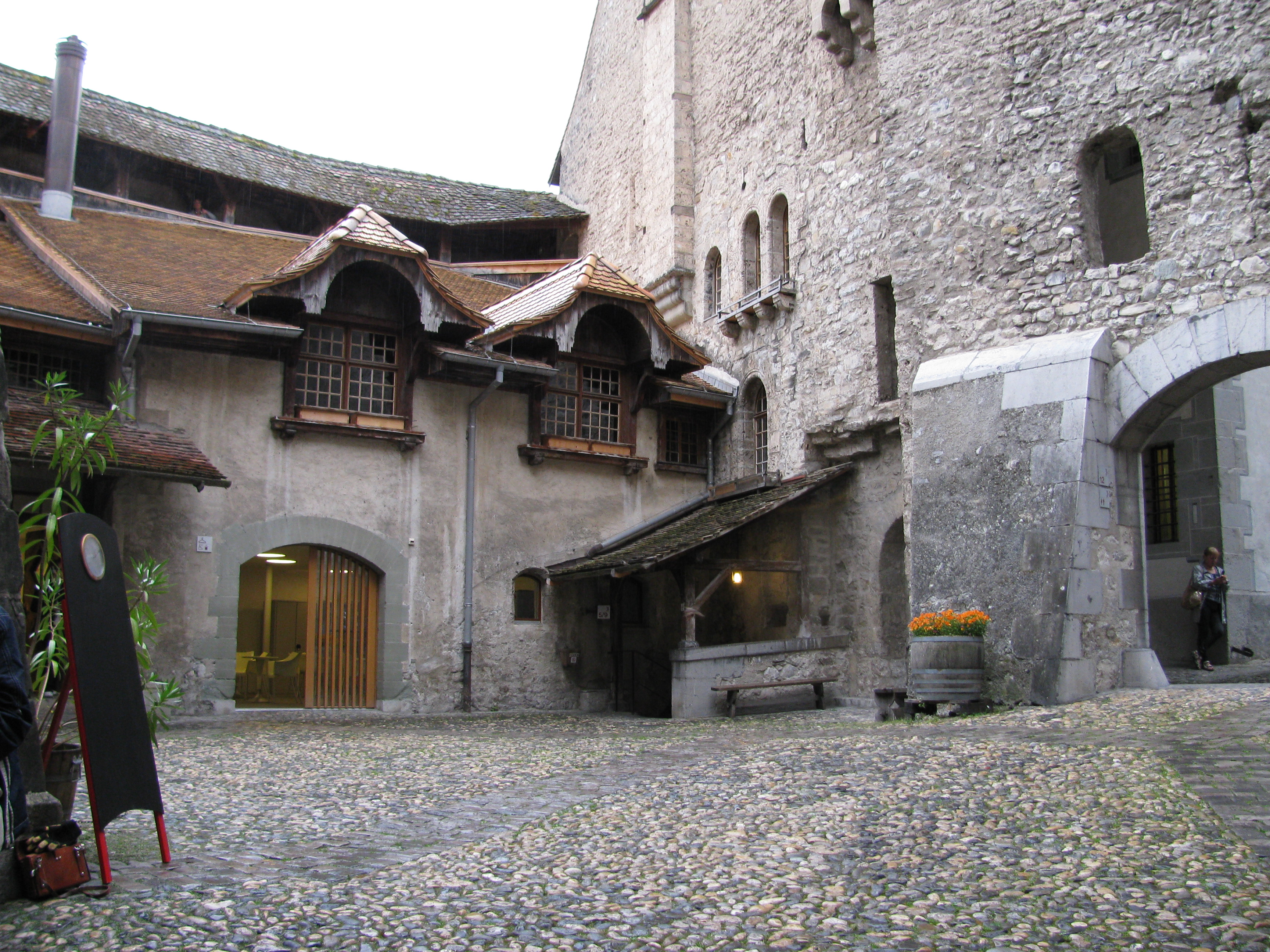
Charming little courtyard. Must not have been so charming though, when the torture sessions were on downstairs.

hedges and eventually opens to a wide path flanked with mansions on one side and botanical gardens fronting the water on the other.

You will pass a casino made famous by Deep Purple’s song Smoke on the Water, which refers to the time it burned down in the 1970s when a patron lit it up with a flare gun. You can go in there to eat, but they will want to take your belongings, your coat, and seemingly your identification while you’re inside. Dave and I measured the wisdom of leaving our valuables with the sort of people who run casinos and decided we’d rather brave the storm outside. It was only a 5 or 10 minute walk from there to a McDonalds, which we did not stop at, although we thought of it because it is the only affordable “Swiss” restaurant we have found so far. Instead, we went onto a pleasant lakefront cafe, which  I will write about tomorrow.

Click on photos for close-ups! 

Tourist burn-out in Montreux

A classic Montreux old-quarter building. How it disgusted us.

It may have been the hosing-down rain, the blasts of wind intensifying as it whistled in through the castle’s torture chamber keyhole openings or the fact we have been in Europe for six weeks now, but at about 5:23 p.m. May 14th, we reached saturation point.

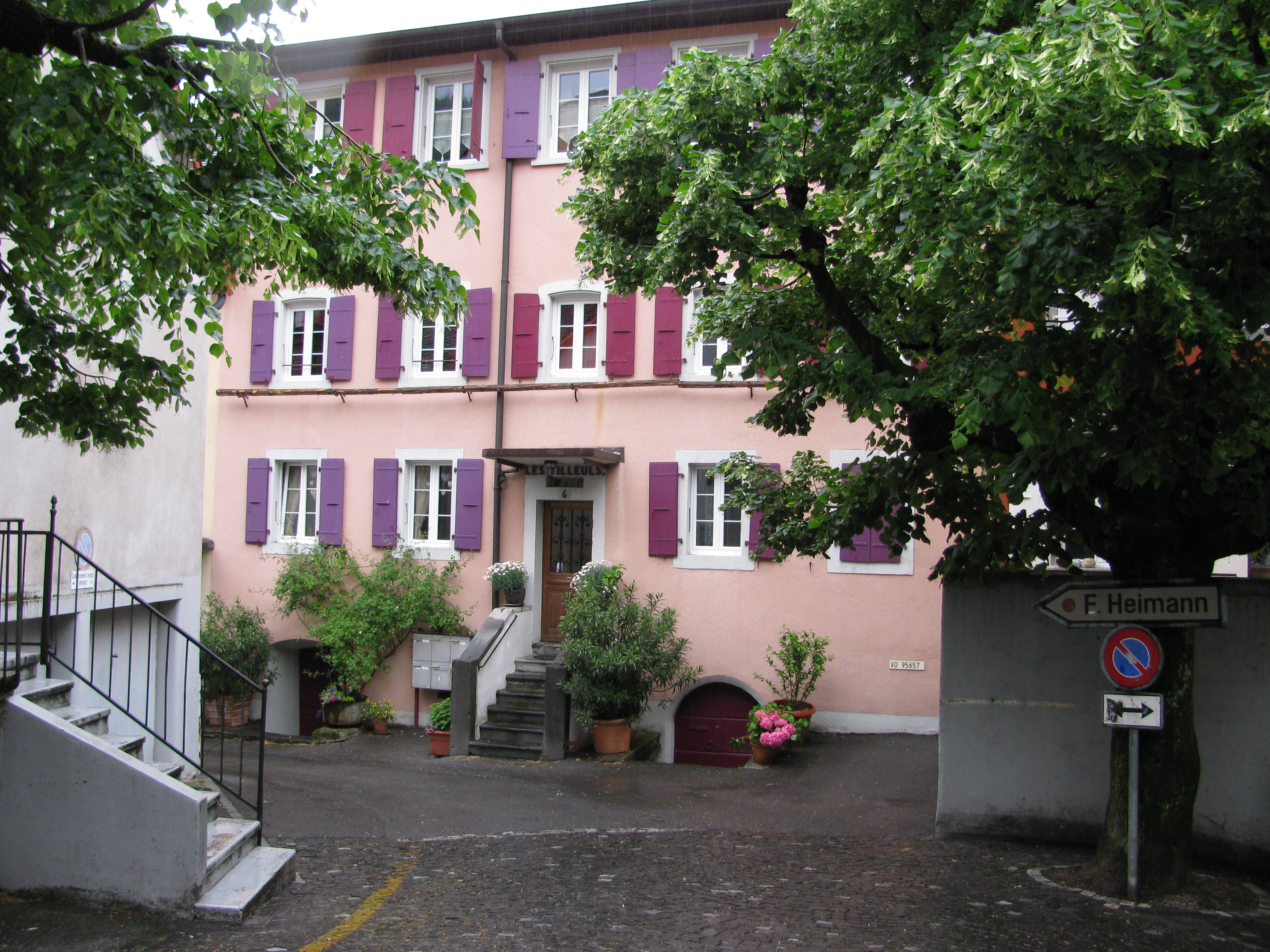
Walking the deserted narrow cobblestone streets that braid their way down the steep-pitched Montreux mountainside, we looked on fairytale clusters of stone buildings, accented with aubergine and cherry shutters, inviting shop windows with unique teacup and hen pottery figures.

It was then that we reached the conclusion we were not suitably amused by the famous enclave that has been home to Shania Twain, her notorious ex Mutt Lange, Freddie Mercury, Bill Gates, Jean-Jacques Rousseau, Ernest Hemingway and other luminaries. What did they see in this place that is called the “Swiss Riviera.”

When tangerine-coloured buildings no longer appeal to you, it's time to take a break.

Looking at the photos this morning, I realize it was all fatigue and no-common-sense that put us in that dour mood. The place is lovely.

We got off the train at Montreux during the lunch hour and made the steep walk down to the water for the requisite visit to the tourist office, which I am pleased to report was actually open. We have found a surprising number of tourist offices that are closed on weekends. The one in the Paris train station read it was “exceptionally” closed the Saturday we were there – by exceptionally they may have meant it was unusual to be closed that day of the week, but we think the French just like to polish up their every move, hence their tourist office closing stands out from all other tourist-office closings by being “exceptional.” In retaliation, we were “exceptionally” put out.

But to get back to this weekend’s wanderings:  Montreux has two “old towns,” a 19th-century quarter and further up the steep slopes, the 16th century village where our appreciation for old-architecture topped up. Looking at the bell tower of a stone church, I felt that my ancestors were absolutely right to leave this  continent at about the same time this place was laying its foundations. Who builds up this high, I wondered?

Of course, building among the clouds was likely part of why this settlement succeeded. They could see trouble coming from a far-off distance and plan their defense accordingly.

It was around 6 p.m. when we trolled these streets, which were empty due to torrential rainfall. Either that, or they knew we were coming. Why did this not enchant us? Tourist-burn-out.

Montreux is on the waterways that connect England and France to Italy, hence it has always been an important trade route and is home to a castle that has been part of that history for a thousand years.

I will write more about that tomorrow, but for now will leave off with photos that demonstrate the little-recognized phenomenon of tourist-burn-out, a condition that can only be treated by gazing on 1970s architecture, horrifying a remedy as that may be, it is the only thing that will recapture our appreciation for ancient European architecture.

Real travel tip: Montreux’s slopes are not only heart-stoppingly beautiful, they are also capable of stopping your heart. A 12-week cardio-and-strength-training regimen is recommended as preparation to walk these cobblestones. I wish I was joking about this.

We will have to stare at this modern monstrosity in order to regain our appreciation for 16th-century architecture. Ugh.

Hopefully this child never has to know the horrors of living in a modern apartment block, where the word "block" truly applies. See right.

Switzerland’s “Toronto”

Zürich police station. You know that if the police station, usually the most functional of buildings, looks like this, the city is going to be spectacular.We said we wouldn't go to Zürich, in light of the recent terror-threat a la bin Laden's demise, but woke up Saturday morning with the day stretched out in front, shrugged our shoulders and said, "Why not?

We said we wouldn’t go to Zürich, owing to the terrorist-threat associated with the demise of Osama bin Laden, but then we shrugged and said, “Why not?”

These two words might be the famous last words of many, but not us, at least not this weekend.

We were partly intrigued by the number of Swiss who almost, but not quite, spit upon the mention of Zürich. They hate it.

Marcel, a well-traveled Swiss geography teacher, told Dave if there’s any part of Switzerland that can be missed, it is Zürich. Our concierge shudders at the mention of it.  Our most helpful front desk clerk, Daniela who scales glaciers and thinks cliff-climbs are a leisurely way to get from one point to another, crinkles her nose and rolls her eyes when she hears its name.

“The place is full of bankers running around,” she said.

And that is the clue to Zurich’s low-standing in the eyes of the Swiss. It is to the Swiss what Toronto is to Canadians, what New York is to Americans and what London is to everyone. An expensive, over-rated, self-absorbed metropolis.

Grossmunster Church profile,which I originally posted incorrectly as Fraumunster. Thank you to alert blog-reader for the correction!

But we didn’t think so. First of all, we showed up on a Saturday and no bankers were in evidence. They were likely resting in Monaco from their week of racing  from one financial institution to another, clutching fistfuls of lucre as they went.

It was an amazingly beautiful city with a train station that rivals Paris, but much less smelly. It fronts onto Lac Zürich, that on Saturday was dotted with white sails and swans so big that they have to gate the boat launch lest the things pad their way up onto the streets and take over the city.

The river that flows from the lake is a clear jewel-green. Its cobblestone streets roll up and downhill, meeting, then fanning out in random directions, none of which that can be said to be “right” or “left,” making following the guidebooks suggestions somewhat difficult, except that it turns out there is no wrong way to go. Every lane is charming.

The fabulous Fraumunster Church.

I couldn't resist photographing this street-side kiosk - is it the adult Lucy's "The Psychiatrist is In" booth, a la Charlie Brown?

It’s older “tourist” district is so large that it is something like seeing eight heritage districts at once. It goes on and on.

We visited massive stone churches, one with 1970s stained glass windows (Fraumunster), which might sound like a mistake, but these windows are perhaps the only artistic/architectural feature hailing from that decade that are worth saving. They are vibrant and unique.

We dined at a street cafe, trolled through shops, some so well-laid-out with such fascinating goods  that to buy something would throw the whole decorative ambience into disarray. It was just perfect as it was.

Fraumunster Church, which still has its mid-13th century presbytery, along with these 1970s stained glass windows by Marc Chagall. It's a wonderful trans-centurial marriage.

Dave checks out a three-wheeled car. What is the point of that?

Zürich's river front, not far from where it opens to Lac Zürich.

Europe's ugliest bridge, according to travel guru Rick Steves. And yes, it is.

Unusual ornate architecture in Zürich, Switzerland. Stood out among Zürich's Gothic and Baroque architecture.

Zürich police station. It is possible this is a torture scene, or a possible warning about how one's lawyers are about to excise one's property to fund a defense, but it sure is different.

Riverside park in Zürich's tourist district. Plenty of quaint, expensive shops that are worth browsing just for fun.

Wandering puppies

Puppies!

We’ve been reduced to wandering the streets like lost puppies.

Our Swiss town shuts down on Sundays, so after a morning of lazing around doing nothing (reading books, surfing the internet in a brainless manner, organizing our single clothing armoire), we headed out to check the town’s movie theatres for listings.

We could just look them up on the web, but roaming the streets without some sort of purpose feels weird to we who are accustomed to striding hurriedly to our next destination, so we seized upon our task, pointless as it may have been.

All the theatres in our town seem to be owned by the same company, so each one’s front door is pasted in white pages that list its own movies, as well as all the other movie-houses’ showings.  There’s no need to check every individual theatre’s listings, but that’s what we do anyway.

If anyone had a bird’s-eye view of our Sunday morning roamings, they would assume we are idiots, going from theatre-to-theatre, checking the identical postings as though it mattered that we’re at the Lido, the Apollo, the Rex or the Beluga (its real name, don’t ask us to explain, we don’t know the answer).

If anyone could eavesdrop on us at every stop, they would hear us re-enact the exact same conversation at each one, puzzling over whether the movies are in English, German, Italian or French, or what manner of subtitle they have. I tell Dave every single time that “Alleman” means German, not “all-languages.”

That we can repeat the same conversation without breaking into hives is evidence of marital fog, a condition that allows us to forget what was said one to another only minutes earlier. This amnesic state preserves marital stability and social order. We would get checked for early signs of Alzheimers, but to this day, neither of us has thought to bring it up during doctor visits.

What was I saying?

Oh yes, we were wandering like panhandlers, minus the begging, when we happened upon two churches in a neighbourhood of old apartments fronted by wrought-iron fences and elaborate tiny gardens with unreliable-looking wood patio chairs. As we stood outside one church debating whether it was English, French or German and I reminded Dave again that “Alleman” does not mean “all-languages,” a couple emerged from the church, smiled at us and let loose a stream of what I can only assume was German.

“See, that’s ‘Alleman,'” I said, never missing a beat on my campaign to achieve ultimate know-it-allness.

As it happens, I was correct, but now we were on the street chatting with people who didn’t really speak our language and neither did we speak theirs. It could have been socially awkward, but we relaxed, comfortable in the knowledge we would forget about the exchange in a few minutes anyway.

That did not happen. Within seconds they retrieved a fluent English-speaking man from within, who invited us in for coffee and sweets. His name is Daniel, a multi-lingual Swiss missionary. Mercifully he did not introduce us to the 100 or so smiling German-Swiss inside, because it would be pretty tiring to explain repeatedly that we didn’t have a clue what they were saying and that we just hoped this wasn’t some kind of cult that would club us senseless before drugging us into shaving our heads, wearing robes and loitering about airports.

We left a little later, emails and phone numbers exchanged, along with a few plans for expanding our small little English enclave.

One could suppose that with a paucity of homeless people in Switzerland, churches have taken to combing the streets for foreigners, but in truth we had happened upon a particular hybrid – Swiss Christians – two very friendly groups mixed into one. It was inevitable that we would be drawn inside, caffeinated, fed with appropriate doses of sugary/buttery goods and then dusted off and returned to the wild. These are the people who brought the Red Cross to the world, so why not rescue a few Canadians?

Say Cheese

How do the Swiss get those holes in their cheese?

Woke up to a smelly apartment this morning. Cheese must have snuck out of the fridge while we were asleep.

Swiss cheese here is not very much like Swiss cheese anywhere outside of Switzerland. In North America, it has a polite nip in its flavour. Over here, it stinks so bad that we are forced to limit the number of times we open the fridge door, just to preserve the air quality in our place. This is a true fact.

It seems heretical to say, but I am having trouble believing in Swiss cheese per se, just as I am deeply suspicious of my mother’s pre-1961 claims about Santa Claus.

For one thing, I have yet to locate a single block of cheese in any of the local stores with the name “Swiss” on it. The only names I recognize are Brie, Camembert, Feta and Emmental.

Note to editors: Yes, I capitalize all cheese names out of respect for any food made up of 70 per cent or more fat. Canadian Press Style Guide be darned.

Instead, the labels on cheeses here change every three days and read in long Franco-Germanic hieroglyphics like Kaltbach Holengereift  affine en grotte Kraftig-Wurzig intensement corse, which I believe translates into:  Right off the Cow’s Back while it hollered and it’s a fine although gross cheese nothing like Kraft, with an intense coarseness.

I’m suspicious of any grocer who claims to carry 983 varieties of cheese, as Swiss grocers make it appear with their vast dairy aisles. Now, having sampled their wares for over a month, I am ready to make the expert assertion that they only have one cheese, but sell it in various states of decay, and what appear to be name brands are actually warning stickers reading: Essenauf Eigene Gefahr and Acht Monate Vorbei Sein Verfallsdatum. *

This is the wonderful thing about the German language: It makes even the simplest things sound complex. It is how they came to master engineering and technology the world over.

In the meantime, I staggered toward the fridge this morning, facecloth pressed firmly over my nose and mouth to prevent inhaling more deadly cheese spores, declaring my intent to save us by disposing of the cheese.

Dave, Scottish by blood, would not hear of throwing out something we paid an exorbitant amount of money for, and declared he would eat the remainder – a sizeable pie-sized piece. Good man. Fell on his sword. **

*Translation: “Eat at your own risk,” and “Eight months past expiry.”

** I meant to write about the absence of Cheddar from Swiss shops, but got side-tracked. This is what cheese-spore-laden air will do to a person.

When things go right

Solothurn's St. Ur's cathedral roofline. We climbed up 250 poorly lit, uneven wood and stone steps to the top (see people there on the right tower - they look like ants. 15 minutes later, that's where we were). Because this was the trip where nothing went wrong, we did not plunge to our deaths. Nice.

My albatrossness began in early childhood, when my Uncle Guy gave me my first lesson in the fine art of fishing.

At 4 a.m. we hiked out to a sparkling clean river with rock waterfalls. At 5 a.m. we returned to the camper. Uncle Guy sported a hole in his ear lobe … this in the day before men got their ears pierced except in fishing accidents … his favorite childhood lucky fishhook was somewhere at the bottom of the river and my right leg was scraped up and down from plunging into a hidden rock crevice as we crossed the waterfalls, bringing the water right up to my chin.

Uncle Guy fished me out – the only catch of the day and one he restrained himself from saying he’d like to throw back.

A year or two later, my Aunt Rosie listened to Uncle Guy’s account and determined that the flaw was in the teacher, not the student. She took me fishing at Rainbow Falls in the Whiteshell. It was the first time she had ever seen anyone hook a seagull.

Fast-forward a few decades and my older brother brought his boat out to our cottage for a fishing excursion. It was the first time he had seen someone hook a loon.

The common thread in these accounts is not fishing, although that might seem reasonable. It is travel. In every instance, bags were packed, gas tanks filled and coolers jammed with sandwiches. It makes my one-city-four-hotels story of Paris appear in a new light.

Solothurn's main promenade.

It’s also why I’m a nervous traveler. I don’t think things are going to go wrong. I know they will.

This is what makes the last weekend so amazing. We hopped the train for a short 15-minute ride to Solothurn, a village so un-noteworthy that even Rick Steeves (our travel guru) gives it no mention in his guidebooks.

It turned out to be the best day-trip yet. And nothing went wrong, ergo I have nothing to write about it except to say that Solothurn, despite it’s somewhat weird name, is outstanding for its baroque architecture, narrow cobblestone streets, Italianesque styling and museums where entrance is by donation (we figure $10 is about right).

Click here to see a 54-second video of Solothurn’s marching band – sorry that my videography skills are substandard. I’m working on it. As Dave says, much would improve if I would just stand up while videotaping. I was standing up.

Solothurn's clock tower.

Dave's ancestor? We don't know. Solothurn art museum held an original Van Gogh, Cezanne and Picasso - not bad for a village of 15,000 and canton (state) of about 245,000..

Are you British?

Swiss village.

We shuffled out of our little English-speaking community of two last week to look further afield for other Anglophones.

Not that we’ve been in total linguistic isolation –  many of the hotel staff here speak English very well and use it to good effect to pump information out of us about Canadian tourist destinations, either that or they are spies.

Normally we seek out an English-speaking church, but the town where we live has none – the very first locale we’ve been where this is the case.

In the past, all we’ve had to do to make friends was show up at a church and let divine intervention take place. Our faithful brethren would size up our  ineptitudes immediately and take us under their wings.

Americans are especially quick to do this, instantly recognizing bumpy roads ahead as they wearily assume a degree of responsibility for acclimatizing me to my host country, knowing full-well I would get pegged as “another obnoxious American.” They are sick of getting grief for the stream of faux pas I commit wherever I go.

Dogs welcome. We kept tripping over someone's little dachshund who roamed the bar/restaurant freely with his leash in tow, felling customers with hardly a wink.

They are not wrong about this. I have a lingering southern accent, the roots of which lie in the fact that for most of my life I have spent a lot of time with Americans from Massachusetts all the way down to Florida. I also was a big fan of the American sitcom Green Acres, but for some reason I did not pick up Zsa Zsa Gabor’s curly Hungarian accent.

All this leads up to our recent appearance at a meeting of a 100-year-old English club. We arrived at Les Caves restaurant where they were gathering to mark the nuptials of Prince Will and Kate. The group looked shocked to see strangers waltz in, even though they invite newcomers on the website.

One of the senior members recovered; eyed us up and down and demanded to know, “Are you British?”

She looked crestfallen when we identified ourselves as Canadians. Just the colonials, that’s all. She turned away in disappointment, mumbling that we might want to speak to an American they kept over in the corner.

Nevertheless, we hung around and soon the wine began to take effect on the club members, who grew more welcoming. By the time we left, they were dragging assurances out of us that we would return.

See. This is the unheralded danger of over-imbibing on spirits… it makes me look socially graceful (I don’t include Dave in this – he is unfailingly polite wherever we go – I’m the one who has foot-in-mouth disease).

We’re going back to the next meeting, which is tonight. We’ll see how that goes.

What’s wrong with Switzerland

This is not me. Judging by the dozens of paragliders floating over the valley, the Interlaken is an excellent place to catch an updraft. Dave spotted one glider just jump up on a mountain side and take off. Not jump "off," just jump "up." The laws of physics and gravity appear to be suspended in Switzerland.

What’s wrong with Switzerland is that it has mountain peaks that stand on tiptoe at over 13,000 feet above sea level. I’m only five feet above sea level. You can see how scary the Alps can be for someone like me.

We decided to check out (not go up) some of those mountain heights in Switzerland’s famous Interlaken region. After two hours of travel via Swiss Rail for the return-ticket price of $80 for two of us, we arrived at the valley floor of Lauterbrunnen, a quaint Swiss village surrounded by quaint Swiss farmyards that looked very much like Vancouver Island’s Saanich Peninsula, except where the peninsula is surrounded by the Pacific Ocean, the Lauterbrunnen valley is surrounded by mountains.

Dave calls this a “material” difference.

Lauterbrunnen cemetery - placed suspiciously close to Lauterbrunnen gondola

We began what appeared to be an aimless stroll by admiring the Lauterbrunnen cemetery, without argument the tidiest, least-scary graveyard I’ve ever seen, except that only six kilometres away is what I call the Gotten Himmel gondola ride, a five-minute 1,600-foot sweep up from the valley-floor to the mountain-clinging village of Gimmelwald (4,593-feet).

Gotten Himmel means “God in Heaven” and certainly my mind was on spiritual matters, being so close to the resting place of the dead and the gondola, an efficient agent of death if ever I saw one.

The enchanting stroll along the Lauterbrunnen valley, that ends at Recipe for Death gondola ride.

I started to climb the wrought iron fence into the cemetery, reasoning that I might as well just lie down and take root, rather than go through the heart-stopping gondola ride, but Dave convinced me we would just walk the valley and see its famous 10 waterfalls. That the gondola was at the end of the valley and we were walking in its direction did not mean we had to get on it.

The sun was hot, the views hypnotic and the walk long, so that by the time we arrived at the gondola site, I had temporarily lost my mind, which is the only explanation for how I found myself standing in line with a gondola ticket in hand.

I made the ride, without screaming, which proves that living-in-denial is the roadway to achievement, even a modest achievement such as getting through five-minutes of this (click to see 54-second clip of end of ride).

More to follow, including a mountain-side restaurant review.

Murrenbach waterfall plunges 417 feet to valley floor. Lauterbrunnen is a classic glacial valley with near vertical cliffs on both sides.

Travel travails continued


Arc de Triomphe, commissioned by Napoleon in 1806, and new symbol of our goal to get to Paris. Will we triumph? In a side note: We have several Spanish coins dated to 1802 with a Napoleonic visage on them. Must remember to get them appraised.

As I made my way through throngs of commuter passengers at Biel’s train station, a middle-aged man in a tan jacket and faded denims unzipped in the train square and let’er rip.

I’ve lived in Spain, so I’ve seen public urination before – usually on the side of the highway where the Spanish men do not give passersby the courtesy of turning their backs to the road as they empty their bladders.

A location for public urination? According to one fellow, it is. Yuk.

This fellow, who stared straight ahead and otherwise appeared sober, had opted for what must be Biel’s  most public venue for such a private act. It was only 6:30 p.m., still broad daylight and the square was jammed.

Maybe he had just come off a day of dealing with a cantankerous travel website, or perhaps he had just discovered his train ticket cost double what he expected.

So I walked on by, noticing that no one else seemed to notice or care much about Mr. Public Urination.

A few minutes later, after meeting Dave inside, we/I learned our train costs will be over $500, according to a different booking agent than the one who earlier in the week had quoted $260. The agents had a good belly laugh when we mentioned the $260 quote.

Because we are Canadians, we did not shout or make any display. We simply groaned inwardly as we felt our stomach ulcers dig in deeper.

At that point, we were still in recovery from the lastminute.com fiasco and it seemed that as Tuscany was for Seinfeld, so Paris would be for us (click here to find out what I’m talking about). It has become our “white whale.” We must get there, and so we ponied up the cash, realizing that we are already at over $1,000 for two days in that famed city.

It goes a little over budget for we frugal types, but we are rapidly losing the ability to care … at least about that. I’d still rather men chose more discreet locations to relieve themselves.  After all, this isn’t Spain.

Postscript: And now a well-traveled friend warns us to stay away from Paris over Easter.  Cue the Jaws theme music.

Making friends fast

As in so many places in the world, it is in Switzerland: It’s easy to make friends when it appears you’re carrying a 24-pack of beer.

This isn’t to say the quality of friends is that which your mother would approve whole-heartedly, but friends all the same.

It started when I gave  into my very North-American vice and picked up a 24-case of Coke Zero for about $13 – quite a bit more than in Canada, but as I said, it’s a vice and today I am missing a few of those.  With the case propped atop my right shoulder, I made the short walk back to our hotel.

Swiss soldier on the look-out for beer.

I didn’t get there before I heard two men shouting at me in German from a car waiting at a red light. The two, dressed in army fatigues  were waving me over enthusiastically, asking me to spare a beer or two for a soldier.  I look German, so I got away with laughing derisively at them before they drove away, all smiles, but no beer (or Coke).

The hotel manager, Reiner, and our helpful front desk clerk Daniela were on their break by the side of our hotel, and as I approached, their wide smiles and exultations expressed their mistaken belief that I was carrying some brewskies. Their faces melted in dismay when I came near enough they could identify the Coke Zero.

The dismay turned into shock when I told them that a. I’ve never carried a 24 of beer and b. generally, speaking I avoid alcohol.

“How can you live this way, how can you be happy?” they demanded to know.

“In wine is a cure for all things,” Daniela said, ” You don’t need vitamins, just wine.”

I can’t say that I agree  – too many tragedies, traffic fatalities, high levels of stupidity start with the bottle, but I’ve got nothing against the occasional glass so I promised to test Swiss wine at the coming autumn festivals.

In the meantime, Dave is spending his evenings reading to me from our favorite travel guru Rick Steves’ guide book, suggesting that this weekend we head up to one of Switzerland’s mountain-peak chalets where sixty beds are jammed into a four-bedroom house with shared baths, but the views are spectacular.

“Just pretend I’m Leslie,” I say.

Leslie is an Atlanta friend of ours who emancipated me from all socially induced pretense back in 1996 when she said to me, “Let’s not pretend that I will ever cook anything,” and “Camping? Never.”

Switzerland's famous Interlake region

Up to that point, I was under the delusion that a love of camping held some mystical virtue and cooking was a necessity, but happily Leslie showed me another way, and that way started with a firm  “No” to crazy ideas that would have me doing either, or anything even remotely resembling such. That includes booking into hostel-style accommodation.

So, no. We are not heading up to any mountain peaks this weekend, but instead will enjoy a train ride through the mountain range’s valleys. Much more civilized.

Luscious Lucerne

Saturday we took the 90-minute train ride east to Lucerne, past lush, meticulously kept pastures, rolling hills, quaint farms with cows lolling about, a trip made sweeter because we now have our Swiss Rail resident half-price cards.

It looks like a great deal, bringing the price for  two return tickets down to $78. We were pretty pleased with that until we realized that we were travelling only 48 miles – what the heck? That’s like a $1.50 a mile.

Swiss comedians? Or the Swiss version of a chain gang (ie. not breaking rocks, just colouring on them).

We arrived in Lucerne to discover the city in the throes of an international comedy festival called “Fumetto” – at least, that was the explanation we got for the men in orange suits studiously scratching a chalk path into one of the cobblestone squares, which didn’t look funny at all, but I’m sure something hilarious was about to happen. We had our doubts, because orange suits are prison gear back in the U.S., so we were suspicious this was the Swiss version of a prison-work program.
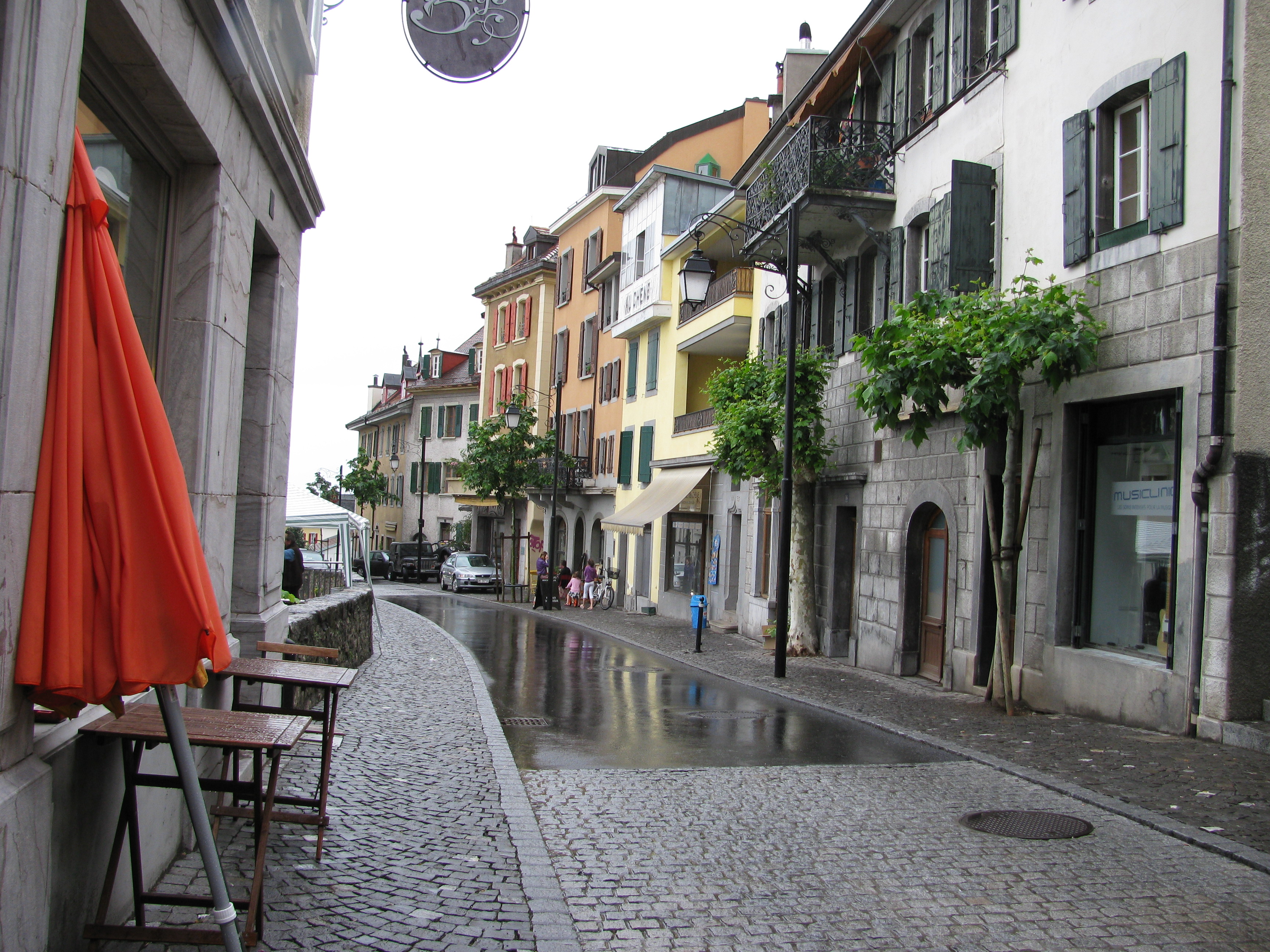
We checked out a kitchen store where laundry bags sold for $99 and shoe stores, at one of which I found a pair of  loafers priced at $269… others were priced higher, but my brain could not compute such numbers well enough to recall them now.

Lucerne is, after all, Switzerland’s Monaco, and the well-heeled were in ostentatious abundance from stylish couples strolling the lakeside promenade to high-end sports cars inching through narrow cobblestone streets that until their arrival, we thought were pedestrian-only. Maybe the rules are different for those driving Bugattis and Lamborghinis.

Even the McDonalds restaurant was high-end with vintage ceiling tiles, orange cube leather seating and a McCafe pastry bar. Ooo la la! It was a beautiful city. I’ll let the photos speak for it. Click on photos to get a larger version.

At a swank chocolate shop called Merkor - I think it translates into "No chocolate under $40"

About half of the chocolate in Merkor's main showcase, and I do mean "showcase." The word "display" just doesn't quite make it.

Lucerne's waterfront. Not so bad.

The inside of Lucerne's Jesuit Church. Very white. Very bright.

Lucerne. Very pretty.

Lunch for the uber-rich - also, where they are on display for gawkers like us.


Many of Lucerne's Old Town buildings sport frescos (murals) - this one depicts the city's Mardi Gras celebrations.

A wall mural depicting the building's former street level cafe-owners in Mardi Gras celebrations.

Lucerne has two homeless men. We found them both. It's noteworthy that this man's wardrobe included a colour (red/orange pepper) that matched many park benches, and that is also favored among the rich (see other photos). Even Lucerne's homeless fall under the dictates of fashion.

The photo quality is not very good, but this stylish 8-10-year-old girl's pic is worth posting - we saw fashion-conscious kiddies everywhere. What is this? France?

A woman parading her control over her husband on Lucerne's Promenade - his attire matches hers right down to his shoes. Somebody help this guy.

View over Lucerne Lake with the Alps in the background. This body of water is also called Vierwaldstattersee. Yes, it is.

Watch your language

French for Dummies, which I am.

Just when I think I’m making headway on this French language thing, I run into a stream of Spanish, ripping my brain right back to Madrid 1999.

We lived in Madrid for about 18 months, over which I acquired a basic level of Spanish. Now that I’m living in Switzerland and trying to adopt French, Spanish words and phrases fling off my tongue with frightening ease.

This could fool me into believing I’ve achieved new heights of fluency in Spanish, but only because there are no Spaniards or Spanish-speakers around to offer their opinions/horrified glares.

Until this morning, that is. As I passed a housekeeper in the hotel hallway, I said hello in French, and then discovered she’s Portuguese. We tripped into a Spanish/Portuguese conversation from which I am still recovering.  I have no idea what I really told her, but I’m pretty sure she gave me a detailed analysis on the hotel’s cleaning schedule.

At the Coop (pronounced cop) grocery store this morning, the cashier asked if I preferred to speak in German or French. I said nine-sprechzeny doich und je ne say pas parl francay (I’ll spell it how I like, thank you), whereupon she surmised that Italian was my language of choice and let fly with a wonderful opera of words that were as discernible to me as Arabic, but it sounded lovely.

I don’t know if I’m ever going to get this multilingual thing wrestled to the ground, although I do love elbowing my way through crowds saying “Scuzay,” which is what the Italians around here spit out as though they are saying “scram.”

And, as I walk through Biel’s streets and shops eavesdropping on French conversations so as to pick up the local accent, I’m also absorbing some German – and worse yet, my English is starting to decay.

All that aside, the Swiss have an admirable tolerance for the tongue-tied. They smile, they coach, they do their best to leave no one behind in conversation. I have yet to see any language-related temper tantrums or snubs.

In the meantime, I am in terror of running into the Portuguese housekeeper again. For all I know, I invited her to be our guest at our Ontario cottage this summer.

Why is moving so exhausting?

Whether packing up two giant suitcases and shuffling them a matter of a 100 metres of so falls under the classication of “moving,” I do not know, but I know I am getting tired of moving, even if they are micro-moves.

How did we get this way? Here is how:

Before arriving in Switzerland, we had emailed back-and-forth with the hotel about their long-stay suites  that had been recently renovated and did not require a lease. Leases are an issue when one arrives without a residency card, but one cannot get a residency card without a lease/permanent address. This Catch-22 is a modern form of torture that leaves no outward bruising.

Our previous apartment.

Our new apartment.

But when we arrived, the suites the agent showed us  were nothing like the ones on the website.

We shrugged.  We’ve been overseas before and cheating, fooling and/or overcharging North Americans is standard, so we were just glad to get a place with hot water.

The city-street view outside our previous apartment. It is a popular ambulance/emergency route.

Several nights sleeping by the corner of a downtown intersection, however, wore on us, so I returned to the hotel desk to ask if there were any other suites. Daniela, the front desk clerk, said yes, and then showed me two absolutely fabulous suites that matched up with the website photos we had seen from Canada.

How can this discrepancy be explained?

The two suites – the noisy one we were in and the courtyard one I quickly snapped up yesterday are in the same building, owned by the same company, however, the ugly ones are sub-leased to a rental company. Our corporate rep mixed up the two.

Our employer had already signed a long-stay lease with the ugly-apartment agency – were we trapped?

Happily not. Our corporate rep, who is redeeming the reputation of bureaucrats everywhere, quickly negotiated a solution and in the space of 45 minutes we moved to the new suite.

Our snazzy little kitchenette with some high-end appliances I do not understand, but I love them all the same.

Daniela, the front desk clerk, is a wonder. She came over after her shift, dressed in her street clothes and ready to head home, but insisted on helping me move, then refused to take a tip.

I am beginning to think the Swiss are practically perfect in every way.

This weekend we head for Lucerne. Or Lausanne. I’m not sure which.

What’s in a name? Murten or Morat?

The view from Murten/Morat's castle ramparts where on June 22, 1476, 2,000 Murtonians/Moratians beat 20,000 invading French back into the lake, causing many of the armor-clad French to drown. The townspeople were aided by about 10,000 neighbours. This battle is considered seminal to the creation of the Swiss Union. Note: The French were hungover from partying the night before. True story. Also of note: The Swiss are famous for their mercenary soldiers. By this we conclude that it is not the legendary Swiss neutrality that protects against foreign invasion, but Swiss ferocity.

It began with us sprinting through the train much to the horror of our fellow passengers, but it wasn’t really our fault. We blame multiculturalism and its child, multilingualism.

In Canada, multilingualism earns high respect, but here in Europe it leads to high-annoyance. My international readers will correct me if I’m wrong, but even the multilingual Swiss can have trouble clearing language hurdles.***

As an example, the lease negotiations between Dave’s corporate rep and our apartment’s leasing agent were conducted in English, although they both spoke French and German. So why English? Because it was their strongest common language and to use the descriptor “strongest” is stretching it.

We, the mute, listened as they waffled back and forth in three not-very-good languages, hearing one question spawn the response “yes” at one moment and “no” in the next. Consequently, the terms of our lease are a mystery to us.

It brought back memories of my multilingual European father who back in the early 1960s decided we would speak English only, saying that it was better to be eloquent in one language than an idiot in many.

Before you write your angry letters, let me say I know there are people out there who are masters in many languages. I just have not run into many yet.

But I drift from my topic, which is Murten/Morat and how we got lost trying to get there. I don’t drift too far, though, as language formed the foundation for our trouble.

Medieval castle ramparts in Murten/Morat.

We got on the right train, heading in the right direction. As Biel fell behind us and the Swiss countryside opened up, we paid attention to town signs and watched the villages for castle ramparts and ancient churches – the attractions that were bringing us to Murten.

After what seemed a reasonable interval, we began to worry that we had missed our stop.

I recalled hearing the train’s recorded announcement heralding “Morat,” which was not on the map or in the train schedule. As it turns out, Morat is the French name for Murten.

We learned this later – that Swiss villages/towns frequently have both German and French names, but for some reason hidden in Swiss Rail’s corporate headquarters, they switch languages in a sporadic manner. Maybe it prevents invasion from foreign armies, or too many tourists amassing at any single point.

In any case, that is how we missed our stop.

Looking out from Cressier's rail station, Switzerland. April 2011. Clearly, we were in trouble.

We got out at Cressier, which by Swiss standards is absolute Heck as you can see by this photo (right), and then feared that this being a Sunday, there might not be a train for hours. Stuck in Cressier! Switzerland’s “Brugge.”

We were wrong about that and with some help, soon boarded a train returning to Murten.

But our travel-nerves were jangled, so we watched anxiously for signs of Murten – or Morat, call it what you want cause that’s what the Swiss do –  and the minute we saw something that remotely resembled the pictures in our guidebook, we got on our feet. The train came to a stop, but the doors wouldn’t open. We don’t know how trains work here, so we sprinted in a frantic manner through the cars looking for an open door, like rats stuck in a  trap.

One of us may have shouted, “Stop the train! Let us out, let us out, we want to go to Murten,” but I’m not saying who. At that point, a passenger said, “We’re not there yet.”

It is comforting to know that we gave our fellow passengers something to laugh about on that otherwise quiet ride. It is also comforting to know that we will never see any of those people again.

As it happened, the doors did not open because we weren’t actually at a station yet. If we had gotten out, we would have plunged down a steep incline. So sorry to have missed that.

By the way, we have also learned that the buttons we thought were for opening doors were actually emergency-stop buttons.

Eventually, we found our way to Murten-Morat, a charming medieval village by any name at all.

***This is a rant, and so is not bound by logic. If my Dad had decided to school us in European languages, our little sprint could have been averted. But where would be the fun in that?