Switzerland’s see-through public washroom + toilet tips for travelers

Lausanne see-through washroom - at least it appears clean, probably because no one will use it.

If there’s one thing I learned in my ten years as journalist, it is that there’s no telling which stories will capture the reading public’s interest.

That has been true in this blog. The posts that I found somewhat ordinary have turned out to garner the largest number of hits. As unexpected, see-through washrooms, changeroom etiquette and French cuisine topped the lists.

Here’s the glass-walled public washroom post. It is not, by the way, the only somewhat exposing washroom archetype in Europe. We’ve seen a few that have led to bladder-freeze. But enough about that.

________________

Switzerland’s See-Through Loos


I’m sure the Swiss have a perfectly good explanation for installing a see-through public washroom in Lausanne, but I cannot imagine what it is.

Don’t believe me? See the 17-second video here. 

I haven’t actually seen it in person, and if I do find it on one of our weekend jaunts,  it’s a good bet that I will not use it, because even though the crystal-glass walls can be made opaque with the touch of a button that allegedly sends an electric current through it, I don’t want to be in there should the city’s power grid fail at the wrong moment.

I don’t want to be walking by it either when someone else is using it, because apparently the opaque-function is optional. It seems like a voyeur’s dream, a voyager’s nightmare. Ugh.

A similar transparency idea was floated in the internationally acclaimed Basel Art Fair in 2004, when a one-way-glass public bathroom was installed outside of the gallery so that people could use the washroom without “missing a thing,” on the street said the Basel Art people, who we now suspect of living a seamy underworld life after-hours.  I can’t prove anything – I’m just saying. And what is going on in the streets of Basel that one can’t his eyes off the street for even a minute?

City of Victoria, British Columbia public urinal

The Swiss are not the first to come up with the idea that they are missing some great show when they are ensconced in the private walls of the lavatory. The City of Victoria in B.C. installed a door-less urinal to offer a less offensive option to its public-urinating night-time bar populace.

The idea here, one can suppose, is that this washroom is not likely to become a shooting-up zone for the city’s drug population, and users (bathroom-users, not drug-users) can keep a watchful eye for any would-be approaching muggers.

Cottagers have long had an affection for outhouses with a view – a troll through cottage-country will reveal a few outhouses with half “Dutch” doors or generous screen cut-outs.

I also own a cottage, but I enjoy the views when I am on the deck or looking out the living room window, boating, swimming, and so forth. I don’t see the need to expand the number of minutes-per-day I get to stare at trees, water and squirrels.

The problem with looking out is that others can look in, so I’m hoping the Lausanne see-through unit doesn’t catch on. I still dread visits to Australia where multi-stalled public washrooms are not always gender-specific – a situation that also exists in some parts of France, we recently discovered. No details will be provided here on how we found out.

Everyone needs public washrooms, but no one writes enough about them, much to the frustration of travelers trying to anticipate foreign bathroom customs.  I am about to change that, at least for those visiting Switzerland.
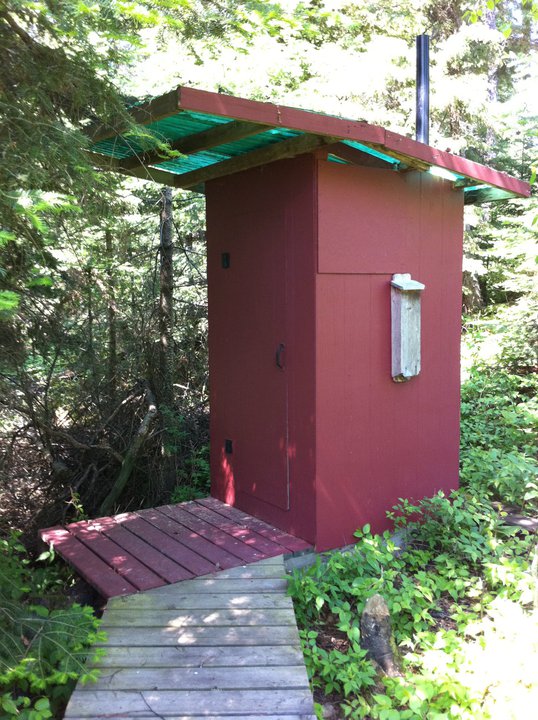
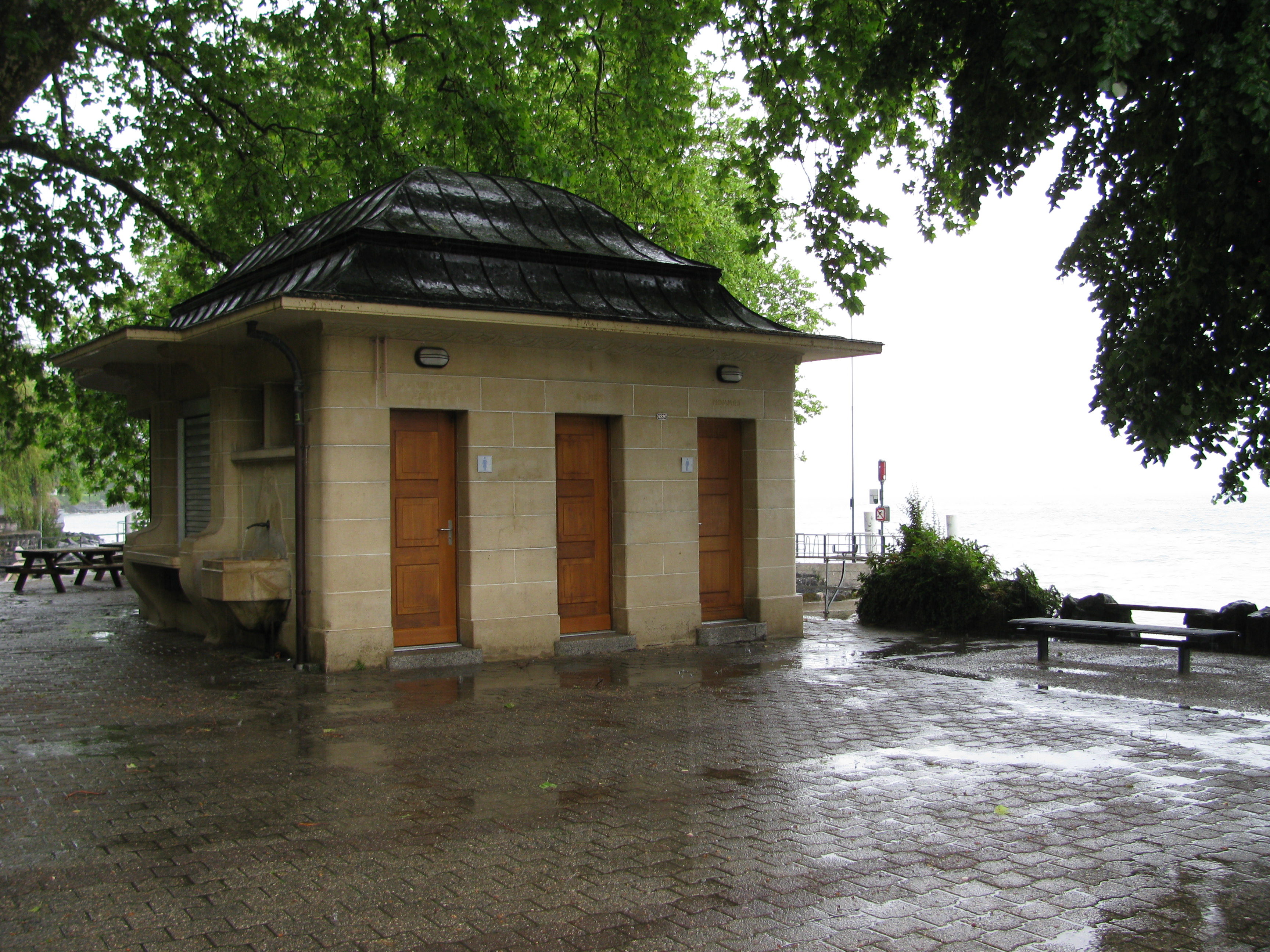
Look at that beautiful outhouse with a full-door and no windows! I'll bet it cost less than Lausanne's glass monstrosity.

Pay washrooms can be found on the streets, sometimes in shiny stainless steel stalls with a vending machine-style pay pad. Train stations frequently have them as well, and any bitterness a Canadian or American might feel about having to pony up a franc or two for a washroom quickly dissipates when inside the stall. They are kept spotless. In fact, the Bern train station has staff on hand, constantly rotating through the stalls in an never-ending sanitizing cycle.

I would not like that job, but I am happy to see someone else do it. I hope they are well-paid.

Washrooms on trains are free, but as trains are heavily used, they are not as clean as one would like, especially when trying to manage while the train rocks and sways, sometimes in unpredictable ways. I will elaborate no  further.

Tourists can get by without using a pay washroom – in fact, we’ve used them only a few times in our travels over the past few months. Many towns have free public washrooms in parks, along promenades and trails, which are kept to a high standard of cleanliness.

If these cannot be found, stop in for a break at a street cafe’ – for the price of a cup of coffee, you can use the restaurant’s washrooms, which we have also found to be unfailingly clean.

Sometimes only pay-washrooms will be located near cafeterias and malls, however, these provide a voucher for a ‘free’ coffee in the cafeteria.

Museums and art galleries generally have free washrooms.

So far, we haven’t found a pay-washroom charging over two francs, so carrying just a few one and two-franc coins should suffice.

A rumour circulates that it is forbidden to flush a toilet during certain night-time hours, out of courtesy for condo or apartment block neighbours. We haven’t heard anything about flushing restrictions yet, but have heard that running a bath late at night is frowned upon.

In the bathrooms-worth-visiting category, when at the Aescher cliff restaurant at Ebenalp, in Switzerland’s eastern Appenzell region, check out the washroom architecture. The mountainside wall of stone is exposed, allowing visitors both a view, and privacy.

Good to know if you go:

  • Carry one and two-franc coins for public washrooms.
  • To see the mountain-wall washroom, which is presumably not the only reason you would visit Switzerland, click here for hiking information about the area and mountain.
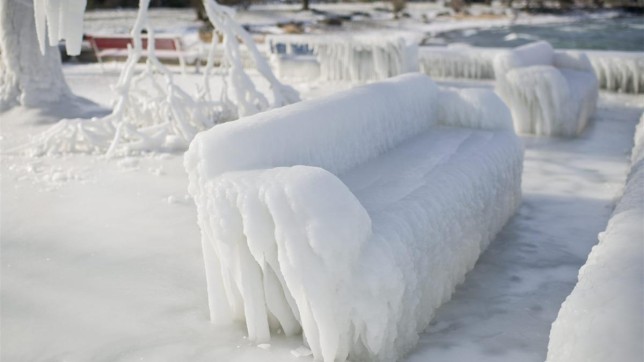
Spectacular ice show

Have a seat. It's ice outside.

Switzerland’s cold snap drags on, but a “deep freeze” that hovers around -15 C does not exactly excite terror in this former Winnipegonian to whom -15 C is a perfect temperature for all-day cross-country skiing. Seriously, Europe, wake up and build a better infrastructure for winter. It does come around every year.

There is one thing, however, that is hard to beat and it is ice-cladding, which frankly, scares the daylights out of me.  Not much to do about this but break out the blowdryers and chisels. Here’s a photo from a photo-fan website. Click here to see more. 

NOTE: I’m having trouble with the ice-links, however, here’s another go at it. Hope these come through. 

Switzerland's ice storm: Showing New York that a "boot" is not the worse thing that can happen to your car.

Lake Geneva transformed into frozen landscape, literally, by blustery winds and freezing temps.

Switzerland's deep freeze.

Teddy Bears: The Swiss’s Secret Weapon in the Event of a Nuclear Disaster

That teddy bear will teach that nuclear monster a thing or two.

A somewhat shaky grasp on the management of natural gas leaks isn’t all that excites us about Switzerland. There’s also the threat of a nuclear disaster.

We get a good view of a nuclear silo on the train ride between Zürich and Biel, but I talked myself into believing it’s just a grain silo, a very wide and somewhat oddly shaped one, but still one that would be good place to store wheat, or perhaps, nuclear stuff.

That little personal myth melted away this week. In the mail, among all the usual sales brochures was a German, French and Italian  square blue and white packet from our Canton police, military, population protection and sports – yes sports – branches.

This Czech Republic nuclear plant is ready for disaster - see, it's next to a chapel, cause if it blows, there will be a prayer meeting like the Czechs have never seen before.

It was the sports part that got me nervous – were they suggesting only the athletic would survive whatever warnings were coming from the police, military and sports divisions?

A quick run through Google Translate revealed that we are within 20 km of a nuclear power plant. The opening line, intended to have a calming effect, declares that nuclear technology is very safe, but the authorities want to minimize any “risk of prejudice in an accident.” What does that mean? In the event of a nuclear meltdown, a little bit of prejudice might be a good thing, seeing as prejudice means to “pre-judge,” and if pre-judgment means I’ll be stocked up on food, water and iodine pills, well, I’m all for that.

The brochure details the rules of behavior in “an increase of radioactivity.” I don’t need the Swiss to tell me that. My rule of behavior will be to run madly in circles, screaming “Oh no, oh no oh no!!!” It may be ineffective, but it’s straightforward and simple to follow.

Swiss authorities to nuclear-fall-out residents: Grab your teddy bears. This is going to get a lot worse before it gets better!

According to the pamphlet, the first thing to do is to listen to the radio and follow the authority’s instructions. The second thing to do is – and I’m not kidding about this, it is in the brochure – is to continue to listen to the radio and continue to follow the authority’s instructions. 

This suggests that the authorities don’t really have any other bright ideas to follow up their first recommendation.

There’s also advice to not let pets outside and to head for your cave or abri. I’m not sure what an abri is, but the accompanying illustration suggests it is a reinforced subterranean bunker, as depicted by a very thick black line that is about 6 times the width of the black lines depicting the house or regular basement. Obviously, it should have no ventilation, but heck, who wants to breathe when the air is full of isotopes or other deadly nano-particles.

But it will be a fun time down in the bunker as the Swiss authorities mandate that we should all bring toys for children. It’s going to be a regular play-date. Yes, a teddy bear will get us through a nuclear meltdown.

Now we are in Switzerland, not Russia, so I don’t really worry about a nuclear disaster, but if I had been in Japan, I would have said exactly the same thing, and I would have been wrong. Cue nervous jitters.

Stumblebum

We’ve been laying low over January, recovering from our Christmas jaunts and mapping out our “should we go there” list as we round into the last leg of our time here. In the meantime, I am discovering more wonderful things about the Swiss that I would never have guessed from afar.

For one thing: They are not as worried bout natural gas explosions as are Canadians. I know this for a fact. When I was a reporter, any sign of a natural gas leak brought out the police and fire departments who would evacuate entire city blocks rather than deal with flying body parts should the leak turn lethal.

Not so with the Swiss. Walking down one of our town’s beautiful canal strolls, I saw police cars and other emergency vehicles arrive at a building. I say “arrive,” because to suggest they sped up and raced from their vehicles would just not be true. The officers and emergency workers strolled up a building that had several windows open. There were no signs of smoke, fire, or rabid protesters, so I thought maybe it was just a training exercise. Then I walked past the vehicles and noticed several with the word “gas” on their sides.

Sure enough, a few feet past the building I caught my first whiff of natural gas in the air. I turned back to see how the emergency workers were doing, and they were busy scratching their heads, which is maybe how they signal to the population to “be calm.” I just hoped no one decided to light up a cigarette (this country is packed with smokers).

Pass me a wrench, wilya?

I went my merry way, walking faster than I normally do until I reached the distance I estimated Victoria police would have cordoned off, and then I relaxed and waited for the boom. It didn’t come, which goes to show that sometimes everything works out just fine.

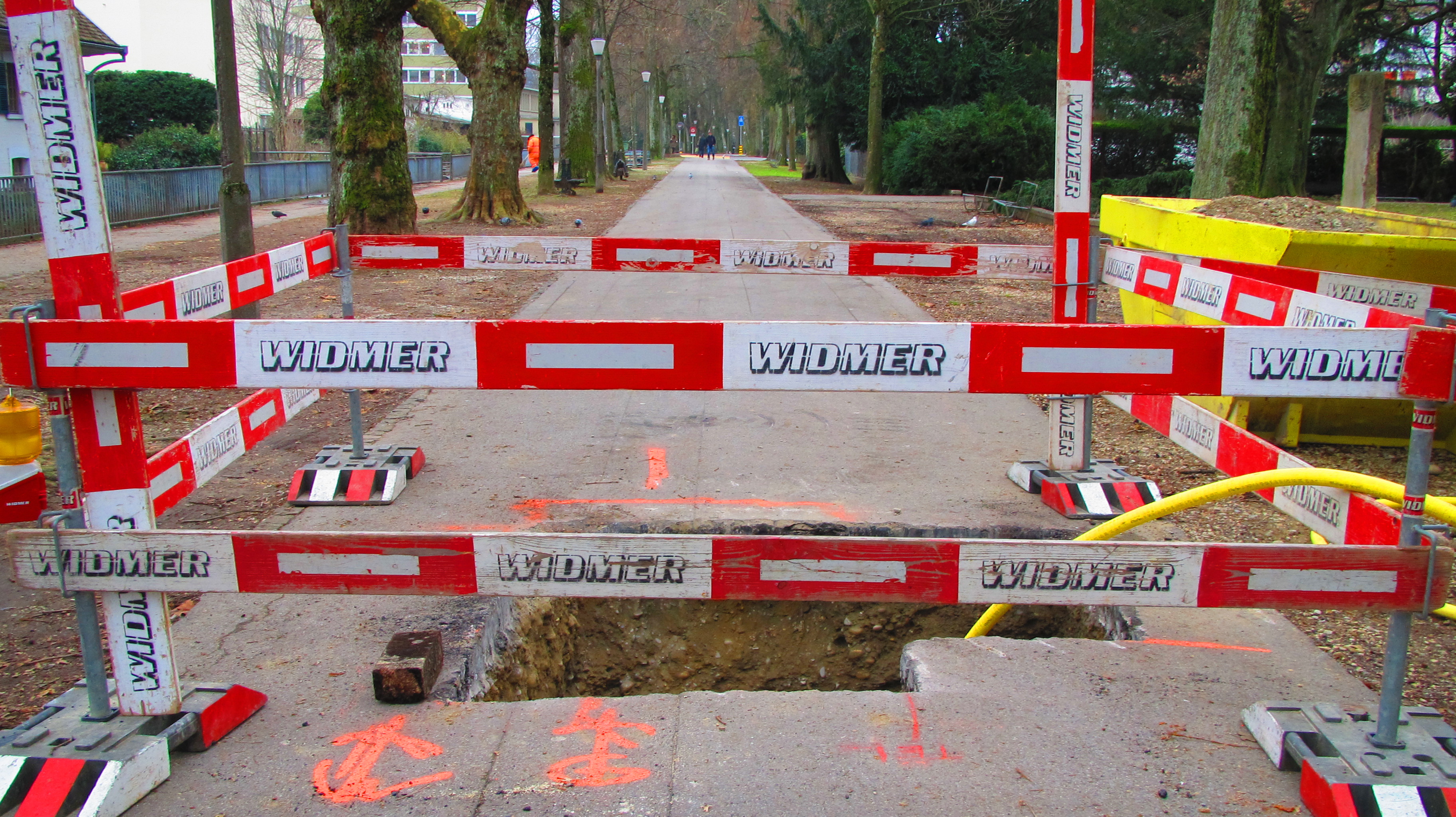
Later, I checked out the site and discovered a giant hole dug into the sidewalk and in that gaping hole lay pretty yellow gas lines. To leave a gas line exposed is another thing that Canadians are fussy about.

The hole has been there since January 12th, unguarded, unsealed and just unsane. No dogs or small children have plunged in, but that’s because it the workers erected rails around it, which by Swiss standards is high-security. They normally just dig holes and leave them unmarked for unwatchful walkers to fall into.

Note: This post is not to suggest the Swiss are in any way lazy. They are not. As proof, the grounds keeping staff in our lakefront park have been mowing, leaf-clearing, debris-disposing, pruning and showing a degree of industry that is impressive. Maybe they’re getting the place ready as a refuge centre in the event of a natural gas explosion.


Languishing in a linguistic laguna

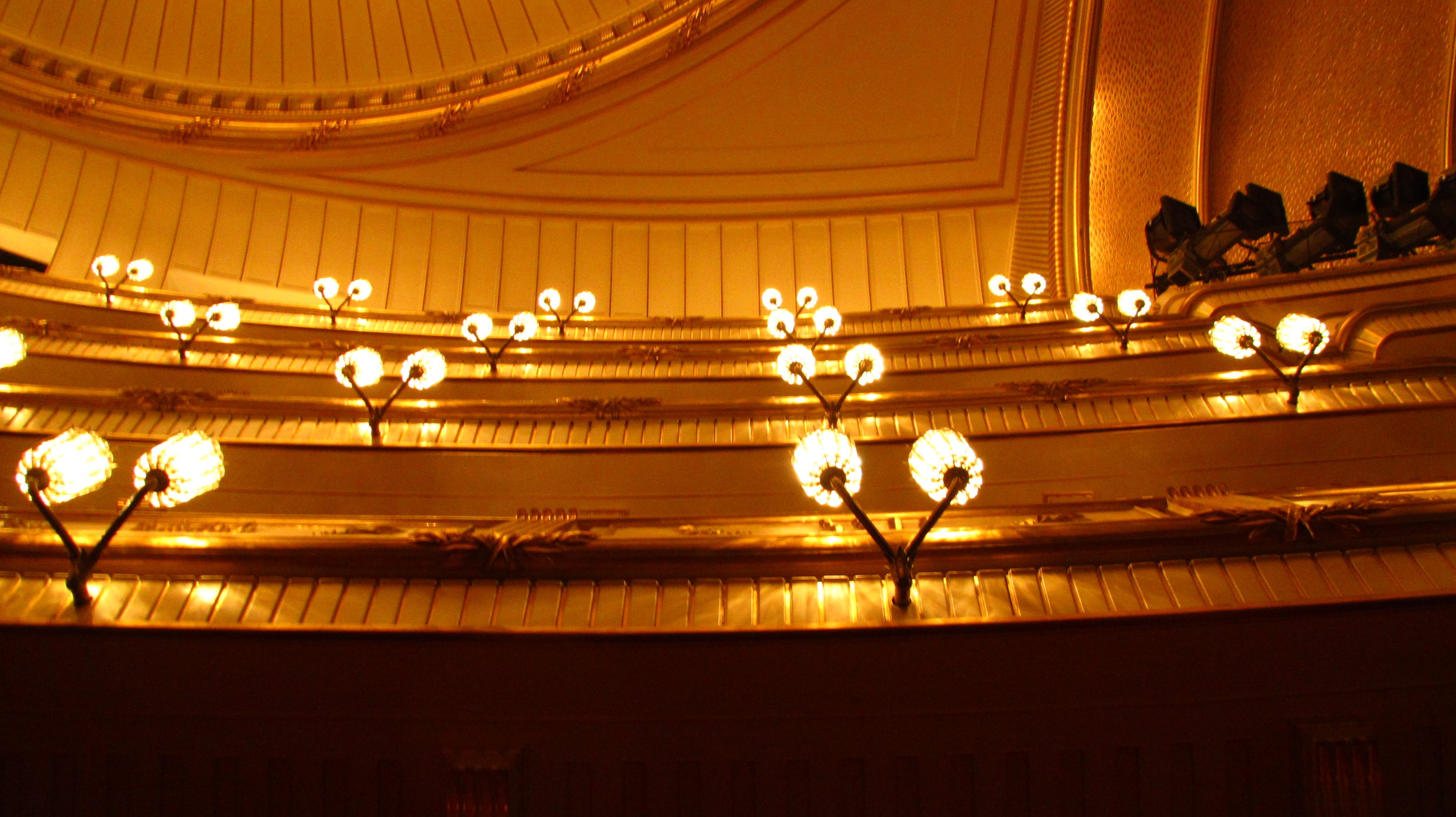
Don't be fooled by this photo. This blog post is not about the Vienna Opera House.

What do these people have in common?

A blond long-haired woman with a man in a blue-and-black sports coat chattered their way down our town’s main retail avenue yesterday. They were speaking English, but more than that, the man’s coat colour screamed “North American” to us. Swiss men usually wear black, grey or brown coats. So do Swiss women, now that I think of it.

In our hotel lobby, we overheard a man trying to get a French translation from our hotel desk staff to explain kitchen drawer and cupboard liners.

In the same lobby shortly after, another man approached the desk and asked in an American accent if the staff could tell him where to find a good German restaurant, to which Jean Philippe, one of our affable front desk staff, held up his chin, reflected, then said, “No. There aren’t any.”

What do all of these people have in common? It’s not only that they were fluent native-English speakers. They were also all besieged by us.

Yes, we have reached the point where we will talk to anyone, anywhere at any time on the sole qualification that they are native English-speakers. And, it doesn’t matter whether they want to talk to us. This is a matter of social conscription.

Looking up at the Vienna Opera House. This photo has nothing to do with this blog post, but I am trying to get through all our holiday photos.

We’ve been here for about 10 months, which is a long time to go before breaking into this uncontrolled yammering, but that’s because English is not so rare here. We enjoy conversations with many, but those conversations still hang up on cultural reference points, a fact under-scored when we make a joke that fails to hit its mark.

When we lived in Spain where English was more of a rarity, we entered this yammering phase within the first week of arrival, just to give you an idea of how starved we were to hear our own language.

It changed our perspectives on immigrants who are often accused of forming their own insular communities in Canada. I know now that if I showed up in Toronto fresh from China, I’d head for Chinatown, too. There’s no intention on the immigrant’s part to stand apart from their new country – they just need that fresh drink of water that is conversing in a language in which they can be their eloquent, witty selves… or in which they can be jerks, if that happens to be what they are in their home country. Being a jerk in your own language is still more fun than being a jerk in someone else’s.

In the meantime, the man looking for the French translation came and sat with us. He’s also from New York and is transferring here for a 10-month work assignment. We thought he was American, but he corrected us on that count: He is Indian. Nationality matters not a whit, of course. As he said, “English! It’s so nice to hear English!” We’re getting together with him later today at Starbucks. Where else would we go but to our own English version of “Chinatown.”

As one other English-speaking former Manitoban’s husband, a couple who is also “stuck in Switzerland,” might quip: The English colonial beachhead has been established.

If you grasped the flow of that last sentence, and you show up in our town, you just might become one of our best friends.

Note: It turned out the man in the blue and black jacket was Swiss, but his shopping friend was from New York.

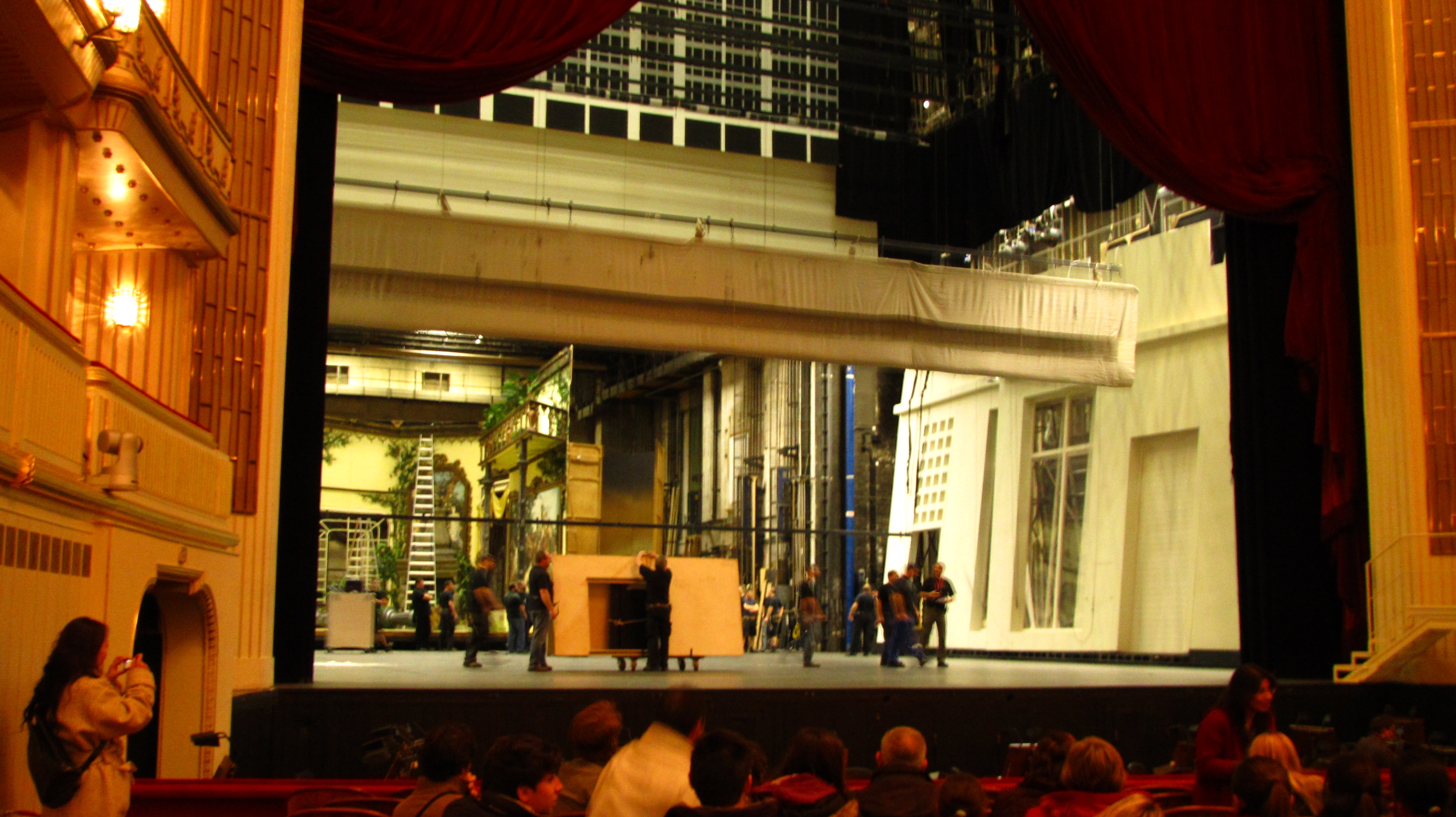
While were at the Vienna Opera House, the stage workers were prepping for an evening performance - the stage itself is an impressive engineering feat that is essentially a rotating elevator that can shift 40 tonnes 28 feet before and 10 feet above. This picture does not do justice to the size of the stage either. Those Viennese - where opera is concerned, they are not just kidding around.

Christmas without the clutter

The Christmas Eve congregation at Biel/Bienne's Alstadt Reformed Church, Dec. 24, 2011

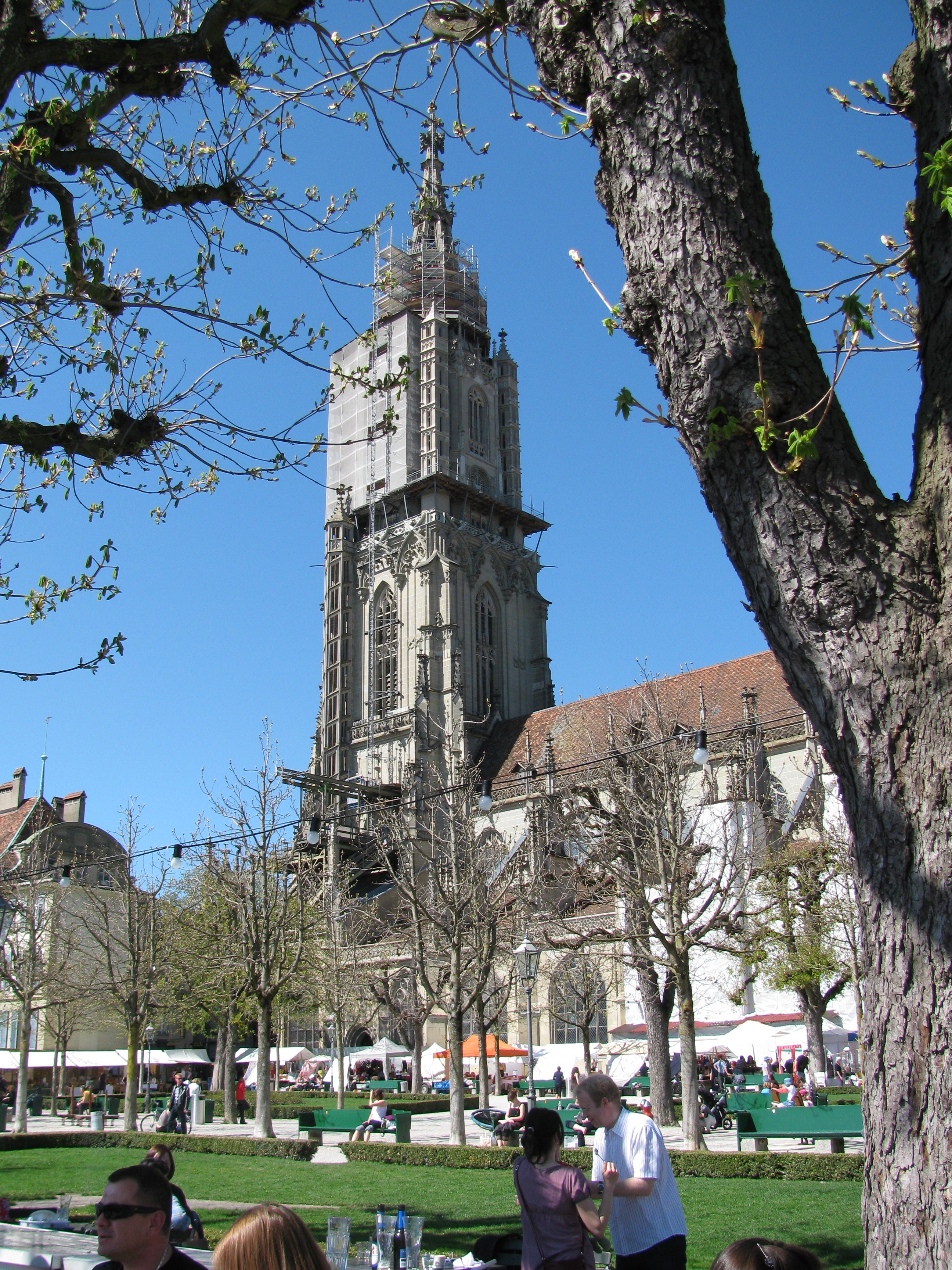
Christmas Eve, we walked up narrow cobblestone alleys to a church dating to the early Middle Ages, our minds anchored to the remembrance of all the generations that made this same trip on this same night through centuries past.

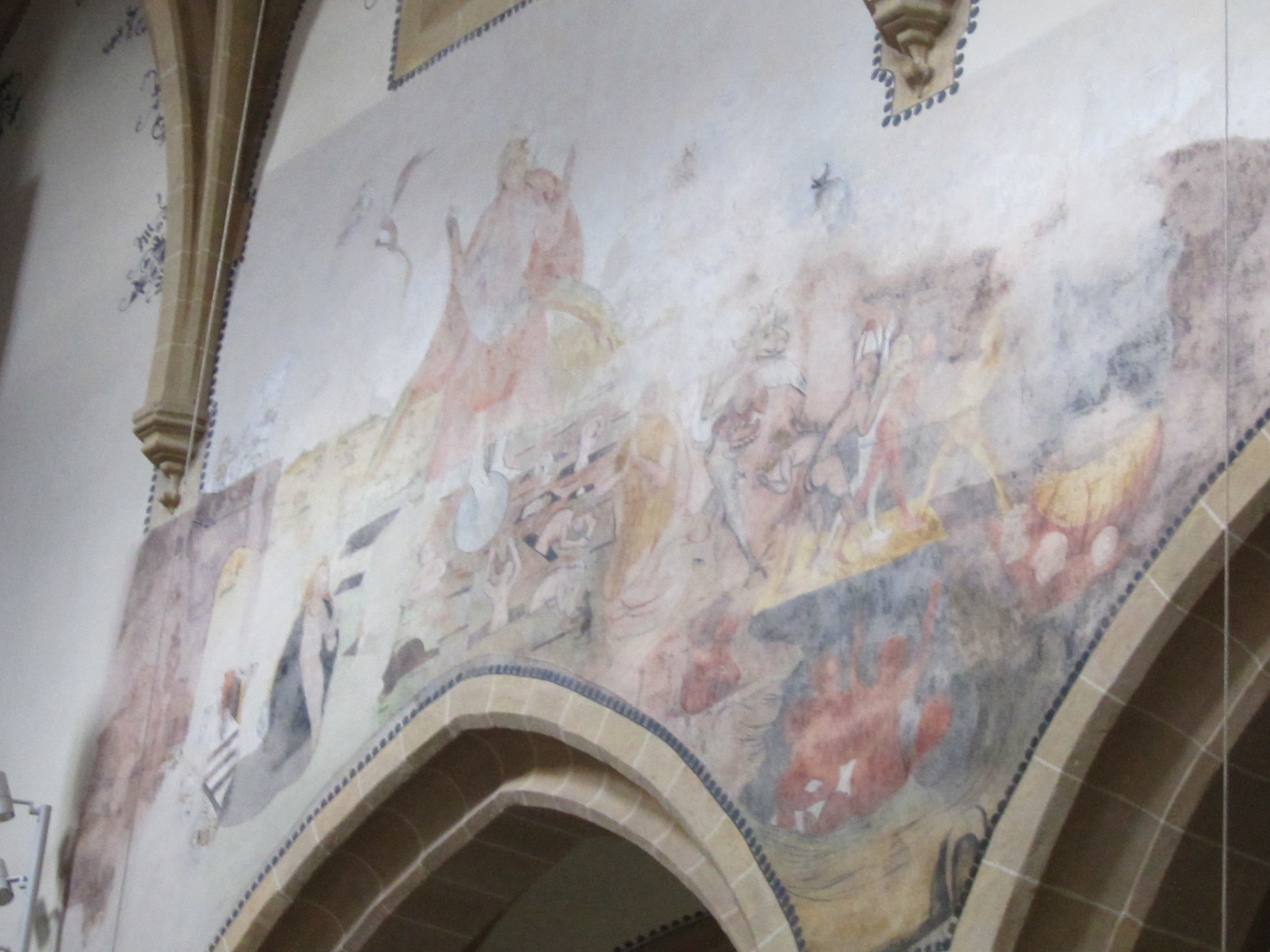
The church is set in the uneven footings of the Jura Mountains, an impressive Gothic building with high ornamented vaults, a massive pipe organ, polished stone floors and faded murals high on its clerestory walls.

It tests the nerves to sit through a service in a language we have yet to grasp, with customs to which we are clueless. Would the congregation do cartwheels? Sing a Las Vegas show-tune? Expect us to stand up and explain ourselves? Test our mettle by demanding we sing Handel’s Hallejulah chorus? Make a public confession of some sort?

The people were quiet – in a building fashioned from stone and stained glass, one expects to hear echo, but it was hard to pick up even a scratch. The service started precisely at 11 p.m. – we are, after all, in Switzerland, the land that guards time. The only decoration was an evergreen tree, adorned only with electric candles, a small wreathe on a flat-cut stone altar and a single burning candle.

A white-haired man in a black suit stepped slowly from the front of the church, not in an air of pomp or down the centre aisle, but in a subdued manner, off to the side, unfurling a beckoning solo from a woodwind instrument. The pipe organ chimed in and this went on until a small man in a black clerical robe with a white bow took the podium.

Mural on the clerestory walls at Biel/Bienne's Alstadt Reformed Church

He started reading, and although it was in German we recognized it as the Gospel narrative. He read of Mary’s visitation from the angel, Bethlehem with its paucity of hotels, Jesus’s birth in the grit of a Middle-Eastern stall. The reader paused  now and again, at which the pipe organ filled the church with sounds very much like a steady wind moving through a forest.

And so the service went, woven between a single human voice,  answered by the pipe organ’s choral timbres.

In the silent moments, there was not a sound to be heard, making us wonder about the difference between North American and Swiss Christians. North American churches are alive with noise, shuffle, chatter, even the more stoic ones. This is the first time I’ve sat in a church where there was literally not a sound, a cough, a swish of fabric or the scrape of shoe against the floor. It was as silent as though we were not there.

We sang four songs from the hymn book, beginning with A Mighty Fortress is Our God. As midnight approached, the minister came into the congregation with a candle with which he lit the candles that we had been given at the door. There was no music or reading, just the sound of people tilting their candles one to the other, so that the drops of light slowly spread back into the dark.

When all were lit, the churches lights were turned off altogether and we sang Silent Night.

The pipe organ sang one more piece and then without benediction or comment, the congregation rose and drifted outside, some still carrying their candles into the tranquil night, painting amber pools against the grey cobblestone.

_____________________________________________

Where are we?

We may be entering an electronic cone-of-silence over the next few days as we travel east by train to check out Viennese pastries and Bratislava’s …. well, whatever it is that makes Bratislava what it is. Auf wiedersehen.

Bratislava Old Town

Vienna: Because we haven't seen enough cathedrals, castles and cobblestone ....

Mugging for Coffee

Life is better with an insulated coffee mug.

In exciting Swiss news, a Canadian almost paid the equivalent of $35 Cdn for an insulated coffee mug yesterday. That Canadian was me.

I desperately miss my travel coffee mugs. Yes, desperately – coffee-drinkers will understand the all-encompassing importance of the coffee experience, including the vessel in which the coffee is cradled. That desperation drove me to spend yesterday afternoon searching for a suitable mug that would not call our financial future into question.

Such a mug was not found, driving me to our town’s new Starbuck’s coffee shop. Do I need to explain that Starbucks is a coffee shop? There I found a darling mug, but for the aforementioned $35. For a few moments, it looked like I would become the kind of person who pays that much for a cup.

Happily, my DNA kicked in and would not allow me to go through with it. Today, I went back onto the streets and shops, suddenly struck with a brilliant idea to look for coffee mugs in book stores and paper/art sections of the local department stores.

This makes no sense, of course, but that is the world of product-placement and to prove that i was not out of my mind, I found an insulated travel mug complete with twist top and handle for about $10.

It was next to some stuffed animals. I cannot explain this, but wait until I finish my first cup of coffee. Then maybe it will make sense.

Naughty or Nice on Zurich’s Streets

Watch out, little girl, you might get a SMACK!

It’s not everyday that an old guy spanks me with a broom and walks away without a bruised solar plexus.

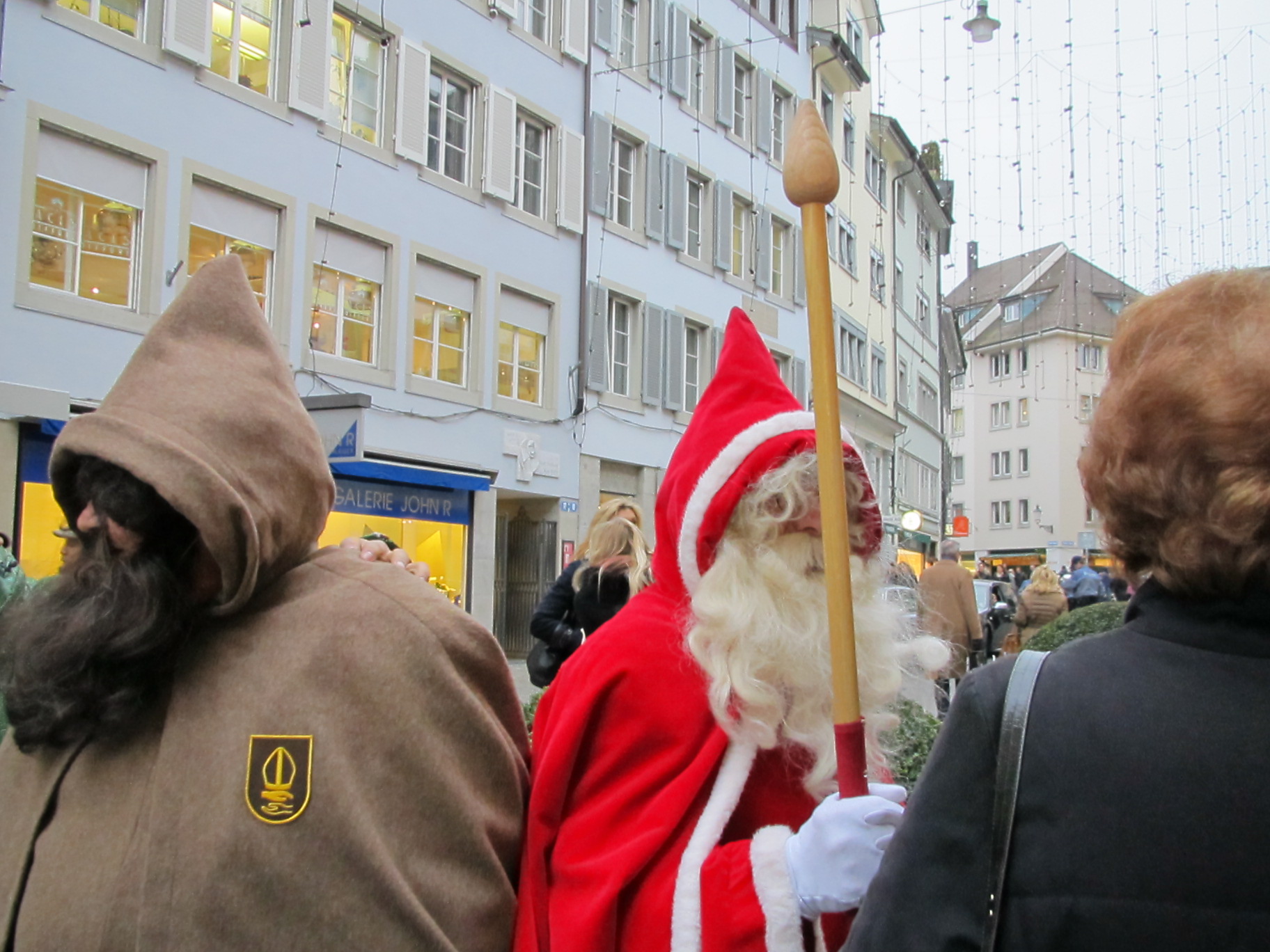
But we’re in Switzerland, and when in Switzerland, do as the Swiss do, which is to tolerate stranger-on-stranger slaps. The stranger in question was Schmutzli, a dark-natured counterpart to a Santa Claus-like figure whom the Swiss assure me is not at all a Santa Claus, but a Swiss Father Christmas. Santa Claus, it is said, is a North American creation. I’m sure someone will argue with that, but that is how the Swiss see this.

Wherever Father Christmas strolls the streets in his characteristic red costume, Schmutzli is not far away in a hooded brown monkish robe, brandishing a twig whisk with which he punishes bad children, or if there are no children around, a middle-aged woman who mistakenly comes within reach.

The Swiss are a fun, friendly people, even when they roam the streets beating people with sticks.

Schmutzli later informed me that he was paid by the municipality to play his role, and that Zürich has plenty of Father Christmas and Schmutzli pairs roaming the streets. Nice work, if you can get it.

Smacking strangers in a tourist-district, however, calls for a certain amount of diplomacy. First, Schmutzli is in costume, which makes him appear less threatening. Second, as he delivers the spank, he smiles benignly and applies only a light, judicious touch, cause who knows, maybe someone has grabbed him by the neck and pushed him into the ground before, such as a woman fresh off the plane from New York or perhaps he has met my Aunty Rosie.

And finally, Schmutzli carries a large sack full of goodies, which he offers after the ceremonial “beating” of the bad child.

Santa has an evil twin!

While our own brush with Schmutzli and his twig-broom was uneventful, the tradition does have its nasty side. It is reported that a boy in Lucerne was chased and beaten by a band of teenage self-appointed Schmutzli. Yikes.

In some traditions, Schmutzli abducts children, which explains why this tradition fails to gain traction in North America. The season would be thick with lawsuits. That would certainly make a Merry Christmas for lawyers.

You can learn more about Schmutzli by clicking here. 

Tidbit: I once interviewed a priest named Father Christmas. I got his name through the New York Dioceses who assured me there were several real Father Christmases in Canada and the U.S. He was very jolly. 

Fruity fruit

In the fascinating world of international travel, I bring you the story of fruit.

Foreign food is different, not just because each culture and country has its own way of seasoning, cooking and serving food, but because the food itself will be different. It is the same principle as in wine, which is said to absorb its  unique flavours from the region in which the grapes grow.

And so, B.C. blueberries differ from Ontario’s (Ontario wild blueberries are better, sorry B.C.), Manitoba eggs taste nothing like those in Madrid, and so on.

Flavour matters to me. I love food. Who would have known it? But, I’m also very particular and so feel some trauma at leaving behind Canada with its fabulous wild blueberries, incredible sweet Silver Rill corn, unbeatable Alberta beef tenderloin and affordable salmon.

Here, everything tastes different. It’s not all bad. Despite my love for the flavours I grew up with in Canada, I have to admit that Switzerland’s store-bought strawberries leave North American franchise grocery offerings in the dust.

When it comes to Canada’s Bartlett pears, I am in heaven, but guess what. There are no Barletts in Switzerland, which has set me on a path of discovery.

I’ll just cut to the chase. Bartlett-lovers should head for Harrow Birnen Sweet, which comes from the same family as Bartlett and has almost exactly the same sugary texture and flavour. Buy it. You will be happy. Happier still, it is a late-season pear, so it was available in our stores until last week. Today, I ate the last one. Sadness descends.

In searching for a replacement, I also tested Italy’s one-pound “Abate” pear and Portugal’s 6 oz. “Rocha” pear. The Rocha is an acceptable Harrow/Bartlett replacement, but it is only 1/7th the pear in flavour, so adjust your standards accordingly. Italy, who has romanced the world with its fabulous eats, falls down on its face with Abate. It is literally a pound in weight, as my new digital scale confirms, and tastes something like an apple, but without the flavour. It costs about $2 a pear, hardly worth it.

How do I know? Despite the $2 investment, I chucked it in the garbage. I am really cheap. Chucking fruit after a single bite is the ultimate insult. Pear-growers in Italy probably felt a disturbance in the force.

How you view terrorist activity is sometimes a matter of proximity

Bahnhof Bern: Services in the neighbourhood of 150,000 passengers a day, centered in a national capital. Yup, this could be a terrorist target.

BERN, SWITZERLAND It sounded like a gun blast at first or a tire-burst. A big one. Then a column of black-grey smoke rose above the passenger train at the Bern train station. The crowd on the platform started and lurched instinctively away from the blast, but no one ran.

The explosion appeared to come from the train the second-track over from the train we had just exited and as is always the case with deciding what to do in an environment where we don’t speak the local language, we watched the crowd to see their reaction.

BBC image of 2004 bombing at Madrid's Atocha train station.

The escalator to an overhead walkway was jammed with people, who all turned to survey the explosion site. On the walkway, people stood and pointed, but no one appeared to panic.

Hmmm, column of black smoke, loud bang – probably nothing wrong. That’s what the crowd reaction told us. We waited for a second explosion, the big one, but it did not come. Thank God.

Bern is Switzerland’s capital city and the train station is massive and densely populated. That makes it a target similar in scale to a London or Japanese subway or Madrid’s Atocha train station. This is what goes through one’s mind when gauging how to react to a loud bang, that and whether searchers will find enough body parts to identify us by DNA and so inform our families of our scattered whereabouts.

Nothing happened afterward, and there was no news of it in the local media, so we can only assume it was some kind of mechanical or electrical gaff, although we didn’t see any mechanics or train staff running toward the site of the blast. The Swiss, they are a calm bunch.

It brought to mind Noam Chomsky and his famous comment in the wake of 9/11 about how Americans should not be so fussed about terrorist attacks, and that the U.S. is big enough to take a hit. It seemed he was unaware the U.S. had already taken a hit with a kill-rate of over 3,000, more lives lost in a few hours than the Irish Republican Army had achieved in over three decades. I would have mailed him a copy of the New York Times dated Sept. 12, 2001 if I had his address.

I also wanted to call Mr. Chomsky and suggest he provide the addresses of his parents or children to the terrorists as an acceptable target, to see if he would then think a “hit” not such a big deal.

When living in an American/British/Canadian enclave in Madrid, we were occasionally treated to warnings that Spain’s Basque terrorists (ETA) were going to target the local malls during the Christmas season to send a message to the Americans. Our U.S. friends were somewhat taken aback, having never heard of the Basque or even been aware that their government had anything to do with the Basque complaints. It did not, but that was not of interest to the terrorists. All they were looking for was a victim that would attract big headlines and American victims fit the bill.

That’s the thing with terrorists – they don’t have to worry about re-election and so they can pick their victims at random without having to defend their decisions at the next polling of the electorate. And while the Spanish turned tail and voted to

run for cover when they did suffer their most significant terrorist attack at the Atocha station in 2004, which occurred just before a national election where they turfed the party that supported sending troops to Afghanistan (however token in number), they were not always so accommodating to bullies.

Interestingly, Spain is the one country that had earlier seen a reduction in terrorist activity when the Spaniards wearied of the ETA blasting children and civilians, and the population took to the streets in a protest not against their government for ‘not controlling the terrorist situation,’ but against the terrorists themselves. It was a refreshingly intellectual move on the part of the Spaniards and one we wish more protesters would emulate.

The ETA took note and announced a ceasefire that turned out to be its longest one (which sadly ended when we were there in 1999/2000).

But that drifts from my point that how one views terrorist activity can be governed by proximity. Living in zones that are potential or declared targets imbues the threat with vigour. Living safely in the confines of wherever Chomsky dwells or others who like to blame the victim or the government of the day for threats authored by madmen is another thing.

It is something to think about while gauging whether to run, drop to the ground or just wait for that final fatal bomb to go off while going about what is an otherwise ordinary day.

After-note: We described the Bern train station sound and smoke to our hotel staff friends and they said it was likely a problem in the electrical system. See, nothing wrong. 

Things you learn on the street

Thursday night, as we strolled Nidaugasse, our town’s pedestrian thoroughfare through its retail district, a young balloon-festooned gal approached us, speaking in French. We weren’t afraid. We’re from Canada. We’ve seen people dressed weirder.

We happily explained that we do not speak French, did not understand a word she said, so we could not give money to her cause/protest/campaign or accept any pamphlets which would be indecipherable to we unilingual clodheads.

It turned we were wrong on all counts. She is getting married today, and so her girlfriends, dressed in little black bunny ears, were taking her out on the streets where she sold little waxen candies in honour of her impending marriage. I’m not sure what this is really about in terms of whether it is a tradition or just something goofy her buddies thought up, but her happiness was infectious. She offered us a candy for any amount of money and we regrettably had to inform her we carried as much money as the Queen of England, which is to say not a penny.  I had not even brought my wallet.

She gave us a candy anyway, and we wished her a beautiful wedding day and happiness in her marriage.

On the same street earlier in the day, one of our town drunks wandered bellowing belligerently such that he actually cleared an entire block of pedestrians. I did not have my camera to show this, but it was fascinating to the see the one guy in the street, while the blocks on either side of him were filled with shoppers. A picture like that would terrify Victoria’s Ken Kelly, an affable chap who runs the Downtown Victoria Business Association in British Columbia, Canada. They are a group of retailers who can be found hand wringing over the commercial degradation of Victoria’s downtown due to its sad street population.

And speaking of town drunks, our leading town drunk was seen up in our neighbourhood this week, walking straight and tall, dressed jauntily like an old sea-captain and looking incredibly sober. We’ve seen him thus several times, and doubt this is a twin, because he has a distinctive mashed up nose that can only be the result of some serious injury or accident, not something likely to be repeated by nature.

And that’s the news from our town’s streets. A happy bride and a screeching alcoholic, each affecting the street atmosphere in their own way.

3: Parting is Such Sweet Sorrow or Tschues

Happy to be headed home, but a little sad to leave the land of castle ramparts and lovely, friendly people.

We are going through our social ‘exit process,’ which is much more pleasant than the bureaucratic one.

We said good-bye to our beloved Starbucks buddies who presented us with a Starbucks Switzerland mug.

Tomorrow we’ll say good-bye to the Lollipop girl who runs our favorite candy shop and who recently exposed her midriff to us to show a sweeping tattoo marking some Swiss legend that we could not understand. We also could not understand why a gal with such fabulous abs would want to colour over them, but that is the youth of today. Now if someone like me opted for a tattoo to visually sculpt my midriff into looking more concave and much less convex, that would make perfect sense. Calm down, Mom. I’m not going to do it.

Switzerland the lovable.

I said farewell to the most embittered glaring grocery store cashier who admitted I really wasn’t that much of a problem. I said so long over coffee and Swiss pastries to a Swiss/Afghani/Indian/American friend with communist sympathies and an adorable calico kitten, as well as her hockey-playing Swiss husband who mistakenly thinks the best team in the NHL is the Detroit Red Wings.

Venner Well: A Swiss warrior statue in Biel’s old town that embarrassed its makers by breaking off at both legs when being set up and then suffering follow-up breakages during stormy weather. The well dates back to the 1400s; the stone statue may date back to the mid-1500s, but the translated records were not clear on that point. It could be older.

Our hotel staff have been saying good-bye to us for weeks, but the intensity is now ratcheting up. They are threatening to lock the doors in a bid to thwart our ‘escape.’ They regularly offer a detailed comparative analysis on the merits of living in Switzerland versus Canada, always arriving at the same conclusion, which is that we will be back by autumn. We’ve been actively campaigning for the ones more familiar to us to come visit in Canada, with the caveat that room service at our house will not measure up to the hotel’s standards. *

Tomorrow we will meet with a young Indian couple and their two daughters who have become like our “Swiss grandchildren.” I preferred to think of them along the lines of nieces, but the parents keep referring to us in grandparent terms, forcing us to accept the fact that we are definitely well into our 50s. Yuk on that. We’re going to miss them, but again we hope they will stop in for a visit some time, although that is less likely as they appear Singapore-bound after their term here.

I have not said farewell to my Winnipeg friend and dame of roller derby fame named Jam Buster, because if our paths can cross at a random writers meeting at an all-by-chance Starbucks 7,000 km away from home, you gotta know no planning is required for us to run into each other again.

*There is no room service in our house. Never has been. Ask our kids. They may still be bitter about this. 

Rappelling Swiss Canals

BIEL/BIENNE, SWITZERLAND You see more of the world when you get out of your car and walk around. You may not go as many miles, but you cover much more ground, so to speak.

Swiss workers know how to have fun on the job. This man is one of a team of city workers who rappelled down a canal wall when there was a perfectly good staircase nearby. The bike was retrieved from the canal, a favorite chucking-out point for bike thieves (or maybe the bike owners themselves discard their rides in this way, perhaps fed up with the European cycling stereotype).

Today provides a good example. A deep stone-walled canal runs through our town. In the late afternoon, two city workers in a low-bed truck pulled up in the walkway by the canal (there is a roadway on one side and a walkway on the other).  Dressed in reflective orange coveralls,they unrolled a line over the canal’s 3.5-foot wrought-iron fencing, which, by the way, prevents no one over the age of three from climbing over and plunging down to an uncomfortable landing. The canal is roughly 15 to 20 feet deep at this point, so unless you took a header, you would probably survive the fall, although with some nasty deforming injuries.

They had tethered the rope to something, so that while one managed the rope, the other swung over the railing and rappelled down the canal. At least I hoped they fastened the rope to something, but in fact, it looked as if they had just looped it around the railing and the topside worker was hanging on to it while his buddy made his descent. I cannot be completely sure about this.

It should be noted that less than 30 feet away was a gate opening to a narrow set of concrete steps that the workers could have easily used. Let’s face it, rappelling is more fun than stairclimbing.

The worker reached the bottom whereupon he started plucking debris from the canal floor and chucking it in the general direction of his crew partner. The first few tosses were random and so boots, empty cans and unidentifiable flying objects landed among the strollers, which happened to include an elderly lady in a long grey coat who nearly got beaned with a shoe.

Such egregious disregard for work and public safety would get somebody in Canada fired, but this is Switzerland where if you can not dodge a few shoes now and then, you are not long for this world anyway.

I’m adding this to my list of proofs that the Swiss are a daring no-nonsense bunch whose primary goal is to get the job done on time, even if this means not getting the job done safely. Yesterday, bucket trucks and ladders lined Nidau Street (Nidaugasse) where workers strung framed Christmas lights overhead, all without benefit of redirecting the pedestrian traffic below. One slip and it would have been Christmas bulbs imbedded in skulls. That did not happen, however, and last night the streets were aglow with Christmas lights.

I would not have noticed any of this had I been speeding by in a car, but then, I also would not have been within range of flying boots and plummeting Christmas lights.

Heartbreaking timepieces

We are surrounded by watches, this being Switzerland, and this being the Canton of Bern, it is also the home of many recognizable Swiss watch brands, including Swatch, Rolex, Longines and so forth.

Not much of this means anything to me. I have a utilitarian attitude toward watches. They need to be on time, they need to be waterproof and they need to be cheap enough that when I lose or break one, it will not rend my soul into pieces.

Watches watches everywhere and not a digital face to buy.


I used to have an expensive Seiko watch, a brand that in Switzerland is despised as a basement-bargain inferior product. I lost that watch back in the 1980s and I look for it still. It was perfect in design and went with any outfit. When I realized it had gone AWOL, I searched every pocket, every closet, every drawer, every nook, every proverbial cranny and it all came to nothing. Even years later, every time we moved, I kept an eye open for that watch to float to the top of the boxes, but no. Nothing.

The habit birthed out of this was to only buy watches that I would not miss, and that watch brand happens to be Timex. If Seiko is despised in Switzerland, Timex is non-existent.

I know this, because my trusty waterproof, $45 Timex sports watch has lost a piece of its strap. There are no replacement straps to be found here in the heart-and-soul of watch-land. There are no Timex watches or even anything that looks like them. More than that, there does not appear to be any digital watches and worse even, every watch I have eyed comes with a heart-stopping price tag. That is to say, heart-stopping for me. I am incredibly cheap.

I have searched our downtown core and have come upon banks and banks of old-fashioned hour, minute and second-handed watches. It is as though 1970 did not exist (the year when Wikipedia says the first digital watches came into being, although I doubt Wikipedia. Nevertheless, I am too lazy to look further than that, so please do not quote me as a reliable source on this point).

And so I walk around with my not-so-secure strap, fearful of losing of my lovely Timex watch that has been with me through so many wonderful lake swims, so many jogs and walks, a stain-proof, reliable device that has a timer, stopwatch, alarm, pulse-taker, a watch I bought only because I knew it would mean nothing to me if I lost it.

It turns out I was wrong about that.

Of course, I bought it before I moved here where it is the rarest of timepieces. If it drops off my wrist, I am going to be looking for it everywhere, just like that blasted Seiko.


Thun, beautiful but often ignored

If this were Winnipeg, the residents would be sandbagging like mad. But it's not. It's Europe and so having water right up to the building's foundations is just fine.

Thun sits within sight of Switzerland’s spectacular Bernese Alps, which means that it is much-ignored as people speed on past to get to the mountains. It’s name is no help: Pronounced ‘toon,’ it struggles to be taken seriously, and fails to inspire curiosity the way that a name like Zermatt, Zürich or Neuchatel might. Poor Thunites.

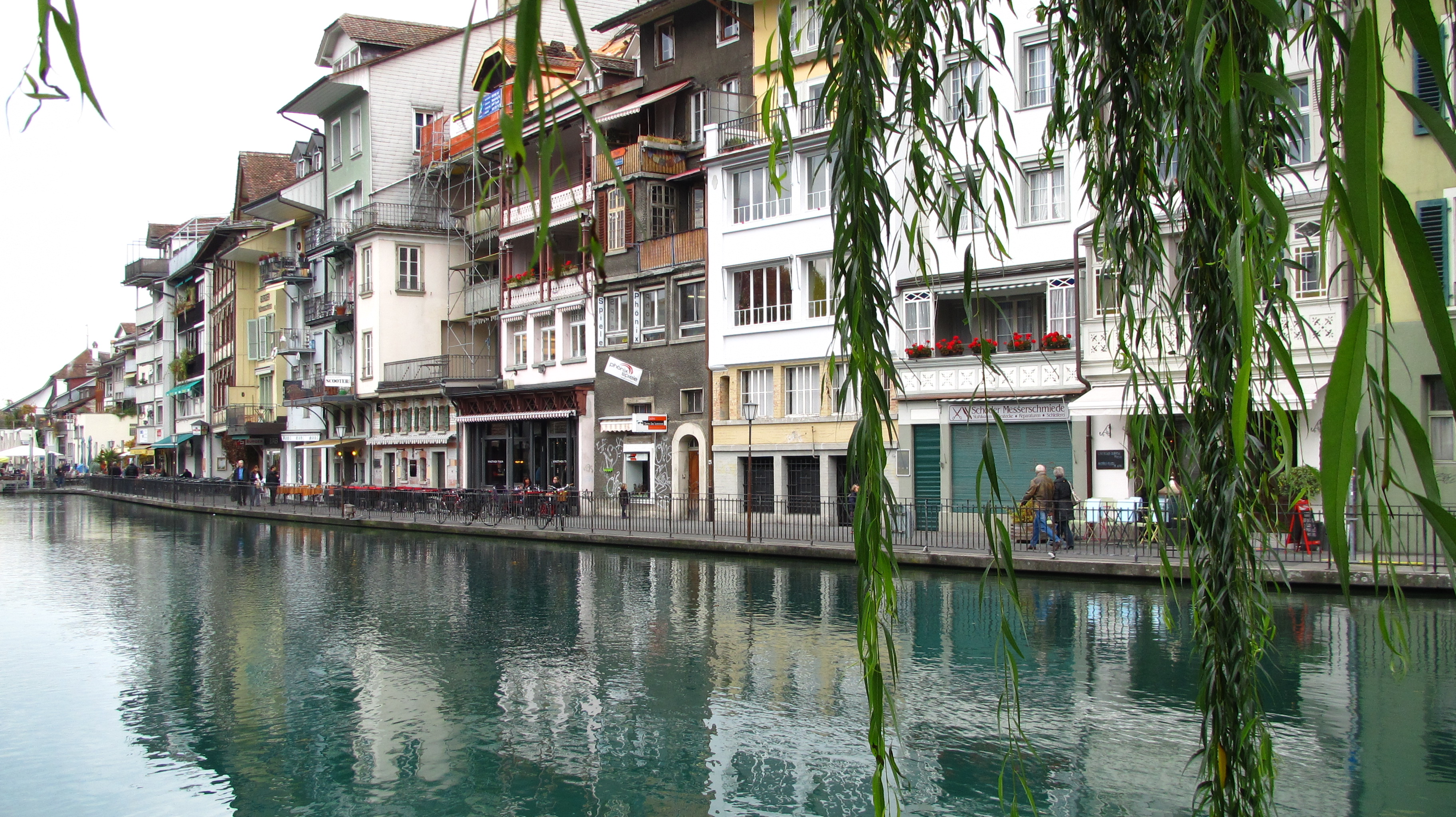
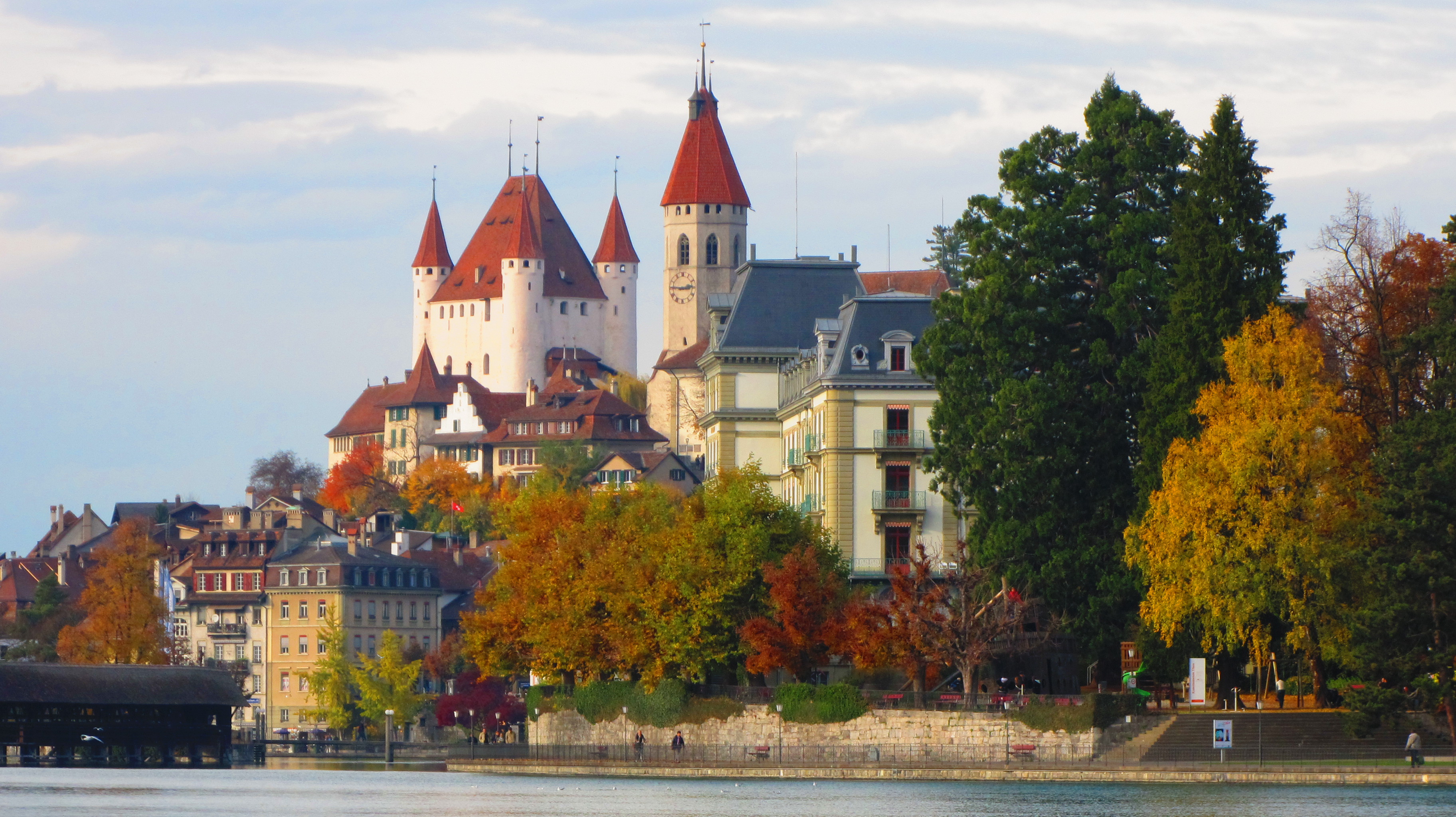
But their town is lovely, with the River Aar running through it, the classical cobblestone streets, covered bridges, a castle, and scores of outdoor riverside cafes.

Once you make it up the steep stairs leading to the castle, you're rewarded with a maze of these lovely cozy walled cobblestone lanes.

Our first clue the town is somewhat overlooked came when we stopped in at the visitor information centre. These are often found in train stations and usually attract a lot of traffic as tourists flood up from the station platforms, but when we arrived we increased the office’s tourist population by 100%. The agent was so happy to see us that she came around from the booth to greet us, bidding us welcome in such a way that it was clear our presence was her only hope for job security.

The truth is, Thun would not rank high on any tourist guide’s “must-see” list, but that is because it has such fierce competition. As Dave has noted, while B.C. has one Victoria, Switzerland has about 500, or one every 10 minutes. How can a place stand out with competition like that?

Thun. Ugh. What a horrible place.

If you go, make sure to take the walk up to the castle. The stair-climbing will just about kill anyone – and as proof, not long after we arrived at the top gasping and clutching our chests, a woman not 30-years-old came up behind us, panting and red-faced. So it wasn’t just us. You will be rewarded with a stroll down some stone-walled, cobblestoned lanes that afford a lovely rooftop view over Thun and onto the Bernese Mountains, which everyone else has rushed off to see, leaving you with Thun all to yourself.

Thun has spectacular views of the Bernese mountains, including Jungfrau.

More street talent

Rob van Wely and his travelling audience.

Biel is a small place in the grand scheme of all things Swiss. It’s not Lausanne, Bern, Zürich, Lucerne, Geneva – all of which have the air of international cities.

It certainly lacks the grandeur of Zermatt or the Alps, which are further south, but it is charming nonetheless, and has so many festivals that any North American city of a similar size appears comatose.

It also attracts a fair number of street performers. It is hard to qualify the value of these musicians. We’ve seen some in Victoria that were raspish to the point where listening to fingernails screeching along a chalkboard seem like a pleasant alternative.  In Switzerland, thus far, the street music has been very good. Maybe the old stone buildings add a particular acoustic value, but every weekend we are amazed at the performances so much that we-the-cheap regularly drop money in their upturned caps.

Here in Biel, we ran into a James-Taylor-ish street performer, Rob van Wely, a modern-day troubadour with a silky voice. In his limited English he told us he’s from Holland, and didn’t seem believe his voice was so nice. Decide for yourself. Check out his performance in Biel by clicking here.

“I whistle better,” he said. He was told 25 years ago that his voice is bad, and he admitted that to be heard over a crowd, he tended to yell. It stole away the gentle nuances of his voice meandering up and down the scale, and so he worked on his guitar-playing and whistling, but then discovered the magic of amplification and brought his vocals back to his performance.

Tomorrow, I’ll post another video of a street performer in Thun that could change my mind about the quality of street music. I just haven’t decided yet.

New links:

  1. Look here at AngloINFO, a Geneva-based website with some handy data for foreigners living in Switzerland.
  2. Look to your right to see a new weather box on HoboNotes. It’s a graphic that depicts the local weather reports (as they come from Bern, we’re too small here in Biel for our own weather reports). It is very cool, thank you to my friend C.A. for pointing it out to me. 
  3. For those who prefer the real thing, go to the Blogroll box to the right and click on “See it now” to go to a webcam showing you a view over Lake Biel, updated every 15 minutes. 

Crossing the Rhine at Basel

Jumping back to our rain-soaked trip to Basel of a few weeks ago, here’s a photo of a water-going vessel that takes nothing to work: No fuel, no wind, and no substantive human effort, although it does require a good current in the water.

From inside the fahri - passengers sit on wooden benches around the edge of the boat - a few are inside a cabin, but most are outside, so if it's raining, prepare to get wet.

Four of these boats (called fahri) bring passengers across the Rhine for 1.60 Euros a head. The heavy timbered boats are tethered to a line strung across the Rhine (they are spread out across the river, so there’s only one boat to a line). The captain shifts a large lever at the bow of the boat which sets it off into the current that pushes it along the line, gradually drawing the boat to the opposite shore.

The captain explained that it’s the direction of the lever that determines which way the boat will go. The boat travels at this oblique angle, which is a little weird to think of a boat that doesn’t ever go straight. The ride only takes a few minutes. Is it worth 1.60 Euros to drift across the Rhine? Sure. Why not?

Rhine ferry-crossing.

Getting lost in 20,000 easy steps

I get lost almost everyday, so poor is my sense of direction, but Dave is of another breed, a type that innately knows where he is all the time. This is one of the reasons I married him. He works better than a compass and comes with the added bonus of holding my hand when leading me around. Compasses are not so compassionate. Also, I keep losing my compass. Dave is a foot taller than me, so I can usually find him.

In a rare moment this weekend, however, Dave was as lost as I, and I blame Basel for this. Look at this map:

Which way is north and south is hard to say when you're in this maze.

We ended up turned around somewhere near Bartusserplatz, a name that to the English ear sounds like a bit of a joke, and that is what we thought the tourist office was playing on us. We roamed the streets in the rainfall, in something of a daze trying to find the city gates, which really are worth finding. They are classical medieval gates that bring to mind Europe’s castle-storming history.

Basel Spalen city gate dating back to sometime between 1080 and 1398.

The city was once surrounded in walls and splendid gates, but in 1859 a city council decided to demolish the whole works but for a few gates, which goes to show that the stupidity of city/municipal councils is a time-honoured tradition that carries on in a lively manner even today, especially in Victoria, B.C., where the regional overseers allowed a crazy-8 traffic circle configuration on an uncluttered highway that serves the airport and ferry terminal, giving tourists heart stoppages in unknown numbers. But I digress…

We often walk about 12,000 to 14,000 steps on a single day of touring, but in Basel we went over 20,000, marching almost 9.5 miles, of which at least six miles were spent completely mystified over our location.

We have come back from this fog with advice for those aspiring to visit Basel. Here it is:

  1. Find the river and make it your reference point. There is no help in making an intersection or any roadway a reference point because they are as thick as the wool in a tight-knit scarf, not to mention that the Swiss are quite lax about street signage (this is probably in case Germany decides to invade, in which case the German army would have to ask for directions; quite an embarrassment for an invading army).
  2. The tourist office will tell you to take a bus from the train station to the historic quarter. Ignore this advice. The walk is less than 10 minutes and goes through a charming park and some pretty streets.
  3. Do not ask a local to place you on the map. We tried. They don’t know where they are either.
  4. When lost, just keep walking. The saving grace of all old-town districts is that they are not that large and eventually you will come out on either a freeway, at the train station or possibly in Spain, all easily identifiable on a map.

Alarming art in Basel

Dave trying out Rodin-inspired man-yoga move.

Growing up in Canada afforded me a culture-enriched education filled with lots of art, music and museums.  So many museums that just typing the word flattens my brain waves, introducing the early stages of what I am sure is a coma.

The problem is that we were not allowed to roam in museums owing to our generations large numbers. We were part of the baby boom, which meant there were a whole lot of us and not many adults, ergo, the adults in our lives, ie. teachers, kept us tightly reined in, especially when on field trips where they feared a few of us might wander away. Thus, we were forced to sit in the bus while they counted us, then stand outside the bus in line while they counted us, following which we would then stand in the museum lobby for as much as 90 minutes for the teachers to count us and then recount when they discovered that Pierre Vaisy was missing, as he often was, then do another count after Pierre was retrieved from the coat room where he had busied himself with inserting chewed gum into the coat pockets of miscellaneous classmates who had called him names. Pierre is not his real name.  It is ToadWart.

Eventually we would be escorted into the first display where we listened to a very old person, someone who was at least 45 years old, drone on about the American bison and why it was not a buffalo, and so on. This was wonderful for those interested in wild bovine creatures, but not so great for those eager to get on to the railroad history section. Sometimes the old person would have us stand near a display that looked very interesting, like the one of Native Americans bearing very cool-looking weapons, but instead the old person would want to talk about a single arrowhead discovered along the banks of the Red River. The arrowhead held our interest for a nano-second, only because we were sure it was an introduction to the battling aboriginals in the next display. Alas, our guide found the arrowhead topic inexhaustible, which meant that he talked until we were tired to death of the thing, and if one of us, perhaps ToadWart, had wrenched the arrowhead from the display to plant it into the carotid artery of the museum guide, not one of us would have stepped forward as a witness to condemn him.

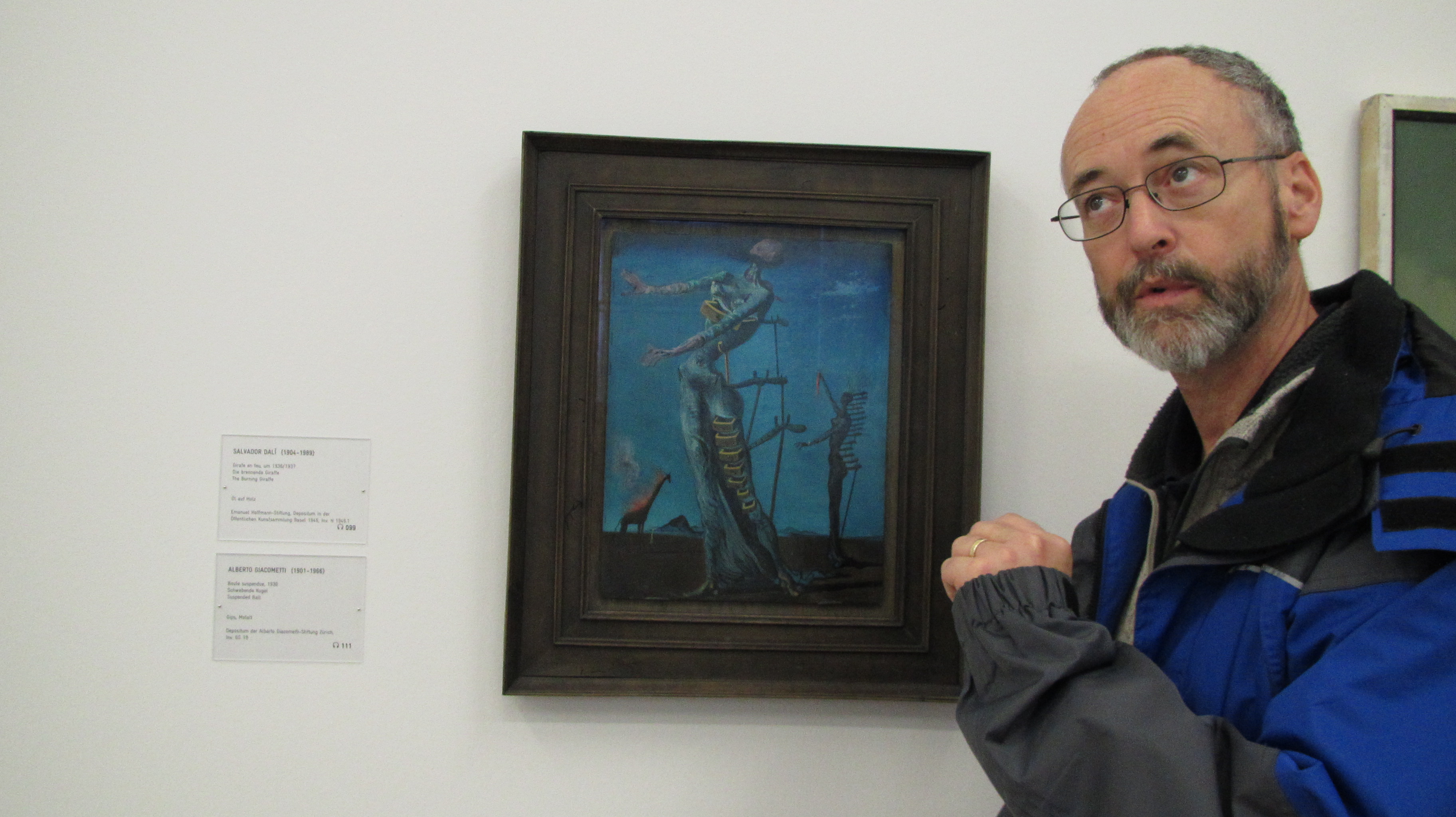
Dave, pretending to paint a Salvador Dali painting.

Which explains why in Basel, an international Swiss city famed for its galleries and museums – numbering at least 30 of note – we only visited one, although to be fair, we did stand outside of a second one and admire its moving-art water display. I simply can’t stand museums, and neither can my husband, which probably explains our very happy marriage where we have spent most of the last 30 years skirting around museums but rarely entering one. When we cannot avoid a museum, we sprint through it. We once went through the Museo Nacional del Prado in Madrid in less than 20 minutes. If you have seen some of the Goya paintings in the Prado, you will appreciate that 20 minutes is about the right amount of time anyone should linger there.

As appalling as sprinting through a world-class museum may seem, it should be noted that the Prado recently stole our idea and introduced time-based tours for those trying to get out as fast as they can. The tours are one, two and three hours long, which is not quite as efficient as our 20-minute tour, but then these are the Spanish and it is likely that they have inserted a siesta into their tour schedule.

Basel’s Kunstmuseum (literally translated means art museum) is one not to miss. Not because of its exceptional collection of Rodin, Cezanne, Monet, Picasso, Dali, Renoir and van Gogh works, but because all of those are protected with an alarm system so that stepping up too close to a painting (we think four inches is the mark) causes a series of loud beeps to play out over a sound system, attracting brow-furrowed, annoyed art-appreciating Swiss guides and security staff. They invariably raced past us, because we are middle-aged and therefore somewhat beyond reproach, especially in a museum as these are known to be the natural gathering-places of middle-aged art connoisseurs except for the middle-aged who grew up in Canada as part of the baby-boom, but I’ve already mentioned that.

It took us about seven alarm soundings before we realized that we were the source of the noise, leading us to experiment with the alarm system. In addition to warning patrons to keep their distance, it also sounds when a camera flash is fired. Fascinating. How do the Swiss do it?

After an hour of wanderings, we left the building, apprehensive they might seize my camera or make us stand in line to count our heads and make sure no one was missing, but that did not happen.

The top of Europe? Not quite.

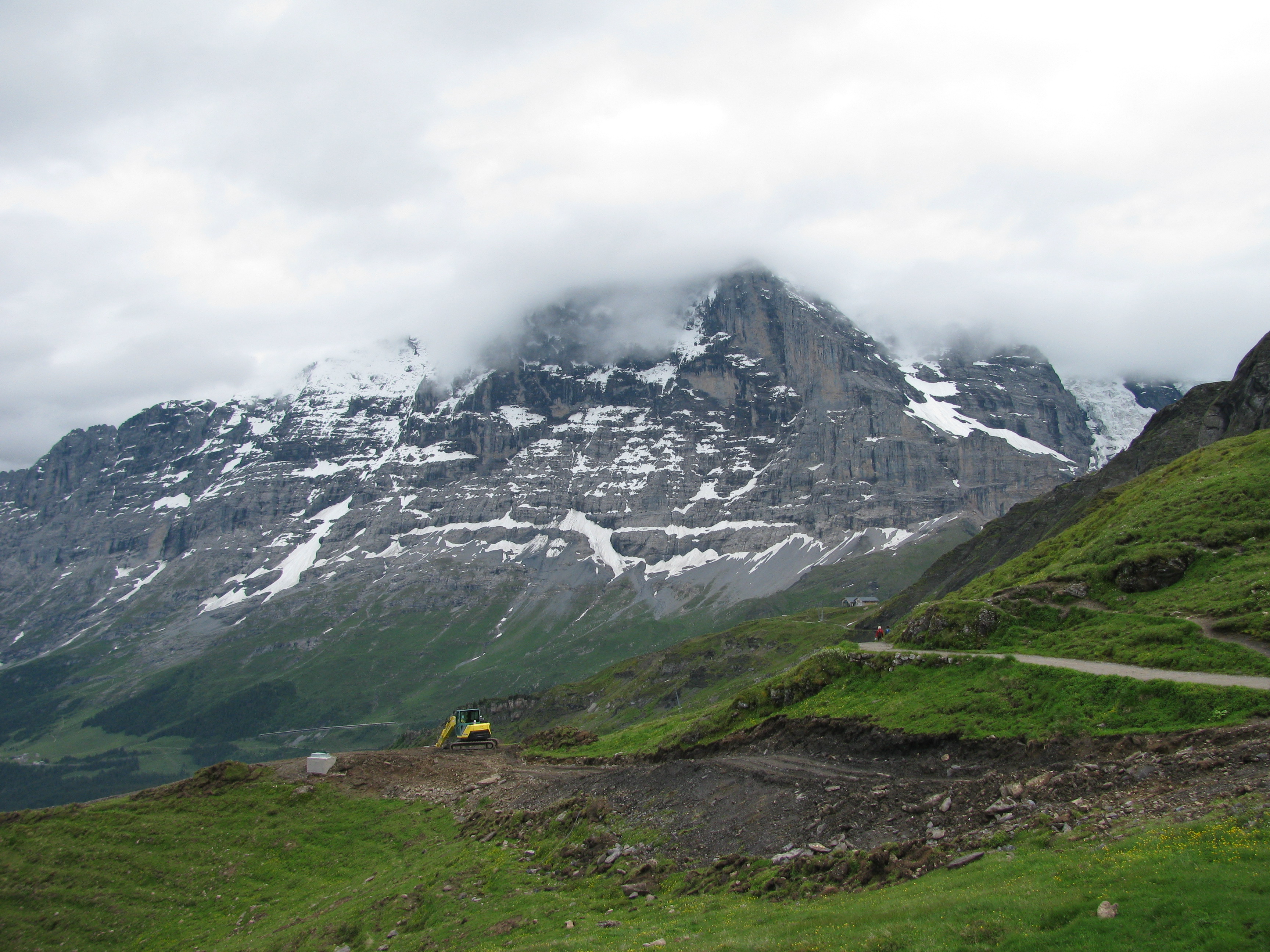
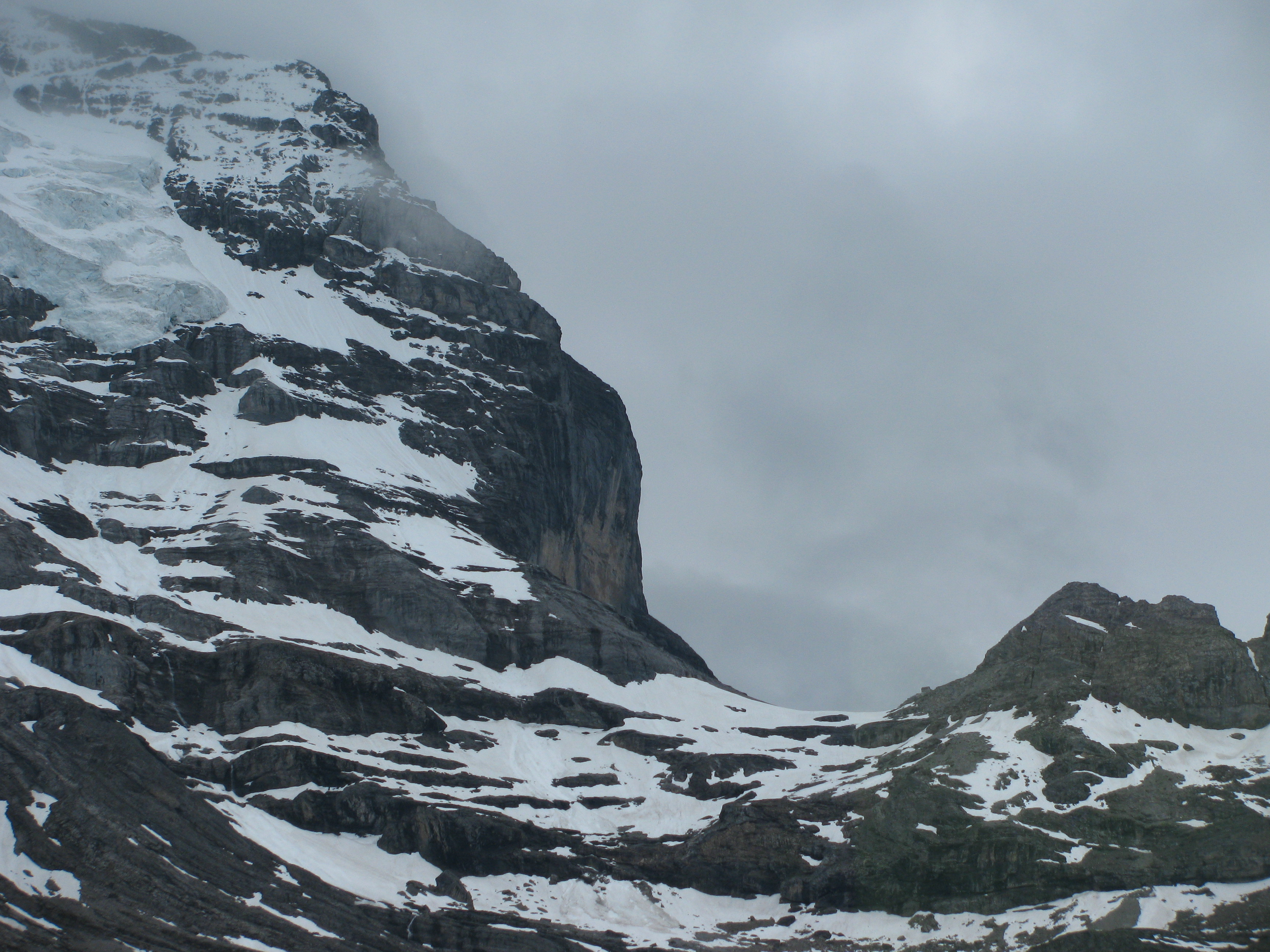
The forecast was for sun, but heavy cloud-cover cancelled our final leg of the journey up to the "top of Europe."

We arrived at the end of the Kleine-Scheidegg trail and discovered the “top of Europe” was obscured in fog. Hand it to the Swiss, they won’t try to sell you a ticket to nowhere. When we queried the ticket agent on whether it was worth taking a chance on the $100 one-hour train trek up to the top, she looked at us as though we had lost our minds. Don’t go, is all she had to say.

At another time, we planned to go to Zermatt to see the legendary Matterhorn, at which Daniela, our hotel concierge said, “Do not go there! Do not! It is covered in snow and fog! Do not go!! Achtung!”

Actually, she didn’t say “achtung,” but we find her hilarious for the way she speaks politely in English to us and then sternly in German to someone else,  such as the time the hotel was a little slow on securing our room’s safe to the wall.

When we alerted her that our request had been unheeded for a few days, she gently said, “Oh, I’m sorry. I will take care of it.” Then she picked up the phone and spit a few sharp German words into the receiver. When she was finished, I asked if I should meet the maintenance man up in the room, to which she replied. “He is already there.” And then she sent a translator along to make sure there were no language gaps between me and the maintenance man.

Daniela is only 22-years old, but if I were embarking on any business venture, I would hire her in an instant. She is a “get-it-done” kind of gal.

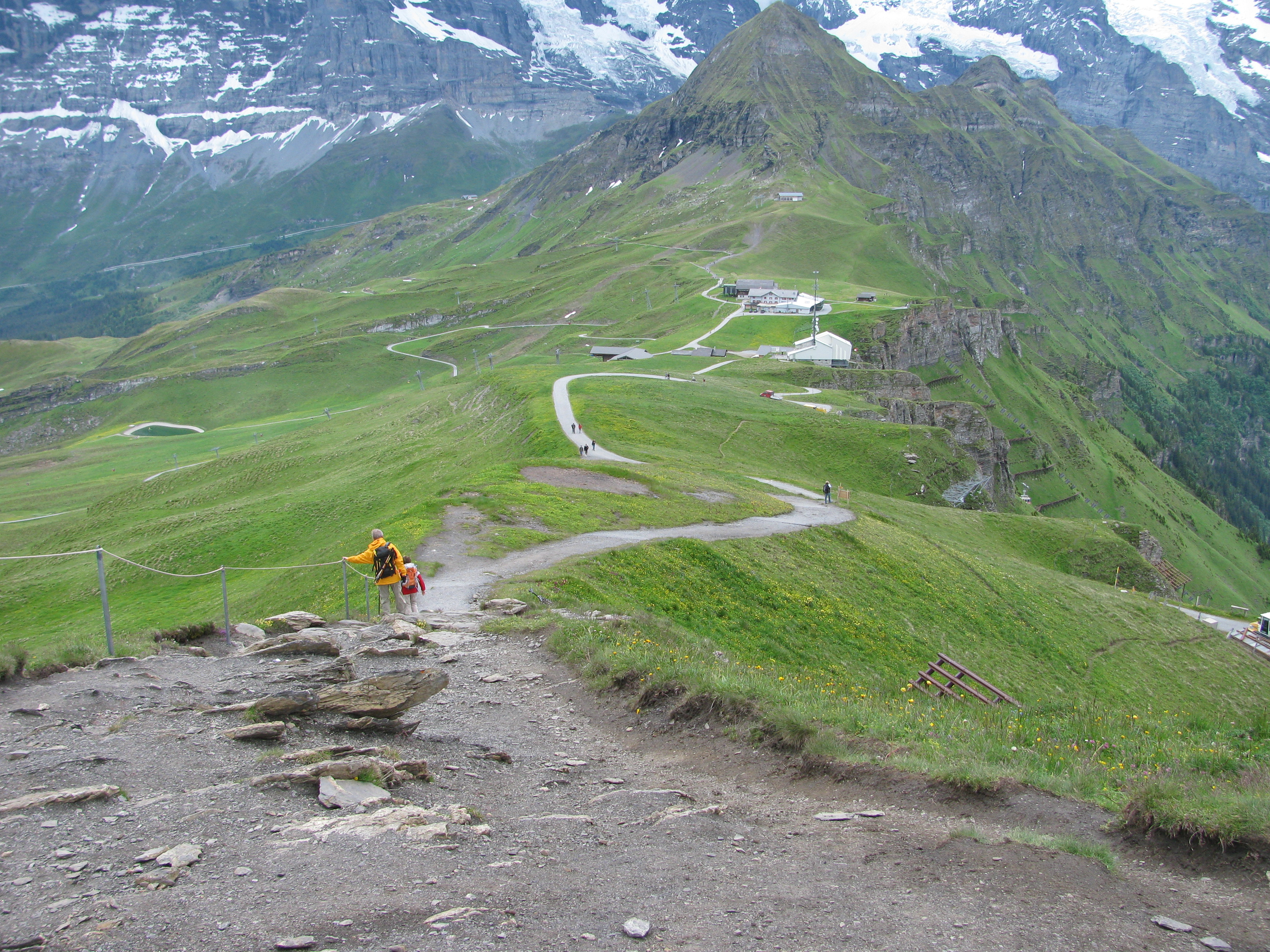
And so, we put off our trip to the “top of Europe,” but we still came back with these lovely photos.

Looking south from Mannlichenbaln toward the Lauterbrunnen valley, which you may notice has nearly perfect vertical walls. It is the site of 10 beautiful waterfalls, as well as the Trummelbach falls, which we hope to visit.

Heading down Kleine-Scheidegg.

The rare Alpenkuchenschelle flower. I did not make that name up. Another hiker with a flower guide book let me photograph the page identifying this rare blossom. At least, she told me it was rare. The book was in German, so I couldn't verify anything, but she looked honest.

More heavy equipment along the Kleine-Scheidegg trail - this one looks a little worse for wear. What the heck - are the Swiss using the Alps as a backhoe-graveyard?

This house needs a new coat of paint, but there's no denying the occupants enjoy a lovely view.

We did not expect to find a Canadian icon at the end of the Kleine-Scheidegg trail. What the heck - teepees!

The roof on this mountainside cabin appeared to be made of irregular shale sheets.

Good-bye to the Swiss Alps. We hope to visit this region again - there is no end of amazing sights here.

Watch your step

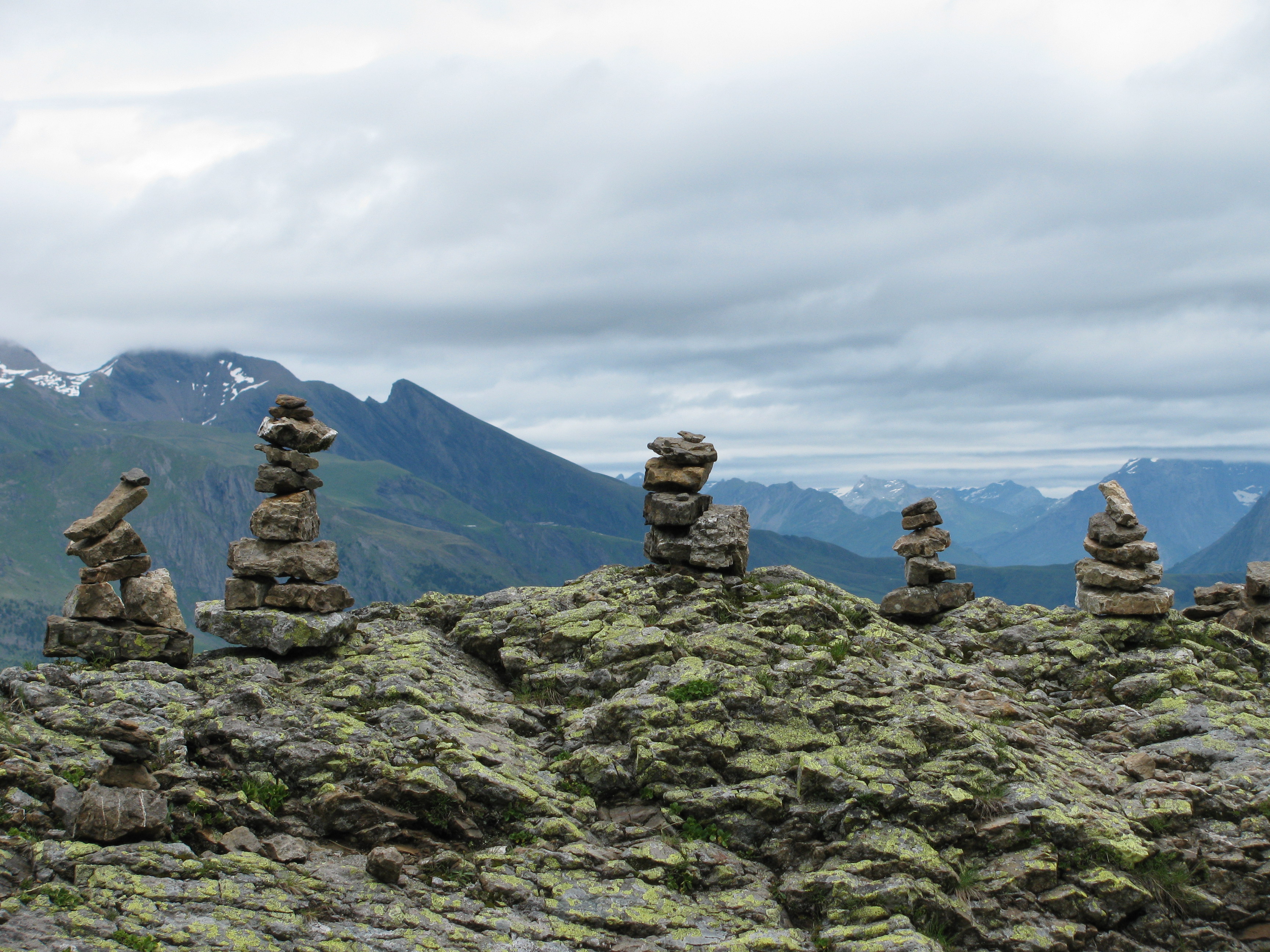
The Swiss version of Inukshuks - a more stream-lined design, lacking in pretension.

We turned away from the Mannlichenbaln look-out with the satisfaction that came from knowing that the rest of the hike would be a gentle downhill stroll,dropping from 2,342 metres to 2,061 metres over a 4-km (2.5 mile) trail.

The problem is that a good piece of that drop appears near the beginning of the journey.

I could be wrong about that – the pitch might be only a 30-foot drop over about 50-feet, but as a borderline acrophobe, it looked pretty bad to me. Remember, I’m only five-feet tall – the slightest undulation in the earth’s surface looms larger at my height, or lack thereof.

Every time Dave sees an Inukshuk, he threatens to kick it down. It is his schoolboy playfulness that makes him say that, but as soon as he got within range of a stone-statue field at Kleine-Scheidegg, he started fixing broken statues. What the heck!?

Dave quickly covered the worst of it owing to his long legs and impeccable sense of balance. I, meanwhile, scurried down crab-like, sideways with my fingers clenched to the rope bordering the steepest part of the slope. I would have got down on all fours and crawled, but there were Swiss everywhere and I was mindful that they not see me fall to such depths symbolically, even as I feared falling to worse depths literally.

The path gradually tilted back into a reasonably level grade as we headed south.  Looking back from the glory of relatively level ground, the pitch did not seem so bad, and I decided to adopt a non-chalant attitude towards this mountain-hiking business.

The trail winds along the ridge, without benefit of a single guard rail, which as I pointed out before, is how the Swiss “thin the herd,” and also thumb their noses at safety-conscious Canadians.

I am not wrong about Canadians and their national obsession with safety. As a three-term parks commissioner, I had the unfortunate experience of sitting through meetings listening to shrill arguments against accepting a particular piece of oceanfront parkland from a developer because it featured a narrow rock gorge, the very thing that I asserted made it a steal-of-a-deal while other commissioners fretted over how to protect the public from it by installing concrete blocks, high fencing and an abundance of bright yellow signs depicting human figures falling from great heights with a crown of exclamation marks about their heads as they contemplated their surprising and very imminent deaths.

To listen to the phobic commissioners, one would such think such a fatality occurred weekly, but there have never been any recorded deaths at that site.

I lost that vote, but I am not bitter.

I do wish, however, the Swiss considered guard rails with a more generous eye.

The beetle was clearly coming after me!

As we made our way along, we spied a sparkly hued beetle picking across the path. As I photographed the beetle, it crept gradually in my direction and so I took a step backwards, then another and still one more.  At that point Dave started to twitch and say “Jo!” with an air of urgency.

We have raised two boys, one of whom put us on a first-name basis with the emergency room staff at a hospital in a town where we had then lived only eight months, so Dave and I have both developed immunity to airs of urgency, not because we don’t care, but because they are so common and the ensuing trips to the hospital so much a regular and predictable part of our lives.

I was unknowingly within a spit of going over the edge, and as is always the case in these matters, things got complicated. An elderly undoubtedly Swiss couple – and I say “undoubtedly” because people of that age from any other nation would wisely stick to golf or some other sport that keeps one within a reasonable proximity of sea level – where was I? Oh, the couple – they were just readying to pass between us, and Dave wasn’t sure if any sudden movements on his part, such as grabbing his wife before she started a new life as a quadriplegic, would cause everyone to flinch and thereby more assuredly send me, and maybe a few others over the edge.

He repeated “Jo!” to which I said “What!?” in irritated tones.  I did not see anything to worry about, but then I never do, primarily because I never look where I am going. I leave that to Dave, so you would think I would listen to him. But I don’t.

It suddenly occurred to me that we were in the Swiss Alps and that if Dave thought I should stand still, it might be a fine idea, so I stopped and disaster was averted. The Swiss couple passed by, commenting that the beetle was of the Schoenborgh valliagnachtunggesselschaft variety, which I asked them to spell, but they only repeated the name as though its spelling was as self-evident as the spelling for the word wow. I suppose they did not want to embarrass me by treating me like a second-grader incapable of mastering a simple 17-syllable word.

We did not expect to see cyclists up on the Kleine Scheidegg trail, but there they were.

We made it to the end of the trail, once having to duck out-of-the-way of speeding cyclists, their presence and velocity suggesting their own ends were nigh. One bump of the wheel and that would be it, although they appeared to be Swiss, and so having attained adulthood, were likely not of the accident-prone variety.

By way of interest, while the Kleine Scheidegg trail is long-famous for its dramatic mountain topography, this has been added to in more recent times as it is the model for the Gran Turismo video race-driving game series.

If you go: The trail is mostly level with a well-maintained gravel-and-soil-packed surface that would likely hold well even in wetter seasons. Hiking boots are recommended, but sports shoes are okay. Going at a relaxed pace owing to my burned-out achilles tendons, we covered the 2.5-mile trail in 73 minutes.

Food & Water: Eateries are plentiful at the base of the gondola leading up to the Kleine-Scheidegg trail, however, stopping in at the local grocer “Coop” to purchase a submarine sandwich and a bottled beverage is recommended, particularly if you choose to hike the trail in the hotter season. Cafeteria-style food is available at the end of the Kleine-Scheidegg end of the trail, but not at the Mannlichenbaln gondola station.

Curious about the cost? 

  • 95 CHF Return train travel from Biel/Bienne to Wengen
  • 25 CHF Gondola between Wengen to Mannlichen
  • 16 CHF Two sandwiches purchased from the grocery store
  • 20 CHF Two more sandwiches purchased at another grocery store
  • 22 CHF Lunch at the Crystal Bar Cafe Wengen
  • Total: 178 Swiss Francs (CHF) – or $204 Cdn or $211 US

Tomorrow: More photos from the Kleine-Scheidegg trail and the cogwheel train trip down the mountain.

Dave does not trust me near steep drops. Yes, he is right to not trust me.

Kleine-Scheidegg trail, Swiss Alps, Jungfrau region

The things you bring back home

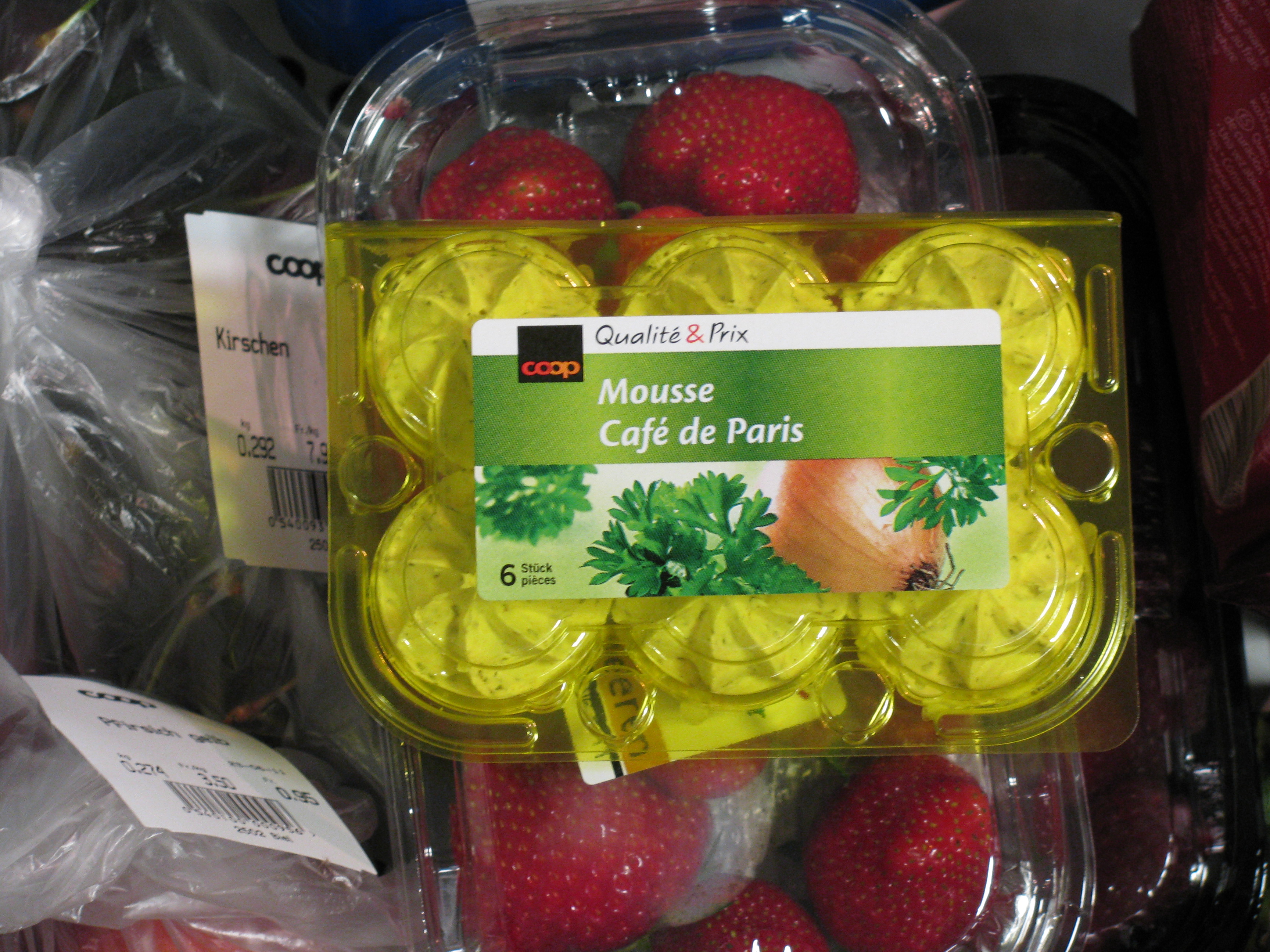
This is not the prettiest photo. It was taken on the sly in the grocery store where I have been scolded for photographing the goods before. This tiny container that fits in my hand cost 4.10 francs, which is way to much to pay for anything that has margarine in it.

In every international move, we have packed along some of the comforts of home, and in every move back home, we pack along some of the discovered comforts of life abroad.

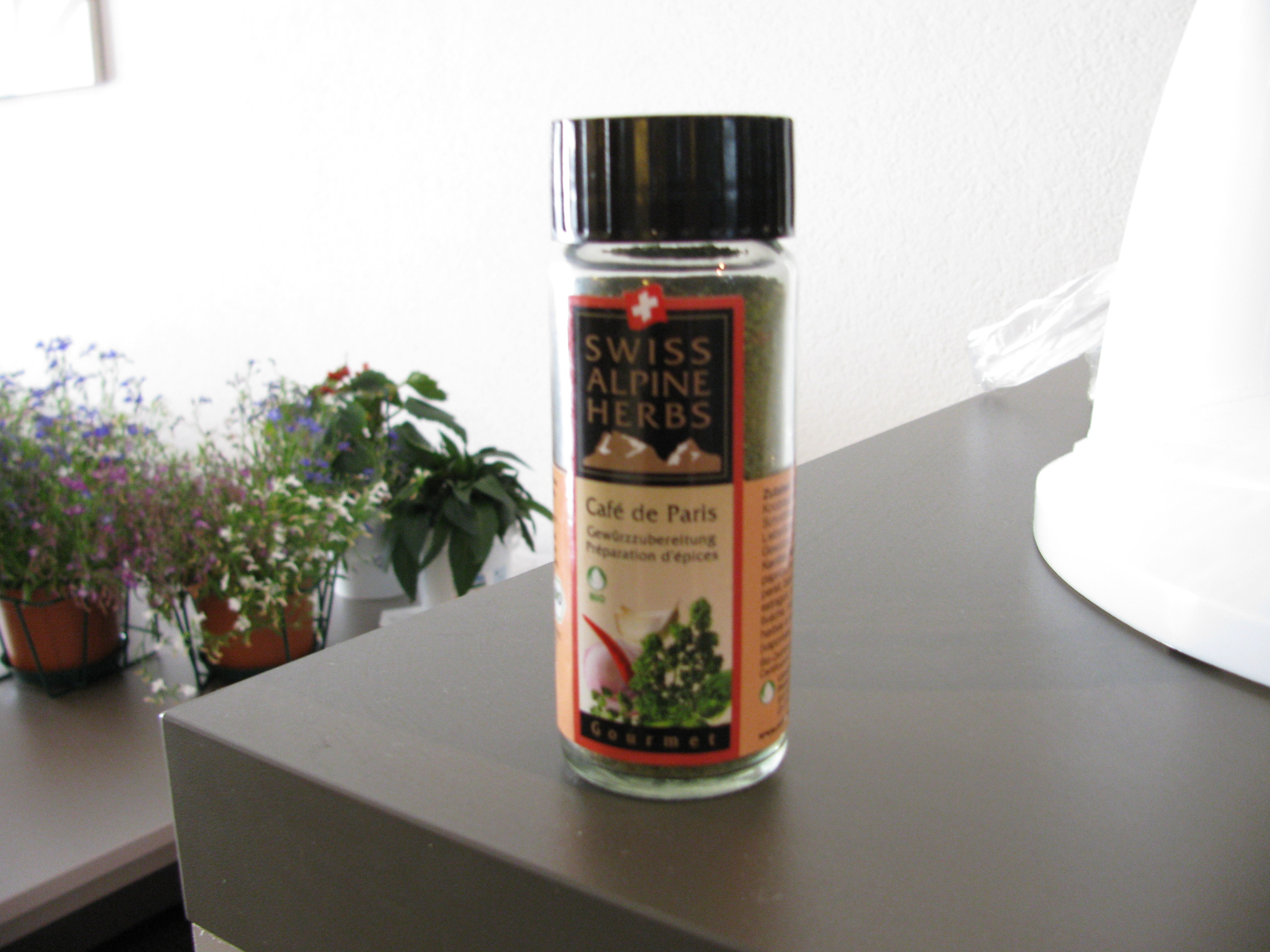
In this instance, I’m bringing back a spice called Cafe de Paris, which I’m hoping is the genuine spice and herb mixture for Cafe de Paris sauce.

You might think that this is French, not Swiss, but you would be wrong about that. The Swiss, like Canadians and Americans, pride themselves on adopting the best from other countries, and that extends to names, even if the sauce was first concocted and served in Geneva. The Swiss have a knack for marketing, and they correctly detected  Cafe de Geneva would fail to rise to the elevated notes of this delicious sauce.

It is incomprehensible that France lets Switzerland get away this, especially as that while the Swiss take the French name, they give nothing back, keeping the ingredients a trade secret. This explains all those French invasions on Swiss villages back in the 1400-1600’s.

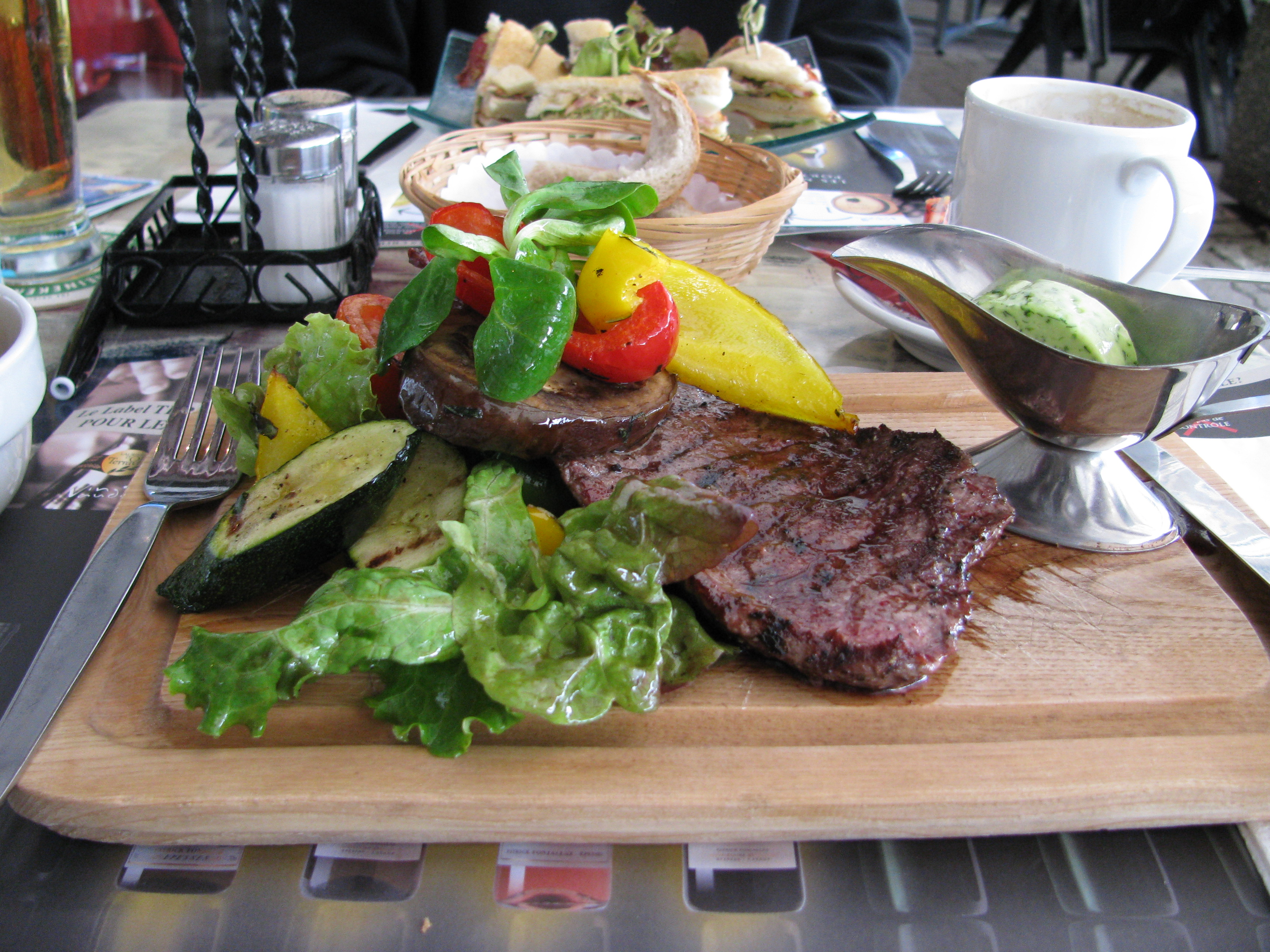
We first learned of Cafe’ de Paris sauce at a restaurant in Montreux. Recommended by the waiter, it came in a scoop nestled in a small gravy boat with my steak dinner.

Is this the transportable good stuff? My summer cottage guests will test it.

It was a pale green, not a very inspiring colour  and despite being listed on the menu as a sauce, it came in solid form.  It had the consistency of  a heavy mousse.

One nibble and I, too, believed sauce could be a solid, powder or vapour. It didn’t matter. Cafe de Paris was beyond delicious.

When I thanked the waiter and asked him what heavenly plateau of cuisine I had just ascended, he waved it away as a mash of minced parsley, butter and a little garlic. Clever waiter. He’s in on the secret, too, and was not about to share.

Several publications have claimed to unlock the secret to this sauce, but the Swiss just shake their heads and say, “Nope, not it.”

Since then, I have been in pursuit of Cafe de Paris. I have discovered a spice of that name listing 15 ingredients, some of which look like something the Swiss would make up.*

Dollops of Cafe de Paris are sold in stores in tiny egg-carton-like form, but one of their ingredients is margarine, proving that the Swiss are still being secretive. Margarine as a base is an abomination, every good cook knows this and even us poor ones are well-aware of it.

*Here are the spice ingredients. Some are easy to figure out – basil, tarragon, pepper, but a few are beyond my resources.  Help me if you can:

German: salz, paprika (ungarn), knoblauch (agypten), petersilie, basilikum, schnittlauch, estragon, zwiebein, pfeffer, liebstockel, majoran, andere krauter und gewurze, pflanzl, fett (gedampft), lauch, karotten.

French: sel, paprica (Hongrie), ail (Egypte), persil, basilic, ciboulette, estragon, oignon, poivre, liveche, marjolaine, autres herbes et epices (curse the Swiss for using this catch-all phrase), graisse veg (vaporissee), poireau, carottes.

Warning: Cafe de Paris sauce is loaded with almost 600 calories in a single serving size, which is about the size of half-an-egg. This, too, is a miracle – to pack so many calories into a dollop that can be taken in one swallow.

Switzerland’s see-through public washroom + toilet tips for travelers

Lausanne see-through washroom - at least it appears clean, probably because no one will use it.

I’m sure the Swiss have a perfectly good explanation for installing a see-through public washroom in Lausanne, but I cannot imagine what it is.

Don’t believe me? See the 17-second video here. 

I haven’t actually seen it in person, and if I do find it on one of our weekend jaunts,  it’s a good bet that I will not use it, because even though the crystal-glass walls can be made opaque with the touch of a button that allegedly sends an electric current through it, I don’t want to be in there should the city’s power grid fail at the wrong moment.

I don’t want to be walking by it either when someone else is using it, because apparently the opaque-function is optional. It seems like a voyeur’s dream, a voyager’s nightmare. Ugh.

A similar transparency idea was floated in the internationally acclaimed Basel Art Fair in 2004, when a one-way-glass public bathroom was installed outside of the gallery so that people could use the washroom without “missing a thing,” on the street said the Basel Art people, who we now suspect of living a seamy underworld life after-hours.  I can’t prove anything – I’m just saying. And what is going on in the streets of Basel that one can’t his eyes off the street for even a minute?

City of Victoria, British Columbia public urinal

The Swiss are not the first to come up with the idea that they are missing some great show when they are ensconced in the private walls of the lavatory. The City of Victoria in B.C. installed a door-less urinal to offer a less offensive option to its public-urinating night-time bar populace.

The idea here, one can suppose, is that this washroom is not likely to become a shooting-up zone for the city’s drug population, and users (bathroom-users, not drug-users) can keep a watchful eye for any would-be approaching muggers.

Cottagers have long had an affection for outhouses with a view – a troll through cottage-country will reveal a few outhouses with half “Dutch” doors or generous screen cut-outs.

I also own a cottage, but I enjoy the views when I am on the deck or looking out the living room window, boating, swimming, and so forth. I don’t see the need to expand the number of minutes-per-day I get to stare at trees, water and squirrels.

The problem with looking out is that others can look in, so I’m hoping the Lausanne see-through unit doesn’t catch on. I still dread visits to Australia where multi-stalled public washrooms are not always gender-specific – a situation that also exists in some parts of France, we recently discovered. No details will be provided here on how we found out.

Everyone needs public washrooms, but no one writes enough about them, much to the frustration of travelers trying to anticipate foreign bathroom customs.  I am about to change that, at least for those visiting Switzerland.

Look at that beautiful outhouse with a full-door and no windows! I'll bet it cost less than Lausanne's glass monstrosity.

Pay washrooms can be found on the streets, sometimes in shiny stainless steel stalls with a vending machine-style pay pad. Train stations frequently have them as well, and any bitterness a Canadian or American might feel about having to pony up a franc or two for a washroom quickly dissipates when inside the stall. They are kept spotless. In fact, the Bern train station has staff on hand, constantly rotating through the stalls in an never-ending sanitizing cycle.

I would not like that job, but I am happy to see someone else do it. I hope they are well-paid.

Washrooms on trains are free, but as trains are heavily used, they are not as clean as one would like, especially when trying to manage while the train rocks and sways, sometimes in unpredictable ways. I will elaborate no  further.

Tourists can get by without using a pay washroom – in fact, we’ve used them only a few times in our travels over the past few months. Many towns have free public washrooms in parks, along promenades and trails, which are kept to a high standard of cleanliness.

If these cannot be found, stop in for a break at a street cafe’ – for the price of a cup of coffee, you can use the restaurant’s washrooms, which we have also found to be unfailingly clean.

Sometimes only pay-washrooms will be located near cafeterias and malls, however, these provide a voucher for a ‘free’ coffee in the cafeteria.

Museums and art galleries generally have free washrooms.

So far, we haven’t found a pay-washroom charging over two francs, so carrying just a few one and two-franc coins should suffice.

A rumour circulates that it is forbidden to flush a toilet during certain night-time hours, out of courtesy for condo or apartment block neighbours. We haven’t heard anything about flushing restrictions yet, but have heard that running a bath late at night is frowned upon.

In the bathrooms-worth-visiting category, when at the Aescher cliff restaurant at Ebenalp, in Switzerland’s eastern Appenzell region, check out the washroom architecture. The mountainside wall of stone is exposed, allowing visitors both a view, and privacy.

Good to know if you go:

  • Carry one and two-franc coins for public washrooms.
  • To see the mountain-wall washroom, which is presumably not the only reason you would visit Switzerland, click here for hiking information about the area and mountain.

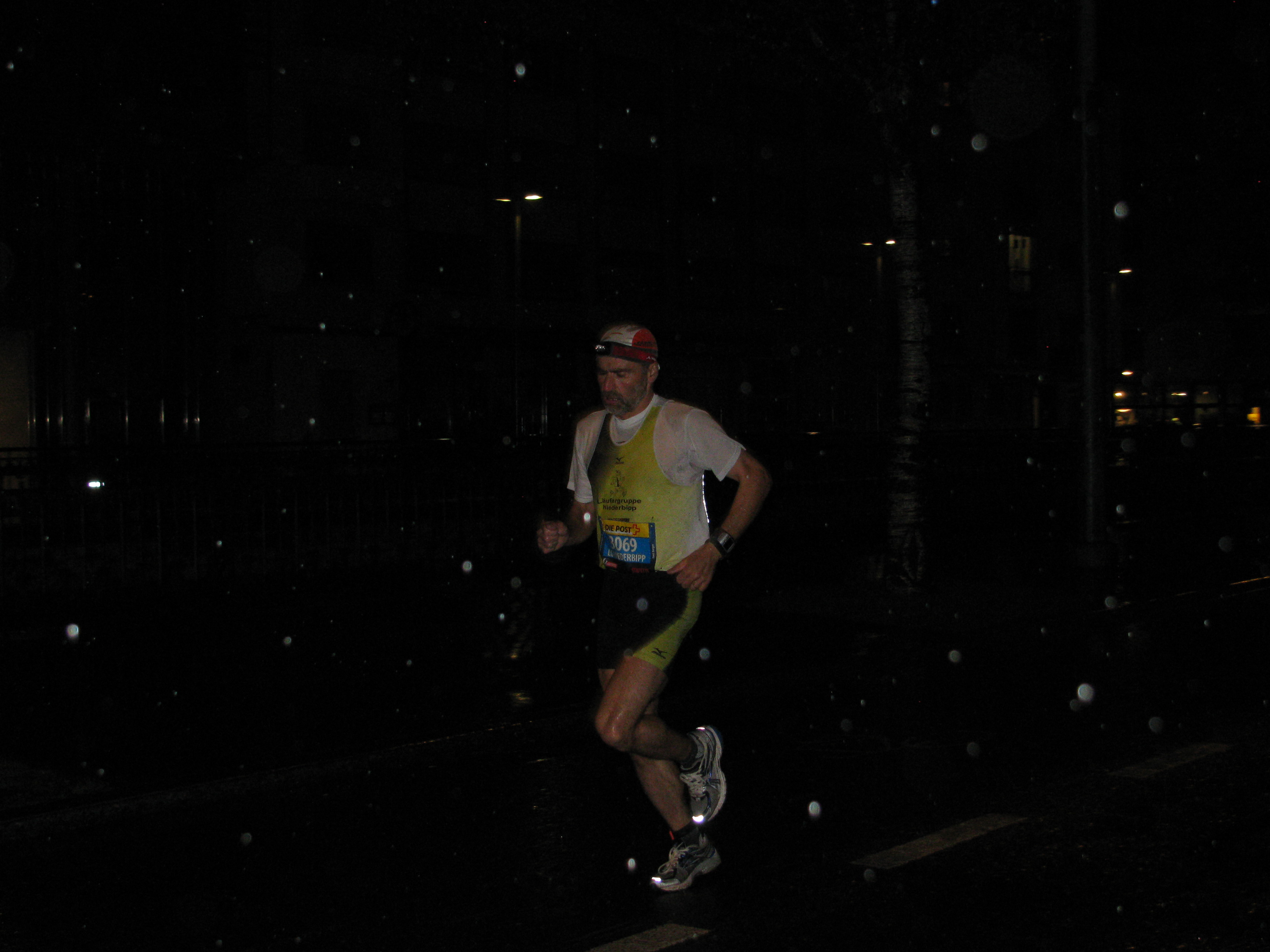
Swiss misdirect night-time marathoners, cut race short by 7.5 km

Somewhere along the way, the Swiss noted the growing popularity of marathons. Factoring in that as many as  a half-million Americans complete them in a year, and about 500 marathons are held worldwide annually, our local Swiss decided 42 kilometres must be too easy.

And so the Swiss of Biel/Bienne introduced a 100-kilometre race, and to protect against it growing too popular, and therefore, easy, they run it at night. It is going on right now, as I write this, although it is just after noon here, but that is what happens when you run a ridiculously long race – it becomes an around-the-clock event.

Runners were here.

If history is an indicator, somewhere in the neighbourhood of 4,500 runners took off from downtown Biel, running right past our hotel, so at a few minutes before 10, Dave announced it was time to go downstairs to watch the runners. At precisely that moment, my Skype box popped up, showing a friend who has been wrangling with a head injury was online.

“You go ahead,” I said. “I’ll just see how the head injury is coming along.” I said this because I believed it would take the runners 10 minutes to get to our corner and that it would be the same as past races I’ve attended or covered as a reporter – in other words there would be at least 10 solid minutes of human flesh pounding the pavement.

It turns out I was wrong about that. Before I had gotten a full report on my friend’s condition, Dave returned to the hotel room. The runners had surged past in one giant overflowing bubble, instead of the long train we had expected.

This is a good time to point out that Dave has scored a victory in the “Hurry up, Jo, we’re going to miss it” department of our marital history. Good for him. He wins. I have learned my lesson.

The runners were supposed to loop around our area twice, so I abandoned my friend and raced down to catch the second surge.

It never appeared. Police officers controlled the intersections with gates, the roads were closed to traffic and down the road we could see throngs of spectators. But no runners. We wandered a block down, and saw a few stragglers on the course. We waited. The crowd’s energy flattened, although music still blared over the loudspeakers.

Then two front-runners came into view, whipped around the corner decisively and were gone. Ah, the pack must be coming soon, we said.

We were wrong about that.

After more than 10 minutes a single runner came down the street that was flanked with overarching balloons and marathon paraphernalia, which suddenly looked like a lot of fuss over not much.

I readied the camera for him to turn the corner, but then instead of turning he went straight. No one stopped him. Not speaking the local languages and unable to discern whether the idiots were us or the race-marshalls, we shrugged and waited.

Minutes passed, the spectators started to break up, and then another lone runner appeared. This one turned the corner where the front-runners had and we surmised that the earlier lone runner had made a dreadful mistake, or perhaps he was on one of the shorter races that runs concurrent to the 100-km race.

Then this last runner turned back, ran up to one of the reflective-jacket-wearing race marshalls who directed him back up the road.

A runner going in the opposite direction of other runners at the Biel/Bienne 100k on June 17. Either he is the only guy to memorize the course and so he's ignoring the race marshalls, or he is but the first of many on a misdirected course.

As we neared our hotel we saw another lone runner, but this one running in the opposite direction of the other runners we had seen. I snapped a photo and we continued to puzzle over the mysterious disappearance of thousands. We walked along dark barricaded roads, passing officers, who we suspected might be thinking the same thing as us, that is,  “Where is everybody?”

It turns out we were right about that.

This morning I checked the race website to see an announcement that gosh-darn-it the organizers are blushing, but it seems that the entire field of runners was misdirected, thus cutting seven kilometres off the race.

Here is the Google Translate version: As a result of a misdirection in the city of Biel (crossing road freight / Murtenstrasse) the runners of the marathon, half marathon and walking without additional round was conducted directly on the route.This lack these routes around 7.5 km distance.

I don’t know yet what this means for the 100-kilometre runners, but some marathoners are going to be mighty pleased with their race times.

Update: Race officials are giving affected runners’ vouchers to waive fees in their events (marathon, half-marathon and walking) in  the 2012 100 KM race, along with a “letter of excuse.” 

What I can’t live without

It is often said that the cultural isolation of international travel teaches a person a lot about herself. It’s taught me something, namely, that I cannot live without a good sharp knife.

In theory, we live in a fully stocked hotel suite.

In fact, something is always lacking, usually a quality butcher’s knife.

Our current suite came equipped with brand new IKEA knives. I love IKEA, I do, but these knives fail to meet  minimum standards. Their blades are not sturdy enough.

I blame my father for this.

When I made my first house purchase, he surveyed my kitchen and said that all a good cook needs is an butcher’s knife and frying pan.  My countertop was choked with small kitchen appliances and there was some evidence I had fallen prey to a convincing Tupperware saleswoman, as revealed by the waterfall of plastics that spilled out when some unaware guest opened a random cabinet door.

Over 20 spatulas reside at my cottage kitchen, which is only a two-month home, but I can defend that on the grounds that it is shared by many guest chefs over the summer. Well, maybe there are 30 spatulas.

In my city home, until I did a little purging before moving to Switzerland, over 60 people could have showed up unannounced for lunch and not one would have eaten off a plastic or paper plate.  That’s how many ceramic dishes I had.

So yes, I overstock. Just a little.

Dad’s subtle point was that I did not need so much, but what do I need? I revisit that question every time we move, which is a lot of times. In some way, he programmed my brain with that comment, because as I look back over the years, in every new allegedly fully stocked kitchen, the first thing I do is add a good-quality butcher’s knife.  I only just realized it today.

But his message to live sparely did not stick: The knife-purchase is only the first sign that the floodgates are about to open. After the knife comes frying pans, bowls, organizers, snap-top plastic bins. I’m trying to not buy such things, and yet, I do.

I admire my friends who live with whatever they can fit into a knapsack as they trudge around Asia for months – or years – at a time. But I do not want to be one of them, so help me Martha Stewart.

The perils of public transport

Train-traveler packs one, two, three bottles/cans in full view for the trip.

Drunks were everywhere this weekend.

At the Bern train station,  a dread-locked man bark loudly in the face of passengers stepping onto a train.

The passengers stoically looked the other way while he pressed in, determined to make his presence known, if not felt.

Drunks upset the delicate social balance where we all agree that when we venture out, we not bark at others, and if we cannot stop ourselves from barking, then at least we should stay far enough away so that our victims are not soaked in our saliva spray.

Is it too much to ask? Apparently so.

This guy must be going on an overnight trip.

Staggerers,  shouters, boorish keg-carriers –  I judge you all.

A red-faced young man carried on what could have been the longest yodel ever as he stood on the train platform. A few minutes later, he smacked himself down in the quadrant of seats behind ours on the train, still yelling. He could have been singing, or bragging, or screaming ‘Help me, I am about to fall into an alcohol-induced coma.’

Given the unpredictability of drunks, especially that their moods  switch swiftly from party to sour to let-me-punch-someone-in-the-face, we quietly moved to another car.

At Fribourg's covered bridge. Isn't it charming? We could barely notice it, thanks to booze-soaked wanderer.

Last week, on the train to France, a tattooed scramble-haired man in an agitated state sat across the aisle from us,  hissing into his cell phone. Was it a drug deal gone bad? Was he going to take it out on us?  It did focus our minds, but not on the French countryside.

This weekend, as we got off  the train at Fribourg, we were happy to leave the drunken yowler behind, but after we made the walk down Fribourg’s plunging cobblestone streets and through its rustic wood-beamed covered bridge, we heard a familiar sound.

The skinny yowler staggered into view. How was it that he was still standing?

Eroded limestone hangs over the river at Fribourg. See the fisherman in the lower right corner. He is having a good day, because he has not met our drunk.

We had just taken out our map to plot our course, but the yowler, not the map, was going to decide where we would go.

He turned away up a narrow side road, his arms flailing, his head cocked oddly, while he continued in that strange thin bellow.

We took the road that he did not, and it was an enchanting road, but it lost some of its allure as we kept an ear open for the yowler.

For the first time since arriving here, I missed my car.

Fribourg's 40-metre long covered bridge, called the "Bern Bridge," dates back to the 17th century and is made of stone, wood and dirt. Yes, dirt, which is also the reference that I make to drunks.

Weekend wanderings – Off to Appenzell, also known as cowbell country

A Swiss cow, WITHOUT a cowbell. What is the land of cheese coming to?

I did not make up the nickname “cowbell country” for Switzerland’s Appenzell region. The Swiss did that all by themselves.

How the cowbells earned higher billing than the cows themselves is beyond me, but we aim to find out. In the meantime, we wonder what kind of conversations dairy farmers have out there. Instead of discussing how many heads of cattle they oversee, maybe they discuss the pitch and tone of the cowbells.

“Good chiming on the up-pasture trip yesterday,” Franz says.

“Yah, yah, it vazt gutt!,” Johann replies.

My goal will be to see the cow museum. Woo hoo!

Dave’s goal will be to get me to ride the Kronberg bobsled ride. Click here to see it. Skip to the 20-second mark to get straight to the ride. Skip to the 1:20 mark to see how close the “bobsleds” get to each other at the bottom of the ride.

Dave says, “What could go wrong?” and I have to admit it looks not-so-bad, except that is the same thing he said just before I slid down an enclosed waterslide tunnel at Whitewater in Atlanta, minutes before I got lodged in said tunnel, which eventually spit me out in a tangled glob of humanity. I will only tell you what that ride was like if someone asks me. It’s better not to ask.

In the meantime, this blog will likely pass the 3,000 mark some time today. As one editor told me, “It’s the photos, dummy. Nobody cares what you write. They care about the pictures.”  Editors. You gotta love’em.

Happy weekend!

Rain

Rain, rain please do stay. I can't take another hot day.

In non-news, yesterday we watched a never-seen-anywhere-else-we’ve-lived  weather-induced phenomenon (I am trying to break a hyphenated-sentence record).

While out on our evening stroll through downtown, heavy rain started pouring, driving many shoppers to line up execution-style, their backs pressed tight against the buildings for shelter in that miniscule 18-inch ribbon of dry pavement next to the wall.

Witnessing this led me to reflect on what this unique behavior would lead to in other parts of the world.

Do this in the Pacific Northwest and you’ll be waiting for the weather to clear from November til April. Try it in Manitoba or North Dakota and soon a sheath of ice will form over you, rendering you immobile until spring.

Lining up in this fashion in a giant American metropolis will lead criminals to assume you are volunteering to be relieved of your wallet or purse, getting you mugged within two minutes. The good news is that ambulance attendants will arrive to get you out of the rain, although you will be in a prone position, likely for quite some time. If you are single, this is even better as you are about meet a lot of doctors, just as your mother always hoped. You might not look your best, but the doctors will be too busy checking your intubation tube to notice. See how a little rain can change your life?

In Victoria, British Columbia, muggers are more polite and will ask for your money instead. Many would-be robberies are aborted in this way as the prospective victim is often unaware he has a role to play. And in true Victoria form, the mugger will be too polite to point out this faux pas to the victim, and let it pass. This happens dozens of times a day there.

In Australia, line up against a wall and someone will hand you a beer. Do this in Spain’s Plaza Mayor and locals will assume you’ve had too much beer,  search you for it and take it away.

Our view: Not very attractive, but not so bad. The buildings absorb the sound of ambulances screaming down our street. I'm not joking. We rarely hear them from inside our courtyard-flat.

I did wonder how long the Swiss would stand there, but as it turned out, the locals knew what they were doing. Within a few minutes, the rain paused in an orderly polite Swiss manner (just  as it started, quickly and on time) and the crowds meandered back onto the roadway. I should point out, this area is a no-car zone, so no tremendous traffic excitement ensued.  In the meantime, the Swiss had a sociable time chattering with their fellow rain-refugees,  presumably about the weather.

In other news that matters to no one in particular, yesterday I was told twice that I speak French very well, proving that you can get by in a foreign language on only two sentences, as long as you pronounce them very well.

And finally, I’ve been told I am living a rich-lady-life, which sounds pretty glamorous, but in the interest of truth, allow me to dispel that myth by sharing the view outside of our flat.

Plants that I plan to neglect.

Montreux

The wet walk between Chateau de Chillon and Montreux, along Lake Geneva.

Bus or boat will take visitors from Chateau Chillon to Montreux, but why bother when a world-famous “Swiss Riviera” promenade waits just outside the castle drawbridge?

Whether we actually voiced such a lucid question is a mystery even to us, as a cleaving wind and pelting rainfall drowned out our conversation. Despite the storm, we decided to walk. The word “decided” is loosely applied here.

A mansion overlooking Lake Geneva on the riviera promenade toward Montreux. Why do the Swiss call this is a "riviera" when it is on a lake?

Part of the problem lies in the “Well, we’re here, why not do it?” syndrome that besets Dave and I in all our ventures.  It eclipses all cognitive thought, which means that we rarely decide anything. Dave knows this, and he uses it to his advantage as was seen when he got me onto the Gondola-Ride-From-Hades up a mountainside. I put my foot down, declaring that said foot was staying within reach of the ground no matter what, but Dave slyly coaxed me into walking near the gondola, hence I ended up on it, because of the dreaded “Well, we’re here …” travel tic.  I wish there was a cure for this.

A sign outside the château claimed the walk to Montreux was 45 minutes, which might be correct, if you’re going at a good clip and not leaning into gale-force winds while keeping a watchful eye on Lake Geneva for signs of rogue waves that might sweep you away to the French side of this massive body of water, all while keeping your ear tuned to the tree branches above for the sound of cracking limbs that might break off and grind your body into the quaint promenade pavement where the Swiss might mistakenly leave you on the assumption that you are some form of modern art. The Swiss do love statues.

Even in the storm, the promenade is worth the walk – it starts out narrow with an uneven surface and rather ordinary hedging, but quickly opens up to a wide mall flanked with mansions on one side and a trim botanical garden on the water side. My guess is that this walk is packed on a sunny day, but with the storm in full voice, Dave and I found ourselves alone but for the occasional daring youth biking past and one very wealthy looking man walking his golden retriever, who gave us a friendly (by Swiss standards) hello, probably on the thinking he might see us at “the club” later, because who else would volunteer for this walk but a well-heeled and eccentric local?

Even the public bathrooms have a stately look in Montreux.

By the time we found ourselves alongside the wharf from which we had started our day’s journey, we had walked a total of 5.5 miles weighted down with rain-soaked clothing (the distance includes tramping through Chillon castle) and were ready for some real food. We stepped up to the restaurant La Metropole, also oddly signed “Caesars” by the wharf, where we had earlier seen a rather elite-looking crowd noshing away at tantalizing dishes. If the rich eat here, we thought, the food must be reasonably good.

As we folded our badly abused umbrellas, a very French-looking waiter rushed out from the restaurant and motioned us towards one of the outdoor cafe tables, even though the weather was still rather exciting. A glance through the windows told the story – the interior showed off elaborately set tables, sparkling wine glasses, perfectly starched tablecloths, while the reflection in the glass informed us of how poorly equipped we were for such surroundings, my hair whipped into a Medusa fright, Dave’s tanned face now bearing the weather-worn visage of a salty sea-captain. We humbly took our place outdoors, just like the dogs we appeared to be.
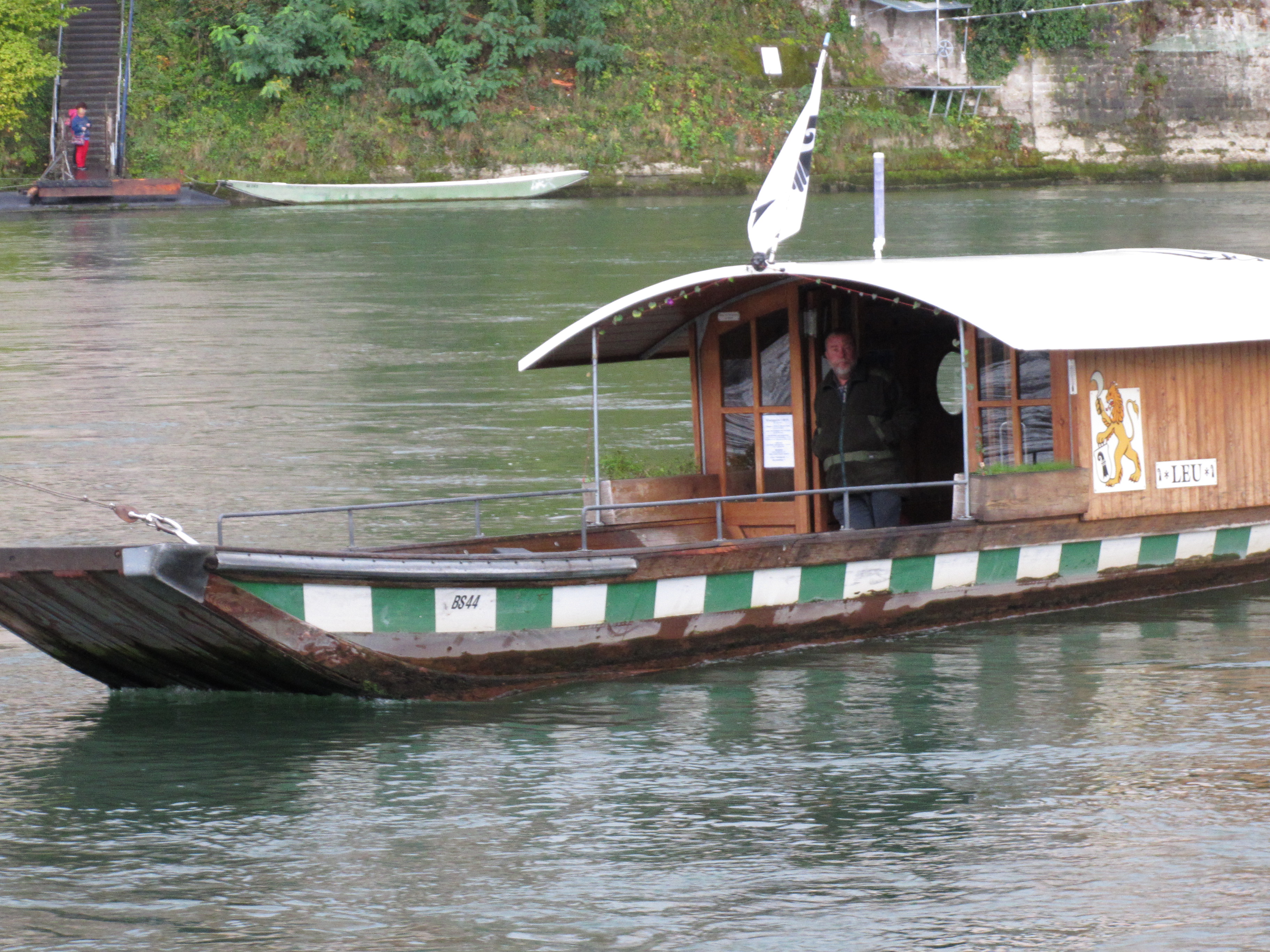
We counted out our children’s inheritance and figured there was just enough to pay off one’s law school debt and enjoy a steak lunch at this establishment, so we braved it. I am not exaggerating when I say “braved it.” We had an earlier unpleasant encounter with Swiss beef, an experience that surprised us both as the Swiss enjoy a cultural association to beef that is perhaps unparalleled worldwide, except in those countries where the cow is looked on as a deity. Consider the widely known Swiss cheese and Swiss chocolate, and the less-famous Swiss fighting cows (a true phenomenon according to guide books), and so forth.

The delicious "Steak de boueffe" grilled to "medium" at Montreux's "La Metropole" restaurant, which also has the sign "Caesar's" above it. We think the dual-name is a byproduct of multilingualism.

I passed up the $45 filet mignon, on the grounds that no one can grill a tenderloin better than my husband and it was unlikely the chefs would let him into the kitchen, and opted for the $35 steak lunch. Dave, still mindful of  our children’s inheritance, wisely ordered a sandwich. We then settled in with our lattes to wait the requisite four hours for the meal to show up. Imagine our surprise when our waiter swept up with our dishes before I had worked a quarter-way down the cup.

The waiter had taken matters in hand and ordered the steak doneness to medium, which meant that it still quivered on the plate, and chose as its companion, a Cafe de Paris sauce. There are waiters whose instincts are unfathomably correct. This man was one of them.

The meat was perfect, tender, and seasoned just so. The Cafe de Paris, which appeared in a dollop of green aspic in a gravy boat carried the steak’s seasoning from wonderful to beyond-heavenly. Our waiter waved away any notion the sauce was extraordinary. “Just parsley, garlic, butter and (indecipherable spice name),” he said. The grilled vegetables were cooked to perfection, lightly buttered, the red-leaf salad was crisp, and the roasted potatoes, which came in a separate bowl, were as good as potatoes can get, which is just to say that no one recognizes a truly great potato dish, yet one only makes note when it is done wrong. This was done right.

A pricy meal, but very enjoyable with excellent professional service overlooking Lake Geneva. It was a perfect end to our blustery walk, and restored our sensibilities and bravado so that we were able to march up Montreux’s steep slopes to enjoy its 16th-century quarter.

What do you think? Does our waiter look French? I think he does and he had a decidedly French accent.

The requisite pose with Freddie Mercury statue.

Chillin at Chillon

Chateau de Chillon

As cottage owners, and therefore owners of an old-fashioned outhouse, we were fascinated to learn of 700-year-old toilets inside a Swiss castle near Montreux. What design, what wood choices, what the heck …. how did the French/German/Swiss make a toilet last this long when all over Canada, wooden outhouses are sagging at the floorboards?

And so we went to Chateau de Chillon, built on a rocky island on the shores of Lake Geneva (locally known as Lac Leman) over the centuries. The site was held by the French Savoys since the 13th century until 1536, when they skittered away in the night after the Germans shot two rounds at them.

Dave checks out secret exit through which French escaped. They had to have run right by their torture chamber prisoners to do it, among whom was Francois Bonivard (1493-1570)who was jailed for being a political upstart. He was made famous by English poet Lord Byron in the poem "The Prisoner of Chillon."

The French, some how forgetting their position’s military advantage (the castle was considered impenetrable), decided they needed to be elsewhere and snuck out through a secret passageway during the night, effectively  handing the keys over to the Germans who must have been a little disappointed to have dragged their cannons all that way when they could have simply showed up and shouted up the castle ramparts.

The castle is the melding together of a conglomeration of structures, and it shows as it weaves and bobs around the island. Despite it’s four grand staterooms, it lacks the palatial air of Spanish castles. Nevertheless, it was more fun to troll through because it had the air of a real working fortress, although that unfortunately included a torture chamber, complete with original etchings of biblical figures on the wall, scratched in by the hapless victims imprisoned there.

Pretty sober stuff that struck home as we toured the castle during a smashing thunder and lightning storm, with waves crashing outside against the island.

Rugged, beautiful, cruel.

But definitely worth seeing. Admission is only $12 an adult, a very decent fare.  It took us two hours to tour the entire castle, which appeared small, but it curves up and down, to the point that visitors quickly lose their orientation, and the only way to be certain of your location is to keep checking the numbered rooms, all 46 of them, which are handily described in a brochure that comes with admission.  According to my pedometer, we walked about 2.5 miles, which doesn’t seem possible, but my pedometer hasn’t lied to me yet.

Yes, I photographed the 700-year-old toilet. I have no class.

The toilets, by the way, were indoors, and simple wood planks set into the stone walls. The “refuse” would tumble down a large stone chasm that curved and eventually opened to daylight, by which we can only assume the refuse ended up in the lake.

Indoor plumbing was tricky back then, because the opening into the wall could be used by an attacking army as a way to crawl inside.

Maybe it was the thought of soiled Germans emerging from the latrines that made the French think they would just as soon not fight, which some might say, has become intrinsically entwined in France’s military history.

If you go, a happy little sign outside of the castle says it’s a 45-minute walk to Montreux along the waterfront promenade. It took us 60-minutes in a pouring rain and cutting wind, however, it was invigorating. For one thing, we were the only tourists on the promenade, which meant we didn’t have to do a two-step to navigate through a crowd. Secondly, it’s a lovely walk that starts out through some nondescript

Charming little courtyard. Must not have been so charming though, when the torture sessions were on downstairs.

hedges and eventually opens to a wide path flanked with mansions on one side and botanical gardens fronting the water on the other.

You will pass a casino made famous by Deep Purple’s song Smoke on the Water, which refers to the time it burned down in the 1970s when a patron lit it up with a flare gun. You can go in there to eat, but they will want to take your belongings, your coat, and seemingly your identification while you’re inside. Dave and I measured the wisdom of leaving our valuables with the sort of people who run casinos and decided we’d rather brave the storm outside. It was only a 5 or 10 minute walk from there to a McDonalds, which we did not stop at, although we thought of it because it is the only affordable “Swiss” restaurant we have found so far. Instead, we went onto a pleasant lakefront cafe, which  I will write about tomorrow.

Click on photos for close-ups! 

On the cusp of villainy … or at least drunkeness

The neighbourhood where we normally walk ... fa la la la ...

We have only four channels on our television, and this paucity of choices has knocked us right off our evening television habit.

Happy streets, shining homes.

Happy Swiss walking to work.

We can’t just sit in the suite and stare at one another, or even out the window where the view is other windows like ours. Might as well paste a mirror up there.  And so, we’ve fallen into the practice of taking an after-supper stroll. Normally we head west, not because we are following an innate migratory desire to head back home to Canada, although that would be okay, but because it is the direction of the lake, not to mention a number of lovely waterfront cafes.

The trees along the way are huge with oddly rumpled trunks, and the canopy is thick owing to the town’s vigorous amputative pruning program that chops off branches so burly that the sight of it would trigger environmentalists into action, raining press releases down on the media, chaining themselves to shrubs, complaining about the effect on fish habitat and marmot reproduction rates.

Where was I? Oh yes:  The wide walkways west of our place follow a network of open canals that lead down to the lake, making it a happy walk, but last night we decided to venture east.

What harm could come of that?

Early clue that we weren't in Kansas anymore (North American cultural reference to being really lost)

Not a third of a block in, we noticed an open produce market. How delightful. But we did not check on it, owing to a number of loitering males. We avoid loitering males, especially in the evening hours. We always suspect they are up to no good, especially if their hygiene regimen appears substandard.

A few feet later, three chums – two men flanking a corpulent woman –  spanned the breadth of the sidewalk. It is difficult to describe them now because we averted our eyes so as to not call attention to ourselves, but it didn’t work. They did not so much walk as lurch, beer cans in hand (very likely as a balancing mechanism), eyes glaring wherever they landed, which was on us.

I’ve noticed this about the town drunks – they look right at passersby menacingly, as if to dare them/us to point out their inebriation.

It’s a little different than Canada’s street drunks, a vigorous lot who spend daylight hours in the courthouse challenging city hall for looking down their noses at addicts and alcoholics pitching tents in parks (I know this seems like a pejorative statement, but I’ve gone and checked, and haven’t seen anyone in those tents who looked much different than what we saw on the seamy side of the street last night).

Nevertheless, at least our Canadian drunks have some gumption. And lawyers.

We passed the wild-eyed, teetering trio, then turned a corner, thinking a one-block walk was sufficient exercise, when we spied another staggering fellow. Apartment buildings took on a blemished look, their balconies curtained in makeshift bamboo screens, and in the narrow walkways and alleys, waves of debris piled up against the buildings.

I went back the next day - this is the seedy mafioso-looking cafe, although really, it probably isn't that. Just looked like it after treading Intoxication Promenade.

We rounded the corner and came upon a scene that looked right out of the Godfather – the early New York ghetto scenes, not the later rich-crook scenes: An assembly of dog-eared cafe tables filled with somber middle-aged men with greasy combed-back hair, shaking hands formally in introductions. It could have been the Knights of Columbus planning its spring fishing expedition, or it could have been the Mafia, plotting what to do with all these foreigners wandering into their turf.

A few metres later, we were back on our street where pedestrians walked in straight lines without the balancing benefit of beer cans in their hands, the alleys were clear, the streets charming enough for a movie set, and the trees appropriately park-like and trimmed. What a difference a simple left or right turn can make.

It is fair to say that we are not ordinarily so jumpy, and in my work I engaged street people in conversation many a time, but there’s a new dimension at play when the street-folk speak another language altogether.

It can be socially awkward. For one thing, you have no idea if they’re asking for the time, or your wallet.

One wrong turn, and the scenery changes. Even Swiss towns have a wrong side of the tracks, although, technically, this is on the same side of the tracks as our neighbourhood, just one block over.

What’s wrong with Switzerland

This is not me. Judging by the dozens of paragliders floating over the valley, the Interlaken is an excellent place to catch an updraft. Dave spotted one glider just jump up on a mountain side and take off. Not jump "off," just jump "up." The laws of physics and gravity appear to be suspended in Switzerland.

What’s wrong with Switzerland is that it has mountain peaks that stand on tiptoe at over 13,000 feet above sea level. I’m only five feet above sea level. You can see how scary the Alps can be for someone like me.

We decided to check out (not go up) some of those mountain heights in Switzerland’s famous Interlaken region. After two hours of travel via Swiss Rail for the return-ticket price of $80 for two of us, we arrived at the valley floor of Lauterbrunnen, a quaint Swiss village surrounded by quaint Swiss farmyards that looked very much like Vancouver Island’s Saanich Peninsula, except where the peninsula is surrounded by the Pacific Ocean, the Lauterbrunnen valley is surrounded by mountains.

Dave calls this a “material” difference.

Lauterbrunnen cemetery - placed suspiciously close to Lauterbrunnen gondola

We began what appeared to be an aimless stroll by admiring the Lauterbrunnen cemetery, without argument the tidiest, least-scary graveyard I’ve ever seen, except that only six kilometres away is what I call the Gotten Himmel gondola ride, a five-minute 1,600-foot sweep up from the valley-floor to the mountain-clinging village of Gimmelwald (4,593-feet).

Gotten Himmel means “God in Heaven” and certainly my mind was on spiritual matters, being so close to the resting place of the dead and the gondola, an efficient agent of death if ever I saw one.

The enchanting stroll along the Lauterbrunnen valley, that ends at Recipe for Death gondola ride.

I started to climb the wrought iron fence into the cemetery, reasoning that I might as well just lie down and take root, rather than go through the heart-stopping gondola ride, but Dave convinced me we would just walk the valley and see its famous 10 waterfalls. That the gondola was at the end of the valley and we were walking in its direction did not mean we had to get on it.

The sun was hot, the views hypnotic and the walk long, so that by the time we arrived at the gondola site, I had temporarily lost my mind, which is the only explanation for how I found myself standing in line with a gondola ticket in hand.

I made the ride, without screaming, which proves that living-in-denial is the roadway to achievement, even a modest achievement such as getting through five-minutes of this (click to see 54-second clip of end of ride).

More to follow, including a mountain-side restaurant review.

Murrenbach waterfall plunges 417 feet to valley floor. Lauterbrunnen is a classic glacial valley with near vertical cliffs on both sides.

Two weeks, more or less

Two weeks in Switzerland: Two weeks of discovering new cheese, new chocolates, new shoe stores (and shoe prices!). Here’s what we’ve learned so far:

They have homeless people, but not in near as many numbers as North American cities. As in all things to do with homeless populations, numbers are extremely difficult to count. One 1980 U.N. survey put the number of Swiss homeless at 2,400, but that figure is 30 years old. Switzerland’s overall population in 2009 was  7.7 million: 

Biel homeless man has worn garbage-bag shoes for the past two weeks, even in the blistering heat.

They love Justin Bieber (who, by the way, has a strong Winnipeg connection): 

Justin Bieber images are everywhere, such as on this junior sheet set at a local department store. His visage outnumbers that of Obama, Clinton (either one), Michael Jackson, the Beatles and anyone running in Canadas current federal election.

They are cane-enabled (get it: Cain’n Abel  – sorry, couldn’t stop myself). : 

Elders favour canes over walkers. Even young people sport these arm-brace-style canes, making us wonder if polio races through the Swiss.

They view sidewalks and roadways as near-equals: 

They park, and occasionally drive, on sidewalks.... not as often as the Spanish, but a lot more than North Americans.

They smoke, a lot:

One in four smoke, according to Switzerlands Federal Health Office. In both Canada and the U.S., one in five smoke. Despite the 25 per cent rate given by the Swiss government, the number of smokers looks higher on the street where the Swiss smoke as they walk, juggle babies, lounge in street cafes. Smoke is blowing into our suite as I write this as my Italian neighbour takes to the balcony for her morning fix.


Their public art holds some surprises: 

Despite their reputation for attention to detail, their take on public art would make North American insurers and art/park commission managers gasp. These wrought-iron statues could inflict fatal wounds if someone tripped into one. Note: Dave does not let me twirl anywhere near these.

Just in case you dont quite see it: The arms on this prone statue are about two inches thick and maybe two feet long - would plunge through a chest wall or eye socket quite easily. Eeeew.


What’s in a name? Murten or Morat?

The view from Murten/Morat's castle ramparts where on June 22, 1476, 2,000 Murtonians/Moratians beat 20,000 invading French back into the lake, causing many of the armor-clad French to drown. The townspeople were aided by about 10,000 neighbours. This battle is considered seminal to the creation of the Swiss Union. Note: The French were hungover from partying the night before. True story. Also of note: The Swiss are famous for their mercenary soldiers. By this we conclude that it is not the legendary Swiss neutrality that protects against foreign invasion, but Swiss ferocity.

It began with us sprinting through the train much to the horror of our fellow passengers, but it wasn’t really our fault. We blame multiculturalism and its child, multilingualism.

In Canada, multilingualism earns high respect, but here in Europe it leads to high-annoyance. My international readers will correct me if I’m wrong, but even the multilingual Swiss can have trouble clearing language hurdles.***

As an example, the lease negotiations between Dave’s corporate rep and our apartment’s leasing agent were conducted in English, although they both spoke French and German. So why English? Because it was their strongest common language and to use the descriptor “strongest” is stretching it.

We, the mute, listened as they waffled back and forth in three not-very-good languages, hearing one question spawn the response “yes” at one moment and “no” in the next. Consequently, the terms of our lease are a mystery to us.

It brought back memories of my multilingual European father who back in the early 1960s decided we would speak English only, saying that it was better to be eloquent in one language than an idiot in many.

Before you write your angry letters, let me say I know there are people out there who are masters in many languages. I just have not run into many yet.

But I drift from my topic, which is Murten/Morat and how we got lost trying to get there. I don’t drift too far, though, as language formed the foundation for our trouble.

Medieval castle ramparts in Murten/Morat.

We got on the right train, heading in the right direction. As Biel fell behind us and the Swiss countryside opened up, we paid attention to town signs and watched the villages for castle ramparts and ancient churches – the attractions that were bringing us to Murten.

After what seemed a reasonable interval, we began to worry that we had missed our stop.

I recalled hearing the train’s recorded announcement heralding “Morat,” which was not on the map or in the train schedule. As it turns out, Morat is the French name for Murten.

We learned this later – that Swiss villages/towns frequently have both German and French names, but for some reason hidden in Swiss Rail’s corporate headquarters, they switch languages in a sporadic manner. Maybe it prevents invasion from foreign armies, or too many tourists amassing at any single point.

In any case, that is how we missed our stop.

Looking out from Cressier's rail station, Switzerland. April 2011. Clearly, we were in trouble.

We got out at Cressier, which by Swiss standards is absolute Heck as you can see by this photo (right), and then feared that this being a Sunday, there might not be a train for hours. Stuck in Cressier! Switzerland’s “Brugge.”

We were wrong about that and with some help, soon boarded a train returning to Murten.

But our travel-nerves were jangled, so we watched anxiously for signs of Murten – or Morat, call it what you want cause that’s what the Swiss do –  and the minute we saw something that remotely resembled the pictures in our guidebook, we got on our feet. The train came to a stop, but the doors wouldn’t open. We don’t know how trains work here, so we sprinted in a frantic manner through the cars looking for an open door, like rats stuck in a  trap.

One of us may have shouted, “Stop the train! Let us out, let us out, we want to go to Murten,” but I’m not saying who. At that point, a passenger said, “We’re not there yet.”

It is comforting to know that we gave our fellow passengers something to laugh about on that otherwise quiet ride. It is also comforting to know that we will never see any of those people again.

As it happened, the doors did not open because we weren’t actually at a station yet. If we had gotten out, we would have plunged down a steep incline. So sorry to have missed that.

By the way, we have also learned that the buttons we thought were for opening doors were actually emergency-stop buttons.

Eventually, we found our way to Murten-Morat, a charming medieval village by any name at all.

***This is a rant, and so is not bound by logic. If my Dad had decided to school us in European languages, our little sprint could have been averted. But where would be the fun in that?

Bern, pronounced Behhhrrn

Telling any Swiss person that we were travelling to Bern (burn) produced puzzled frowns. Now we know why. We were saying it all wrong. We would feel bad about this, but how can the Swiss expect us to grasp place-pronunciation when they themselves can’t make up their minds what to call anything.

Bern: This clock tower was once a gate in the town ramparts, however, the city outgrew its boundaries twice.

We are sitting on a French-German cusp, and to keep everyone happy, every place has both a French and German name, such as our current place of residence Biel-Bienne.  Murten is also Morat. All along the train tracks are villages and towns with German names such as Mongbratzverstenspiel and a corresponding French name that doesn’t bear any resemblance to the German counterpart, such as Le Bleu. Okay, I just made up both those names, but if I had the strength to look at a map, I could pull out a few excellent examples.

Bern, happily, seems to run along on a single name, perhaps because it is the nation’s capital and they can’t afford to have a Franco-Germanic squawk about it without creating terrible unrest. I don’t know that. I am still making up things, owing to the linguistic spaghetti forming inside my brain.
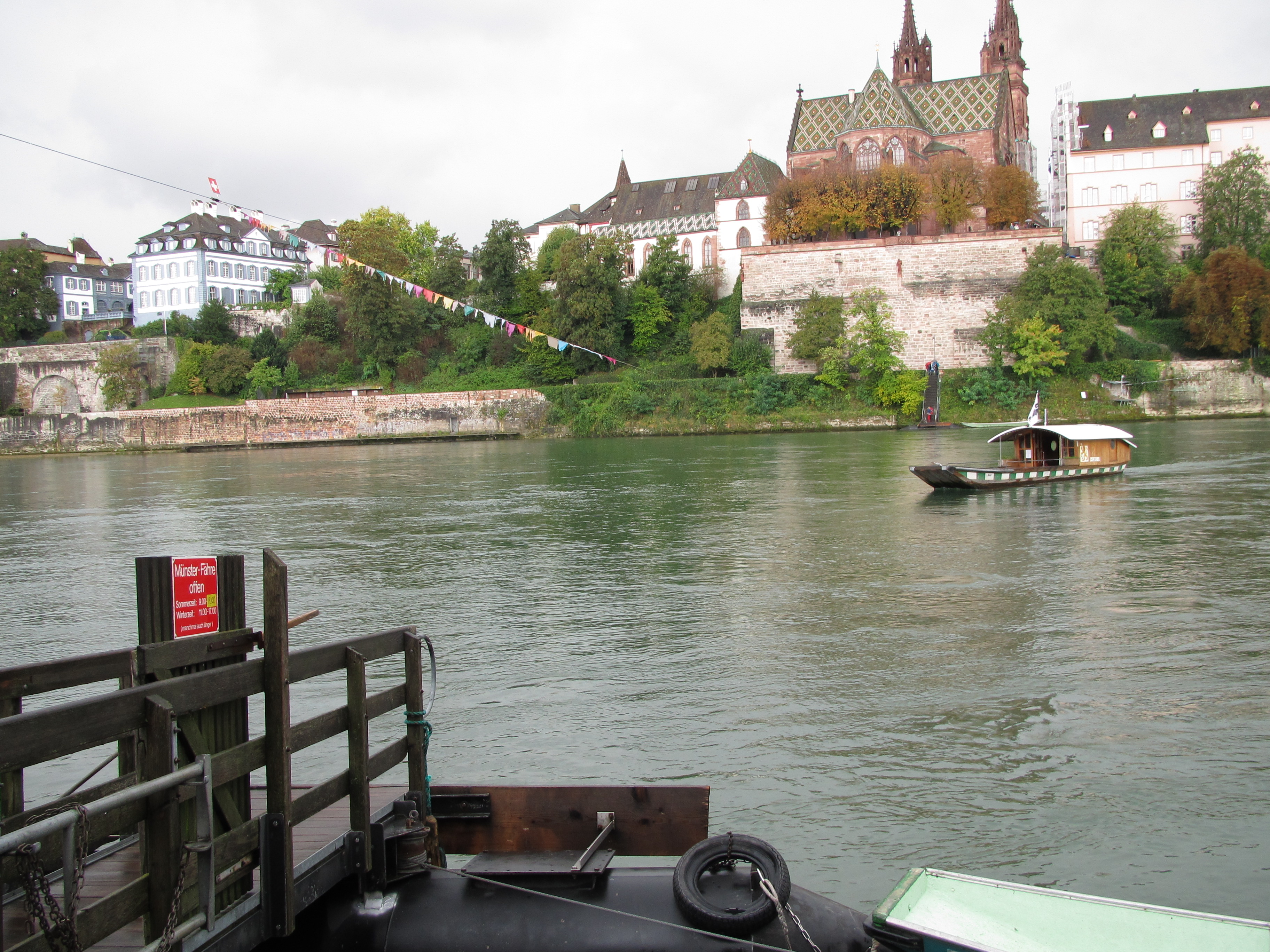
Dave seated at Albert Einstein's desk when he worked at the patent office in Bern. Einstein is said to have made his greatest discoveries while living in Bern between 1901 to 1909. Then he left his wife and married his cousin. Ugh. In the meantime, Dave developed several new theories while seated at Einstein's desk.
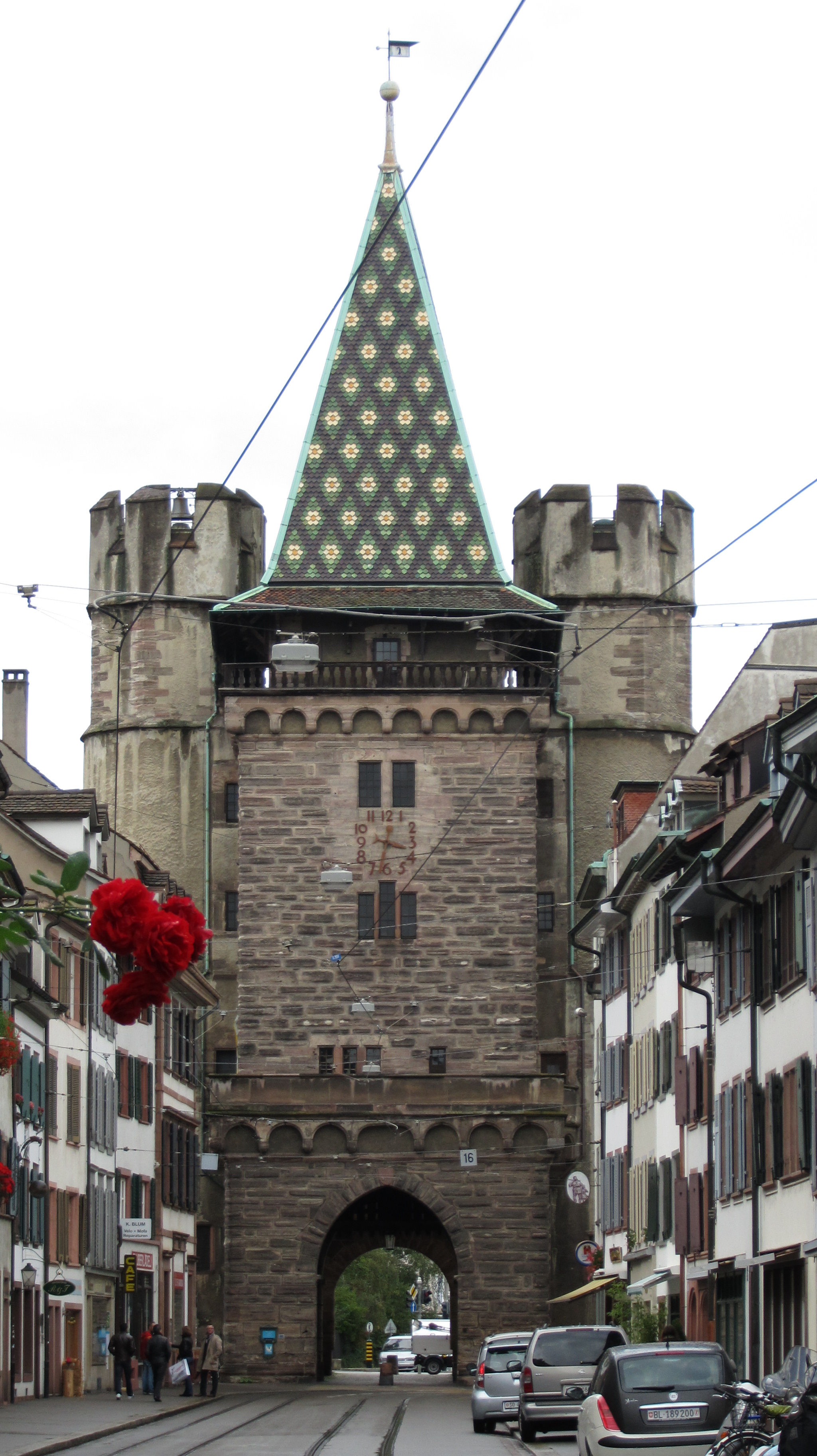
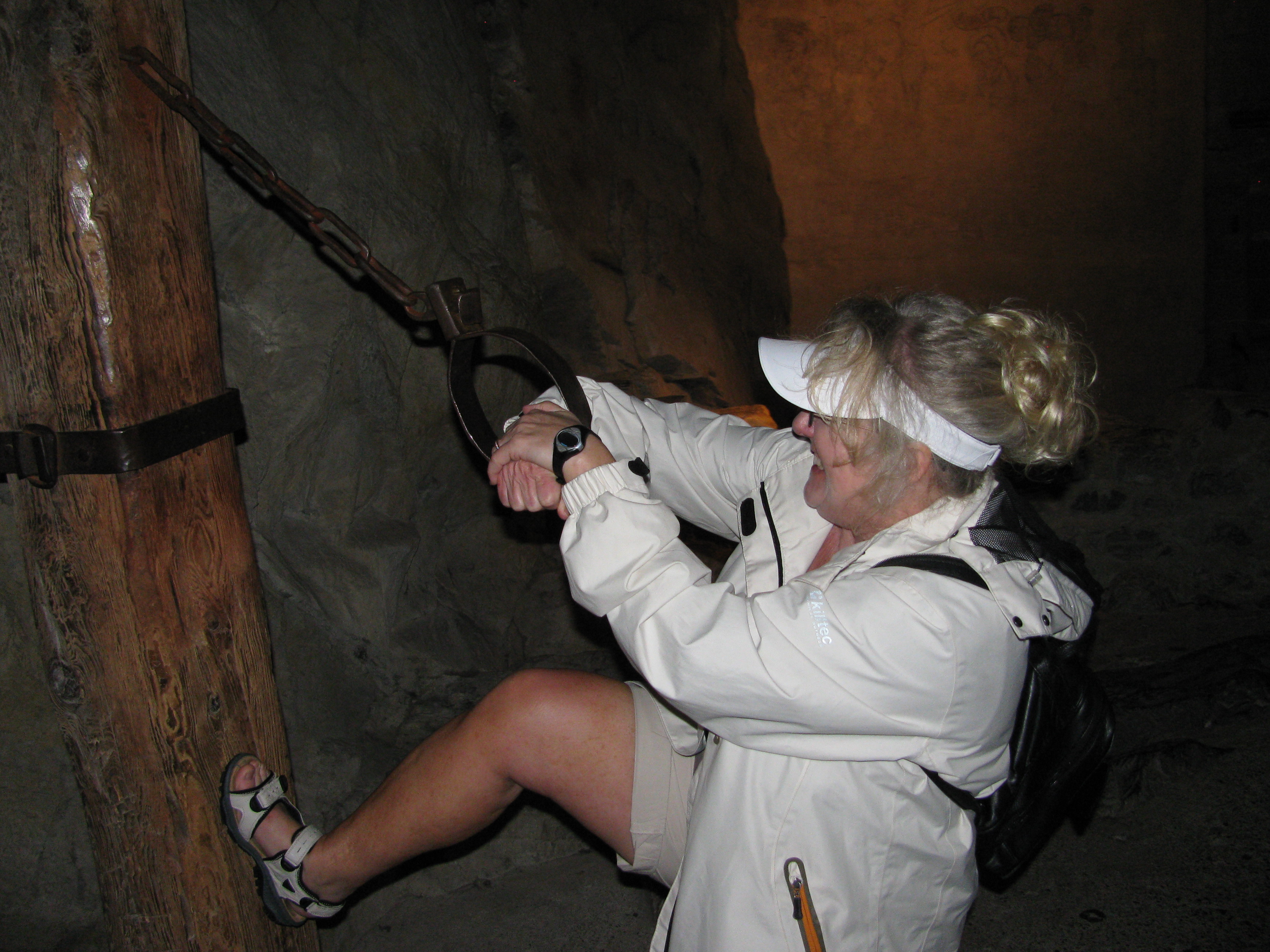
A 30-minute train ride from Biel (pronounced Beeeel), Bern’s historic quarter covers over a peninsula formed by a bend of the Aare River. It was founded in 1191 and is built of porous green-grey sandstone that, like Spain’s famous golden sandstone buildings, can be scrubbed away rather easily, hence the Swiss have built into the walls to create what they call “arcades,” broad covered walkways drawing pedestrians behind the exterior, theoretically preventing them from touching the sandstone portions.

Of course, the first thing we did on our arrival to Bern was to head to the sandstone walls and scrub away,  just to see if our guidebook was right. It was. I should say, Bernese sandstone is not as delicate as Spanish sandstone. Nor is it as pretty. The entire town is a murky gray-green, but this does not take away from its impressive architecture.

While there, we saw a large group of dark-skinned people filling the town square as Swiss police took positions and parked paddy wagons around.  I approached the Swiss police as though they were Saanich police*, ie. friendly, non-combative and wishing something would happen.
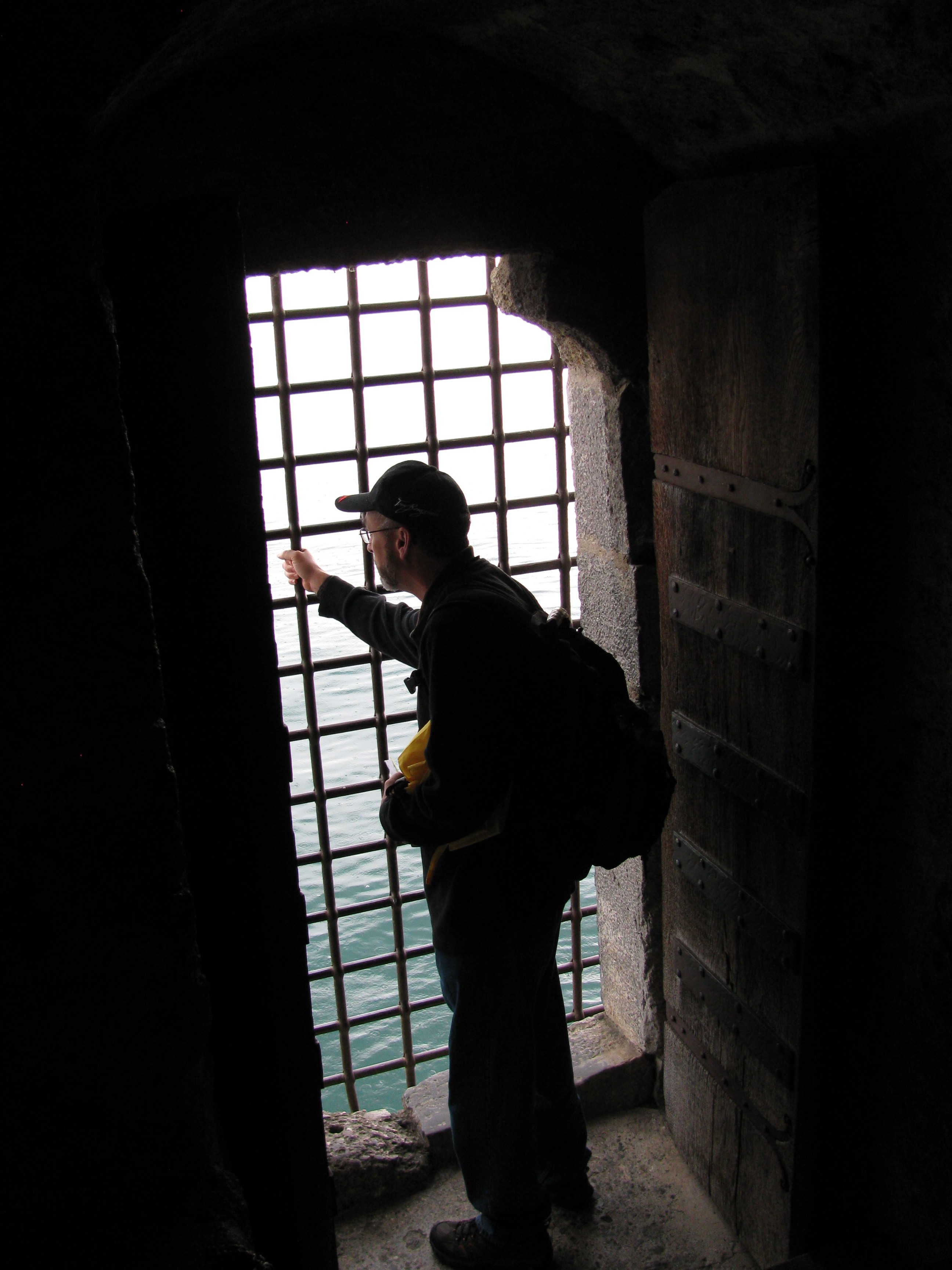
“Is this a concert?” I asked. They laughed heartily while tasering me a few times before throwing me into the paddy wagon.
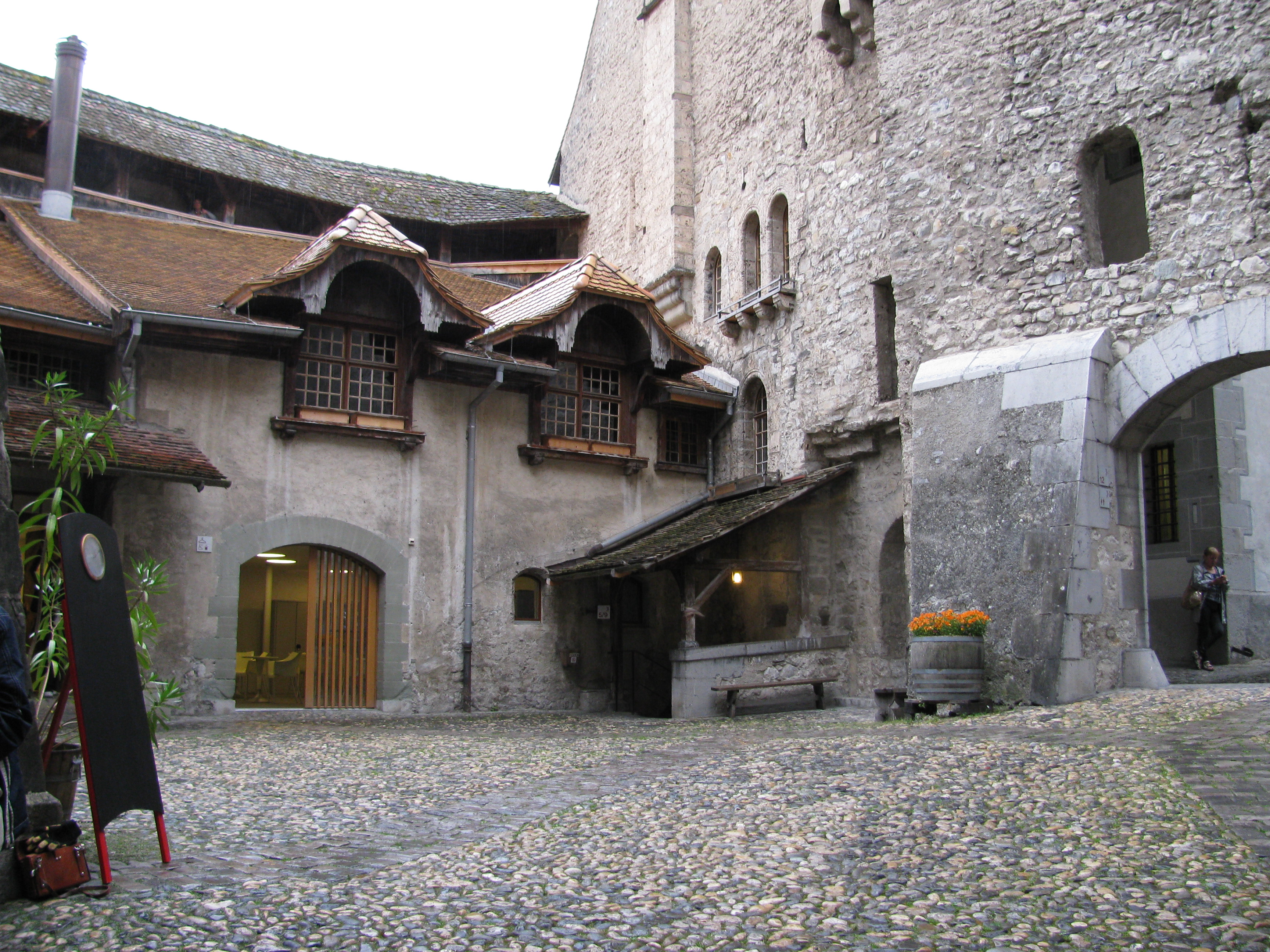
No, they did not do this, but can you imagine if they did? Now this would be one heck of a blog. In fact, they gave me some evasive answers (a la Victoria police, aka VicPD**), so I did the only thing I could and that was walk into the midst of the protesters and look for someone who did not look away as I approached.

Bern Munster Cathedrale, dating back to 1421. While we were inside, the organist kicked the massive pipe organ into gear. Stunning.

This is what retired reporters do – look for trouble. Although, we don’t know it, because years of angling to get as close as possible to ground-zero of any event has numbed our common sense. We are in a stupor.

I found an affable 35-40-year-old man, rather pudgy who looked like someone I could possibly outrun and asked him “what’s up.” He very kindly explained this was the Swiss Tamil community and they were demonstrating to dissuade the Swiss government from deporting Tamil political refugees, also sometimes known as terrorists.

My sons later scolded me, saying that walking into a large group of black people surrounded by police never ends well, but they are wrong. It ended well, with me unharmed, except for my arm which is a little sore from my  husband dragging me out of the crowd.

Bern is, by the way, highly recommended as a must-see on any trip to Switzerland. It is truly outstanding.

* Saanich Police is one of the many police departments covering the southern tip of Vancouver Island. Their area is generally considered a low-crime one, but I don’t actually know for sure. Because of this, they are constantly getting teased as “soft” by …

** Victoria Police, the department that covers the urban centre of Victoria, which is full of gritty stuff – drugs, homeless, homicides, and the like.

Day Two in Switzerland

I studied French for three months to get ready for living in Switzerland. Apparently, I made a mistake.

Things are looking up. Early this morning as we enjoyed a wonderful breakfast in the Hotel Elite’s posh dining room, a waiter with a heavy accent asked if we would like him to take our photograph together.

I said yes, thinking that he had asked if I wanted a whole pot of coffee at our table. As I said, his accent was heavy. I was pretty enthusiastic about the pot of coffee, which did not materialize. Not so enthusiastic about the picture, which accurately records the previous day’s trauma on my face.

And then I lost the digital photos – some how. Some way. It was wonderful.

After breakfast we trundled down to the Hotel Mercure to meet a representative who would walk us through our setting-up day. We waited around for an apartment rental agent who showed up fashionably attired and fashionably late. As per usual, she forgot to bring the right key to show us the apartment, but then we lucked out and discovered the cleaning staff were inside and the door was open.

Having seen  plans that took months to build fail at a rate of one-per-hour over the course of a single day, we took a run at the apartment as though we were hipsters. We didn’t ask all the important questions, paid almost no attention to any details because hanging over our heads was the biggest question of all: Why bother? If we learned anything this week, it is to be reckless.

Evidence of a parallel universe: Coke Light instead of Diet Coke.

Next came our visit to the police station for our residency papers where a genetically linked version of Attila the Hun in menopausal-woman-form handled our file. I’m not insulting her when I say “menopausal,” because I’m in that state myself, but she looked really bitter about her hormone depletion. Me, I’m too sleep-deprived to be bitter.

As one would expect, she grimly informed us that there were not enough signatures on our apartment lease. She said this in French but I understood her perfectly owing to our parallel menopausal status. I almost congratulated her on the way out. You have to respect a woman who can glance at a bundle of officious documents and pick a needle out of that haystack to make our introduction to Biel just a little more cumbersome.

We walked to the rental office where everyone told us in French that the signature was unattainable because the

Strange little garden-shed villages line the rails between Zurich and Biel.

manager was away. Again, I understood every word. There is something about rejection that I am growing to recognize.

After some verbal rough-housing with our representative, the papers were signed and we went back to the police station where we had a non-menopausal young woman process our application, and things went much better. Nevertheless, while we were told we’d get our permits today, turns out it could take another week or two. Naturally.

On a more personal note, without the benefit of my hair “toolkit,” my hairstyle grows more exciting everyday. Pictures will not be posted.

Suitcase Security

In my previous life as a staff reporter at a serious daily newspaper,  my editors would sometimes obliquely mock our readers by forcing reporters, myself included, to write stories that revealed the editorial staff’s estimation of the readers’ intelligence.

The story would expound the gritty minutae of a task so universally understood that the reporter would know instantly that its publication would tar him/her forever as the designated village-idiot. There is nothing the reporter could do about this.

What follows is what one such story might look like, a story about how to fit a strap around your suitcase.

You may have seen similar stories in fine publications like The Globe and Mail and The National Post, one of which actually published a Page A3 story on how to hold a kitchen knife. Page A3 is usually reserved for top local news, crime, politics or events/people of note.

No doubt, the reporter had her own unwritten thoughts on uses for knives.

How I got this way

“You’re living the dream,” is what people say when they learn we’re heading to Europe for an extended stay, but I don’t always feel that way.  Hotel-living, travel, sight-seeing, modest cardiac-safe levels of adventure – what’s not to like?

Bureaucrats, that’s what’s not to like.

Yesterday’s discovery that our designated bureaucrat forgot to process my visa application  is a classic twist in the overseas-working-holiday picture.  In short, whatever you expect the bureaucrat to do, whatever he/she says they’re doing – it is not so.

And the fact that they hold your passport and identity information, plus wield the awesome powers of “the state,” forces you to be your better self when dealing with them, when really you want to be your five-year-old, tantrum-throwing self.

Our friends Al & Nina (not their real names – must shield their identities from foreign bureaucrats who might wreak horrible vengeance on them for sharing this story) danced this dark waltz with Spanish visa authorities who insisted she stay in Canada during her application while sending him willy nilly around the globe fetching documents to feed into their paper shredders (I’m sure this is true).

After sending Al to Japan on a boomerang mission to fetch security clearance from a northern district’s police department, because they had lived there once, and then return immediately to British Columbia, and then back to Toronto to pick up their visas, a Spanish official handed Al his visa, with a dark comment about Al stealing jobs from decent, hard-working Spaniards (Al’s company was creating 400 jobs for those Spaniards, but visa bureaucrats are weak on math).

And then, the official turned to Nina and informed her that her visa had been denied.  Nina – who had endured a forced year-long  separation from her beloved because of this bureaucrat – is ordinarily a suave, well-dressed, dignified, intelligent and articulate woman.

As she threw herself against the embassy’s safety glass, she reminded the official that while inside the embassy she “may technically be on Spanish territory, but you have to come out sometime, and when you do, you’ll be in MY country and I”LL be WAITING.” Nina  managed to say a few more things as her husband physically dragged her out of the building, but I don’t want this blog to get blocked for inappropriate content, so you will have to imagine the rest.

We are waiting for the day that embassy’s security tapes get hacked and put up on Youtube. It’s going to be a doozy of a show.

In the meantime, I’m coping with my own visa-stress by applying generous dollops of Breyers Black Forest ice cream to my thighs,via my digestive system, of course.

Just about the right amount of ice cream required to soothe bureaucrat-burn.