
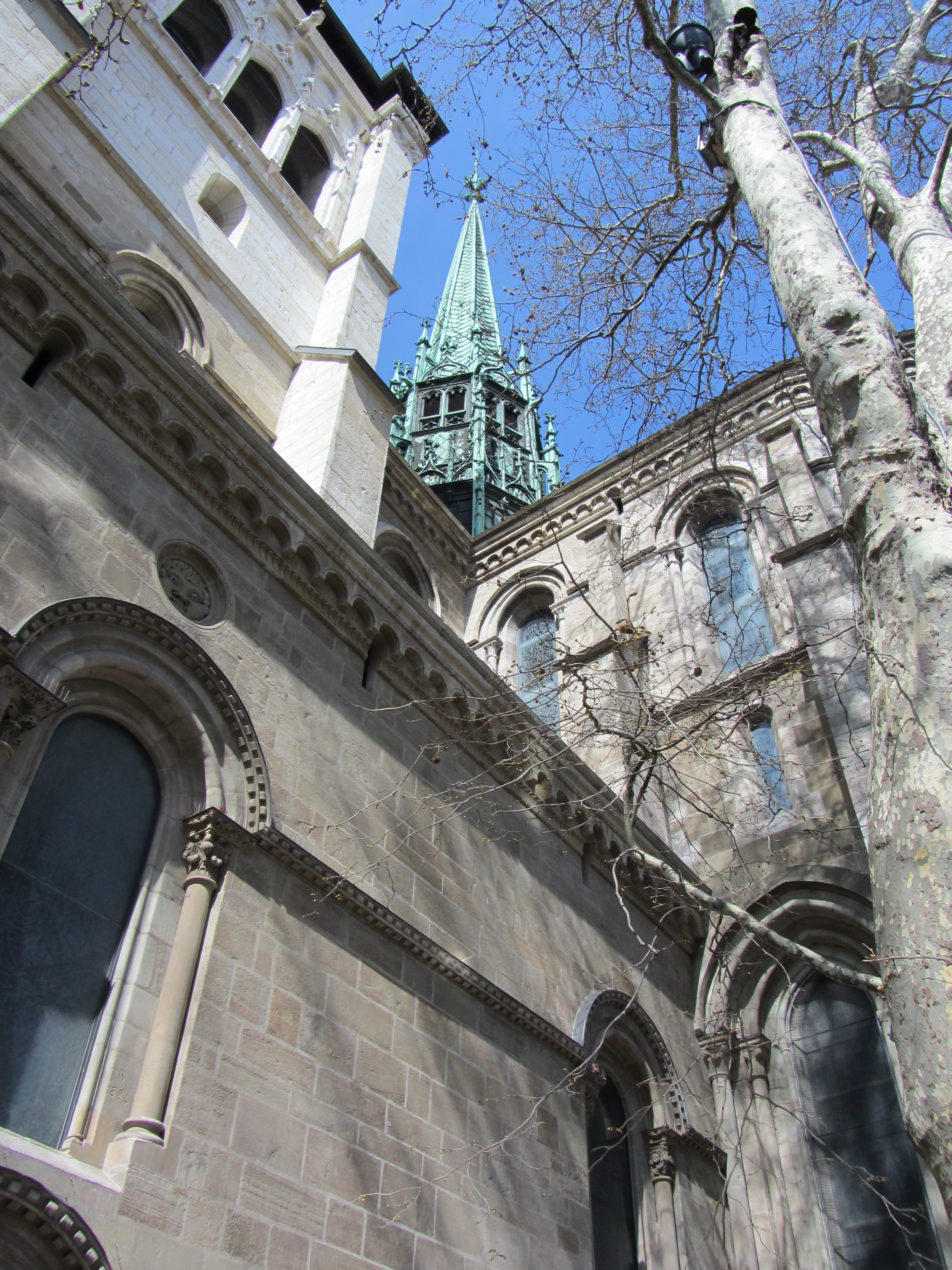
Cathedral Saint-Pierre, Geneva, Switzerland. A Romanesque-Gothic structure dating back to 1150 A.D., which took 150 years to build. A church has stood here since the 4th Century and before it, a Roman temple. There is an archaeological dig and crypts beneath it. The church went from Catholic to Protestant in 1536, when it was stripped of its icons and other adornments that Protestants view as a form of idol worship, but that Catholics look upon as markers of the faith and examples from the lives of early saints. See notation below.
Daniella, one of our favorite Swiss friends, crinkled up her nose at learning we spent a day in Geneva.
“Why ever would you go there?” she asked, staring at me for signs of mental instability.
“It’s a ‘world city,'” I said. “It has the U.N., the Red Cross, the Geneva Convention, it’s the seat of the Protestant Reformation.”
“Yes, but whyyyyyy would you go there?” she repeated.
Why indeed.

John Calvin's preaching chair.
But many do go to Geneva, possibly on mandatory business travel, and those people still want to know what to do once they’ve checked into their hotel room. One suggestion would be to get on a train to visit Gruyeres or Montreux, in other words, to get out of town as fast as possible, but it is not necessary.
Geneva does have many charming niches, high-end shopping, and as noted, the “seat of the Protestant Reformation.”
This is a literal statement. John Calvin (1509 to 1564), arguably the most influential thinker and theologian in the Reformation, and also a humanist lawyer – yes, a lawyer – preferred to give his sermons sitting down, which leads to suspicions that his sermons might have been a tad too long. On investigation, however, we discovered the chair in which he sat was/is a straight-backed wooden thing with no cushioning whatsoever. I could probably deliver a seven-minute sermon in it, tops.

Ooooo, dredging equipment. This photo shows that this blog values engineers and those inclined toward technology.
Tourists with an engineering bent can enjoy the dredging equipment currently parked in at the mouth of the Rhone – which is surprisingly shallow for a waterway feeding off massive Lake Geneva.
The city has many parks which will be beautiful once the trees are in leaf (in Geneva’s defense, we did get there at the turn of Spring when greening-up was just starting). One-quarter of Geneva is parkland – that’s something to think about.
Bastions Park has a charming open-air cafe for lounging away a sunny day, large chess boards enjoyed by many, and shady promenades, as well as the historic statues marking the city’s fulcrum point in world history – that is, statues of the fathers of the Reformation. I say “fathers,” but I’m sure there were “mothers,” too, but they didn’t make it into the statuary.

This accordion/violin/vocals duo from France gave Geneva's old-town a wonderful musical air. They were truly amazing. They would not give us their names, however, they said they were called "Children of the World." They also accused their countrymen, the French, as being unappreciative of the musical arts and so they came to Switzerland to perform where the people are more cultured. Take that, France, from your own cultural citizenry.
Nearby, is the city’s old town, along with Cathedral Saint-Pierre where Calvin preached, and to which many French reformers fled religious persecution in France. It’s all sweet and fluffy now when Catholics and Protestants jost about on theological points, but back then it was a matter of life and death where disagreements could end in rather nasty bloodshed, the intensity of which is best illustrated by the Catholic Church digging up the bones of 14th-Century Bible translator John Wycliffe 40 years after his death, just so they could burn what was left of him (some say his bones were just crushed and scattered). Suffice it to say, emotions ran high.*

Bastions Park, Geneva
It may seem to not matter so much to some, but these were the seeds of the freedom of expression and worship that the Western World now prizes. It was when a bunch of Christians sought to weed from the then Catholic Church it’s powerful political core and return it to what nowadays would be called its grassroots origins, that is, the Gospel of Jesus Christ who had never held any worldly position of power or even aspired to such.
So, historically, a visit to Geneva is a little like a visit to Leipzig, Germany which triggered the fall of Communism and the Berlin Wall. The cobblestone lanes are charming now, but it doesn’t take much imagination to envision the intensity of emotion and peril that the city streets once hosted.
Notation on blog accuracy: The dates given on historical events, such as when churches were built, protests staged, and so forth, are taken from the best source I can find. Often, however, we see different dates expressed in travel books, academic websites and reliable legitimate media sources, as well information given in the site’s brochures and signage. This is a conundrum. I list the dates that are agreed upon by the most reliable sources, leaning heavily toward the local sources who would have most familiarity with the subject. If it’s a draw as to which date is more reliable, I list the range of dates given.
Also of note: Ancient structures usually have multiple “additions,” and so this blog lists the earliest date for a still-in-existence portion of the structure. This probably explains part of the confusion over dating.
*Another note: To be fair on the question of the first English translation of the Bible, Catholic apologists point out that when the Bible was printed in Latin, it was not as exclusive as it seems, because Latin was the language of the educated classes. I am not a theologian or a church historian, so this is as far as I will go on this topic. Please post angry letters through this blog’s contact page.
Blog Bits
On Hobonotes at this very moment:
- Most hits come from: Australia.
- Least hits come from: United Kingdom
- “Change Room Etiquette” post again shows up in top three hits.


 HoboNotes